

Posted on June 26 2026
What are the Eligibility Requirements for a UAE Work Visa?

By , Editor & Director
Updated July 03 2026
To apply for a UAE work visa from India, you need a confirmed job offer from a UAE-registered employer and a work permit approved by the Ministry of Human Resources and Emiratisation (MoHRE). Unlike many other destinations, the UAE offers multiple visa routes such as the Standard Employment Visa for employer-sponsored professionals, the Green Visa for skilled self-sponsored workers, the Golden Visa for investors and exceptional talent, and the Virtual Work Visa for remote workers. Each route has distinct eligibility criteria, income thresholds, and document requirements.
*Interested to work in UAE? Sign up with Y-Axis to guide you with the process.
Eligibility Criteria to Apply for a UAE Work Visa from India
Applying for a UAE work visa from India requires either employer sponsorship (Standard Employment Visa) or proof of self-sponsorship eligibility (Green Visa or Golden Visa). The process is managed through MoHRE for mainland roles or through the relevant free zone authority for free zone positions.
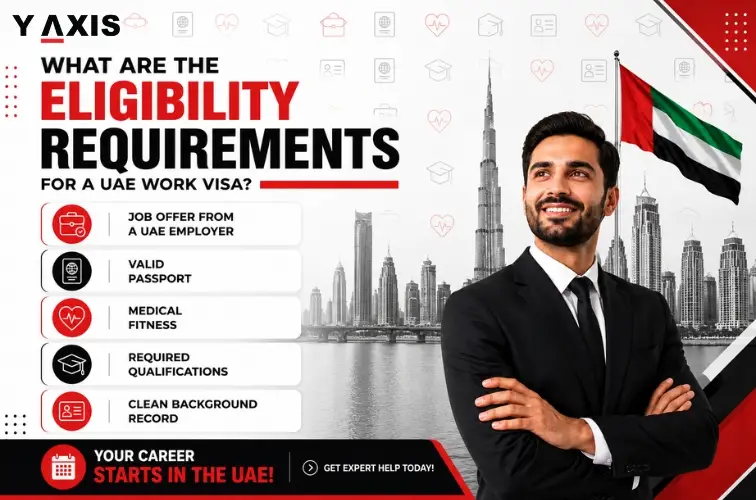
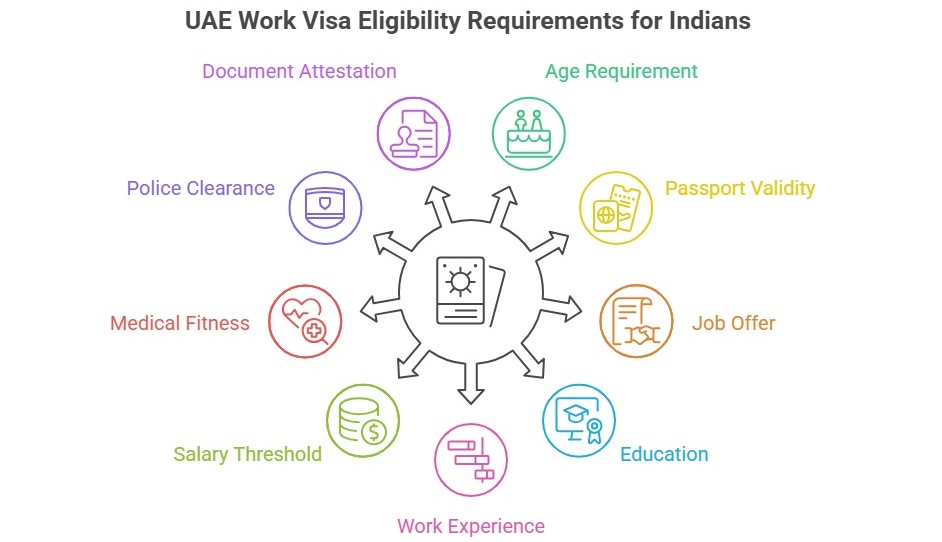
The general eligibility criteria for a UAE work visa are as follows:
- Be at least 18 years of age
- Hold a valid Indian passport
- Possess a confirmed job offer or employment contract from a UAE-registered employer (for Standard Employment Visa)
- Hold a bachelor's degree or equivalent professional qualification recognised by the UAE
- Have at least two years of relevant work experience in the applied field
- Meet the minimum salary threshold applicable to your visa category (AED 15,000/month for Green Visa skilled employee route)
- Obtain a medical fitness certificate from a GAMCA-approved centre in India before departure
- Submit a Police Clearance Certificate (PCC) from India
- Provide educational certificates attested by the HRD Ministry and MEA India, and then by the UAE Embassy or Consulate in India
*Want to work in Dubai? Sign up with Y-Axis for end-to-end assistance.
Eligibility Requirements by Visa Type
The eligibility criteria vary significantly depending on which UAE work visa route you apply under. The table below outlines the four main visa types available to Indian professionals.
| Visa Type | Who Can Apply | Minimum Salary/Income | Validity | Key Benefit |
|---|---|---|---|---|
| Standard Employment Visa | Foreign nationals with a job offer from a UAE mainland or free zone employer | No fixed minimum — determined by employer and MoHRE skill classification | 2 years, renewable | Employer-sponsored; most accessible route; covers all skill levels |
| Green Visa (Skilled Employee) | Skilled professionals in MoHRE occupational levels 1, 2, or 3 with UAE employment contract | AED 15,000/month (~₹3.45 lakh/month) minimum | 5 years, self-renewable | No employer sponsorship required after issuance; freedom to change jobs; 6-month grace period on expiry |
| Green Visa (Freelancer) | Self-employed professionals and freelancers with an active UAE freelance permit | AED 360,000/year (~₹82.8 lakh/year) proven over the previous two years, OR AED 40,000 in financial solvency | 5 years, self-renewable | Full independence; no employer tie; can sponsor family members |
| Golden Visa | Investors, highly skilled professionals (AI, healthcare, engineering, research), entrepreneurs, and outstanding students | AED 2 million investment OR skill/talent-based approval (expanded categories from 2026) | 10 years, self-renewable | Long-term security; sponsor family; no employer required; tax-free income |
Also, read...
UAE Job Market Trends and Opportunities
What are the Employer Requirements for Hiring Indian Professionals in the UAE?
UAE-based employers sponsoring a Standard Employment Visa must meet specific obligations under Federal Decree Law No. 33 of 2021 on the regulation of employment relationships. The employer drives the work permit application through MoHRE before the employee enters the UAE.
Emiratisation (Nafis) Quota Compliance
UAE mainland employers in the private sector are subject to the Emiratisation policy under the Nafis programme, which requires a minimum percentage of Emirati nationals in the workforce. This affects the number of expatriate work permits available to an employer.
- Private sector companies with 50 or more employees must meet annual Emiratisation targets — currently 2% per year across designated skill-intensive sectors
- Companies that fail to meet Emiratisation quotas are subject to a monthly contribution (AED 6,000 per unfulfilled Emirati position) paid to the Nafis Fund
- Employers applying for new work permits must demonstrate current Nafis compliance through the TAMM portal or the MoHRE smart system
- Free zone employers are generally exempt from Emiratisation requirements — a significant advantage for Indian professionals targeting free zone roles
Also, read...
Top In-Demand Jobs in UAE for Indians
MoHRE Skill Classification and Wage Protection
The UAE classifies all foreign workers under MoHRE's occupational skill levels. The classification determines the work permit category and minimum wage expectations. The Wage Protection System (WPS) requires all UAE employers to pay salaries electronically through approved financial institutions — non-compliance results in permit suspension.
- Level 1 (Skilled): Professionals with university degrees or equivalent, such as engineers, doctors, IT specialists, and finance professionals
- Level 2 (Semi-Skilled): Technical and vocational workers with diplomas or certifications, such as technicians, nurses, and supervisors
- Level 3 (Unskilled/General): Workers in manufacturing, construction, hospitality, and domestic services
- The Wage Protection System (WPS) mandates electronic salary payment within 10 days of the due date — employers who miss WPS cycles face automatic permit bans
Also, read...
UAE introduces new work permits rules from May 2026. Check your eligibility now!
Watch to Know More: Work in Dubai 2026 🇦🇪 | Jobs, Salaries & UAE Work Visa Guide
Discover the latest job opportunities in Dubai, average salary insights, UAE work visa requirements, and practical tips to help you secure a job in the UAE.
What Sector-Specific Requirements Apply for UAE Work Visas?
Certain professions in the UAE require additional regulatory approvals before a work visa can be issued. The table below outlines sector-specific requirements for Indian professionals.
| Sector | Additional Requirements |
|---|---|
| Healthcare and medical | Doctors, nurses, and allied health professionals must obtain a licence from the relevant emirate health authority — DHA (Dubai), DoH (Abu Dhabi), or MOHAP (other emirates) — before commencing practice. Licence evaluation typically requires primary source verification of Indian medical credentials through the Medical Council of India. |
| Engineering | Licensed structural, civil, and electrical engineers must register with the Society of Engineers UAE (SoE-UAE). For free zone roles, registration requirements vary by zone authority. IT and software engineers do not require SoE registration. |
| Legal services | Foreign lawyers cannot practise UAE law independently. Legal consultants must obtain a licence from the UAE Ministry of Justice. Indian law graduates can work in advisory, in-house counsel, or international law roles without independent practice rights. |
| Finance and accounting | Chartered Accountants (CAs) and CPAs must register with UAE authorities through the UAE Accountants and Auditors Association. ACCA and CFA qualifications are widely recognised in UAE financial services without additional registration. |
| Education | Teachers in UAE government and private schools require attestation of academic qualifications and approval from the Ministry of Education UAE or the relevant emirate education authority such as KHDA (Dubai) or ADEK (Abu Dhabi). |
| Construction and real estate | Real estate agents must hold a Certified Training for Real Estate Brokers (CBRE/DREI) qualification and register with RERA (Dubai) or the Abu Dhabi Real Estate Centre (ADREC). Construction workers require a contractor-sponsored permit under the relevant emirate municipality. |
Also, read...
UAE Introduces 13 Work Permit Types to Meet a Growing Workforce Demand. Apply Now!
How to Apply for a UAE Work Visa from India?
Applying for a UAE work visa from India is primarily employer-driven for the Standard Employment Visa. For the Green Visa and Golden Visa, applicants can self-initiate through the ICP (Federal Authority for Identity, Citizenship, Customs and Ports Security) online portal.
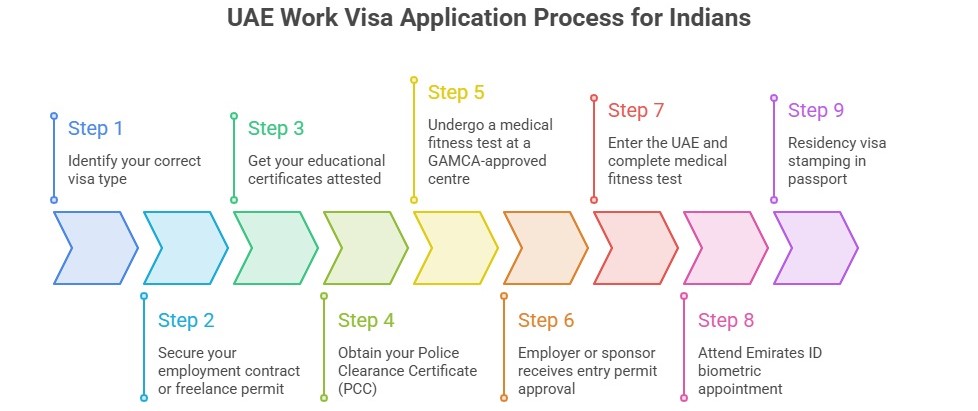
The steps to apply for a UAE work visa for Indians are as follows:
Step 1: Identify your correct visa type such as Standard Employment Visa if you have a UAE job offer; Green Visa if you are a skilled professional earning AED 15,000+/month or a freelancer with AED 360,000/year income; Golden Visa if you qualify under investment, exceptional talent, or the 2026 expanded skill categories.
Step 2: Secure your employment contract or freelance permit.
Step 3: Get your educational certificates attested.
Step 4: Obtain your Police Clearance Certificate (PCC) as the PCC must be attested by MEA India and the UAE Embassy.
Step 5: Undergo a medical fitness test at a GAMCA-approved centre in India.
Step 6: Your employer or sponsor receives the entry permit approval [ valid uptp 60 days ] from MoHRE or the free zone authority.
Step 7: Enter the UAE on the entry permit and complete the government medical fitness test at a DHA/DoH/MOHAP-approved centre in the UAE.
Step 8: Attend your Emirates ID biometric appointment and document verification.
Step 9: Your employer or the ICP portal completes the residency visa stamping in your passport.
Step 10 : Upon receiving your final residence visa stamp, get ready to legally live and work in the UAE.
Are you looking for step-by-step assistance with UAE immigration? Contact Y-Axis, the world's No. 1 overseas immigration consultancy!
FAQs
What is the UAE work visa for Indians?
The UAE work visa for Indians is an official permit issued by the Ministry of Human Resources and Emiratisation (MoHRE) or the relevant free zone authority that allows Indian nationals to live and work legally in the UAE. The main routes are the Standard Employment Visa (employer-sponsored, 2 years), Green Visa (self-sponsored, 5 years, AED 15,000/month minimum), and the Golden Visa (10 years for investors and exceptional talent). Indians make up approximately 38% of the UAE's total expatriate population.
Can Indian nationals apply for a UAE work visa?
Yes. Indian nationals are among the most eligible foreign workers for UAE work visas. Indians form the largest expatriate community in the UAE, numbering over 4.75 million as of 2026. The process depends on visa type: the Standard Employment Visa requires a UAE employer to initiate the work permit through MoHRE; the Green Visa and Golden Visa allow self-sponsorship. No labour market test or quota restriction applies specifically to Indian nationals applying through standard channels.
What is the minimum salary for a UAE Green Visa?
For the UAE Green Visa under the skilled employee route, the minimum monthly salary is AED 15,000 (~₹3.45 lakh/month or ~₹41.4 lakh/year). The applicant must also be classified within MoHRE's occupational levels 1, 2, or 3 (skilled, semi-skilled, and specialised categories). For the Green Visa under the freelancer/self-employed route, the minimum is AED 360,000 per year (~₹82.8 lakh) provable over the previous two years, or demonstrated financial solvency of AED 40,000.
What is the UAE Golden Visa and who qualifies?
The UAE Golden Visa is a 10-year self-renewable residency visa for investors, highly skilled professionals, entrepreneurs, and exceptional talent. In 2026, the UAE expanded Golden Visa eligibility to include senior IT professionals, AI specialists, specialist doctors, researchers, and engineers based on professional contribution rather than investment alone. Investors need a minimum AED 2 million deposit or business capital. Approved entrepreneurs need a start-up or project valued at AED 500,000 or more. Outstanding students with a minimum 95% grade or 3.5 GPA also qualify.
What documents are required for a UAE work visa from India?
Documents required for a UAE work visa include: valid Indian passport with at least six months' remaining validity; signed employment contract or job offer letter; educational certificates attested by HRD Ministry, MEA India, and UAE Embassy; Police Clearance Certificate (PCC) attested by MEA India and UAE Embassy; GAMCA medical fitness certificate from an approved Indian centre; two recent passport-sized photographs meeting UAE photo standards; and Emirates ID application form completed in the UAE after arrival. Free zone applicants may require additional zone-specific documents.
How long does UAE work visa processing take?
The entry permit for a UAE Standard Employment Visa is typically issued within 3–7 working days after MoHRE or the free zone authority approves the work permit application. After arriving in the UAE, completing the government medical test, Emirates ID biometrics, and residency visa stamp takes approximately 10–15 working days. From July 2026, AI-assisted DHA health screening applies in Dubai, which may reduce screening timelines. Urgent processing through the ICP portal is available for an additional fee, with approvals possible within 24 hours in some cases.
Can a UAE work visa lead to permanent residency?
The UAE does not offer conventional permanent residency in the traditional sense. However, the 10-year Golden Visa functions as long-term residency and is self-renewable with no employer tie. In September 2022, the UAE introduced a path to UAE citizenship for exceptional contributors — granted by presidential approval to investors, professionals, and creative talent. For most Indian professionals, long-term stay is maintained by consecutively renewing the 2-year Standard Visa, upgrading to the Green Visa (5 years), or qualifying for the 10-year Golden Visa.
What is the Virtual Work Visa in the UAE?
The UAE Virtual Work Visa (also called the Remote Work Visa or Dubai Virtual Working Programme) allows foreign nationals employed outside the UAE to live in Dubai for up to one year while continuing to work remotely for their non-UAE employer. It is self-sponsored and requires a minimum monthly income of USD 5,000 (~₹4.15 lakh/month). Applicants must hold valid health insurance covering the UAE and pay a processing fee. Indian IT, finance, and consulting professionals at multinational companies are common applicants.
What are the employer obligations when sponsoring a UAE work visa?
UAE employers sponsoring a Standard Employment Visa must be registered with MoHRE, hold a valid trade licence, and comply with the Wage Protection System (WPS) — which requires electronic salary payment within 10 days of the due date. Private sector mainland employers with 50+ employees must also meet Emiratisation (Nafis) quota targets — currently 2% Emirati workforce per year in skill-intensive sectors. Failure to comply results in work permit bans. Free zone employers are exempt from Emiratisation but must comply with their respective free zone authority's employment regulations.
What is the difference between mainland and free zone UAE work visas?
The key difference is the issuing authority and operational scope. Mainland UAE work visas are issued through MoHRE and allow the holder to work with any UAE-registered company. Free zone work visas are issued by the relevant free zone authority (such as JAFZA, DMCC, or DAFZA) and restrict employment to companies operating within that specific free zone. Free zone employees typically enjoy faster processing, exemption from Emiratisation quotas, and 100% foreign business ownership. To work across both mainland and free zone, a dual licence or separate permit is required.
📞 Call: +91-7670800000
📩 Email: info@y-axis.com
🌐 Visit: https://www.y-axis.com
Tags:
Work in UAE
Dubai work visa
migrate to UAE
UAE immigration
eligibility requirements for UAE work visa
steps to apply for UAE work visa
UAE work visa from India
UAE work visa for Indians
free work permit zone in UAE
Share
Options for you by Y-Axis

Get it on your mobile

Get News alerts

Contact Y-Axis
Latest Article
Popular Post
Trending Article
Posted On September 25 2026
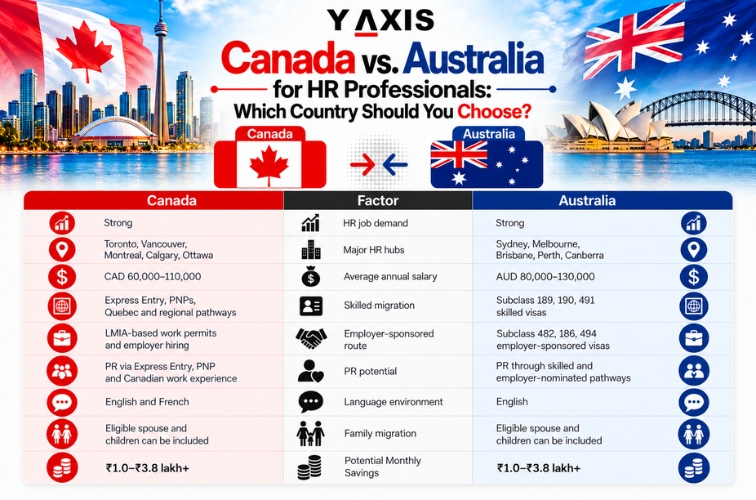
Canada vs. Australia for HR Professionals: Which Country Should You Choose?