

Posted on June 22 2026
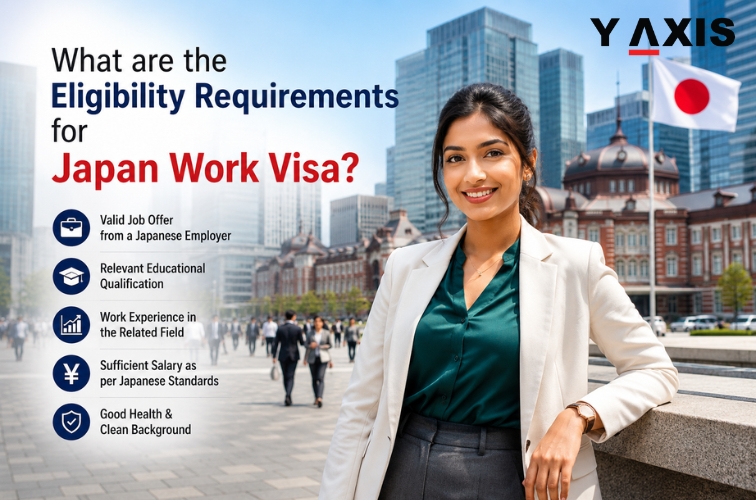
What are the Eligibility Requirements for Japan Work Visa Eligibility Requirements

By , Editor & Director
Updated June 26 2026
The eligibility requirements for a Japan work visa include having a valid job offer from a Japanese employer, the required educational qualifications, and relevant work experience for the position. Applicants must also hold a valid passport, have a clean criminal record, and be in good health. In most cases, the employer in Japan must obtain a Certificate of Eligibility (COE) from Japan's Immigration Services Agency before the visa application is submitted. Once the COE is issued, applicants can apply for a Japan work visa through the nearest Japanese embassy or consulate.
*Want to apply for a work visa in Japan? Let Y-Axis guide you through the process.
What are the requirements for a Japan Work Visa?
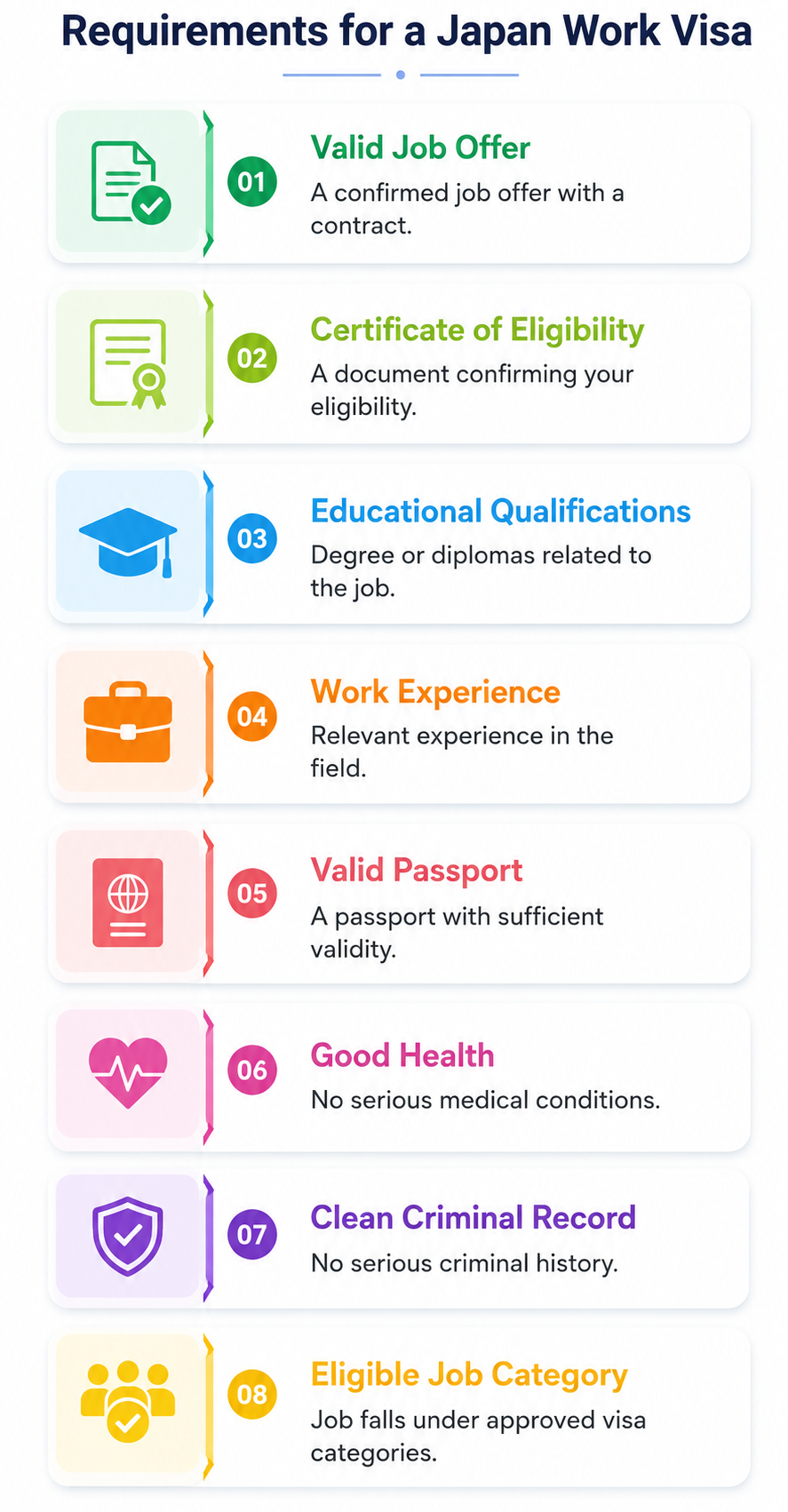
To be eligible for a Japan work visa, you must meet the following requirements:
- Valid job offer: You must have a confirmed job offer from a Japanese employer. You should also have an employment contract that explains your job role, salary, and employment period.
- Certificate of Eligibility (COE): Your employer in Japan must apply for a COE on your behalf from Japan's Immigration Services Agency. This document confirms that you meet the requirements for the visa category you are applying for.
- Educational qualifications: You should have a degree, diploma, or other qualifications related to the job you will do in Japan.
- Work experience: Some jobs require relevant work experience. In certain cases, strong work experience can be accepted instead of formal educational qualifications.
- Valid passport: You must have a valid passport with enough validity and blank pages for the visa.
- Good health: You should be in good health and not have any serious medical condition that could affect public safety.
- Clean criminal record: You should not have a serious criminal record or a history of being deported from Japan.
- Eligible job category: Your job must fall under one of Japan's approved work visa categories, such as Engineer, IT Professional, Teacher, Researcher, Business Manager, Healthcare Worker, Skilled Worker, Specified Skilled Worker (SSW), or Highly Skilled Professional.
Also, read...
List of Documents required for a Japan work visa
The documents required for a Japan work visa are as follows:
- Valid original passport (plus a photocopy of the identification page; passport must have at least two blank pages and be valid for the intended period of stay)
- Certificate of Eligibility (COE) – original or copy (electronic COE is also accepted)
- Completed Japan visa application form
- One recent passport-sized photograph (white background, taken within the last six months)
- Signed employment contract or job offer letter from the Japanese employer
- Educational certificates and academic transcripts (degree certificates, diplomas, or equivalent)
- Work experience certificates or employment letters confirming prior relevant experience
- Police Clearance Certificate (PCC) from your home country
- Health certificate (required for certain categories such as Medical Services and Nursing Care)
- Additional documents specific to your visa category
*Read more…
Common Japan Work Visa Categories
According to recent workforce projections, Japan is expected to face a significant labor shortage and may require nearly 1 million foreign professionals by 2040. To address growing demand in key sectors such as healthcare, information technology, and construction, the country plans to welcome approximately 820,000 skilled workers through its Skilled Worker Visa program over the next five years. Actual salary levels vary based on factors such as occupation, industry, qualifications, experience, and job location.
Understanding the most in-demand jobs in Japan for the next 10 years can help applicants choose the most suitable Japanese work visa.Japan offers a range of work visa categories based on the nature of the job.
The table below lists the most common ones:
| Visa Category | Who It Is For |
|---|---|
| Engineer / Specialist in Humanities / International Services | IT engineers, software developers, designers, translators, foreign language instructors, and copywriters |
| Highly Skilled Professional (HSP) | Professionals who score 70+ points under Japan's points-based system — covers academic research, business, and technical fields |
| Specified Skilled Worker (SSW) Type 1 | Workers in 14 designated labour-shortage industries |
| Specified Skilled Worker (SSW) Type 2 | Workers with higher skills in select SSW industries, allowing longer stay and family accompaniment |
| Instructor | Teachers at elementary, junior high, and high schools |
| Professor | University professors, associate professors, and research assistants |
| Researcher | Researchers and investigators at research institutes and companies |
| Business Manager | Company presidents, directors, and branch managers of businesses operating in Japan |
| Medical Services | Physicians, dentists, pharmacists, and nurses certified under Japanese law |
| Nursing Care | Certified care workers (Kaigo Fukushishi) providing welfare services |
| Skilled Labor | Chefs specialising in foreign cuisine, pilots, animal trainers, sports trainers, and sommeliers |
| Intra-company Transferee | Employees transferred from an overseas office to a Japanese branch of the same company |
| Entertainer | Musicians, actors, singers, dancers, professional athletes, and models |
*Are you looking for step-by-step assistance with overseas immigration? Contact Y-Axis, the world's No. 1 overseas immigration consultancy, for end-to-end assistance!
FAQs
What are the basic eligibility requirements for a Japan work visa?
To be eligible for a Japan work visa, you need a valid job offer from a Japanese employer, a Certificate of Eligibility (COE) obtained by your employer from Japan's Immigration Services Agency, a valid passport, relevant educational qualifications, and matching work experience. You must also be in good health and have a clean criminal record. The specific requirements vary by visa category, so you must ensure that your job role aligns with an eligible activity under Japanese immigration law.
Is a job offer mandatory for a Japan work visa?
Yes, a job offer from a Japanese employer is mandatory for most Japan work visa categories. The employer plays a central role in the visa process; they must apply for the Certificate of Eligibility (COE) on behalf of the applicant before the visa application can proceed. Without a confirmed job offer and an employer willing to sponsor the COE application, it is not possible to obtain a standard Japan work visa.
What is a Certificate of Eligibility (COE) and why is it needed?
A Certificate of Eligibility (COE) is a document issued by Japan's Immigration Services Agency. It certifies that a foreign national meets the landing conditions required for a specific visa category under Japan's Immigration Control Act. Your employer in Japan applies for the COE at the local immigration office before you apply for your visa. Once the COE is issued, you submit it along with other documents to the Japanese embassy or consulate in your home country to complete the visa application. Submitting a COE speeds up both the visa issuance and the airport landing examination.
What are the main types of Japan work visas available?
Japan offers several work visa categories based on the nature of employment. The most common categories include:
- Engineer/Specialist in Humanities/International Services (for IT engineers, designers, translators, etc.)
- Instructor (for school teachers)
- Professor (for university faculty)
- Researcher
- Business Manager
- Medical Services
- Nursing Care
- Skilled Labor (for specialized tradespeople such as foreign chefs, pilots, and sommeliers)
- Intra-company Transferee
- Specified Skilled Worker (SSW) for 14 designated labour-shortage industries
- Highly Skilled Professional (HSP), which uses a points-based system and offers fast-tracked residency benefits
What educational qualifications are needed for a Japan work visa?
The required educational qualification depends on your visa category. For the Engineer/Specialist in Humanities/International Services category, a university or junior college degree in a field related to the job is generally required. For technical roles, the degree must be in a relevant science or engineering discipline. For some visa categories, substantial work experience — typically 10 years or more — can substitute for a degree. For the Specified Skilled Worker visa, passing the relevant sector-specific skills test is the primary requirement.
Is Japanese language ability required for a Japan work visa?
Japanese language ability is not a mandatory requirement for most standard work visas. However, for the Specified Skilled Worker (SSW) visa, passing a Japanese Language Proficiency Test (generally JLPT N4 level) is required. For the Highly Skilled Professional (HSP) visa, Japanese language proficiency contributes additional points under the points-based evaluation system. For roles such as Instructor or jobs in international services, the ability to communicate in the language of your hiring company may be expected rather than formal Japanese language certification.
Can Indian citizens apply for a Japan work visa?
Yes, Indian citizens are eligible to apply for a Japan work visa if they meet all the requirements for their chosen visa category. This includes securing a job offer from a Japanese employer, obtaining a COE sponsored by the employer, and submitting the required documents at the Embassy of Japan in India. Indian nationals may apply at the Japanese embassy in New Delhi, or at Japanese consulates in Mumbai, Chennai, Kolkata, or Bengaluru. Indian applicants must ensure that their educational and work experience documents are in English or accompanied by certified translations.
What is the processing time for a Japan work visa?
The Japan work visa stamp itself is typically processed within 5 to 10 working days after submission at the Japanese embassy or consulate, once the COE is in hand. However, the Certificate of Eligibility, which must be obtained first by the employer in Japan, takes considerably longer, usually between 1 to 3 months depending on the workload of the regional immigration office. Applicants should plan their timeline accordingly and begin the COE process well in advance of their intended start date.
How long is a Japan work visa valid?
The standard Japan work visa (excluding the Business Manager category) is issued with a period of stay of 5 years, 3 years, 1 year, or 3 months, depending on the outcome of the visa assessment. The Business Manager visa can also be issued for 4 months. Visa periods can generally be renewed as long as your employment continues and you remain eligible under the relevant visa category. The Highly Skilled Professional visa is issued for a period of 5 years.
What is the Highly Skilled Professional (HSP) visa in Japan?
The Highly Skilled Professional (HSP) visa is a points-based visa designed to attract skilled foreign talent to Japan. Points are awarded based on factors such as educational background, work experience, annual income, age, and Japanese language ability. Applicants who score 70 points or above qualify for the standard HSP visa, while those with 80 points or above (or who meet specific conditions) may qualify for the Special Highly Skilled Professional (J-Skip) status. HSP visa holders enjoy benefits such as a 5-year period of stay, the ability to bring family members to Japan, and an accelerated pathway to permanent residency.
📞 Call: +91-7670800000
📩 Email: info@y-axis.com
🌐 Visit: https://www.y-axis.com
Tags:
Japan work visa
Japan work visa eligibility
Japan work visa requirements
Certificate of Eligibility Japan
Japan work permit
Japan employment visa
Japan job visa
Japan work visa documents
Japan immigration
Japan work visa for Indians
Share
Options for you by Y-Axis

Get it on your mobile

Get News alerts

Contact Y-Axis
Latest Article
Popular Post
Trending Article
Posted On September 18 2026
What Are the Different Types of Canada Visas to Immigrate?