


Posted on May 13 2026
PR Through Study in Australia: Which Courses Actually Give You the Best Pathway?

By , Editor & Director
Updated May 17 2026
Australia is still one of the most popular countries for Indian students who want both quality education and a chance to get Permanent Residency (PR). According to the Department of Education, Australia had around 5,51,717 international students in January 2026, and India was the second-largest source of students after China.Before choosing a university or course, many Indian students ask one important question: “Which course will help me get PR in Australia?”. The answer is simple, not every course leads to PR opportunities. Australia follows a points-based skilled migration system. To improve your chances of getting PR, your course should match jobs listed in Australia’s Skilled Occupation Lists, such as the Core Skills Occupation List (CSOL) or the Medium and Long-term Strategic Skills List (MLTSSL), managed by the Department of Home Affairs.
In this blog, we explain the best courses in Australia for PR in 2026, the student and PR visa options you should know about, the points required for PR, and the step-by-step pathway for Indian students to move from studying in Australia to becoming permanent residents.
*Need guidance to apply for Australia PR? Get expert advice with Migrate to Australia Flipbook.
Why Choose Australia for PR Through Study in 2026?
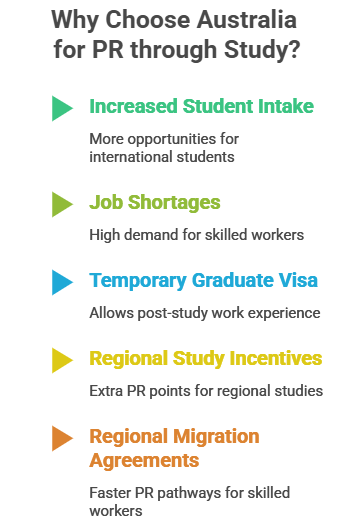
Australia is one of the best countries for Indian students who want to study abroad and later apply for Permanent Residency (PR). Here are some of the main reasons why Australia is a popular study-to-PR destination in 2026:
- Australia has planned to allow around 2,95,000 new international students in 2026, which is 8% more than in 2025. This means more opportunities and study seats for Indian students.
- According to Jobs and Skills Australia, many jobs in sectors like healthcare, engineering, IT, teaching, and skilled trades do not have enough workers. These are also some of the best fields for getting PR in Australia.
- After completing their studies, international students can apply for the Temporary Graduate Visa (Subclass 485), which allows them to stay and work in Australia for 2 to 4 years.
- Students who study in regional areas of Australia can get 5 extra PR points. Regional study can also help students get state nomination faster through the Subclass 491 visa.
- Some regional programs under the Designated Area Migration Agreements (DAMA) allow skilled workers to apply for PR through the Subclass 186 Employer Sponsored Visa after only 2 years of work experience in Australia.
Top PR Courses in Australia for Indian Students in 2026
Based on the latest CSOL and MLTSSL lists released by the Department of Home Affairs and the Occupation Shortage List from Jobs and Skills Australia, here are the courses that give Indian students the strongest PR pathway in 2026.
1. Nursing and Midwifery
Nursing tops every PR course list in Australia for one simple reason: persistent national shortage. Registered Nurses, Enrolled Nurses, and Midwives are all on the MLTSSL and CSOL, which means nursing graduates qualify for Subclass 189, 190 and 491 visas. Invitations for nurses are routinely issued at 65–80 points because the demand outstrips the supply. After completing your Bachelor of Nursing or Master of Nursing (Pre-Registration), you must register with AHPRA (Australian Health Practitioner Regulation Agency). The annual AHPRA nursing registration fee is AUD 193, and ANMAC handles the skills assessment.
|
Occupation |
Average Annual Salary (AUD) |
Top Universities |
|
Registered Nurse (Hospital) |
AUD 85,000 – 95,000 |
University of Sydney, Monash University, University of Melbourne |
|
Registered Nurse (Aged Care) |
AUD 70,000 – 80,000 |
Deakin University, Queensland University of Technology, University of Technology Sydney |
|
Midwife |
AUD 88,000 – 1,05,000 |
Monash University, University of Technology Sydney, University of Melbourne |
|
Nurse Practitioner |
AUD 1,10,000 – 1,40,000 |
University of Sydney, Monash University, Queensland University of Technology |
|
Community Health Nurse |
AUD 78,000 + regional loading |
Deakin University, University of Melbourne, University of Technology Sydney |
2. Information Technology (IT) and Cybersecurity
With Australia investing heavily in digital transformation, IT remains one of the strongest study-to-PR pathways for Indian students. Software Engineers, ICT Business Analysts, Developer Programmers, Cybersecurity Specialists, and Data Scientists are all on the CSOL with multiple PR routes. Skills assessment for IT occupations is conducted by the Australian Computer Society (ACS). A Master of IT, Master of Data Science, or Master of Cybersecurity from a recognised Australian university typically takes 1.5–2 years.
|
Occupation |
Average Annual Salary (AUD) |
Top Universities |
|
Software Engineer |
AUD 1,00,000 – 1,40,000 |
University of Melbourne, UNSW, Monash University |
|
Cybersecurity Specialist |
AUD 1,15,000 – 1,60,000 |
Australian National University (ANU), University of Sydney, RMIT University |
|
Data Scientist |
AUD 1,10,000 – 1,50,000 |
University of Melbourne, Monash University, ANU |
|
ICT Business Analyst |
AUD 95,000 – 1,30,000 |
UNSW, RMIT University, University of Sydney |
|
Developer Programmer |
AUD 95,000 – 1,25,000 |
Monash University, University of Melbourne, RMIT University |
3. Engineering (Civil, Mechanical, Electrical and Software)
Engineering is the classic Indian student favourite and for good reason. Civil Engineers, Mechanical Engineers, Electrical Engineers, Chemical Engineers, Mining Engineers, and Software Engineers all sit on the MLTSSL, opening up Subclass 189, 190 and 491 pathways. Engineers Australia conducts the skills assessment via a Competency Demonstration Report (CDR).
|
Occupation |
Average Annual Salary (AUD) |
Top Universities |
|
Civil Engineer |
AUD 1,00,000 – 1,30,000 |
University of Melbourne, UNSW Sydney, University of Queensland |
|
Mechanical Engineer |
AUD 95,000 – 1,25,000 |
Monash University, RMIT University, University of Sydney |
|
Electrical Engineer |
AUD 1,05,000 – 1,40,000 |
UNSW Sydney, University of Melbourne, University of Adelaide |
|
Mining Engineer |
AUD 1,30,000 – 1,80,000 |
University of Queensland, University of Adelaide, UNSW Sydney |
|
Petroleum Engineer |
AUD 1,40,000 – 2,00,000 |
University of Adelaide, Monash University, University of Queensland |
4. Accounting, Finance and Auditing
Accounting has been on Australia's PR list for over a decade. Taxation Accountants, External Auditors, Management Accountants, and Finance Managers continue to feature on the MLTSSL. Skills assessment is conducted by CPA Australia, CA ANZ, or IPA. A Master of Professional Accounting (MPA) is the most popular choice for Indian students because it satisfies both academic and skills assessment requirements.
|
Occupation |
Average Annual Salary (AUD) |
Top Universities |
|
Taxation Accountant |
AUD 80,000 – 1,10,000 |
University of Melbourne, UNSW Sydney, Macquarie University |
|
External Auditor |
AUD 85,000 – 1,15,000 |
University of Sydney, Monash University, University of Queensland |
|
Management Accountant |
AUD 90,000 – 1,20,000 |
UNSW Sydney, University of Melbourne, Monash University |
|
Finance Manager |
AUD 1,30,000 – 1,80,000 |
University of Sydney, Macquarie University, University of Queensland |
|
Internal Auditor |
AUD 90,000 – 1,25,000 |
Monash University, UNSW Sydney, University of Melbourne |
5. Teaching and Early Childhood Education
Australia is facing one of its worst teacher shortages in decades. Jobs and Skills Australia confirms acute demand for Secondary School Teachers (especially STEM), Primary School Teachers, Early Childhood Teachers, and Special Education Teachers. At least 21,000 additional Early Childhood Education and Care professionals are needed nationally to meet current demand. A Master of Teaching (Primary or Secondary) is the most efficient route for Indian students who already hold a bachelor's degree. The Australian Institute for Teaching and School Leadership (AITSL) conducts the skills assessment.
|
Occupation |
Average Annual Salary (AUD) |
Top Universities |
|
Early Childhood Teacher |
AUD 75,000 – 95,000 |
Monash University, Deakin University, University of Wollongong |
|
Primary School Teacher |
AUD 80,000 – 1,05,000 |
University of Melbourne, University of Sydney, Queensland University of Technology |
|
Secondary School Teacher |
AUD 85,000 – 1,15,000 |
Monash University, University of Melbourne, Deakin University |
|
Special Education Teacher |
AUD 90,000 – 1,20,000 |
University of Sydney, Queensland University of Technology, University of Wollongong |
|
University Lecturer |
AUD 1,05,000 – 1,50,000 |
University of Melbourne, Monash University, University of Sydney |
6. Trade Courses (Automotive, Electrical, Plumbing, Carpentry, Cookery)
Skill Level 3 occupations trades and technical roles are now the hardest category to recruit in Australia, with a fill rate of just 54.3% according to Jobs and Skills Australia. Trades account for 51% of all persistent shortages. This makes Australian VET (Certificate III and IV, Diploma) trade courses a powerful and underrated PR pathway for Indian students. Popular PR trade qualifications include Carpentry, Electrical Technician, Plumbing, Automotive Mechanic, Commercial Cookery, Bricklaying, Welding, and Air Conditioning & Refrigeration. Trades Recognition Australia (TRA) handles the skills assessment.
|
Trade Occupation |
Average Annual Salary (AUD) |
|
Electrician |
AUD 90,000 – 1,30,000 |
|
Plumber |
AUD 85,000 – 1,20,000 |
|
Carpenter |
AUD 80,000 – 1,10,000 |
|
Automotive Mechanic |
AUD 75,000 – 95,000 |
|
Commercial Chef |
AUD 70,000 – 95,000 |
7. Social Work
Social Workers are on the MLTSSL and qualify for Subclass 189, 190 and 491. The Australian Association of Social Workers (AASW) handles the skills assessment. A Master of Social Work (Qualifying) typically takes 2 years and is open to graduates from any discipline. Social workers earn between AUD 80,000 and AUD 1,10,000 a year, with strong demand in mental health, child protection and aged care.
8. Medical Sciences and Allied Health
Medical Practitioners, Physiotherapists, Occupational Therapists, Speech Pathologists, Dentists, Pharmacists, and Medical Laboratory Scientists are all on the MLTSSL. These pathways take longer (Bachelor + internship + AMC exams for doctors) but lead to PR with some of the highest salaries in the country, medical practitioners earn AUD 2,00,000 to AUD 4,50,000 annually.
Australia PR Points System 2026: How Indian Students Can Score More Points
Australia uses a points-based system to select skilled migrants for PR visas such as Subclass 189, Subclass 190, and Subclass 491. Your chances of getting an invitation depend on the total points you score. These points are given based on factors such as your age, English language score, education, work experience, study location, and state nomination. Understanding the PR points system is very important for Indian students because choosing the right course and city can help increase your score and improve your chances of getting PR faster.
Here are the main factors that contribute to your Australia PR points:
|
Points Factor |
Maximum Points |
|
Age (25–32 years) |
30 |
|
English language proficiency (Superior level) |
20 |
|
Skilled work experience outside Australia (8–10 years) |
15 |
|
Skilled work experience in Australia (8–10 years) |
20 |
|
Qualifications (Doctorate / PhD) |
20 |
|
Australian Study Requirement |
5 |
|
Study in Regional Australia |
5 |
|
Specialist STEM Master’s / Doctorate |
10 |
|
Credentialled Community Language |
5 |
|
Professional Year Program in Australia |
5 |
|
Single applicant / Partner skills |
10 |
|
State nomination (Subclass 190) |
5 |
|
Regional nomination (Subclass 491) |
15 |
Although the minimum score required for PR is 65 points, most Indian students usually need around 85 to 95 points to receive a competitive invitation in 2026.
There are several ways students can improve their PR score:
- Study in regional areas of Australia to earn extra points
- Complete a Professional Year Program after graduation
- Achieve high scores in IELTS or PTE
- Gain skilled work experience in Australia
- Apply for state or regional nomination
- Choose occupations that are in high demand in Australia
Planning your education and career pathway early can make a big difference in your chances of getting Australian PR after study.
*Check your eligibility to become a Permanent Resident of Australia with the FREE Australia immigration Points Calculator and get an instant score!
Eligibility Requirements for Australia PR Through Study
Before you choose your course, run through this Y-Axis checklist to confirm you are on the right PR pathway:
- Your chosen course must be CRICOS-registered and lead to a qualification at AQF Level 7 (Bachelor), 8 (Honours/Graduate Diploma), 9 (Master's) or 10 (Doctorate).
- The course must be of at least 2 academic years (92 weeks) duration to satisfy the Australian Study Requirement.
- Your nominated occupation must appear on the MLTSSL, CSOL or Regional Occupation List (ROL).
- Your qualification must match the ANZSCO code of your nominated occupation.
- You must be under 45 years of age at the time of invitation for Subclass 189, 190 or 491 (50 for some DAMAs).
- You must score Competent English at minimum (IELTS 6.0 in each band) and Superior English (IELTS 8.0) to maximise points.
- You must lodge a positive skills assessment from the relevant assessing authority.
- You must score at least 65 points in the points test, but realistically aim for 85+ points
Step-by-Step Process to Get Australia PR Through Study
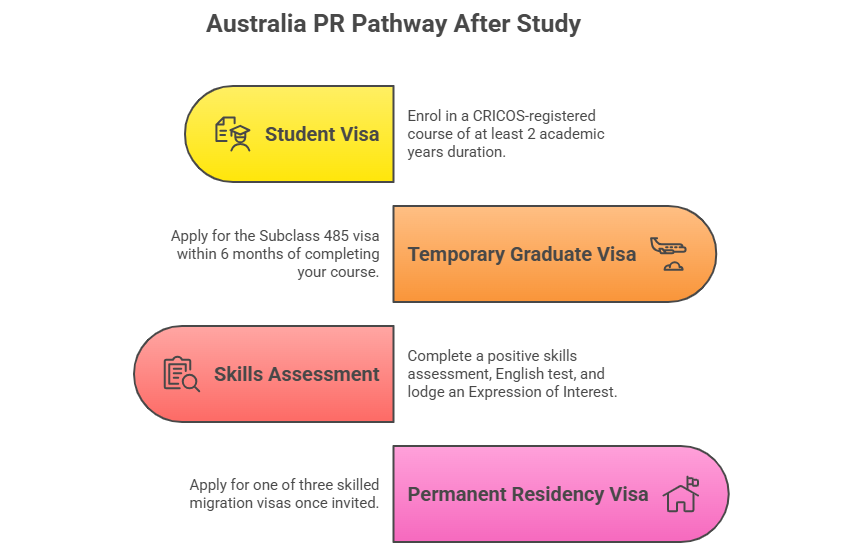
The Australia PR pathway after study is a 4-stage journey. Indian students who plan their course, location, and occupation carefully can transition from student visa to permanent residency in 3 to 6 years.
Stage 1: Student Visa (Subclass 500)
You enrol in a CRICOS-registered course of at least 2 academic years duration that satisfies the Australian Study Requirement. Your chosen program must align with an occupation on the MLTSSL or CSOL.
Stage 2: Temporary Graduate Visa (Subclass 485)
Within 6 months of completing your course, you apply for the Subclass 485 visa. As per Home Affairs rules effective 2026, the duration depends on your qualification level:
|
Qualification |
Post-Study Work Stream |
Eligibility Note |
|
Bachelor's degree |
2 years |
Standard duration |
|
Master's coursework |
2 years |
Standard duration |
|
Master's by research |
3 years |
Extended stream |
|
Doctoral degree (PhD) |
4 years |
Up to age 50 |
|
Vocational education (VET) |
Up to 18 months |
Post-Vocational stream |
The maximum age limit is 35 years (50 for masters by research and PhD). The primary applicant fee is AUD 4,640 as of March 2026.
Stage 3: Skills Assessment + English Test + Expression of Interest (EOI)
During your post-study work years, you must complete a positive skills assessment from the relevant assessing authority (for example, Engineers Australia for engineers, ANMAC for nurses, ACS for IT, CPA Australia for accountants, AITSL for teachers). You also need a competent-to-superior score in IELTS, PTE, or OET, and lodge an Expression of Interest through SkillSelect.
Stage 4: Permanent Residency Visa (Subclass 189, 190 or 491)
Once invited, you apply for one of three skilled migration visas:
|
Visa |
Key Feature |
Pathway to PR |
|
No sponsorship needed; MLTSSL only |
Direct PR |
|
|
Requires state/territory nomination; +5 points |
Direct PR |
|
|
Regional nomination; +15 points |
PR after 3 years via Subclass 191 |
The minimum points required is 65, but in 2026 most successful invitations are issued at 85–95 points depending on the occupation.
*Also Read....
What are the key differences between Subclass 189 and Subclass 491 Visas in 2026?
Why Regional Australia is a Better Option for PR?
For Indian students who want Permanent Residency (PR) in Australia, studying in a regional area can be a smarter choice than studying only in major cities like Sydney or Melbourne. In 2026, regional study offers many extra benefits that can improve your chances of getting Australian PR faster.
Regional areas in Australia include places such as South Australia, Tasmania, Northern Territory, ACT, and many locations outside the main cities in Western Australia, Queensland, Victoria, and New South Wales.
Students who study in these regional areas can get several PR advantages, including:
- 5 extra PR points for studying in regional Australia
- Longer post-study work rights for international students
- Eligibility for the Subclass 491 regional visa, which gives an extra 15 PR points
- Lower competition for state nomination compared to major cities like Sydney and Melbourne
- Better access to regional migration programs such as DAMA (Designated Area Migration Agreements), which can lead to PR after 2 years of work experience
Bachelor’s degree graduates in regional Australia may also receive a longer post-study work visa compared to students studying in major metro cities.
Some of the most popular regional study destinations for Indian students include:
- Adelaide
- Hobart
- Canberra
- Perth
- Darwin
- Newcastle
- Wollongong
- Geelong
- Cairns
- Townsville
Choosing the right regional city can help students save money, gain extra PR points, and improve their chances of receiving a faster PR invitation in Australia.
*Want to apply for Australia Student Visa? Contact Y-Axis for complete guidance
Common Mistakes Indian Students Make on the Australia PR Pathway
After helping thousands of Indian students migrate to Australia, Y-Axis has identified the most common and expensive mistakes:
- Choosing a course that is not on the CSOL/MLTSSL. A Diploma in General Business or an MBA without a specialisation rarely leads to PR.
- Picking a metro city by default instead of evaluating regional options for bonus points and easier state nomination.
- Not preparing for the IELTS, PTE or OET seriously enough to score Proficient (7.0+) or Superior (8.0+)
- Waiting too long after graduation to apply for the Subclass 485 visa, you have only 6 months.
- Skipping the Professional Year program for accounting, engineering or IT graduates, which adds 5 valuable points.
- Applying for skills assessment with an incomplete CDR (engineers) or insufficient work documentation.
- Underestimating the importance of partner skills points if married, a skilled partner can add up to 10 points.
Tips for Indian Students to Improve Their Australia PR Chances
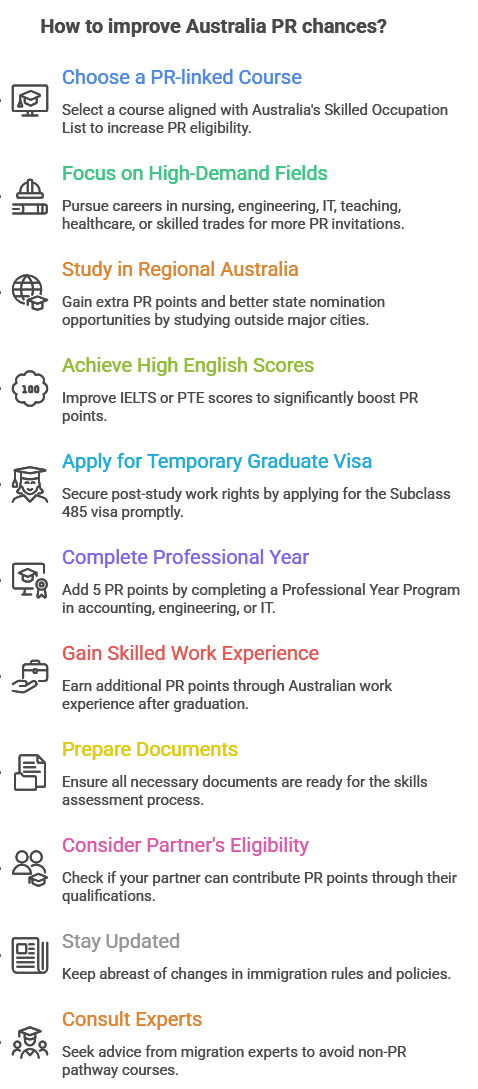
Indian students who plan their education and career carefully can improve their chances of getting Permanent Residency (PR) in Australia faster. Here are some useful tips to help students build a strong PR pathway:
- Choose a course that is linked to occupations on Australia’s Skilled Occupation List (CSOL or MLTSSL).
- Prefer high-demand fields such as nursing, engineering, IT, teaching, healthcare, and skilled trades, as these occupations usually receive more PR invitations.
- Consider studying in regional Australia to gain extra PR points, longer post-study work rights, and better state nomination opportunities.
- Aim for high scores in IELTS or PTE exams because better English scores can significantly increase your PR points.
- Apply for the Temporary Graduate Visa (Subclass 485) as soon as possible after graduation to avoid missing the deadline.
- Complete a Professional Year Program if you are studying accounting, engineering, or IT, as it can add 5 extra PR points.
- Gain skilled work experience in Australia after graduation, as Australian work experience gives additional PR points.
- Keep all your documents ready for the skills assessment process, including work experience letters, academic documents, and project reports.
- If married, check whether your partner can also contribute PR points through qualifications, English scores, or skilled occupation eligibility.
- Stay updated with changes in Australia’s immigration rules, occupation lists, and state nomination requirements because PR policies can change regularly.
- Consult trusted migration experts or education consultants before selecting your course and university to avoid choosing a non-PR pathway course.
*Planning to migrate to Australia? Y-Axis can guide you step-by-step — from choosing the right PR-friendly course and university to helping you build your Australia PR pathway. Speak to our experts today.
FAQs
What is PR through study in Australia?
PR through study in Australia means you become a permanent resident after finishing your studies in the country. First, you come on a student visa (Subclass 500) and complete a CRICOS-registered course. After you finish, you get a Temporary Graduate visa (Subclass 485) and work for a few years. Then you apply for a skilled PR visa like Subclass 189, 190, or 491. This pathway works only if your course leads to a job on the official Skilled Occupation List of Australia.
Which courses give the best PR pathway in Australia in 2026?
The best PR courses in Australia for Indian students in 2026 are nursing, IT and cybersecurity, engineering, accounting, teaching, social work, and trade courses like plumbing or carpentry. These courses lead to jobs that Australia urgently needs. They are on the MLTSSL or CSOL lists from the Department of Home Affairs. Healthcare and trade roles have the lowest competition. IT and engineering offer the highest salaries. Always check the latest occupation list before choosing your course, because the list is updated every year.
Is nursing the best course for PR in Australia in 2026?
Nursing is one of the best courses for PR in Australia in 2026. Australia has a serious shortage of nurses, so invitations often come at just 65 to 80 points. Registered Nurses and Midwives are on both the MLTSSL and CSOL lists. You can apply for Subclass 189, 190, or 491 visas. Nurses earn around AUD 85,000 a year and get extra pay in regional areas. You must register with AHPRA and complete a skills assessment from ANMAC before you can apply for PR.
Can I get PR in Australia after a one-year master's degree?
No, a one-year master's degree is not enough for Australia PR. You must finish at least 92 weeks of study, which is about two academic years, in a CRICOS-registered course. This rule is called the Australian Study Requirement. So a single one-year master's program does not count. You can either choose a two-year master's course or combine two related programs to reach the 92-week limit. Many Indian students pick two-year master's degrees in IT, nursing, or engineering for this reason.
How many points do I need for Australia PR in 2026?
The minimum points needed for Australia PR is 65 in the official points test. But in 2026, the actual cut-off is much higher. Most invitations are given to people who score 85 to 95 points. The cut-off depends on your job. Nursing invitations come at 65 to 80 points because of high demand. IT and engineering invitations need 90 or more points. To raise your score, study in regional Australia, achieve Superior English, and add partner skill points to your profile.
What is the MLTSSL in Australia?
MLTSSL stands for Medium and Long-term Strategic Skills List. It is one of Australia's main skilled occupation lists, kept by the Department of Home Affairs. Jobs on this list are in long-term demand in Australia. If your job is on the MLTSSL, you can apply for Subclass 189 (independent), 190 (state-nominated), and 491 (regional) PR visas. The list has around 212 occupations, including engineers, nurses, doctors, accountants, teachers, and social workers. Always check the latest version on the Home Affairs website before choosing your course.
What is the CSOL in Australia?
CSOL stands for Core Skills Occupation List. This new list was introduced for the Skills in Demand (SID) employer-sponsored visa, which is part of Australia's reformed migration system. The CSOL has around 456 occupations. If your job is on this list, you can apply for the SID visa and move to Subclass 186 Permanent Residency after just two years of full-time work. The CSOL is wider than the MLTSSL and gives more Indian students access to clear employer-sponsored PR pathways in Australia.
What is the Subclass 189 visa?
The Subclass 189 visa is the Skilled Independent Permanent Residency visa of Australia. You do not need any state or employer to sponsor you. Your job must be on the MLTSSL. It is a points-based visa, and the minimum score is 65. In 2026, most invitations go to people with 85 to 95 points. Once you get the visa, you become a permanent resident with full rights to live, work, and study anywhere in Australia. Your family members can also be included in the application.
What is the Subclass 190 visa?
The Subclass 190 visa is the Skilled Nominated Permanent Residency visa of Australia. You need a nomination from an Australian state or territory government to apply. Your job must be on the MLTSSL or STSOL. State nomination adds 5 extra points to your score. Once granted, you get full PR with the right to live and work anywhere in Australia. But, you usually must promise to live and work in the nominating state for at least two years. Each state has its own occupation list.
What is the Subclass 491 visa?
The Subclass 491 visa is the Skilled Work Regional (Provisional) visa of Australia. It is for skilled workers who want to live and work in regional parts of Australia. You need a nomination from a state government or a sponsorship from an eligible family member. Regional nomination gives you 15 extra points. The visa is valid for 5 years. After living and working in a regional area for at least 3 years, you can apply for full PR through the Subclass 191 visa.
What is the Subclass 485 Temporary Graduate visa?
The Subclass 485 visa is the Temporary Graduate visa of Australia. It lets international graduates work in Australia after they finish their studies. The duration depends on your course: bachelor's gives 2 years, master's by research gives 3 years, and PhD gives 4 years. The age limit is 35 years for most graduates and 50 for PhD or research master's holders. The visa fee is around AUD 4,640 in 2026. You must apply within 6 months of finishing your course in Australia.
What is the age limit for Australia PR?
For the Subclass 189, 190, and 491 visas, you must be under 45 years of age when you receive your invitation. The maximum points (30) for age are given between 25 and 32 years. After 33, you lose 5 points right away. After 40, you lose 10 more points. For some DAMA agreements, the age limit can go up to 55 years. The Temporary Graduate visa Subclass 485 has its own age limits — 35 for most graduates and 50 for PhD holders.
Why should I study in regional Australia?
Studying in regional Australia is a smart move for Indian students who want PR. You get 5 extra points for the Australian Study Requirement. You also get a longer Temporary Graduate visa, up to 3 years for bachelor's graduates. You can apply for the Subclass 491 regional visa, which gives 15 bonus points. Regional state nomination has less competition than Sydney or Melbourne. Living costs are 20 to 30 percent lower. Top regional cities include Adelaide, Hobart, Canberra, Perth, Darwin, Newcastle, Wollongong, and Geelong.
What is a CRICOS-registered course?
CRICOS stands for Commonwealth Register of Institutions and Courses for Overseas Students. A CRICOS-registered course is an Australian study program that is approved for international students by the Australian government. Only CRICOS courses count for your student visa and for the Australian Study Requirement, which is needed for PR. Each course has a unique CRICOS code. Before you apply, always check that your chosen course and university have valid CRICOS registration. The official list is available on the cricos.education.gov.au website maintained by the government.
Can I work full-time on a student visa in Australia?
On a Subclass 500 student visa in Australia, you can work up to 48 hours every two weeks during study terms. This rule came into effect from July 2023. During official course breaks like semester holidays, you can work full-time with no hour limit. Master's by research and PhD students can usually work without any cap on hours. Your spouse or partner on a dependent visa can also work part-time. These work hours help you cover living costs and gain useful Australian work experience.
What is the Australian Study Requirement for PR?
The Australian Study Requirement is a rule from the Department of Home Affairs that you must meet to claim study-based PR points. You need to finish at least 92 weeks of CRICOS-registered study, which is about two academic years. The study must be in English. You can combine two or more courses to meet the 92-week limit. Meeting this rule gives you 5 PR points in the points test. If you study in a regional area, you get 5 extra points as a regional study bonus.
What is the skills assessment for Australia PR?
Skills assessment is the test of your qualifications and work experience for your chosen Australian job. Each occupation has its own assessing body. Engineers Australia checks engineers, ANMAC checks nurses, ACS checks IT workers, CPA Australia checks accountants, AITSL checks teachers, and TRA checks tradespeople. You must apply, send proof of your degree and work history, and pay the assessment fee. A positive skills assessment is required before you can submit your EOI in SkillSelect. Without it, you cannot apply for any skilled PR visa.
How long does the Australia PR process take after study?
The full Australia PR pathway after study usually takes 3 to 6 years for Indian students. You spend 2 years in study, then 2 to 4 years on the Subclass 485 Temporary Graduate visa, and a few months for skills assessment and EOI invitation. Once you get an invitation, the PR visa processing takes 6 to 12 months. The Subclass 491 regional visa needs 3 more years of work in a regional area before you can apply for the Subclass 191 permanent visa.
What IELTS score is needed for Australia PR?
For Australia PR through study, you need to score Competent English at the very minimum. That means IELTS 6.0 in each of the four bands, or PTE 50, or OET B. But to earn extra PR points, you should aim higher. Proficient English (IELTS 7.0 in each band) gives you 10 points. Superior English (IELTS 8.0 in each band) gives you 20 points. Most Indian students need Proficient or Superior English to reach the invitation cut-off of 85 to 95 points.
Is an MBA a good course for PR in Australia?
A normal MBA is not the best course for PR in Australia. Standard management roles are not on the MLTSSL or CSOL. But a specialised MBA can work better. You can choose an MBA in Marketing, ICT Management, Project Management, Supply Chain, or Healthcare Management. Even then, you may need extra work experience for the skills assessment. Indian students serious about PR should consider Master's in IT, Nursing, Accounting, or Engineering instead. These courses are directly linked to occupations in shortage and lead to clear PR pathways.
What is the Professional Year program in Australia?
The Professional Year is a 44-week paid training program for international graduates in Australia. It is available for IT, Accounting, and Engineering graduates only. The program combines classroom learning with a 12-week internship in an Australian company. Completing this program gives you 5 extra PR points, which is very valuable. It also helps you gain real Australian work experience and build a strong professional network. Many Indian students complete the Professional Year during their Subclass 485 Temporary Graduate visa to boost their PR points score.
What is DAMA and how does it help PR?
DAMA stands for Designated Area Migration Agreement. It is a deal between the Australian government and a state, territory, or regional area. DAMAs let regional employers sponsor workers in jobs that are not on the standard skilled lists. In 2026, there are 13 active DAMAs across Australia. They offer benefits like higher age limits, lower English score limits, and reduced work experience. Many DAMAs now offer a clear PR pathway through Subclass 186 ENS after just 2 years of full-time work in the region.
Y-Axis snapshot
1M
Successful applicants
1500+
Experienced counselors
20Y+
Expertise
50+
Offices
📞 Call: +91-7670800000
📩 Email: info@y-axis.com
🌐 Visit: https://www.y-axis.com
Tags:
Australia PR through study
best courses for PR in Australia
study in Australia for PR
Australia PR for Indian students
PR pathway Australia
Australia skilled occupation list
Australia student visa to PR
Australia regional study PR
Share
Options for you by Y-Axis

Get it on your mobile

Get News alerts

Contact Y-Axis
Latest Article
Popular Post
Trending Article
Posted On September 24 2026
What Is the Average Salary in Switzerland?