

Posted on November 18 2026
What Is the Average Salary in South Korea?

By , Editor & Director
Updated November 18 2026
The average monthly salary in South Korea is about KRW 4.2 million, or roughly ₹2.5 lakh. This figure comes from the Ministry of Employment and Labor (MOEL) survey of businesses with one or more employees. It includes basic pay, overtime and bonuses. The median salary is lower, at about KRW 2.88 million a month. This means half of all wage workers earn less than this amount. Skilled professionals in IT, semiconductors, finance and healthcare usually earn between KRW 4 million and KRW 8 million a month. South Korea has a national minimum wage of KRW 10,320 per hour, or KRW 2,156,880 a month. Income tax rates range from 6% to 45%. Employees also pay about 9–10% of their salary in social insurance. Many employers add bonuses, meal allowances and severance pay to the basic salary.
*Want to work in South Korea? Let Y-Axis guide you through the process.
Average Salary in South Korea by Occupation
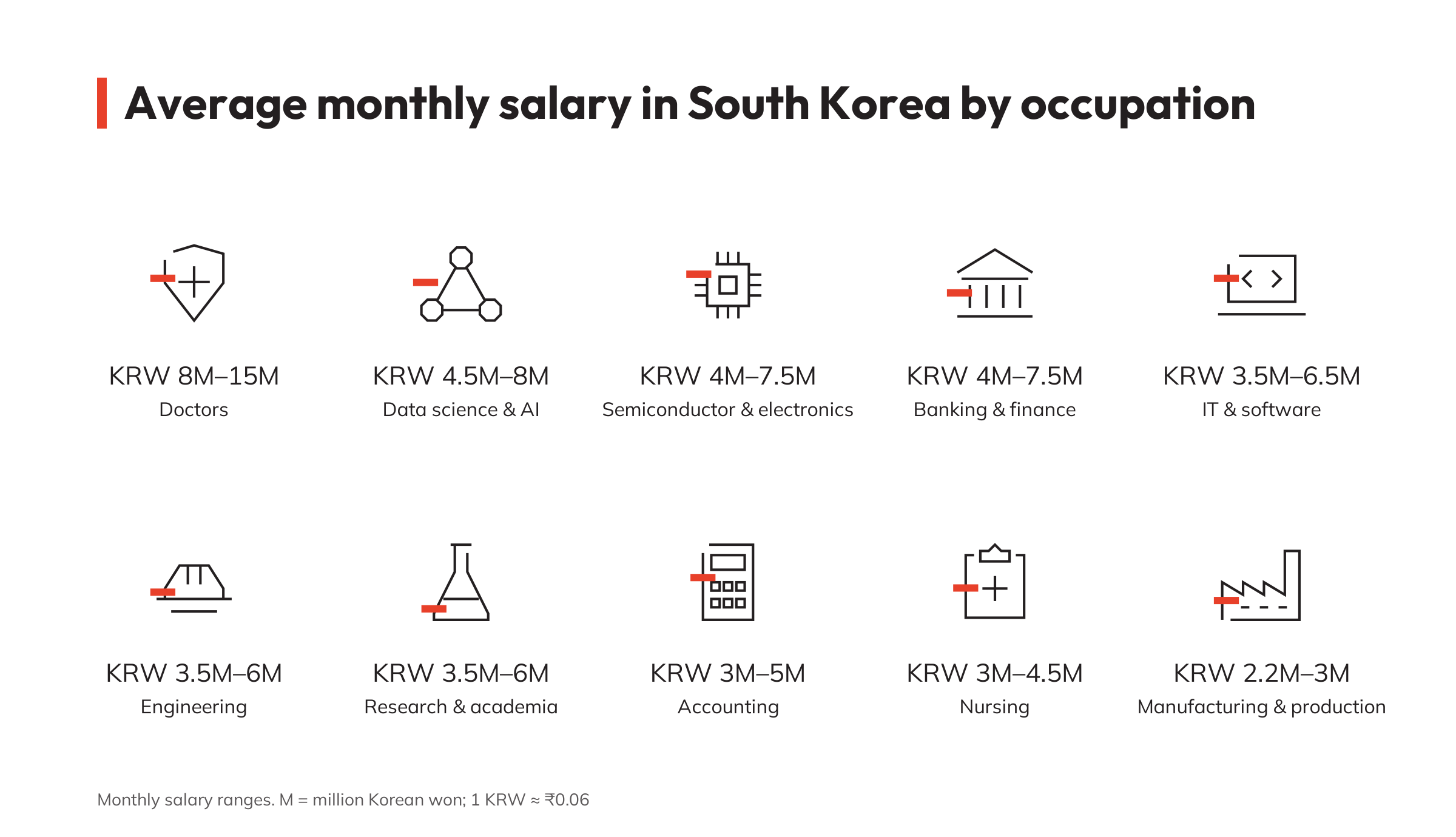
Your occupation has the biggest impact on your salary in South Korea. Medical, technology and finance roles pay the most. South Korea's semiconductor and electronics industries also create strong demand for skilled engineers. Here are typical monthly salaries for in-demand occupations. INR amounts use an approximate rate of ₹0.06 per Korean won.
|
Occupation |
Average monthly salary (KRW) |
Gross annual salary (KRW) |
Notes |
|
Healthcare (Doctors) |
8,000,000–15,000,000 |
96M–180M (₹57.6 lakh–₹1.08 crore) |
Specialists at large hospitals earn the most |
|
Data Science & AI |
4,500,000–8,000,000 |
54M–96M (₹32.4–57.6 lakh) |
Among the fastest-growing technology roles |
|
Semiconductor & Electronics Engineering |
4,000,000–7,500,000 |
48M–90M (₹28.8–54 lakh) |
Large chipmakers pay at the higher end |
|
Banking & Finance |
4,000,000–7,500,000 |
48M–90M (₹28.8–54 lakh) |
Seoul is the main financial hub |
|
IT & Software |
3,500,000–6,500,000 |
42M–78M (₹25.2–46.8 lakh) |
Senior engineers can earn KRW 8 million or more a month |
|
Engineering (Mechanical, Civil, Electrical) |
3,500,000–6,000,000 |
42M–72M (₹25.2–43.2 lakh) |
Automotive and shipbuilding firms pay well |
|
Research & Academia |
3,500,000–6,000,000 |
42M–72M (₹25.2–43.2 lakh) |
Government research institutes and universities |
|
Accounting |
3,000,000–5,000,000 |
36M–60M (₹21.6–36 lakh) |
Certified accountants earn at the higher end |
|
Nursing |
3,000,000–4,500,000 |
36M–54M (₹21.6–32.4 lakh) |
Korean nursing licence required |
|
Manufacturing & Production Workers |
2,200,000–3,000,000 |
26.4M–36M (₹15.8–21.6 lakh) |
Overtime and shift pay can add to earnings |
Note: These are typical ranges from salary surveys. Actual pay varies by employer, experience and city.
Also, read…
Highest Paying Jobs in South Korea for Indians
Factors That Affect Salaries in South Korea
Two people in the same job can earn very different salaries in South Korea. These are the main factors that decide your pay:
- Occupation and skills: Medical, technology and finance roles pay far more than general roles.
- Experience: Pay rises steadily with years of service, and senior professionals earn the most.
- Company size: Large conglomerates pay much more than small and medium-sized firms.
- Location: Seoul pays the highest salaries, followed by Gyeonggi Province and Ulsan.
- Employment type: Regular (permanent) workers earn far more than temporary or part-time workers.
- Industry: Semiconductors, electronics, finance and healthcare offer the highest pay.
- Korean language skills: Korean proficiency can widen your job options and raise your salary offer.
Also, read…
South Korea Job Market in 2026–30
Benefits and Allowances Included in South Korea Salaries
In South Korea, your total package is often worth more than your basic salary. Many employers add benefits to attract and keep skilled workers. Common benefits include:
- Bonuses: Many employers pay annual or performance bonuses, sometimes worth several months' salary.
- Meal allowance: A monthly meal allowance of up to KRW 200,000 is tax-free.
- Severance pay: Workers receive at least one month's average wage for each year of service after one year.
- Social insurance: Employers contribute to the national pension, health, employment and industrial accident insurance.
- Paid annual leave: Workers get at least 15 days of paid leave after one year of service.
- Housing support: Some employers offer housing or relocation help to foreign professionals.
- Tax options: Eligible foreign employees may choose a flat 19% income tax rate for a limited period.
*Are you looking for step-by-step assistance with overseas immigration? Contact Y-Axis, the world's No. 1 overseas immigration consultancy, for end-to-end assistance!
FAQs
What is the average salary in South Korea?
The average monthly salary in South Korea is about KRW 4.2 million, or roughly ₹2.5 lakh. This figure comes from the Ministry of Employment and Labor survey of businesses with one or more employees. It includes basic pay, overtime and bonuses. The average annual salary is about KRW 50 million. Actual pay depends on your occupation, experience, employer size and city.
What is the median salary in South Korea?
The median monthly income of wage workers in South Korea is about KRW 2.88 million, or roughly ₹1.7 lakh. This means half of all wage workers earn less than this amount. The median is lower than the average because very high salaries at large companies pull the average up. For most job seekers, the median gives a more realistic picture of typical pay.
What is the minimum wage in South Korea?
South Korea has a single national minimum wage of KRW 10,320 per hour. For a full-time worker, this equals KRW 2,156,880 a month, based on 209 paid hours. The same rate applies to all regions and industries. It also applies equally to Korean and foreign workers. The Minimum Wage Commission reviews the rate every year, and any change usually takes effect on 1 January. Employers who pay below this rate can face penalties.
Which jobs pay the highest salaries in South Korea?
Doctors and medical specialists earn the highest salaries in South Korea, often KRW 8 million or more a month. Data science, artificial intelligence and semiconductor engineering roles also pay well. Finance, banking and senior software engineering roles usually pay KRW 4 million to KRW 7.5 million a month. Large companies such as electronics and automotive groups generally pay more than small firms.
How much do IT professionals earn in South Korea?
IT and software professionals in South Korea usually earn between KRW 3.5 million and KRW 6.5 million a month. Entry-level developers earn at the lower end of this range. Senior engineers at large technology companies can earn KRW 8 million or more a month. Skills in artificial intelligence, cloud computing and data engineering usually attract higher salary offers from employers.
Is salary taxed in South Korea?
Yes, salaries in South Korea are taxed. National income tax rates range from 6% to 45%, depending on income. A local income tax of 10% of the income tax amount is added. Eligible foreign employees may choose a flat tax rate of 19% for a limited period, subject to conditions. Employees also pay social insurance contributions of about 9–10% of salary.
What is the take-home salary in South Korea?
Take-home pay in South Korea is usually about 80–90% of the gross salary. Deductions include income tax, local income tax and social insurance. Social insurance covers the national pension, health insurance, long-term care insurance and employment insurance. Your exact take-home pay depends on your salary level, tax deductions and number of dependants. Higher earners keep a smaller share because tax rates rise with income.
Which city in South Korea pays the highest salaries?
Seoul pays the highest salaries in South Korea. Regular workers in Seoul earn about KRW 4.85 million a month on average, compared with about KRW 4.29 million nationally. Gyeonggi Province and Ulsan also pay above-average salaries because of large technology and industrial employers. Living costs, especially rent, are also highest in Seoul, so compare salary offers with local living expenses.
What benefits do employers offer in South Korea?
Employers in South Korea often add benefits to the basic salary. Common benefits include annual and performance bonuses and a tax-free meal allowance. Workers also get statutory severance pay after one year of service and paid annual leave. Employers contribute to the national pension and health insurance. Some employers also provide housing support or relocation help for foreign professionals and their families.
How much do foreign workers earn in South Korea?
Most foreign workers in South Korea earn between KRW 2 million and KRW 3 million a month. Official survey data shows that about half of foreign wage workers fall in this range. About 37% earn KRW 3 million or more. Skilled professionals on E-7 work visas earn more, as the E-7-1 category requires a minimum fixed salary set by the government.
Tags:
Average salary in South Korea
South Korea salary for Indians; average monthly salary in South Korea
Share
Options for you by Y-Axis

Get it on your mobile

Get News alerts

Contact Y-Axis
Latest Article
Popular Post
Trending Article

Posted On November 18 2026
UK Records 349,900 Study Visa Applications and 41,800 Seasonal Worker Applications: What the Latest Data Reveals