

Posted on January 22 2026
3 Million Jobs in Germany Over the Next Decade: Job Outlook and Work Visa Options

By , Editor
Updated February 02 2026
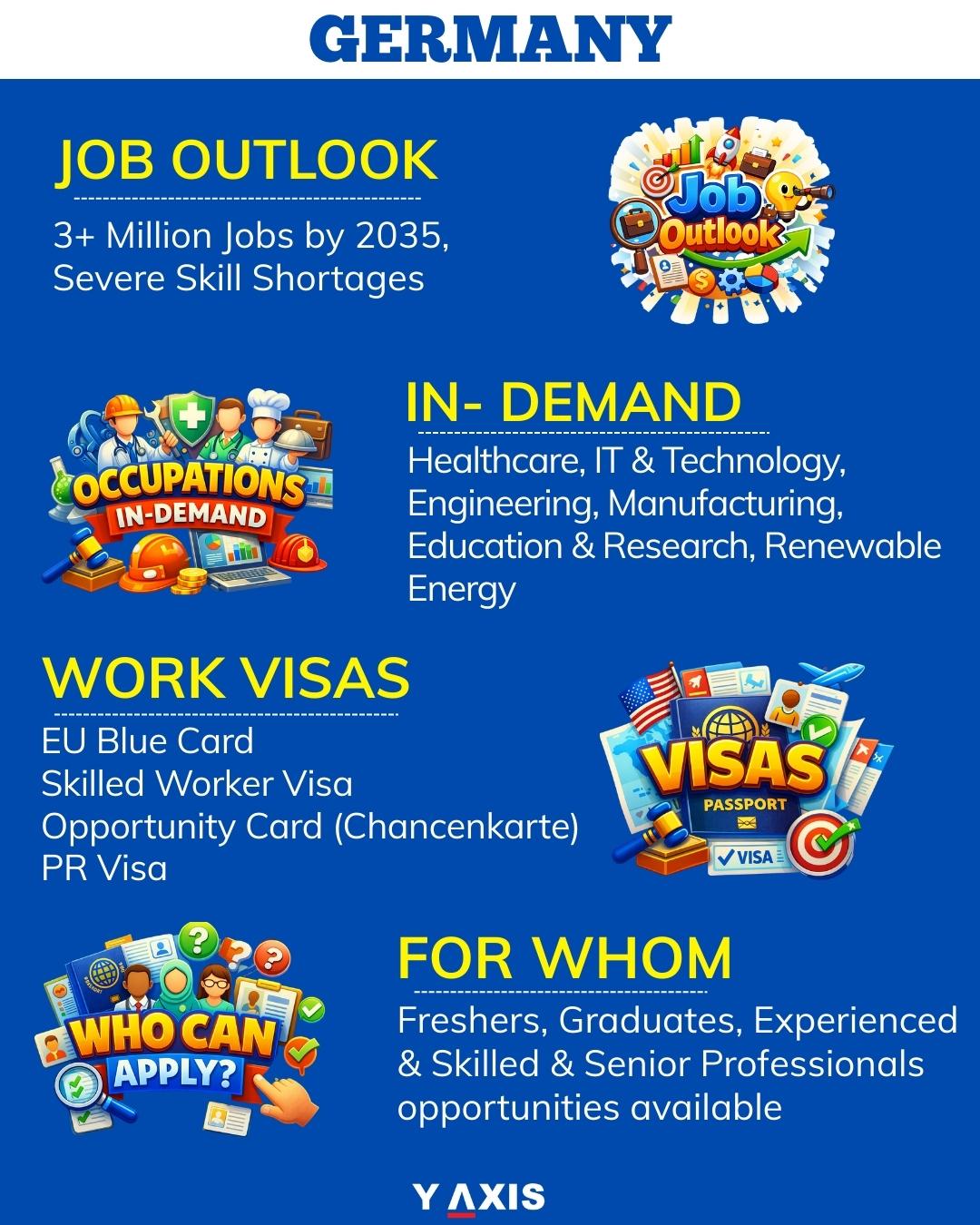
Germany is expected to create about 3 million new and replacement jobs in the next 10 years. This is because many people are retiring, industries are growing, technology is expanding, and green energy projects are increasing.
To fill these jobs, German companies are hiring more international professionals, especially from countries like India. The German government has also made immigration rules easier to attract skilled professionals.
Germany offers good job opportunities in engineering, IT, healthcare, manufacturing, logistics, automotive, and research. These jobs also help people get long-term residence, permanent settlement, and the chance to work across Europe, making Germany a popular choice for global professionals.
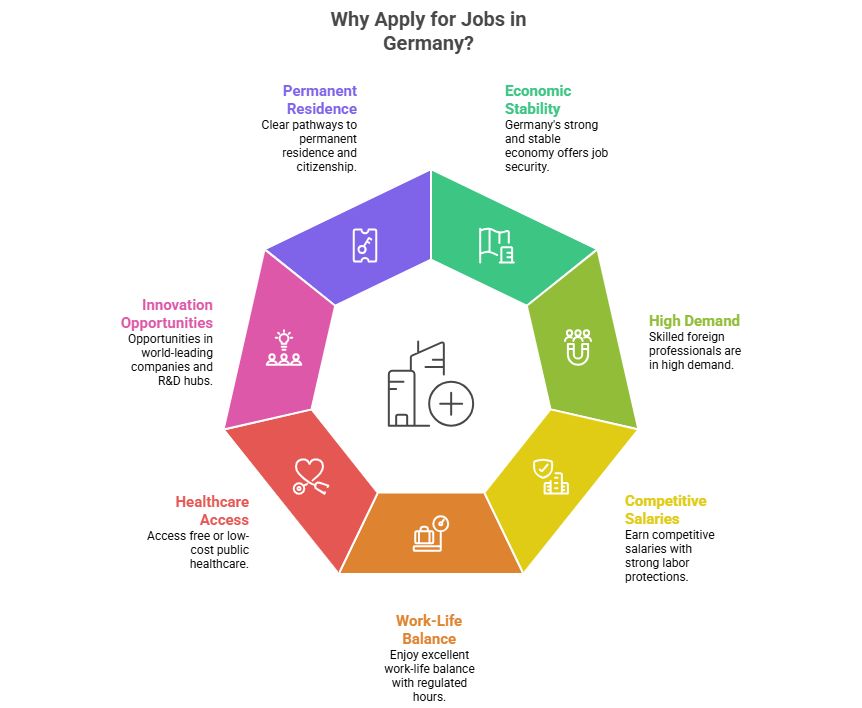
Why Apply for Jobs in Germany?
- Work in Europe’s strongest and most stable economy
- High demand for skilled foreign professionals
- Earn competitive salaries with strong labor protections
- Excellent work-life balance with regulated working hours
- Access to free or low-cost public healthcare
- Opportunities in world-leading companies and R&D hubs
- Clear pathways to permanent residence and German citizenship
Want to work in Germany? Let the Y-axis guide you through the process.
Job Outlook in Germany for the Next 10 Years
Germany’s job market is expected to remain highly positive and talent-driven over the next decade. More than 30% of the German workforce is expected to retire by 2035, creating a large gap that local hiring alone cannot fill.
To address this, Germany has introduced new immigration-friendly policies, including the Skilled Immigration Act, Opportunity Card (Chancenkarte), and faster recognition of foreign qualifications.
Key Employment Trends
- Ageing workforce: Rising demand for healthcare workers, caregivers, and medical professionals
- Industry 4.0 & digitalization: Strong need for IT specialists, AI experts, software developers, and data engineers
- Green energy transition: Job growth in renewable energy, sustainability, and environmental engineering
- Manufacturing & automotive: Continued demand for engineers, technicians, and skilled trades
- Research & innovation: Growth in STEM research, applied sciences, and industrial R&D
Employment Opportunities by 2035
- Nearly 3 million job openings expected across sectors
- Germany depends a lot on international professionals to fill skill shortages
- The government runs special programs to attract foreign workers
- More companies are offering jobs with visa sponsorship for overseas candidates
Who Can Apply for Job Opportunities in Germany?
Germany welcomes candidates at all career stages, provided they meet qualification and skill requirements.
Freshers & Graduates
- Fresh graduates can apply for entry-level roles and trainee programs
- High demand in IT, engineering, logistics, hospitality, and healthcare
- Germany offers a Job Seeker Visa / Opportunity Card to search for jobs
- Many employers support work visas once a job offer is secured
Experienced Professionals
- Mid-level professionals are highly valued in Germany
- Strong demand in IT, engineering, finance, manufacturing, and healthcare
- Employer-sponsored work visas are common for skilled roles
- Offers better salaries, stability, and long-term career growth
Skilled & Senior Professionals
- Senior professionals can apply for leadership and specialist roles
- Eligible for EU Blue Card and German Skilled Worker Visa
- Faster pathways to permanent residence (PR)
- Ideal for professionals planning long-term settlement in Europe
Looking for jobs in Germany? Use Y-Axis Resume Marketing Services to find the right opportunity.
Most In-Demand Jobs in Germany for Indians
Germany needs a large number of skilled professionals in many industries. Many people are retiring, and companies are growing, which has increased the demand for workers. The jobs listed below are expected to have high demand over the next 10 years. These roles offer stable jobs, good salaries, and chances to get work visas and permanent residence, making Germany a good choice for long-term career growth.
|
Occupation |
Estimated Job Vacancies (Next 10 Years) |
Average Annual Salary (Euros) |
|
Engineering |
700,000+ |
€58,380 |
|
Information Technology |
650,000+ |
€58,067 |
|
Transportation |
400,000+ |
€35,652 |
|
Healthcare & Social Services |
500,000+ |
€51,804 |
|
Finance |
350,000+ |
€46,743 |
|
Sales & Marketing |
300,000+ |
€52,472 |
|
Childcare & Education |
450,000+ |
€33,325 |
|
Construction & Maintenance |
500,000+ |
€42,175 |
|
Law Enforcement |
200,000+ |
€38,139 |
|
Accounting & Administration |
320,000+ |
€56,364 |
|
Shipping & Manufacturing |
600,000+ |
€30,927 |
|
Food Services |
350,000+ |
€32,241 |
|
Retail & Customer Service |
550,000+ |
€47,415 |
|
Hospitality & Travel |
380,000+ |
€45,700 |
Read More…
Top In-Demand Occupations in Germany
In-demand Jobs Roles in Germany
The job roles listed below are in high demand in Germany and offer good salaries, stable jobs, and opportunities to get work visas and permanent residence.
|
Industry |
Job Roles |
|
Healthcare |
Doctors, Nurses, Caregivers, Medical Technicians, Physiotherapists |
|
IT & Technology |
Software Developers, AI Engineers, Data Scientists, Cloud Engineers |
|
Engineering |
Mechanical, Electrical, Civil, Automotive, Industrial Engineers |
|
Manufacturing |
CNC Operators, Toolmakers, Production Engineers |
|
Education & Research |
Researchers, University Lecturers, Scientific Assistants |
|
Renewable Energy |
Solar Engineers, Wind Energy Technicians, Sustainability Experts |
Germany Work Visa Options
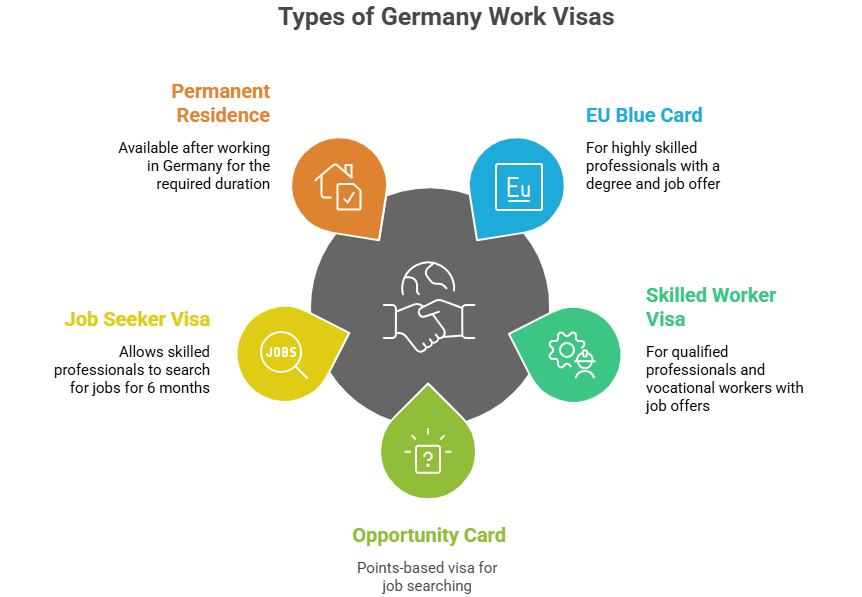
Germany offers several work visa options for international professionals based on their skills, qualifications, and career goals. These visas allow foreign professionals to legally live and work in Germany. Some visas require a job offer, while others allow candidates to enter Germany first and search for employment. Many of these visas also provide a clear pathway to permanent residence (PR) and long-term settlement. The main types of work visas are listed below:
- EU Blue Card:
For highly skilled professionals with a recognized degree and a job offer meeting salary thresholds. Offers fast-track PR. - German Skilled Worker Visa:
For qualified professionals and vocational workers with job offers from German employers. - Opportunity Card (Chancenkarte):
A points-based visa allowing candidates to enter Germany and search for jobs. - Permanent Residence (PR):
Available after working in Germany for the required duration under an eligible visa.
*Need help choosing the right Germany visa? Speak to Y-Axis experts for complete guidance.
Cost of Living in Germany
The cost of living in Germany varies by city. Cities like Munich, Frankfurt, and Hamburg are more expensive, while smaller cities are affordable. On average, a single person needs €1,500–€1,800 per month for rent, food, transport, and utilities.
Germany offers free or low-cost public healthcare, subsidized education, and strong social security benefits, making it ideal for long-term living.
How to Apply for a Germany Work Visa from India?
Step 1: Identify the right Germany work visa based on your qualifications and job role
Step 2: Search and apply for jobs with German employers
Step 3: Receive a job offer and employment contract
Step 4: Get qualification recognition (if required)
Step 5: Prepare documents and apply for the visa
Step 6: Attend a biometric appointment at the German VAC
Step 7: Travel to Germany and begin employment
When Is the Best Time to Apply for Jobs in Germany?
The best time to apply for jobs in Germany is when many industries are facing a shortage of skilled workers and employers are looking for professionals from other countries. German companies are actively hiring overseas candidates and offering work visa sponsorship, which makes it easier for foreign professionals to move and work legally in Germany. There are also clear options for permanent residence (PR), helping candidates plan a stable and long-term future.
Applying early gives candidates a better chance of getting job offers, visa approval, and a smooth relocation process. Many German employers plan their hiring months in advance, so early applicants have more job options, better access to visa support, and stronger chances of building a successful career in Germany.
*Are you looking for step-by-step assistance with German Immigration? Contact Y-Axis, the world's No. 1 overseas immigration consultancy, for end-to-end support!
FAQs
How many job vacancies will Germany have in the next 10 years?
Germany is expected to have around 3 million new and replacement job vacancies over the next 10 years. These jobs will be created because a large number of workers are retiring and many industries are expanding. Sectors like IT, engineering, healthcare, manufacturing, logistics, and renewable energy need more workers every year. Germany does not have enough local workers to fill all these roles, so companies are looking for skilled professionals from other countries. This creates strong job opportunities for international candidates, including Indians.
Can Indians apply for jobs in Germany?
Yes, Germany offers many job opportunities for Indian professionals across different industries. Indian candidates are especially in demand in IT, engineering, healthcare, manufacturing, logistics, and research roles. German employers value Indian professionals for their technical skills and work experience. Many companies also provide visa sponsorship for eligible candidates. With simplified immigration rules and clear work visa options, Indians have good chances of finding jobs and building long-term careers in Germany.
Which sectors have the highest job demand in Germany?
The highest job demand in Germany is seen in engineering, information technology, healthcare, manufacturing, construction, transportation, and renewable energy. These sectors are growing fast and are also affected by worker shortages due to retirement. Digital transformation and green energy projects have further increased demand. Jobs in these sectors offer stable employment, good salaries, and strong visa support, making them attractive for overseas professionals.
What are the most in-demand jobs in Germany?
Some of the most in-demand jobs in Germany include software developers, data scientists, AI engineers, mechanical and electrical engineers, nurses, caregivers, CNC operators, technicians, and renewable energy specialists. These roles are required across industries and regions in Germany. Due to long-term skill shortages, these jobs are expected to stay in demand for many years. Many of these roles are also eligible for work visas and permanent residence pathways.
What is the average salary for jobs in Germany?
The average salary in Germany depends on the job role, industry, and experience level. In general, professionals earn between €35,000 and €65,000 per year. IT, engineering, finance, and healthcare roles usually offer higher salaries. Entry-level jobs may pay less, while experienced professionals and specialists earn more. Germany also provides strong labor protections, social security benefits, and healthcare support, which adds more value to the salary.
Does Germany offer visa-sponsored jobs?
Yes, Germany offers many visa-sponsored jobs for international professionals. Employers can sponsor candidates through visas like the EU Blue Card and German Skilled Worker Visa. These visas allow foreign professionals to legally live and work in Germany. Sponsored jobs are common in skill-shortage sectors such as IT, engineering, healthcare, and manufacturing. Visa sponsorship also helps candidates apply for permanent residence after meeting the required work period.
Is it easy to get a job in Germany without knowing German?
It is possible to get a job in Germany without knowing German, especially in IT, engineering, research, and technical roles, where English is commonly used. However, learning basic German is strongly recommended. German language skills improve job chances, workplace communication, and daily life. In sectors like healthcare, education, and customer service, German language knowledge is often required. Even basic German can make a big difference in job success.
What visas are available to work in Germany?
Germany offers several work visas for foreign professionals. These include the EU Blue Card, German Skilled Worker Visa, and Opportunity Card (Chancenkarte). Each visa has different eligibility rules based on qualifications, job offers, and salary levels. These visas allow professionals to work legally and also provide clear pathways to permanent residence (PR). Choosing the right visa depends on your education, experience, and career plans.
Can freshers apply for jobs in Germany?
Yes, fresh graduates and entry-level professionals can apply for jobs in Germany. Many companies offer trainee programs, internships, and junior roles. Germany also provides options like the Job Seeker Visa and Opportunity Card, which allow candidates to enter Germany and look for jobs. Freshers with technical skills, internships, or practical training have better chances. Learning German and gaining relevant skills can further improve job opportunities.
How long does it take to get permanent residence in Germany?
The time required to get permanent residence (PR) in Germany depends on the visa type and work history. In most cases, professionals can apply for PR after 2 to 5 years of working in Germany under eligible visas such as the EU Blue Card. Factors like language skills, salary level, and social security contributions can affect eligibility. PR allows individuals to live and work in Germany without restrictions.
What is the job market like in Germany for the next 10 years?
Germany’s job market is expected to remain strong and stable over the next 10 years. Due to long-term worker shortages and economic growth, employers will continue to hire both local and international professionals. Technology, healthcare, manufacturing, and green energy sectors will see consistent demand. The government’s support for skilled immigration also makes Germany a reliable destination for long-term career growth and settlement.
Are manufacturing and automotive jobs still in demand in Germany?
Yes, manufacturing and automotive jobs are still highly in demand in Germany. The country is a global leader in these industries. There is strong demand for engineers, technicians, CNC operators, production workers, and automation specialists. With the shift toward electric vehicles and smart manufacturing, new job roles are also being created. These jobs offer stability, good pay, and visa sponsorship options.
What are the chances of long-term settlement after working in Germany?
Germany offers clear and reliable settlement options for foreign professionals. After working for the required period and meeting conditions such as language skills and social contributions, candidates can apply for permanent residence and later citizenship. Germany’s social benefits, healthcare system, and quality of life make it a popular choice for long-term settlement. Many professionals successfully settle in Germany with their families.
Tags:
Germany Jobs
Work in Germany
Germany Job Outlook
Germany Work Visa
Jobs in Germany for Indians
Germany Skilled Worker Visa
German Immigration
Germany Careers
Employment Opportunities in Germany
Germany PR Pathways
Share
Options for you by Y-Axis

Get it on your mobile

Get News alerts

Contact Y-Axis
Latest Article
Popular Post
Trending Article

Posted On April 11 2026
Jobs in Ireland for Indians: How to Land a Job & Apply for a Work Visa