

Posted on January 21 2026
2 Million Jobs in Canada Over the Next Decade – Fresher’s, Experienced & Professionals Can Apply!

By , Editor
Updated February 06 2026
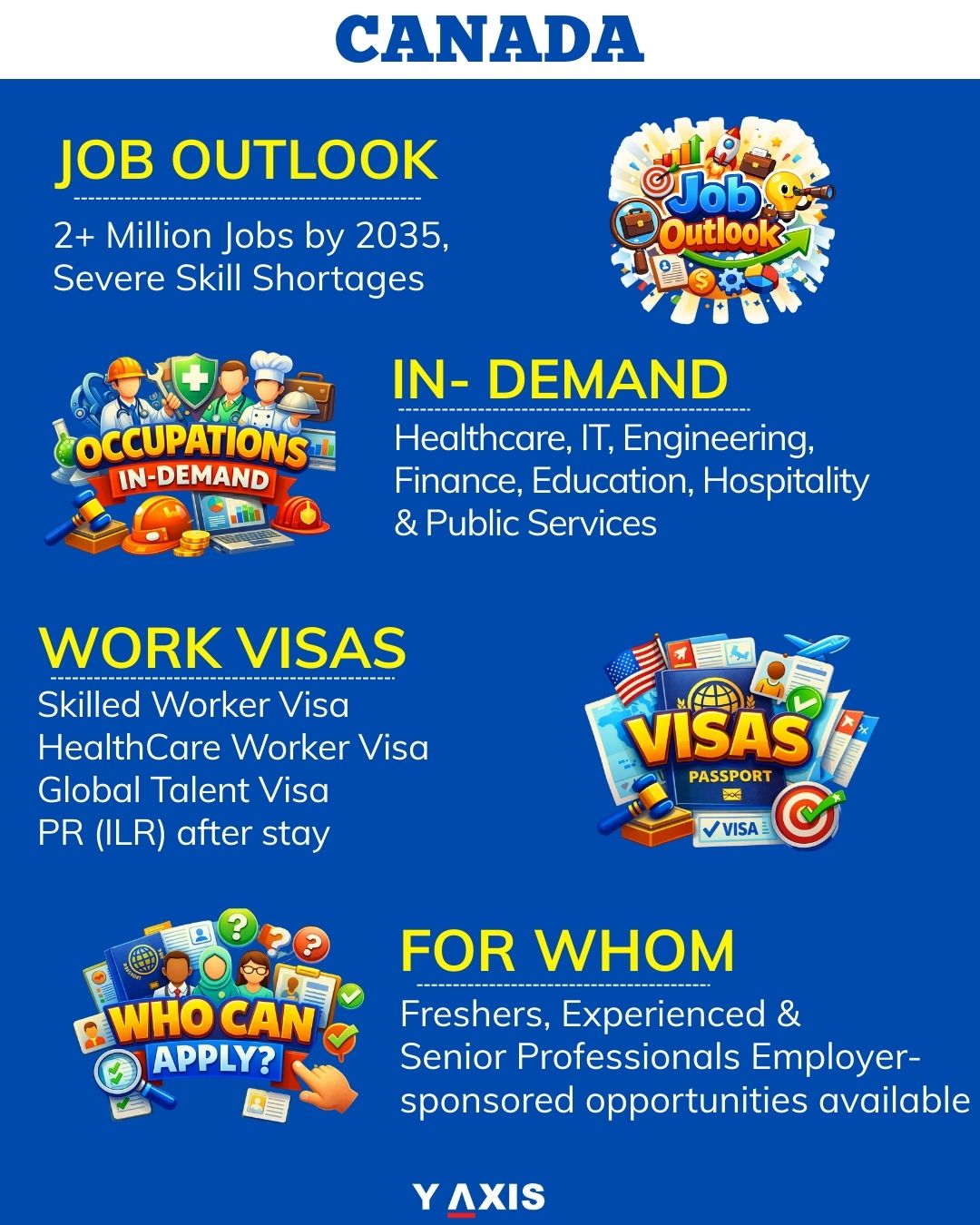
Canada is expected to have more than 2 million jobs in the coming decade. The increasing number of job opportunities is mainly due to the expanding industries, economic growth, and an aging population, with high retirement rates. Canada needs skilled foreign workers, experienced professionals, and freshers with skills to address the country’s ongoing labour shortages.
Canada is one of the most stable and immigrant-friendly countries, with a high demand for skilled workers across sectors such as IT, healthcare, engineering, finance, logistics, construction, education, and skilled trades. The current workforce demand across Canada is for individuals at all experience levels, making it ideal for freshers or recent graduates, highly experienced, and mid-level skilled professionals to migrate to Canada for work.
The country offers different work visas and PR pathways for foreign workers with work benefits and long-term settlement options. The streamlined immigration pathways in Canada provide clear pathways to reside, work, and settle in the country. Canada is one of the best options for skilled workers planning to work abroad, as it offers high-paying jobs, employment rights and benefits, and long-term settlement, making it an ideal choice for Indians looking to migrate overseas for work.
*Want to apply for a Canada work visa? Let Y-Axis guide you with the steps.
Why Work in Canada?
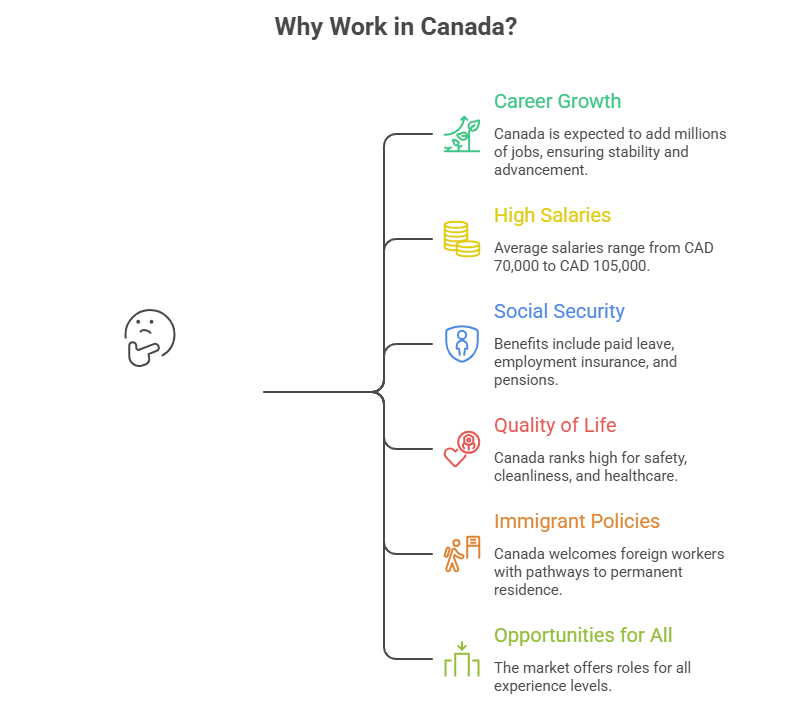
Working in Canada can be beneficial for skilled workers, as it ranks among the top for work-life balance, immigrant-friendly policies, high salaries, and job security. The country has a huge demand in skill-shortage sectors, offering high-paying job opportunities for freshers, experienced skilled workers, and professionals seeking long-term benefits.
Here are some reasons why you should work in Canada:
- Career growth and job stability: Canada is expected to add more than 2 million jobs over the next decade, indicating steady job growth and an increasing rate of retirements, with expansion across industries and sectors; this promises long-term job stability while advancing your career.
- High salaries: The average annual salary in Canada ranges between CAD 70,000 and CAD 105,000, based on your level of expertise, the type of job role, and the location of your job.
- Social security benefits: As an employee working in Canada, you can benefit from policies such as paid leave, employment insurance, and pensions.
- High quality of life: Canada ranks among the top 10 countries for its quality of life, low crime rates, clean cities, and free public healthcare.
- Immigrant-friendly policies: Canada is actively welcoming foreign workers through work permits, work visa-to-permanent residence pathways, and skilled migration, making it easier to transition to PR in Canada, and plans to invite 2 million newcomers by the end of 2028.
- Opportunities for all experience levels: The Canadian labour market offers opportunities for freshers, experienced professionals, mid-level professionals, and seniors in high-demand sectors such as IT, finance, skilled trades, engineering, healthcare, and construction.
Job Outlook in Canada for the Next 10 Years
Canada’s job outlook over the next 10 years seems optimistic, with growing demand for healthcare, IT, and skilled trades professionals. The aging population and the retirement rates drive the demand for skilled foreign professionals. Canada will offer new opportunities, driven by a changing economy and replacement demand, promising stable career growth for both freshers, mid-level, and experienced candidates.
Employment trends in Canada over the next decade
Here are five key employment trends that will be seen in Canada over the next 10 years:
- Immigrant-driven workforce: Over the coming years, Canada is expected to rely heavily on immigration, with a majority of its net labour force driven by immigrants. This will be due to rising retirement rates and labour market supply.
- Increasing demand in the Social services and Healthcare sector: The country’s aging population has increased demand for healthcare professionals, including nurses, caregivers, and allied health workers.
- Expansion of Tech and digital jobs: There will be continuous growth in job roles across sectors such as IT, AI, cloud computing, data analytics, and cybersecurity, as Canada receives significant investments in automation and digital technologies.
- Rise of construction and skilled trades sectors: There will be more infrastructure development and public projects to address housing shortages. This will create opportunities for construction workers, technicians, and skilled trades professionals across Canadian provinces.
- Priority will be given to Regional and Provincial Hiring: Canadian provinces will invite more skilled workers through frequent PNP draws, creating job opportunities in both smaller provinces and metropolitan centres across Canada.
Read more…
Canada Job Market: Trends & Opportunities
Employment Opportunities Expected Over the Next Decade in Canada
Canada is projecting over 2 million job opportunities in the coming 10 years, both the creation of new jobs and the replacement of the existing workforce.
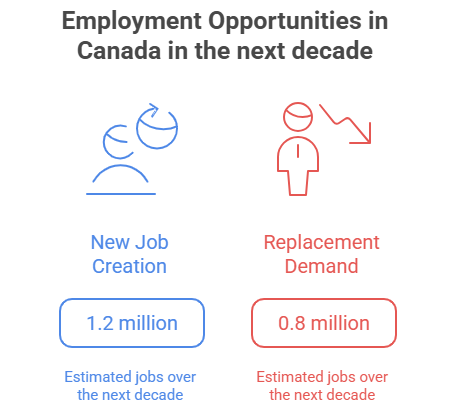
The aging workforce and the expansion of key industries will play an important role in meeting labour market requirements.
|
Category |
Estimated Jobs |
|
New job creation |
~1.2 million |
|
Replacement demand (retirements & exits) |
~0.8 million |
|
Total employment opportunities |
2 million+ |
Read more…
What are the most in-demand jobs in Canada for the next 10 years?
Who Can Apply for Jobs in Canada?
The Canadian job market is slowly offering more opportunities for foreign professionals, including freshers and recent graduates, as well as experienced and senior, skilled workers. Canada plans to actively recruit skilled foreign talent across multiple high-demand sectors due to persistent labour shortages and long-term workforce needs. The country offers different work visa options and PR pathways for those interested in working and settling in Canada.
You can apply for jobs in Canada as a fresher/graduate, an experienced or mid-level professional, or a senior professional.
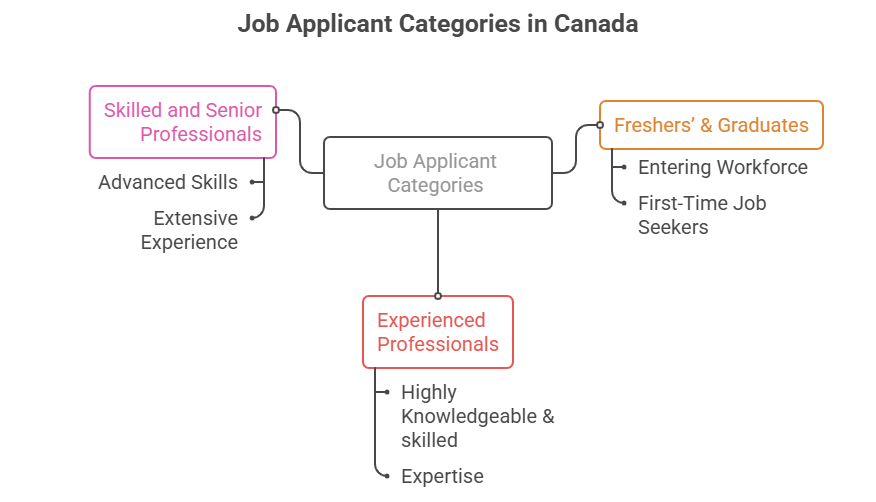
Freshers’ & Graduates
Recent graduates, freshers, or those just starting their professional careers can apply for entry-level jobs in Canada across sectors such as IT, healthcare, hospitality, business services, and engineering. International students who have studied in Canada can apply for the Post-Graduation Work Permit (PGWP), which allows them to work in junior-level roles in Canada, provided they have employer sponsorship. You must meet the English language proficiency levels and have the required academic qualifications. You can also convert your work visa to a PR pathway once you fulfill the requirements.
Experienced Professionals
Mid-level or experienced professionals with 2-8 years of experience in top industries such as engineering, healthcare, IT, finance, logistics, education, and construction can apply for jobs in Canada. Most Canadian employers recruit foreign workers with prior experience, for sponsored and mid-level job roles, offering work permits that can later be converted to PR. If you have verified experience relevant to the occupation, required language skills, and other requirements, you can have better chances of getting selected.
Skilled and Senior Professionals
Highly qualified and skilled senior professionals will always be preferred for critical roles that address long-term workforce shortages in the country. You can also get jobs in Canada in roles that require leadership and specialization. Jobs for senior professionals are often offered high salaries, direct access to PR pathways, and employer sponsorship. Professionals with international work experience, strong academic qualifications, and high-demand skills can even qualify for the fast-track hiring options in Canada.
*Want to apply for jobs in Canada? Avail Y-Axis Resume Marketing Services to find the right one.
Most In-Demand Jobs in Canada
Some of the most in-demand jobs in Canada include roles in IT, healthcare, engineering, skilled trades, and logistics.
The table below has details of the top in-demand jobs in Canada, along with the average annual salaries offered for each:
|
Occupation / Industry |
Estimated Job Opportunities (Next 10 Years) |
Average Salary per Year (CAD) |
|
Healthcare (incl. Nursing & Support) |
520,000+ |
CAD 75,000 |
|
Information Technology (IT & Tech) |
380,000+ |
CAD 90,000 |
|
Engineering (All Streams) |
320,000+ |
CAD 85,000 |
|
Skilled Trades & Construction |
260,000+ |
CAD 70,000 |
|
Education & Teaching |
170,000+ |
CAD 74,000 |
|
Banking, Finance & Accounting |
160,000+ |
CAD 78,000 |
|
Hospitality & Tourism |
150,000+ |
CAD 55,000 |
|
Retail & Customer Service |
170,000+ |
CAD 50,000 |
Note: The job vacancies mentioned above are estimates and may vary by industry. However, reports suggest that the total number of job opportunities in Canada will exceed 2 million in the coming decade.
Read more…
Highest Paying Jobs in Canada for Indians
Industry-Wise Career Opportunities in Canada
Industries like IT and Tech, healthcare, engineering, education, skilled trades, and construction will continue to offer the most career opportunities in Canada.
The table below has industry-wise information, along with the in-demand job roles:
|
Industry |
In-Demand Job Roles |
|
Healthcare |
Doctors, Registered Nurses, Nurse Practitioners, Healthcare Aides, Physiotherapists, Medical Laboratory Technicians, Radiographers |
|
IT & Technology |
Software Developers, Data Analysts, AI & Machine Learning Engineers, Cybersecurity Specialists, Cloud Engineers, IT Support Analysts |
|
Engineering |
Civil Engineers, Mechanical Engineers, Electrical Engineers, Project Engineers, Industrial Engineers, Quality Engineers |
|
Skilled Trades & Construction |
Electricians, Plumbers, Welders, Carpenters, HVAC Technicians, Construction Supervisors |
|
Education |
School Teachers, College Lecturers, Early Childhood Educators, Teaching Assistants, Special Education Teachers |
|
Finance & Accounting |
Accountants, Auditors, Financial Analysts, Tax Consultants, Risk Managers, Compliance Officers |
|
Banking & Insurance |
Banking Officers, Credit Analysts, Loan Officers, Investment Advisors, Claims Analysts |
|
Logistics & Transportation |
Truck Drivers, Supply Chain Coordinators, Logistics Managers, Warehouse Supervisors |
|
Hospitality & Tourism |
Hotel Managers, Chefs, Restaurant Supervisors, Food & Beverage Managers, Front Office Executives |
|
Retail & Customer Service |
Retail Store Managers, Customer Service Representatives, Sales Associates, Call Centre Executives |
Read more…
Canada Work Visas
You must apply for a Canadian work visa to work in the country for a specified period legally. You will generally require a valid job offer and a positive LMIA report confirming that no Canadian citizen is available to fill the role. Canada offers different work visas and immigration pathways for foreign nationals to immigrate to the country, based on their job role, qualifications, education, and work experience. You can apply for a temporary or long-term visa, with some even offering a direct pathway to permanent residency in Canada.
You must choose the right Canada work visa, depending on your eligibility, occupation, and long-term prospects.
Canada Work Visas for Indians
Here are some of the most common Canada work visa options and pathways for Indians to work in Canada:
Temporary Work Permit (Employer-Sponsored)
The Temporary Work Permit allows foreign nationals to reside and work in Canada, provided they have a valid job offer from a registered Canadian employer. Generally, the employer must obtain an LMIA (Labour Market Impact Assessment) to demonstrate that there are no local workers available for the vacant role. Employer-sponsored work permits in Canada provide visa applicants with a pathway to convert to PR through programs such as the CEC and the Canada PNP.
*Want to apply for a Canada Temporary Work Visa? Let Y-Axis guide you with the process.
Global Talent Stream (GTS)
The Global Talent Stream (GTS) in Canada is a fast-track hiring pathway for highly skilled workers in technology, T, or innovation-related roles. The GTS stream offers faster processing in about 2 weeks and is a great option for Canadian employers to fill critical job roles in skill-shortage sectors.
Read more…
All you need to know about Canada's Global Talent Stream
Canada Post-Graduation Work Permit (PGWP)
International students who graduate from eligible Canadian Designated Learning Institutions (DLIs) can apply for a PGWP (Post-Graduation work permit). With a PWGP, international graduates can live and work in Canada for up to 3 years, depending on the length of their study program.
*Want to apply for Canada PGWP? Let Y-Axis assist you with the steps.
Cost of Living in Canada
Living costs in Canada vary by city, province, lifestyle, and occupation. Some of the best cities in Canada for foreign nationals include Vancouver and Toronto, which are slightly on the expensive side, while Winnipeg, Halifax, and Calgary offer an affordable lifestyle.
On average, you may need around CAD 2,000 to CAD 2,500 per month as a single person living in Canada. This cost will include your rent, living expenses, food, and transportation charges. Housing or accommodation is generally the largest expenditure, followed by utilities, groceries, and public transportation. You may have to lower costs if you choose to live outside the main city centre or prefer a shared accommodation arrangement.
|
Expense Category |
Average Monthly Cost (CAD) |
|
Rent (1-bedroom apartment, city centre) |
CAD 1,200 – 1,800 |
|
Rent (1-bedroom apartment, outside city centre) |
CAD 900 – 1,400 |
|
Groceries & food |
CAD 300 – 450 |
|
Utilities (electricity, heating, water) |
CAD 120 – 180 |
|
Internet & mobile phone |
CAD 80 – 120 |
|
Public transportation |
CAD 100 – 160 |
|
Health insurance / medical expenses |
Mostly covered (public healthcare) |
|
Miscellaneous & personal expenses |
CAD 150 – 250 |
Note: The table above is an estimated cost for a single person; the cost of living varies by city/province, lifestyle choices, and housing arrangements.
Also, read…
Comparison of buying a house in Delhi/Mumbai, India versus Toronto/Vancouver, Canada
How to Apply for a Canada Work Visa from India?
Here’s how you can apply for a Canadian work visa from India:
Step 1: Check your eligibility to work in Canada
Step 2: Choose the right Canadian work visa based on your skills, qualifications, work experience, and long-term plans (standard work visa, GTS, PGWP)
Step 3: Apply for jobs in Canada in companies that are actively recruiting foreign workers. You can use the Y-Axis Resume Marketing Services for complete job search support.
Step 4: Get a job offer in Canada along with an LMIA approval (if required)
Step 5: Arrange the documents required for the Canadian work visa (job offer, LMIA report, employment number, educational qualifications, work experience letters, proof of funds, etc.).
Step 6: Apply for the Canada work visa online or at the nearest Canadian embassy or consulate
Step 7: Complete the work visa fee payment
Step 8: Schedule a visa appointment at the local VAC (Visa Application Centre) in India and submit your biometrics.
Step 9: Receive a port-of-entry letter and fly to Canada.
Also, read…
List the jobs that give PR in Canada
Immigration pathways for High Demand Jobs in Canada
| Title | Link |
| How can I migrate to Canada as a Chef? | https://www.y-axis.com/blog/how-can-i-migrate-to-canada-as-a-chef/ |
| How can I migrate to Canada as an AI Specialist? | https://www.y-axis.com/blog/how-can-i-migrate-to-canada-as-an-ai-specialist/ |
| How to migrate to Canada as a Doctor? | https://www.y-axis.com/blog/how-to-immigrate-to-canada-as-a-doctor/ |
| How can I migrate to Canada as a Registered Nurse? | https://www.y-axis.com/blog/how-can-i-migrate-to-canada-as-a-registered-nurse/ |
| How can I migrate to Canada as a Civil Engineer? | https://www.y-axis.com/blog/migrate-to-canada-as-civil-engineer/ |
| How can an IT professional immigrate to Canada? | https://www.y-axis.com/blog/how-can-an-it-professional-immigrate-to-canada/ |
*Know more about salaries in Canada
When Is the Best Time to Apply for Jobs in Canada?
Now is the right time to apply for jobs in Canada, as the country faces ongoing skill shortages across key industries.
With an ageing population and rising retirement rates, there are more job opportunities in Canada than ever before. The country has a high demand for skilled professionals in the IT, healthcare, skilled trades, logistics, and construction sectors, who are hiring freshers, mid-level experienced, and senior professionals.
Canada’s economy is steady and is receiving significant investments in technology, infrastructure, healthcare, and housing, which are directly contributing to new job creation. Applying early for jobs in Canada boosts your chances of getting an employment offer with employer sponsorship, giving you the advantage of eventually transitioning to PR upon eligibility.
*Are you looking for step-by-step assistance with Canadian immigration? Contact Y-Axis, the world’s No. 1 overseas immigration consultancy, for end-to-end assistance!
FAQs
Will Canada really have 2 million job openings over the next 10 years?
Yes, reports suggest that Canada will have around 2 million job opportunities in the coming decade. More job opportunities will be available for freshers, experienced, and senior professionals due to the ageing population and long-term economic developments. There will be a combination of new job creation and replacement demand in top sectors such as IT, healthcare, skilled trades, education, and construction.
Who can apply for jobs in Canada – freshers or only experienced professionals?
There are no restrictions on who can apply for jobs in Canada; both freshers and experienced professionals can apply. While fresher’s can take up entry-level roles, skilled professionals can secure senior-level roles in top sectors, with high salaries and long-term PR benefits.
Which sectors will create the most jobs in Canada in the next decade?
The sectors with the most jobs in Canada over the coming decade include IT, skilled trades, healthcare, logistics, construction, education, and finance. There will be an expansion of sectors involving infrastructure and digital growth, creating more opportunities.
Are there job opportunities in Canada for Indian professionals?
Yes, there are job opportunities in Canada for Indian professionals due to the ongoing labour shortages. The country actively invites skilled foreign workers through immigration programs like Express Entry, PNP, and other employer-sponsored work permits.
Do I need a job offer to work in Canada?
Yes, a job offer is required for most Canadian work visas. If you wish to migrate to Canada without a job offer in hand, you can choose immigration pathways like Express Entry or specific PNP streams. While a job offer is not mandatory, it is advisable to have one before migrating to Canada, as it can boost our chances of getting selected.
What are the top in-demand jobs in Canada right now?
The table below has the list of jobs in Canada that are currently in demand:
| Occupations | Average Salaries per year (INR) | Average Salaries per year (CAD) |
|---|---|---|
| Engineering | ₹ 76,58,001 | $121,681 |
| IT | ₹ 62,02,968 | $101,688 |
| Healthcare | ₹ 77,16,195 | $126,495 |
| Marketing & Sales | ₹ 52,25,748 | $85,668 |
| Banking and Finance | ₹ 50,81,178 | $83,298 |
| Nursing | ₹ 49,03,241 | $80,381 |
| Education | ₹ 44,12,069 | $72,329 |
| Accountants | ₹ 48,63,164 | $79,724 |
| Hospitality | ₹ 40,90,843 | $67,063 |
| Skilled Trades | ₹ 36,79,764 | $60,324 |
How does replacement demand benefit fresh graduates and skilled professionals in Canada?
The replacement demand in Canada directly creates new job opportunities for recent graduates and experienced professionals, who will largely contribute to the country’s economy. The ageing population in Canada will lead to the retirement of senior employees, leaving most job openings vacant and available to a new workforce. Freshers can choose junior or entry-level roles that come with training programs and career advancement. A large share of the 2 million projected jobs in Canada over the next decade will involve replacing retiring workers in top sectors such as engineering, IT, healthcare, construction, and public services.
Can recent graduates from India work in Canada?
Yes, recent Indian graduates can work in Canada in entry-level job roles. Indian students studying in Canada can apply for a Post-Graduation Work Permit (PGWP) that allows them to work in the country for up to 3 years, depending on the duration of their study program. Skilled graduates who qualify can also convert to permanent residency after meeting the required criteria.
Is Canada hiring foreign workers due to labour shortages?
Yes, Canada is currently facing labour shortages in multiple top sectors. While labour shortages are not the only reason Canada is hiring foreign workers, they are also due to the aging population, which is creating new job opportunities for skilled foreign professionals in key industries like IT, healthcare, education, and skilled trades.
What is the average salary for jobs in Canada?
The average salary in Canada varies by job role and occupation. However, the median annual average wage in Canada is between CAD 65,000 and CAD 95,000, and more, depending on your skills, job role, and location. Skilled professionals in top sectors such as engineering, IT, Healthcare, and finance can earn higher salaries and receive other benefits.
Which Canadian provinces offer the most job opportunities?
Canadian provinces such as Alberta, Ontario, Saskatchewan, and Quebec generally offer the most job opportunities.
- British Columbia (High jobs in technology, construction, and healthcare)
- Quebec (High jobs in healthcare and social services)
- Alberta (high jobs in healthcare & social assistance)
- Manitoba (healthcare, education, agriculture, and trades)
- Newfoundland and Labrador (Healthcare & Social Assistance, Mining & Minerals, Tourism, Hospitality & Culture)
Can I get a Canada PR through a job?
Yes, you can qualify for permanent residency in Canada through a job. In general, a valid and registered job offer in Canada can help you convert from a work permit to PR. Immigration programs such as PNP, CEC, or employer-driven PR streams can help you qualify for PR, provided you meet the required criteria.
Is IELTS required to work in Canada?
Yes, IELTS is generally required to work in Canada, particularly when applying for skill-based jobs or immigration pathways such as Express Entry, which require a minimum level of English language proficiency. While IELTS is not necessarily mandatory, it can add credibility to your profile, based on the program you are applying for.
How long does it take to move to Canada for work?
The time it takes to move to Canada for work depends solely on the immigration pathway or work visa type you have applied for. While Canadian work permits may take a few weeks to months (3 to 12 months), PR pathways like Express Entry may take around 6-8 months, on average, after issuing an ITA. You can also opt for faster visa processing through the Global Talent Stream (GTS), provided you meet its eligibility criteria.
Are skilled trades in demand in Canada?
Yes, skilled trades are among the most in-demand sectors in Canada and will require around 220,000 workers over the next three years. Reports also suggest that 700,000 skilled trades professionals will likely retire in the next few years, creating more opportunities for foreign professionals.
Can I apply for Canadian jobs from India?
Yes, you can apply for jobs in Canada from India through trusted and verified job search platforms. However, to get a job in Canada, you must have the relevant skills and qualifications required for the job role you are applying for.
Does Canada prefer younger workers?
Canada invites both young and experienced skilled workers, with skills that match the labour market needs. While the country prefers young professionals aged 18-35 for maximum points, skilled and experienced workers are also prioritized in high-demand sectors.
What is the best immigration pathway to work in Canada?
The Express Entry system is one of the best and fastest immigration pathways to work in Canada. Other pathways include the Canada PNP and the Canadian Experience Class (CEC).
Is Canada a good long-term career destination?
Yes, Canada is considered a good destination for long-term career opportunities due to its high quality of life, strong economy, and favorable immigration pathways.
How can Y-Axis help me apply for jobs and immigration to Canada?
- Eligibility check for Canadian immigration
- Visa application support
- Canada PR application guidance
- Canada work visa application guidance
- Visa Documentation support
- English language proficiency tests
- Assistance to help you prepare for the visa interviews
Tags:
Jobs in Canada
2 Million Jobs in Canada Over the Next Decade
Jobs in Canada for Indians
Work in Canada
high paying jobs in Canada
salaries in Canada
Canada work visa
Canada job outlook
Canada job market
In demand jobs in Canada
In demand careers
Share
Options for you by Y-Axis

Get it on your mobile

Get News alerts

Contact Y-Axis
Latest Article
Popular Post
Trending Article
Posted On March 14 2026
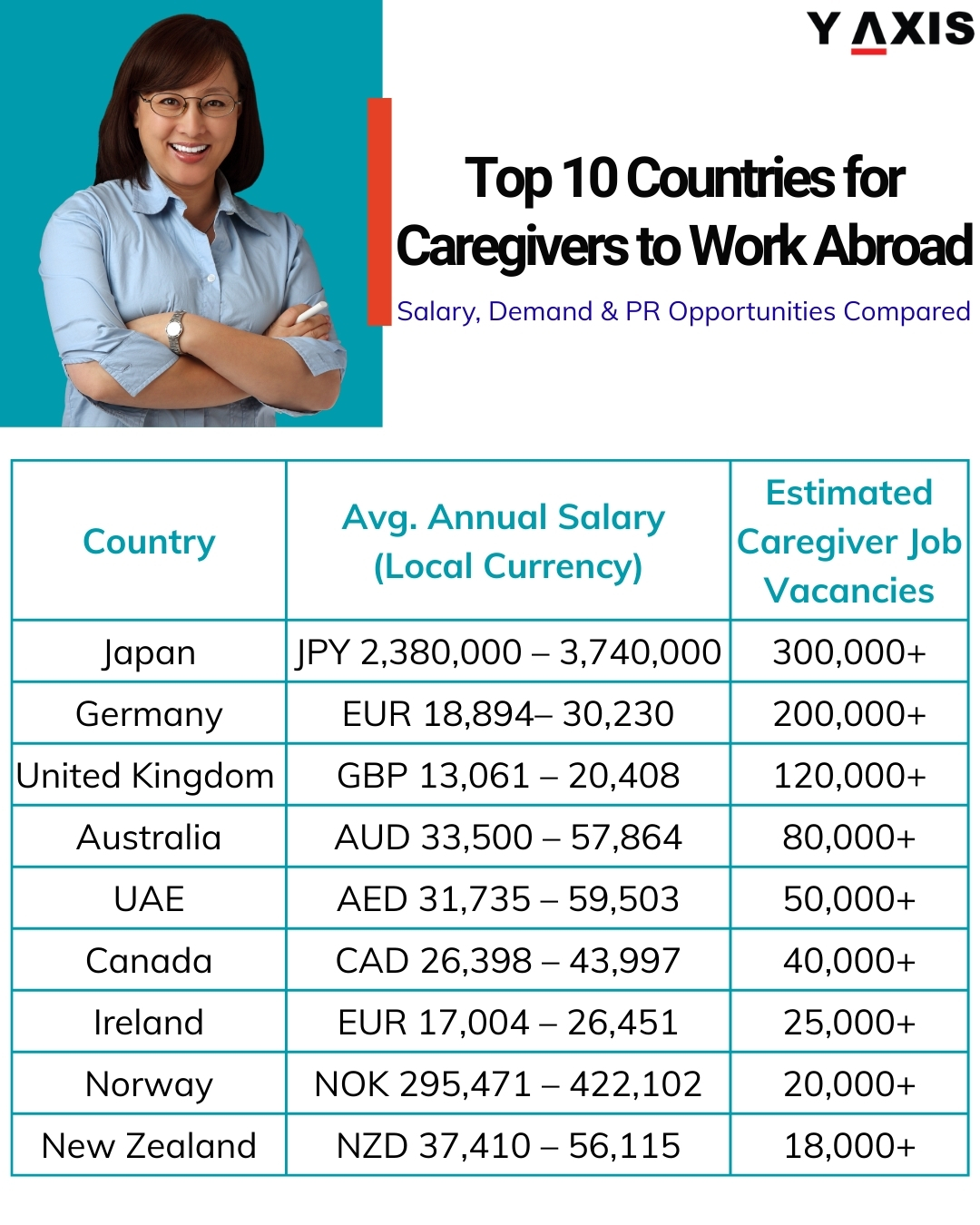
Top 10 Countries for Caregivers to Work Abroad: Salary, Demand & PR Opportunities Compared