


Don't know what to do ?
Get Free Counseling
Why apply for a Turkey Work Visa?
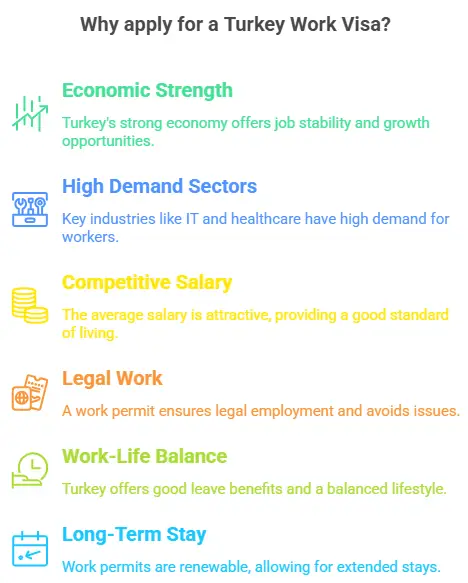
- Turkey has a strong economy with GDP over USD 1 trillion
- High demand for employees in IT, construction, healthcare, tourism, and manufacturing
- Average monthly salary is TRY 25,000–45,000
- Work legally with a valid work permit
- Standard work time is 40 hours per week
- Good paid leave benefits and public holidays
- Work permits are renewable for long-term stay
- Good work life balance and job security
Turkey is a fast-growing country located between Europe and Asia. It offers many job opportunities for foreign professionals across different industries. The cost of living is affordable compared to many European countries. Turkey has modern cities, good infrastructure, and a diverse culture. Many professionals choose Turkey for its improving work environment, stable economy, and better work–life balance.
Capital: Ankara | Population: ~86.1 million (2025) | Official Language: Turkish | Second most spoken language: Kurdish (~19% of population) | Largest city: İstanbul (15.75 million) | Currency: Turkish Lira (TRY) |
*Want to apply for a Turkey work visa? Let Y-Axis guide you with the steps.
Benefits of Working in Turkey:
- Rapidly growing economy with strong opportunities in sectors including manufacturing, construction, tourism, finance, and technology
- Strategic location bridging Europe and Asia, offering access to markets across two continents
- Thriving startup ecosystem, particularly in Istanbul
- Gateway to regional markets including the Middle East, Central Asia, North Africa, and the EU
- Strong manufacturing and export base offering roles in automotive, textiles, defense, and agri-food industries
- Access to world-class universities and vocational training institutions for professional development
- Employer-provided benefits including social security (SGK) coverage, annual leave entitlements, and severance pay protections under Turkish Labor Law.
Why Should Indians Migrate to Turkey?
- Over 20,000 Indians currently reside in Turkey, with a growing community in Istanbul, Ankara, and Antalya.
- Turkey's booming construction, tourism, textile, and technology sectors actively seek skilled international professionals.
- Indians are eligible for Turkey's work visa and residence permit pathways, with a relatively straightforward process.
- High demand for Indian professionals in IT, engineering, hospitality, education, and healthcare sectors.
- Turkey offers a significantly lower cost of living compared to Western Europe or North America.
- After 5 years of legal continuous residence, Indians can apply for Turkish Citizenship.
- The Turkish Citizenship by Investment program allows Indians with capital to obtain citizenship by investing a minimum of $400,000 in real estate or $500,000 in a Turkish business or fund.
*Looking for jobs in Turkey? Sign up with Y-Axis for end to end assistance.
Turkey Work Visa
Indian citizens who want to work in Turkey must apply for a Turkey Work Visa before travelling. This visa is mandatory for all non-EU citizens. You can apply only after getting a valid job offer from a Turkish employer. The employer applies for your work permit in Turkey, and once it is approved, you must apply for the work visa at the Turkish Embassy in India. The visa allows you to live and work legally in Turkey under the job mentioned in your contract. The work permit is usually issued for 1 year initially and can be renewed if you continue working. After several years of legal work and stay, you may become eligible for long-term residence. Eligible family members can also apply to stay with you in Turkey.
Types of Turkey Work Permit
Turkey offers different types of work visas based on the nature of employment. Indian citizens must apply for the correct Turkey Work Visa depending on their job role and purpose of travel. Each visa type allows Indians to work legally in Turkey under specific conditions.
- Employment Purpose / Special Employment Purpose: This Turkey work visa is issued to Indian professionals who have secured a regular job with a Turkish employer. It covers most full-time roles in sectors such as IT, construction, manufacturing, healthcare, and services. The visa allows Indians to live and work legally in Turkey for the duration of their employment contract.
- Assigned Lecturers / Academics: This visa is meant for Indian teachers, professors, and academic staff appointed by Turkish universities or educational institutions. It allows Indians to work legally in teaching or research roles in Turkey for the approved period.
- Assigned Sportsperson: Indian athletes who are officially contracted by Turkish sports clubs or organizations can apply for this work visa. It allows them to train, participate in competitions, and work as professional sports persons in Turkey.
- Assigned Artists: This work visa is issued to Indian artists who are invited to perform or work in Turkey. It applies to professionals such as musicians, dancers, actors, painters, and performers taking part in cultural or artistic activities.
- Assigned Free Zone Workers: Indian nationals working in Turkey’s designated free zones can apply for this visa. It is issued to employees hired by companies operating in these zones and allows them to work legally within the free zone area.
- Assigned Journalists: This Turkey work visa is for Indian journalists who are officially assigned to work in Turkey by foreign media organizations. It allows them to carry out reporting, media coverage, and related professional activities in the country.
Turkey Work Visa Eligibility for Indians
To apply for a Turkey Work Visa, Indian applicants must meet the following conditions:
| Category | Details |
|---|---|
| Ideal Candidate Profile | IT professionals, healthcare workers, engineers, educators and academics, hospitality and tourism managers, financial analysts, construction project managers, textile and manufacturing specialists, and investors. |
| Education Requirements | A Bachelor’s degree or higher is usually required for skilled jobs. Master’s or PhD degrees help in research, healthcare, and academic roles. Vocational or technical certificates are accepted for trade and manufacturing jobs. Indian degrees are generally recognised but may need notarisation, apostille, and Turkish translation. |
| Work Experience | Relevant experience is required. Around 2–3 years is common for most roles, while senior or specialist positions may require 5+ years. Experience must match the job offered by the Turkish employer. |
| Language Requirements | Turkish is not mandatory for many corporate, tech, or multinational jobs. English is widely accepted in international companies and tourism. |
| Salary Thresholds | Skilled employee: Minimum salary about 3× the Turkish minimum wage (~TRY 60,000+ per month in 2026). Department heads/senior managers: 6× minimum wage. Aviation pilots and engineers: 9× minimum wage. Key personnel or company partners: 4× minimum wage. |
| Additional Requirements | Valid passport (at least 6 months beyond stay), clean immigration record, confirmed job offer from a Turkish employer registered with the Social Security Institution (SGK), employer must submit the work permit through the Ministry of Labour e-permit system, biometric residence permit after arrival, and documents such as diploma, CV, passport copy, and employment contract. Work permits are usually issued for 1 year initially, extendable to 3 years and then 6 years, eventually leading to indefinite work permit eligibility. |
Turkey Work Visa Requirements
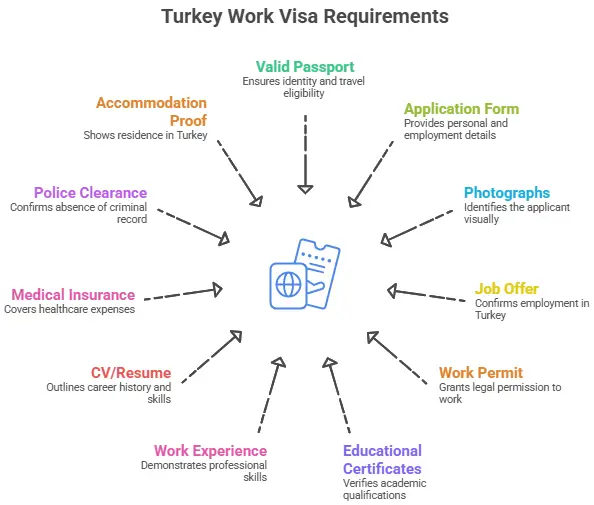
To apply for a Turkey Work Visa, Indian applicants must submit the following documents:
- Valid passport
- Turkey work visa application form
- Recent passport-size photographs
- Job offer or employment contract
- Work permit approval letter
- Educational certificates
- Proof of work experience
- Updated CV / Resume
- Medical insurance
- Police clearance certificate
- Proof of accommodation in Turkey
- Additional documents may be requested by the embassy if required.
Job Market in Turkey
Turkey offers a dynamic job market with high demand in construction, tourism, manufacturing, IT, healthcare, finance, and defense. Commercial hubs include Istanbul (finance and tech), Ankara (government and defense), Izmir (trade), and Antalya (tourism).
The country faces growing shortages in engineering, healthcare, cybersecurity, and software development, making it increasingly open to skilled foreign professionals.
Also, read...
Turkey Job Market: Trends and Opportunities
Top Jobs in Turkey for Indians
Major infrastructure projects under the Vision 2053 agenda including smart cities, high-speed rail, and defense expansion will generate thousands of roles annually.
| Industry | In-Demand Job Roles |
|---|---|
| IT & Software | Software Developers, Cloud Engineers, Cybersecurity Analysts, Data Scientists, ERP Specialists |
| Healthcare & Medicine | Physicians, Surgeons, Dentists, Nurses, Medical Researchers, Pharmacists |
| Engineering | Civil, Mechanical, Electrical, Structural, Petroleum Engineers |
| Tourism & Hospitality | Hotel Managers, Tour Operators, Event Coordinators, F&B Specialists, Travel Consultants |
| Finance & Banking | Financial Analysts, Risk Managers, Investment Bankers, Accountants, Fintech Specialists |
| Construction & Infrastructure | Project Managers, Site Engineers, Quantity Surveyors, Architects, Skilled Tradespeople |
| Defense & Aerospace | Defense Engineers, Systems Analysts, Drone Technicians, Aerospace Designers |
| Education & Academia | STEM Teachers, University Faculty, Language Instructors, Curriculum Designers |
| Manufacturing & Textiles | Production Engineers, Quality Control Specialists, Supply Chain Managers, Textile Technologists |
| Pharmaceuticals & Biotech | Clinical Research Associates, Biomedical Engineers, Drug Safety Specialists, Lab Scientists |
Also, read...
What Are the Most In-Demand Jobs in Turkey for the Next 10 Years?
Average Salary of Skilled Workers in Turkey
Turkey's salary levels vary significantly across sectors and regions, with Istanbul consistently offering the highest compensation. Wages are governed by the national minimum wage, which is set at TRY 22,104 gross/month (approx. $650/month).
Skilled professionals benefit from annual bonuses (typically 1–2 months' salary), employer-covered SGK social security contributions, private health insurance in corporate roles, and transportation and meal allowances.
| Experience Level | Average Gross Salary (TRY / Month) | Approx. Salary (USD / Year) | Approx. Salary (INR / Year) |
|---|---|---|---|
| Entry-Level | TRY 25,000 – 40,000 | $8,800 – $14,000 | ≈ ₹7.3 – ₹11.7 LPA |
| Mid-Level | TRY 45,000 – 80,000 | $15,800 – $28,000 | ≈ ₹13.2 – ₹23.4 LPA |
| Senior-Level | TRY 90,000 – 1,50,000+ | $31,500 – $52,500+ | ≈ ₹26.3 – ₹43.8 LPA |
Also, read...
Highest Paying Job Opportunities in Turkey
Steps to Apply for Turkey Work Visa from India
Step 1: Get a valid job offer from a Turkish employer
Step 2: Employer applies for your work permit in Turkey
Step 3: Receive work permit approval
Step 4: Apply for Turkey work visa at the Turkish Embassy
Step 5: Submit biometric details
Step 6: Pay visa application fees
Step 7: Attend visa interview
Step 8: Wait for visa decision
Step 9: Travel to Turkey and register your residence
Turkey Work Visa Cost
When applying for a Turkey Work Visa, Indian applicants (and their employers) must pay government fees for the work permit and permit card. These are the official charges set by the Turkish authorities for 2026:
| Permit Type | Government Work Permit Fee (INR) | Card Fee (INR) |
|---|---|---|
| Temporary Work Permit (up to 1 year) | ₹35,200 | ₹2,700 |
| Temporary Work Permit (1–2 years) | ₹70,400 | ₹2,700 |
| Temporary Work Permit (2–3 years) | ₹1,05,600 | ₹2,700 |
| Temporary Work Permit (4–5 years) | ₹1,76,000 | ₹2,700 |
| Permanent Work Permit | ₹3,52,500 | ₹2,700 |
| Independent Work Permit | ₹3,52,500 | ₹2,700 |
Turkey Work Visa Processing Time
The Turkey Work Visa usually takes 3 to 8 weeks to process. The exact time can change based on the embassy workload and how quickly documents are checked. In some cases, it may take more time if additional verification is needed. Applicants are not allowed to start working in Turkey until the work permit is officially approved.
Dependent Benefits for Turkey Work Visa Holders
Spouses and children of Turkey work permit holders are entitled to certain benefits under Turkish immigration and labour law. Turkey has a developing social security system (SGK), and dependent benefits are generally accessible once the main applicant holds a valid work permit and residence permit.
| Category | Details |
|---|---|
| Dependent Visa | Spouses and unmarried children under 18 can apply for a Family Residence Permit under Law No. 6458. The permit is linked to the main applicant’s work permit and must be renewed with it. |
| Spouse Work Rights | Spouses with a Family Residence Permit cannot work automatically. They must apply for a separate work permit through a Turkish employer. After 3 years of legal residence, they may apply for an Independent Work Permit. |
| Children’s Education | Children can attend free public schools in Turkey. Enrolment requires a valid residence permit and proof of address. Public education is state-funded from primary to secondary level. |
| Healthcare Access | Dependents can be included under the main applicant’s SGK (Social Security Institution) coverage, allowing access to public hospitals and clinics. Some employers also provide private health insurance for families. |
| Child Benefit | Low-income families may receive family support through the Social Assistance and Solidarity Foundation (SYDV). |
| Childcare Support | Some municipalities offer free or low-cost childcare services. |
Pathway to Long-Term Residency in Turkey
Turkey's residency pathway is structured around residence permits, work permits, and a points-based long-term residency system.
| Category | Details |
|---|---|
| Short-Term Residence Permit | Usually the first permit for foreign workers. Issued for up to 2 years initially and can be renewed. It covers purposes such as employment, tourism, education, and property ownership under Law No. 6458. |
| Long-Term Residence Permit | Available after 8 years of continuous legal residence in Turkey. It grants indefinite residence and work rights without renewal, with most rights similar to Turkish citizens (except voting and military service). |
| Indefinite Work Permit | Available after 8 years of continuous legal employment. Allows the holder to work for any employer and in any sector without restrictions. |
| Priority Date & Waiting Period | Turkey has no per-country caps or backlog. Residence permit applications are usually processed within 30–90 days by the Provincial Directorate of Migration Management. |
| Citizenship by Residency | Foreign nationals can apply for Turkish citizenship after 5 years of continuous legal residence. Requirements include financial stability, clean criminal record, basic Turkish language ability, and intention to live permanently in Turkey. |
| Citizenship by Investment | Fast-track citizenship without the 5-year wait. Options include real estate investment of $400,000, bank deposit of $500,000, or capital investment of $500,000 in a Turkish business or fund. Processing typically takes 3–6 months. |
| Language Requirements | No language test is required for residence or work permits. Basic Turkish proficiency is required for citizenship by residency. No language requirement for citizenship by investment. |
| PR Eligibility Timeline | Many Indian professionals start with a 1-year work permit, which can be extended to 3 years and then 6 years, before becoming eligible for an indefinite work permit after 8 years of continuous employment. |
| Dual Citizenship | Turkey allows dual citizenship. India does not permit it, so Indians must surrender their Indian passport if they obtain Turkish citizenship. |
Turkey Work Permit to Permanent Residence
Foreign professionals in Turkey can eventually apply for long-term or permanent residence after working and living in the country for a number of years.
To be eligible for permanent residence in Turkey, Indian work visa holders must meet these basic conditions:
- You must have lived in Turkey legally for at least 5 years continuously under a valid work permit.
- You must have a valid work permit or residence permit during this entire period.
- You must not have stayed outside Turkey for long periods during these years.
- You must prove that you have a stable income or job to support yourself.
- You must have basic knowledge of the Turkish language and culture (as required by immigration rules).
- You must not have a serious criminal record in Turkey or in your home country.
- You should be able to show that you have suitable accommodation in Turkey.
Once these conditions are met, you may apply for long-term residence. This status allows you to live in Turkey without being tied to a specific job or employer. You can stay in Turkey even if you change jobs or stop working, as long as your residence permit remains valid.
How can Y-Axis help you?
Y-Axis is a trusted overseas career and immigration consultant with 26+ years of experience in helping professionals work abroad. Our experts guide you at every stage of the Turkey work visa process, making the application simple, clear, and stress-free. From choosing the right visa to settling in Turkey, Y-Axis provides complete support.
Our services include:
- Expert guidance for Turkey work visa process
- End-to-end application support
- Resume writing services for overseas jobs
- Visa interview preparation
- Free career counselling
Don't know what to do ?
Get Free Counseling
Looking for Inspiration
Explore what Global Indians have to say about Y-Axis in shaping their future
Frequently Asked Questions