


Don't know what to do ?
Get Free Counseling
Last Updated 22 September 2026
Philippines Work Visa for Indian Professionals — 9(g), SWP, PWP and 47(a)(2) Complete Guide
The Philippines, also known as the Republic of the Philippines, is one of the fastest-growing Southeast Asian countries, with a GDP of $494.16 billion. The country is emerging as a hub for IT services, global businesses, and manufacturing sectors. The Philippines is currently looking for skilled foreign professionals in top industries such as IT, engineering, BPM, Fintech, healthcare, construction, and renewable energy.
The Philippines offers various work visa pathways and programs that invite skilled workers to the country. English is widely spoken throughout the Philippines, with no strict language requirements for a work visa. There is a high demand for job roles in AI and software development, data analysis, cybersecurity, digital marketing, and tech-enabled accounting, particularly in the Green energy sector, which is projected to require over 350,000 skilled workers in the next five years.
The low cost of living, business-friendly environment, and a booming economy make the Philippines one of the best choices for skilled workers.
Capital: Manila | Population: ~118 million | Languages: Filipino & English | Currency: Philippine Peso (₱) ≈ ₹1.50
Why Work in the Philippines?
- Fast-growing economy in Southeast Asia with a huge demand for skilled professionals
- High need for professionals in IT-BPM, healthcare, digital marketing, and the renewable energy sector
- Will have more than 350,000 job vacancies in the Green energy sector in the next five years
- Plenty of job opportunities in MNCs in Manila, Cebu, Clark, and Davao.
- Full-time workers in top sectors (tech and IT-BPM) can earn up to ₱1.5 million per year.
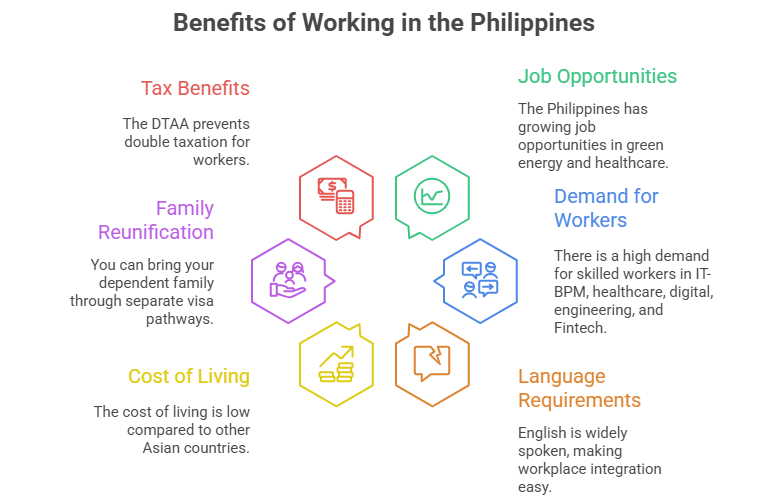
Benefits of Working in the Philippines
- Growing job opportunities: The country is expected to create 350,000 new job opportunities in Green energy over the next five years, with a projected need for 100,000 healthcare professionals by 2028.
- High demand for skilled workers: Huge demand for professionals in the IT-BPM, healthcare, digital, engineering, and Fintech industries.
- No strict language requirements: English is one of the widely spoken languages in the Philippines, making it easy for workplace integration.
- Low cost of living: The cost of living in the Philippines is low compared to other Asian countries, with affordable education and healthcare services.
- Allows family reunification: Allows you to bring your dependent family through separate visa pathways, such as the 9(a) and 13(a) visa.
- Tax Benefits: The India–Philippines Double Taxation Avoidance Agreement (DTAA) helps prevent double taxation for workers.
Types of Philippines Work Visas
| Particulars | 9(g) Work Visa | Special Work Permit (SWP) | Provisional Work Permit (PWP) | 47(a)(2) Visa |
|---|---|---|---|---|
| Purpose | Pre-arranged employment visa for long-term employment. | Temporary permit issued for short-term work of up to 6 months. | Temporary permit allowing work while waiting for 9(g) visa approval. | Long-term work authorisation for foreign nationals employed by PEZA or BOI-registered companies. |
| Education | Depends on job role; generally requires relevant qualifications. | No specific degree requirement; depends on short-term assignment. | No strict requirement; linked to 9(g) visa application. | Depends on job role; determined by the PEZA/BOI-registered employer. |
| Language | No strict language requirement. | No language requirement. | No language requirement. | No language requirement. |
| Eligibility | Valid job offer from a Philippine employer and Alien Employment Permit (AEP) required. | Valid visa and job contract for work under 6 months. | Issued to applicants awaiting 9(g) visa approval. | Must be employed by a PEZA or BOI-registered company. Fewer documentation requirements than 9(g). |
| Typical Professions | IT professionals, engineers, teachers, healthcare workers, finance specialists, managers, BPO roles. | Consultants, technicians, project specialists, trainers, performers. | Same roles as 9(g) Work Visa. | IT professionals, engineers, BPO and export-zone workers employed by PEZA/BOI companies. |
| Visa Fees (Embassy) | PHP 26,800–27,000 (~₹38,400 for Indians; may vary by nationality). | PHP 6,440 | Approx. PHP 4,040 (includes multiple processing fees). | Fees vary; generally lower than 9(g). Confirm with your PEZA/BOI-registered employer. |
Also, read...
What are the eligibility requirements for a Philippines work visa?
Top 10 Occupations in Demand in the Philippines
The Philippines has a huge demand for skilled professionals across top sectors such as engineering, technology, education, and healthcare. Foreign nationals can find more job opportunities with high salary packages and stable career growth.
The table below has the list of the top in-demand occupations in the Philippines:
| Occupation | Average Annual Salary (PHP) |
|---|---|
| Software Engineers & Developers | ₱420,000 – ₱960,000 |
| Cyber Security Analysts | ₱480,000 – ₱1,080,000 |
| Data Scientists / AI Engineers | ₱540,000 – ₱1,200,000 |
| Medical Practitioners (Doctors, Consultants) | ₱960,000 – ₱1,440,000+ |
| Nurses & Medical Technologists | ₱300,000 – ₱480,000 |
| Civil & Structural Engineers | ₱360,000 – ₱720,000 |
| Accountants & Finance Managers | ₱384,000 – ₱900,000 |
| IT Managers & Systems Architects | ₱720,000 – ₱1,440,000 |
| STEM & English Language Teachers | ₱180,000 – ₱360,000 |
| Renewable Energy Engineers | ₱420,000 – ₱840,000 |
Read more...
Highest Paying Jobs in the Philippines for Indians
Top Companies in the Philippines Hiring Indian Professionals
| S. No. | Company | Industry | Why It's Good for International Talent |
|---|---|---|---|
| 1 | Accenture Philippines | IT / BPO / Consulting | One of the largest IT employers; hires foreign professionals for tech, consulting, AI, cloud, and transformation roles. |
| 2 | IBM Philippines | IT / Cloud / AI / Consulting | Strong global presence with roles in cloud, AI, cybersecurity, and enterprise IT; supportive environment for foreign workers. |
| 3 | Infosys BPM Philippines | IT / BPM / Shared Services | Indian-origin company with strong presence; great for Indian professionals with visa-friendly hiring. |
| 4 | Tata Consultancy Services (TCS) Philippines | IT Services / Consulting | Offers roles in software development and project management with smooth onboarding for Indian professionals. |
| 5 | Concentrix Philippines | BPO / Customer Experience / Tech Support | Major BPO employer hiring foreign specialists in process management, analytics, and digital solutions. |
| 6 | Teleperformance Philippines | BPO / IT / Customer Operations | Global BPO giant offering roles in operations, training, and digital transformation. |
| 7 | Google Philippines | Technology / Digital / Cloud | Strong presence in digital services; roles in cloud, analytics, marketing, and business strategy. |
| 8 | Microsoft Philippines | Technology / Cloud / Software | Ideal for engineers and IT architects; international-friendly workplace with strong global exposure. |
| 9 | Ayala Corporation | Conglomerate / Real Estate / Finance / Telecom | Top Filipino conglomerate hiring global talent for digitalization and innovation roles. |
| 10 | SM Investments | Retail / Real Estate / Operations | Expanding across APAC; opportunities in marketing, operations, and digital transformation. |
| 11 | JG Summit Holdings | Manufacturing / Airlines / F&B / Telecom | Offers roles in engineering, supply chain, IT, and corporate strategy. |
| 12 | Aboitiz Group | Energy / Infrastructure / Tech | Expanding digital infrastructure; strong demand for engineers and data professionals. |
| 13 | Procter & Gamble (P&G) Philippines | FMCG / Supply Chain / Marketing | Top MNC offering global roles in supply chain, analytics, and brand management. |
| 14 | Nestlé Philippines | FMCG / Manufacturing / Supply Chain | Opportunities in manufacturing leadership, quality control, and logistics. |
| 15 | Manulife Philippines | Finance / Insurance / Technology | Global finance brand with roles in fintech, analytics, IT, and investment management. |
*Want to apply for jobs abroad? Avail the Y-Axis resume marketing services to find the right one.
Key Industries Hiring in the Philippines
The Philippine job market is actively recruiting skilled professionals and fresh graduates across high-demand sectors such as digital services, construction, IT-BPM, and healthcare. Last year, the Department of Labor and Employment (DOLE) reportedly conducted over 300 job fairs, with nearly 670,000 job vacancies for foreign nationals.
Here’s a list of key industries in the Philippines that currently have job vacancies:
- IT-BPM & Business Process Outsourcing
- Healthcare & Allied Medical Services
- Construction & Engineering
- Education & English Language Teaching
- FinTech & Financial Services
- Renewable Energy
- Logistics & Supply Chain
- Hospitality & Tourism
Key Tips for Indian Professionals
- Look for job opportunities through trusted and verified job search platforms, as well as the career sites of top companies, which frequently post job openings.
- Most employers in the Philippines sponsor their employees; however, it is always advisable to confirm their willingness to process the documents for the Alien Employment Permit (AEP) and the 9(g) Work Visa.
- Apply for job roles in high-demand sectors, such as IT-BPM, engineering, software development, Fintech, healthcare, and digital marketing.
- English is widely spoken in the Philippines; learning basic Filipino can help you better integrate with the society.
Market Background & Trends in the Philippines
- High demand for foreign workers: The Philippines requires skilled foreign talent in the Tech, healthcare, engineering, and infrastructure sectors.
- Expansion of the IT-BPM sector: The IT-BPM sector in the Philippines is projected to have 2.5 million job vacancies by 2028.
- Healthcare professionals: The country is facing a shortage of 100,000 healthcare professionals over the next five years.
- Varied work visa options: The Philippines offers different visa pathways, including 9(g) Pre-Arranged Employment Visa, Special Work Permit (SWP), and Provisional Work Permit (PWP) for skilled foreign professionals.
- Growing job opportunities: The country is expected to have 800,000 to 1 million job opportunities in the coming five years, particularly in high-demand sectors.
Also, read...
Philippines Job Market: Trends & Job Opportunities
Average Salary in the Philippines
Salaries in the Philippines vary by job type, industry, work experience, and occupation. Skilled professionals in high-priority sectors such as engineering, IT, finance, and healthcare can earn high salaries and other benefits.
The table below has details of the average annual salary offered to entry-level, mid-level, and senior professionals in the Philippines:
| Experience Level | Average Salary (PHP per year) |
|---|---|
| Entry Level | ₱180,000 – ₱360,000 |
| Mid-Level | ₱420,000 – ₱600,000 |
| Senior Level | ₱720,000 – ₱1,800,000+ |
Steps to Apply for a Philippines Work Visa
Step 1: Avail Y-Axis Resume Marketing Services: Sign up for the Y-Axis Resume Marketing services for a job search experience tailored to your profile.
Step 2: Receive a job offer: Y-Axis connects you with professional and verified employers in the Philippines, offering sponsorship for your job role.
Step 3: Employer files for an Alien Employment Permit (AEP): Your Filipino employer files for an Alien Employment Permit (AEP) with the Department of Labor and Employment, with complete documentation support from Y-Axis.
Step 4: Apply for a Philippine work visa: Once your AEP is approved and you have received a copy of the approval, you can apply for a Philippine work visa. Y-Axis will offer end-to-end support with the application process.
Step 5: Fly to the Philippines: Once your application is approved, Y-Axis will guide you through the post-arrival formalities in the Philippines.
Changing Employers in the Philippines — Visa Downgrading
The 9(g) visa is employer-specific. When you resign, are terminated, or change employers: (1) your employer must notify the Bureau of Immigration and DOLE within 3 working days of termination; (2) your 9(g) must be formally downgraded to 9(a) tourist status at the Bureau of Immigration; (3) you then have 59 days to find a new employer or arrange departure; (4) your new employer must file a new AEP (subject to DO 248's 30-day PhilJobNet requirement) and petition for a new 9(g), or a new PWP if an immediate start is needed.
Philippines Work Visa Fees
| Visa Type | Application Fee |
|---|---|
| 9(g) Work Visa | PHP 26,800 – 27,000 |
| Special Work Permit (SWP) | PHP 6,440 |
| Provisional Work Permit (PWP) | PHP 4,040 |
| 47(a)(2) Visa | Fees vary; generally lower than 9(g). Confirm exact fee with your PEZA/BOI-registered employer. |
There may be additional costs, including medical examination charges, an ACR-I Card (US$50 for 12 months), and express processing fees.
- Medical Examination Fee: ₱1,500–₱3,000 (₹2,200–₹4,400)
- Document Translation & Notarization: ₱500–₱2,000 (₹750–₹3,000)
- Alien Employment Permit (AEP): PHP 9,000 per year (initial filing fee, paid by employer to DOLE). Annual renewal: PHP 9,000 per year. AEP must be renewed annually before expiry. Under DOLE DO 248 (2026), employers must also budget PHP 50,000–200,000 for Understudy Training Programs.
- Express Fees (BI): ₱500–₱1,200 depending on service (₹750–₹1,800)
- Airfare to the Philippines: ₹18,000–₹30,000 (one-way on average)
ACR I-Card: approximately PHP 2,700 for initial issuance. Required for all international travel out of the Philippines.
Important: All ACR I-Card holders must file an Annual Report with the Bureau of Immigration between January 1 and March 1 each year. Fine for non-compliance: PHP 2,000 (maximum) plus motion fees. Y-Axis can assist with Annual Report compliance — contact us before January 31 each year to avoid fines.
Philippines Work Visa Processing Time
| Visa Type | Processing Time (on average) |
|---|---|
| 9(g) Work Visa | 1–3 months |
| Special Work Permit (SWP) | 5–10 working days (approximately 1–2 weeks) |
| Provisional Work Permit (PWP) | 2–3 weeks |
| 47(a)(2) Visa | 4–8 weeks (PEZA/BOI-registered employers) |
Note: The SWP is designed for fast-track short-term assignments and is one of the fastest-processed work authorisations in the Philippines.
Factors Influencing Processing Time:
- Completeness of the visa application: Incomplete applications with inaccurate documentation may face delays.
- Request for additional verification: Applications that require further verification of documents or background checks may experience extended processing times.
- False or incorrect documents: Documents that are false or applications with mistakes or errors can face delays.
Also, read...
What is the cost and processing time for a Philippines work visa for Indian applicants?
Jobs in the Philippines (2025–2035)
The Philippines will likely see strong job growth in priority sectors over the next 10 years, with huge demand in renewable energy and healthcare. Infrastructure investments and digital transformation are the main drivers of increased job growth.
Here are some of the key points related to the jobs and workforce projections in the Philippines in the next 5-10 years:
- The economic reforms taking place in the country will likely create nearly 1.6 million jobs in the next 10 years, with real wages increasing by 9%. These changes will directly impact the GDP growth rate by 1.5% per annum in the coming decade.
- The IT-BPM sector in the Philippines is expected to create over 1 million new jobs in the next 2 years, bringing the overall workforce to 2.5 million. Reports suggest that more than half of these job roles will be concentrated outside Metro Manila, according to the IBPAP's official Industry Roadmap 2028.
- As a part of the Philippine government’s reform agenda, the annual GDP growth rate could increase to 6.8%, creating nearly 5.1 million surplus jobs by 2040, particularly in the digital and manufacturing sectors.
- The Trabaho Para sa Bayan Plan 2025–2034 is one of the Philippines’ first national employment initiatives, which focuses on new job creation in the healthcare, sustainable industries, infrastructure, and digital services sectors.
Also, read...
What are the most in-demand jobs in the Philippines for the next 10 years?
Pathway to Permanent Residency in the Philippines
Skilled foreign workers in the Philippines can qualify for PR after living in the country for 10 consecutive years. Qualifying investors and retirees can access fast-track options without having to fulfil the 1-year residency pathway.
Philippines Work Visa Policy Updates 2026 (DOLE DO 248)
DOLE issued Department Order No. 248 (DO 248) in late 2025, with addendum DO 248-A-25, introducing the most significant AEP changes in years:
(1) Expanded Labour Market Test: mandatory 30-day posting on PhilJobNet before AEP approval — adds about one month to the pre-AEP timeline.
(2) Economic Needs Test: DOLE formally assesses whether the foreign hire is genuinely necessary; additional documentation may be required.
(3) Understudy Training Programs: employers must implement formal skills transfer to Filipino staff (budget PHP 50,000–200,000 per programme; DOLE audits annually; non-compliance risks AEP denial or revocation).
(4) OAPS: AEP applications are now filed via DOLE's Online Application and Payment System.
How can Y-Axis help you?
As the world's No. 1 overseas immigration consultancy, Y-Axis has been providing unbiased, personalized services for 25 years. Our team of experts is here to provide comprehensive assistance throughout your immigration journey, ensuring a seamless process. Our impeccable services include:
- Y-Axis Resume Writing Services to help you create a compelling resume
- Expert assistance with the Philippines work visa process.
- Review of your documents and visa application form
- Complete application processing
- Y-Axis Resume Marketing Services to help you find the best jobs for you
Y-Axis snapshot
1M
Successful applicants
1500+
Experienced counselors
25Y+
Expertise
50+
Offices
Don't know what to do ?
Get Free Counseling
Looking for Inspiration
Explore what Global Indians have to say about Y-Axis in shaping their future