


Don't know what to do ?
Get Free Counseling
Last Updated 22 May 2026
Highest paying Job Opportunities in Norway
Norway has a strong economy and a high standard of living, making it one of the best countries to work in Europe. The country faces a growing need for skilled professionals in various sectors due to an aging population and digital growth. According to Statistics Norway, there are over 90,000 job vacancies across industries, with high demand in IT, engineering, healthcare, construction, and education. The average monthly gross salary across industries is about NOK 59,370 (4.3 lakhs). Norway also offers competitive salaries, flexible working hours, paid vacations, and excellent work-life balance. If you are planning to build a career abroad, Norway provides excellent job opportunities, a safe environment, and strong employee rights.
Some of the highest paying job opportunities in Norway are listed below:
|
Occupations |
Average Salaries per year |
|
NOK 6,50,000 |
|
|
NOK 637,800 |
|
|
NOK 690,000 |
|
|
NOK 590,000 |
|
|
NOK 191,000 |
|
|
NOK 550,100 |
|
|
NOK 635,000 |
|
|
NOK 773,938 |
Source: Talent Site
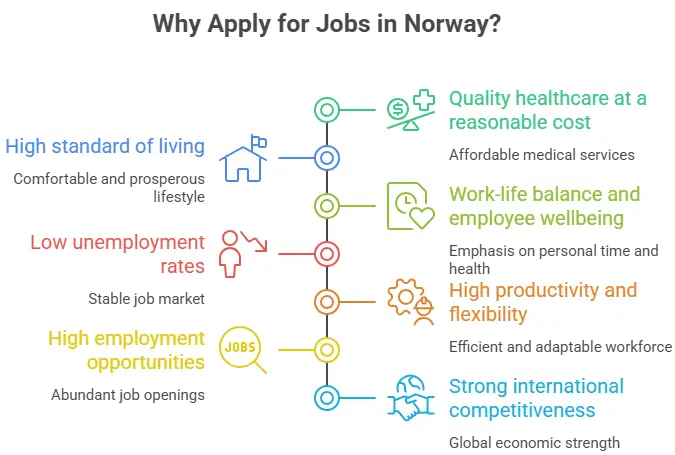
Why apply for Jobs in Norway?
- Quality healthcare at a reasonable cost
- High standard of living
- Work-life balance and employee wellbeing
- Low unemployment rates
- High productivity and flexibility
- High employment opportunities
- Strong international competitiveness
The Norwegian business sector is technologically advanced and quick to adopt new innovations. Norway has long been an innovative country with professional expertise in oil and gas, energy, the maritime sector, and seafood industries.
Norway is a secure and peaceful country with strong welfare systems and a well-regulated employer-employee relationship. Norwegian workplaces are known for transparency, employee participation, and a highly skilled workforce.
Job Vacancy in Norway
Norway currently has around 90,000 job openings. Many companies are looking for skilled workers, especially in IT, engineering, healthcare, and construction. Demand is rising due to a shortage of skilled professionals. More than 60% of jobs in Norway require high-level skills, creating strong opportunities for qualified foreign workers. The table below shows the estimated job vacancies in Norway by 2030:
|
Occupation / Sector |
Estimated Job Openings by 2030 |
|
IT & Software |
45,000 |
|
Engineering & Manufacturing |
40,000 |
|
Healthcare & Nursing |
35,000 |
|
Education & Research |
25,000 |
|
Construction & Infrastructure |
20,000 |
|
Finance & Business Services |
18,000 |
Step-by-Step Guide for Job Search in Norway from India
Step 1: Search for jobs in Norway on trusted platforms like LinkedIn, NAV, EURES, Indeed, and Glassdoor.
Step 2: Identify Norwegian employers that hire foreign workers and offer visa sponsorship.
Step 3: Prepare a clear and professional CV and cover letter highlighting your education, skills, and work experience. Knowing basic Norwegian is helpful, but many companies work in English.
Step 4: Apply directly through company career pages or use recruitment agencies that assist international candidates.
Step 5: Attend online interviews and explain your qualifications, experience, and reasons for wanting to work in Norway.
Step 6: Once you receive a job offer, your employer will guide you through the Norway Work Visa documentation.
Step 7: After visa approval, apply for a residence permit, plan your travel, and relocate to Norway to begin work.
*Looking for jobs in Norway? Find the right opportunity with Y-Axis resume marketing services.
Migrate to Norway via a Work Visa
International professionals from outside the EU or EEA must apply for a Residence Permit for Work, commonly known as a Norway Work Visa, before starting employment. This permit allows skilled workers to live and work legally in Norway for a specific employer. A valid job offer and required qualifications are mandatory. Visitors on a Schengen Visa cannot work or convert their visa into a work permit. Applications must be submitted from the applicant’s home country prior to arrival.
Types of Norway work visa
- Skilled Worker Visa – For professionals with a job offer in Norway and a university degree or vocational training.
- Seasonal Worker Visa – For short-term or seasonal jobs, usually up to 6 months.
- Job Seeker Visa – For graduates from Norwegian universities to stay and find a job (valid up to 1 year).
- Vocational Training / Research Visa – For students or researchers doing training or study-related work.
- Short-term Artist Visa – For artists or performers working in Norway for up to 14 days.
- Working Holiday Visa – For individuals aged 18–31 from selected countries to live and work in Norway for up to 1 year.
Requirements of Norway work visa
The requirements for the Norway Work Visa are given below:
- Original passport
- Completed Norway Work Visa application form
- Recent passport-size photographs (white background)
- Employment offer registered on the UDI website and completed by the employer
- Proof of accommodation in Norway
- Academic qualification certificates (university or vocational diploma)
- Previous work experience certificates
- Resume / CV
- Proof that salary meets Norway income requirements
- Legal residence proof if applying from a country other than your home country
- Proof of legal stay in Norway if applying from within the country
- Power of Attorney Form (if the employer applies on your behalf)
Top Careers in Norway
Information Technology:
Norway is adopting advanced technologies to drive innovation. High-demand roles include data scientists, app developers, full-stack engineers, and cloud architects.
Engineering:
With strong investment in green energy and sustainable projects, Norway has high demand for mechanical, electrical, civil, renewable energy, and power system engineers.
Tourism:
Tourism plays a key role in Norway’s economy. In-demand roles include hotel managers, tour guides, travel agents, and hospitality managers.
Teaching:
Norway places strong emphasis on quality education. There is demand for kindergarten teachers, vocational instructors, and special education teachers.
Building and Construction:
With increasing housing and infrastructure projects, demand is growing for architects, construction managers, civil engineers, and building inspectors.

List of Shortage Occupations in Norway
The list of shortage occupations in Norway is given below:
- Doctor
- University teacher
- Kindergarten teacher
- Engineer (mechanical / electrical / construction)
- Builder
- Sales representative (retail / wholesale)
- Finance professional
- Nurse / nanny
- Programmer
- Tourism specialist
- Handyman
- Agricultural worker, including horticulture and fish industry
- School teacher
- Nurse
- Oil & gas professional
Steps to Apply for a Norway Work Visa
Step 1: Register on the UDI (Norwegian Directorate of Immigration) website.
Step 2: Select the correct visa type and complete the application form.
Step 3: Pay the visa fee online.
Step 4: Gather all required documents.
Step 5: Book an appointment at the nearest VFS centre or Embassy.
Step 6: Submit your documents and biometrics.
Step 7: Wait for approval and travel to Norway.
How can Y-Axis help you?
Y-Axis has been providing unbiased and personalized immigration assistance for over 25 years. Our experienced consultants offer end-to-end support to help you migrate to Norway. Our services include:
- Document identification and collection
- Completing the visa documentation checklist
- Creating a complete application package
- Accurate form filling and submission
- Application tracking and follow-ups
- Interview preparation
Y-Axis snapshot
1M
Successful applicants
1500+
Experienced counselors
25Y+
Expertise
50+
Offices
Don't know what to do ?
Get Free Counseling