


Don't know what to do ?
Get Free Counseling
Highest Paying Job Opportunities in Italy
Being one of the top 10 biggest economies in the world, Italy is expanding into a developing market for jobs and employment. With about 4 lakh new hires expected until January 2026 and one million job openings by 2030. The country is welcoming skilled professionals from around the world. There are numerous jobs in Italy for Indians, especially in sectors like IT, engineering, finance, and healthcare.
Some of the highest paying jobs in Italy are listed below:
|
Occupation |
Average annual salary |
|
IT and Software |
€ 93, 432 |
|
Healthcare |
€ 85,713 |
|
Engineering |
€ 77,500 |
|
Accounting and Finance |
€ 75,210 |
|
Nursing |
€ 78,000 |
|
Sales and Marketing |
€ 68,220 |
|
STEM |
€ 95,500 |
|
Human Resource Management |
€ 53,000 |
|
Tourism |
€ 55,000 |
|
Teaching |
€ 55,225 |
*Want to work in Italy? Let -Axis guide you with the process.
Job Vacancy in Italy by 2030
Italy will have many new job opportunities in the coming years. By 2030, there will be demand for skilled professionals in areas like IT, healthcare, engineering, finance, and tourism. The expected job vacancies in Italy by 2030 by different occupations by 2030 are listed below:
|
Occupation |
Job Vacancy in Italy by 2030 |
|
IT & Software |
70,000 |
|
Tourism |
100,000+ |
|
Hospitality |
68,000 |
|
Healthcare |
65,000 |
|
Teaching |
45,000 |
|
Nursing |
39,000 |
|
Engineering |
35,000 |
|
Accounting & Finance |
33,000 |
|
Human Resources & Management |
22,000 |
|
Marketing & Sales |
10,000 |
Read more...
Top In-Demand Jobs in Italy for the Next 10 Years
Step-by-Step Guide for Job Search in Italy
Step 1: Look for jobs in your field.
Step 2: Use online job portals, company career websites Consider recruitment agencies.
Step 3: Prepare your CV and cover letter according to Italian job standards and the specific role.
Step 4: Network with professionals, connect with people working in Italy through LinkedIn or professional groups.
Step 5: Keep track of your applications and politely follow up with recruiters.
Step 6: Prepare for online interviews and know about Italian work culture.
Step 7: Make sure you meet the requirements for an Italy work visa before applying.
Also, read...
Italy Job Market: Trends & Job Opportunities
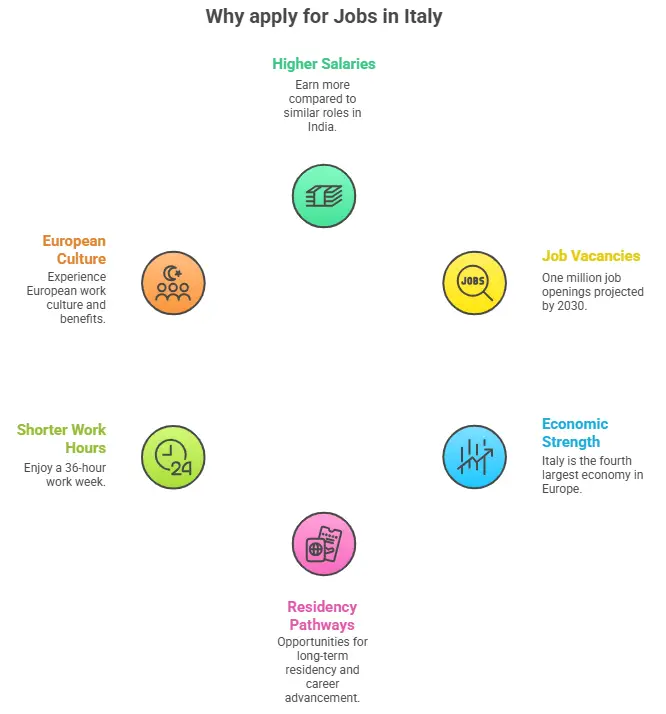
Why apply for Jobs in Italy?
- Higher salaries compared to India for similar roles
- One million job vacancies projected by 2030
- Fourth largest economy in Europe
- Pathways for long-term residency and career growth
- Work for 36 hours a week
- Access to European work culture and benefits
Migrate with an Italy work visa
An Italian work visa is simply an entry visa, and it is required to own a work permit before entering Italy. It comes under the long-stay visa category, also called D-visa or National visa. After obtaining an Italy work visa, you must apply for a residence permit within eight days of entering the country.
Types of Italy Work Visa
Italy offers different types of work visas depending on your job and nationality. EU citizens (including Iceland, Liechtenstein, and Norway) do not need a work permit but must register with local authorities if staying more than 90 days. Non-EU citizens, including those from the UK, must obtain a work visa before moving to Italy.
The main types of Italy work visas are:
- Salaried Employment Visa: For people hired by an Italian company. The employer must get permission first.
- Self-Employment Visa: For freelancers or people starting their own business in Italy.
- Highly Specialized Worker Visa: For professionals with advanced skills in fields like IT, engineering, or research.
- Digital Nomad / Remote Worker Visa: For people working for a foreign company while living in Italy.
- Seasonal Work Visa: For temporary jobs in agriculture, tourism, or hospitality.
*Willing to migrate to Italy? Y-Axis will help you with the step-by-step process.
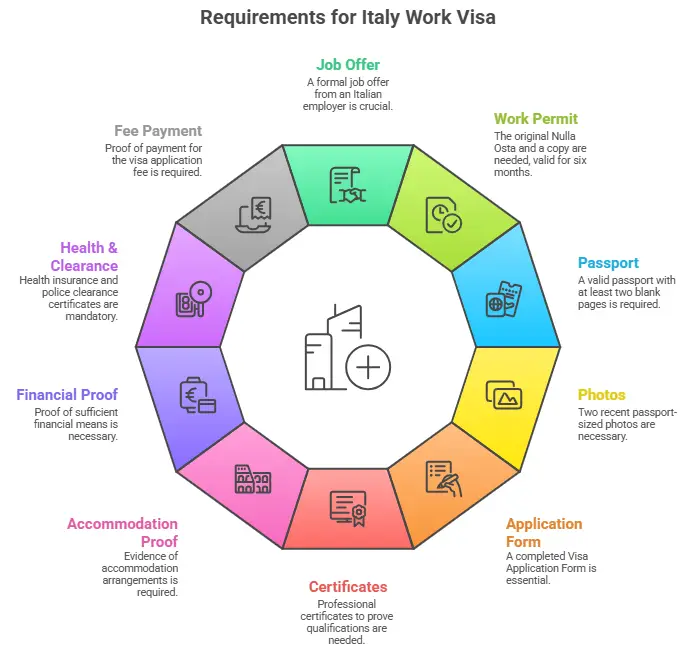
Requirements for Italy work visa
To obtain a work visa in Italy, the following requirements are needed:
- You must have a real job offer from an Italian employer
- You need the original work permit (Nulla Osta) and a copy for your visa. It is valid for six months, so apply within that time
- A valid passport with at least two blank pages
- Two recent passport-sized photos
- Filled Visa Application Form
- Professional certificates to show your qualifications.
- Proof of Accommodation
- Proof of Financial means
- Health Insurance and police clearance certificate
- Proof that you have paid the visa application fee
*Looking to work overseas? Contact Y-Axis, the world’s No. 1 overseas consultant for assisted guidance.
Top Careers in Italy
IT Jobs in Italy
The IT sector in Italy is growing rapidly, with high demand for roles like software developers, AI specialists, cybersecurity experts, and cloud engineers. Professionals with skills in Python, Java, and are in-demand. Salaries in top IT jobs can range from €35,000 to €95,000 per year, and senior roles or specialized tech positions can earn even more. Cities like Milan, Rome, and Turin offer the most opportunities for IT professionals.
Healthcare Jobs in Italy
Healthcare professionals such as doctors, surgeons, and nurses are in high demand, particularly in northern Italy where the population is older. Specialists like cardiologists, neurologists, and anesthesiologists earn competitive salaries, often ranging from €50,000 to €120,000 per year. Hospitals and private clinics actively seek skilled professionals, making it a secure career choice.
Engineering Jobs in Italy
Italy offers strong opportunities for engineers, especially in software, aerospace, mechanical, and petroleum engineering. Those with advanced degrees or international experience are highly valued. Salaries typically range from €30,000 to €70,000 per year, with senior or specialized engineers earning more. Engineering roles are concentrated in industrial hubs like Milan, Turin, and Bologna.
Financial Jobs in Italy
Finance professionals, including bank managers, financial analysts, and accountants, are among the top earners. Experienced financial managers can earn up to €156,000 per year, while mid-level roles average around €50,000–€70,000. Financial institutions in Milan and Rome offer the best salaries and career growth opportunities.
Sales & Marketing Jobs in Italy
Sales and marketing directors can earn around €80,000 per year on average. Roles in multinational companies or tech firms offer even higher pay. Skills in digital marketing, sales strategy, and client management are highly valued.
Teaching Jobs in Italy
University professors earn an average of €55,000 per year, with higher pay for senior or specialized positions. Academic careers in Italy provide opportunities for research, teaching, and international collaboration.
Also, Read...
Italy’s Travel & Tourism Sector to Create 500,000 Jobs
Italy Work Permit
An Italy work permit, also known as Nulla Osta, is required for non-EU citizens who want to work in Italy. It is a legal authorization issued by the Italian authorities allowing foreign professionals to take up employment in the country. To obtain a work permit, you must have a confirmed job offer from an Italian employer. The permit is usually valid for the duration of your employment and must be applied for before entering Italy. Once approved, you can apply for a long-stay work visa (D-type) and, after arrival, a residence permit to legally live and work in Italy.
Residence Permit to Long-Term Residence Permit
After living and working in Italy with a residence permit (Permesso di Soggiorno), non-EU citizens can apply for a long-term residence permit. If you continuously live and work in Italy for several years, which provides more stability, easier job changes, and access to social services. It is an important step for anyone planning a long-term career in Italy.
Requirements to Apply for a Long-Term Residence Permit
- You must have lived in Italy legally for at least 5 years.
- You need a valid residence permit during this period.
- Proof of steady income or employment is required.
- You must have health insurance covering your stay.
- Proof of suitable housing in Italy is needed.
- You should have a basic knowledge of the Italian language.
- No serious criminal record in Italy or your home country.
*Searching for jobs in Italy? Find the right one with the help of Y-Axis Resume Marketing Services.
How to Apply for an Italy Work Visa
Step 1: Find a suitable job from an Italian employer.
Step 2: Make sure you meet the requirements for the type of work visa you need.
Step 3: Complete the online application –
Step 4: Gather all required documents
Step 5: Pay the visa fee.
Step 6: Submit your application and documents at the nearest Italian embassy or consulate.
Step 7: Attend the interview (if required)
Step 8: Wait for processing
Step 9: Once approved, enter Italy with your visa and apply for a residence permit.
Step 10: Start working legally in Italy
How can Y-Axis assist you?
Y-Axis guides you in the path to get work in Italy. Our exemplary services are:
- Y-Axis has helped and benefited more than trusted clients to obtain work in Italy.
- The exclusive Y-axis jobs search portal will help you search for your desired Job in Italy.
- Y-Axis coaching will help improve language proficiency tests.
- Free counseling services to move on the right path.
Don't know what to do ?
Get Free Counseling
Looking for Inspiration
Explore what Global Indians have to say about Y-Axis in shaping their future
Frequently Asked Questions