

Don't know what to do ?
Get Free Counseling
Last Updated 04 August 2026
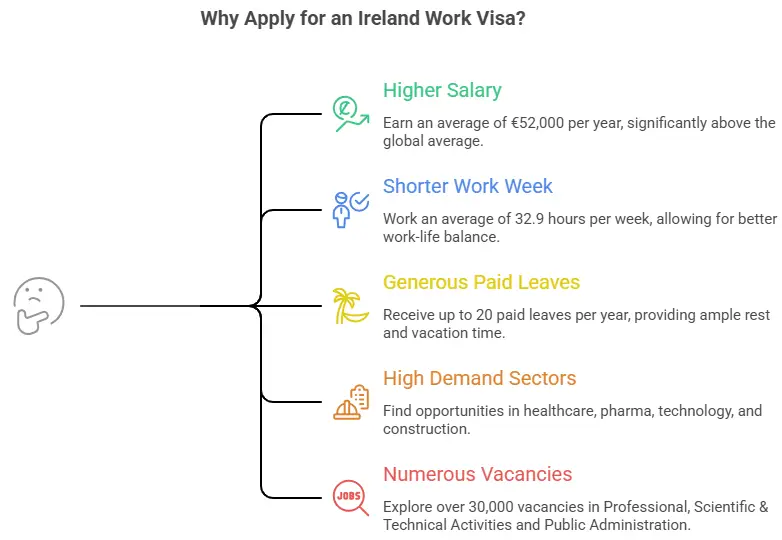
Why Apply for an Ireland Work Visa?
An Ireland work permit — issued by the Department of Enterprise, Trade and Employment (DETE) — allows non-EU/EEA nationals including Indians to legally work in Ireland. Unlike most countries, Ireland has a two-step process: DETE approves the employment permit, and INIS (Irish Naturalisation and Immigration Service) issues the accompanying long-stay visa. The Critical Skills Employment Permit (CSEP) and General Employment Permit (GEP) are the two main routes for Indian professionals.
- Earn an average annual salary of €52,600 per year
- The average actual working hours are approximately 32–34 hours per week for full-time employees (CSO Ireland Labour Force Survey, 2025–2026). The Organisation of Working Time Act 1997 sets a maximum average of 48 hours/week, calculated over a 4-month reference period; most employment contracts specify a standard 39–40 hour week.
- Get up to 20 paid leaves per year
- Skilled foreign workers are needed in top sectors like healthcare, pharma, technology, and construction
- Over 30,200 job vacancies in Ireland with high demand in Professional, Scientific & Technical Activities and Public Administration
Work in Ireland
Ireland is a popular destination for persons looking for work outside of their home country. Working and residing in Ireland also entitles you to free European Union membership. Another advantage is that after five years in Ireland, you can apply for citizenship.
How Can I Migrate to Ireland as a Software Engineer?
Benefits of Working in Ireland for Indians
Ireland is one of the in-demand countries for skilled foreign professionals looking to work abroad.
Given below are some reasons why you should consider working in Ireland:
- English-speaking country: English is widely spoken throughout Ireland, making it easy for foreign workers to live and work there without language barriers.
- Large Indian community: Ireland has a large Indian community in top cities such as Cork, Galway, and Dublin, with plenty of opportunities in the pharma, healthcare, and tech sectors.
- Strong Tech base: Ireland hosts the European headquarters of Microsoft, Apple, Amazon, Google, and Meta, and is home to some of the world's best software companies.
- High demand for the life sciences and pharmaceutical sectors: Ireland is the third-largest pharmaceutical exporter in the world, with companies such as AstraZeneca, Pfizer, and Johnson & Johnson operating there. These growing sectors create more job opportunities for life science professionals worldwide.
- Direct CSEP eligibility for Indian graduates: Graduates from IIT, IISc, IIM, and other NIRF-ranked institutions or UGC-recognised universities with Level 8+ qualifications can directly qualify for the Critical Skills Employment Permit (CSEP) without additional assessments. This includes engineers, IT professionals, nurses, pharmacists, and finance professionals from state universities across India — not only IIT or IIM alumni.
- Work anywhere in Europe: Once you receive Stamp 4, you can work in Ireland without an employment permit — this permission is valid only in Ireland and does not extend to other EU member states (Ireland has opted out of the EU Long-Term Residents Directive). Irish citizenship, available after at least 5 years of reckonable residence within the previous 9 years (including 1 continuous year immediately before applying), grants full EU citizenship rights, including the right to live and work anywhere in the EU.
- Family reunification: You can bring your dependent family members, including spouses and children, through family reunification benefits. Qualifying spouses, upon entering Ireland, can apply for a Dependant/Partner/Spouse Employment Permit without paying an additional fee and without restrictions on their ability to work.
- Pathway to PR: The primary visa holder, along with the spouses and dependents, is eligible for long-term residency after completing at least 60 months in Ireland, offering a pathway to settle in Ireland permanently.
India vs Ireland: Salary Comparison for Indian Professionals (2026)
Foreign workers can earn 5–10x their current Indian salary in Ireland — see the Minimum Salary Thresholds table below for the full breakdown by permit type.
Work Visa for Ireland
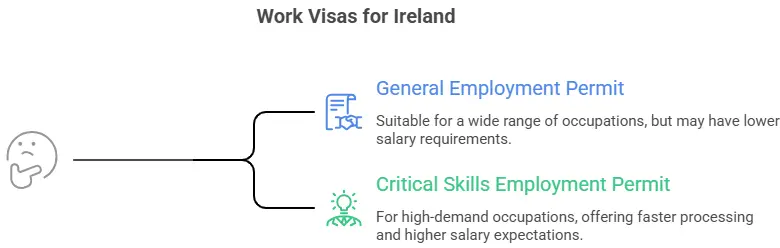
If you want to work in Ireland, you must be aware of the visa requirements. If you are from a non-EU nation, you’ll need a work permit before you can work in Ireland. Work permits are divided into two categories:
- Ireland General Employment Permit
- Ireland Critical Skills Employment Permit
How to apply for an Ireland work visa?
Ireland Critical Skills Employment Work Permit Visa
Critical Skills Employment Permit is issued for an initial period of two years. After 2 years, CSEP holders can apply for Stamp 4, allowing them to work without a permit An initiative by department of jobs, it provides excellent opportunity for qualified professionals. Ireland Green Card is your pathway to settle in the European Union. It allows you to bring your family in as dependents.
How to apply for Ireland work permit?
Ireland General Employment Permit
This permit allows you to work in Ireland for a minimum of EUR 36,605 per year. Before applying for the visa, you must have a job offer. This visa is available to you or your company. At the very least, your job should endure two years. To apply for this visa, you must have a degree that is relevant to the employment for which you were chosen.
This visa is good for two years and can be extended for another three years. After completing 5 years on a GEP, holders can apply for Long-term Residency (Stamp 4).
CSEP vs GEP: Which Ireland Work Permit Is Right for You?
| Feature | Critical Skills Employment Permit (CSEP) | General Employment Permit (GEP) |
|---|---|---|
| Minimum Salary (from March 2026) | €40,904/yr (with degree); €68,911/yr (without degree) | €36,605/yr |
| Occupation Restrictions | Must be on DETE Critical Skills Occupations List | Must NOT be on Ineligible Occupations List |
| Initial Permit Duration | 2 years | 2 years |
| Stamp 4 (no permit needed) | After 21 months | After 5 years (60 months) |
| Pathway to Irish PR | Fast-track: 21 months to Stamp 4 | Standard: 5 years |
| Family Sponsorship | Spouse/partner gets free Dependant Permit with unrestricted work rights | Spouse/partner permit available; fees may apply |
| Application Fee | €1,000 — 50% refunded if refused by DETE | €1,000 (24 months); €500 (≤6 months) |
| Employer Sponsorship Required | Yes — verified Irish employer | Yes — verified Irish employer |
| Degree Requirement | Level 8+ degree OR minimum salary of €68,911 | Relevant degree or qualification generally required |
| EU Citizenship Pathway | 5 years legal residence → Irish naturalisation → full EU citizenship | 5 years legal residence → Irish naturalisation → full EU citizenship |
Ireland Work Permit Visa Eligibility
- Offer Letter from employer
- Occupations with a minimum annual remuneration of €36,605
- A relevant degree qualification or higher is required.
- Job offer to be valid for 2 years
Are Indians eligible to work in Ireland?
Ireland Work Permit Requirements
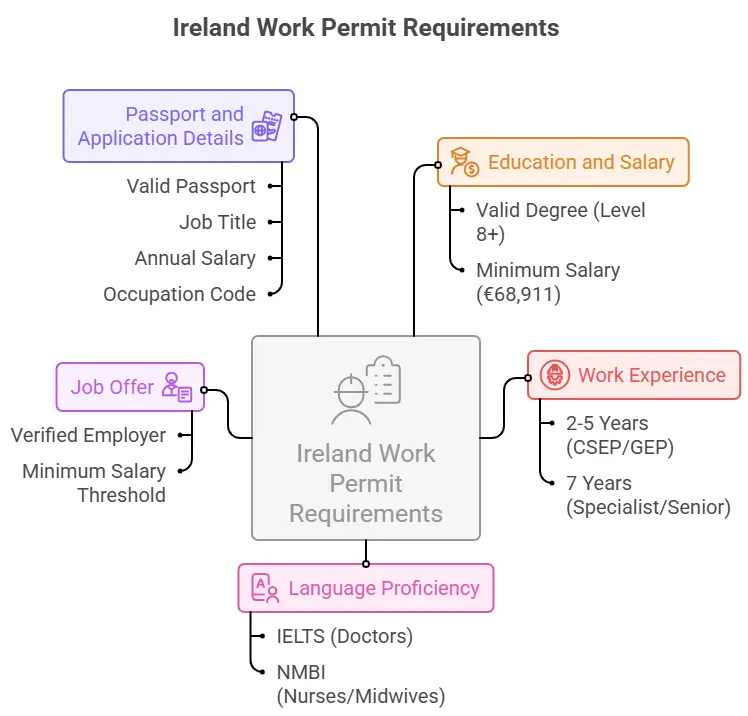
Given below are the requirements to apply for an Irish work visa:
- Have a valid degree of Level 8 or above, or meet the minimum salary threshold of €68,911 in the absence of a valid degree (for CSEP)
- Have at least 2-5 years of qualified work experience (CSEP or GEP), while specialist or senior roles require at least 7 years of work experience.
- Meet the minimum English language requirements (IELTS for IMC registration for doctors and NMBI registration for nurses and midwives)
- Valid job offer from a verified Irish employer
- The employment offer must fulfil the minimum salary threshold set for your permit type.
- Valid original passport
- Valid job title, annual salary details, and occupation code mentioned in your permit application
What Documents Are Required for an Ireland Work Permit?
- A certified copy of your passport.
- Passport-size photo that meets Ireland’s photo criteria.
- A copy of the employment contract signed by you and your employer.
- If you are a resident of Ireland at the time of application, a copy of your registered immigration stamp.
- A copy of the IDA/Enterprise Ireland Letter of Support, if appropriate.
- Information about your job, including the company’s registration number, address, and name, as well as certificates from recognized organizations.
- Job specifics such as compensation, job responsibilities, tasks, and length of employment.
Ireland Work Permit Fees
The Irish work permit costs between €500 and €1,000 and may vary depending on the type of permit and the duration of employment.
| Permit Type | New Application | Renewal |
|---|---|---|
| CSEP | €1,000 (up to 24 months) | 50% refundable if DETE refuses the application (transitions to Stamp 4) |
| GEP | €1,000 (up to 24 months); €500 (≤6 months) | €1,500 (up to 36 months) |
| ICT Permit | €1,000 (up to 24 months) | €1,000–€1,500 |
| Dependant/Spouse Permit | No fee | No fee |
| IRP Registration | €300 per person | €300 per renewal |
Ireland Work Permit Processing Time
The processing time for an Irish work permit is typically 4-12 weeks. However, the time taken to process the Irish work visa application may vary depending on the type of permit you are applying for and whether it is a new application or a visa renewal.
| Application Type | Processing Time (Approximate) |
|---|---|
| Critical Skills Employment Permit (CSEP) – New | 2 – 3 weeks |
| General Employment Permit (GEP) – New | 7 – 8 weeks |
| Intra-Company Transfer (ICT) – New | 4 – 5 weeks |
| Intra-Company Transfer (ICT) – Renewal | 12 + weeks |
| All Other Renewal Applications | 12 + weeks |
Application process for an Ireland Work Visa for Indians
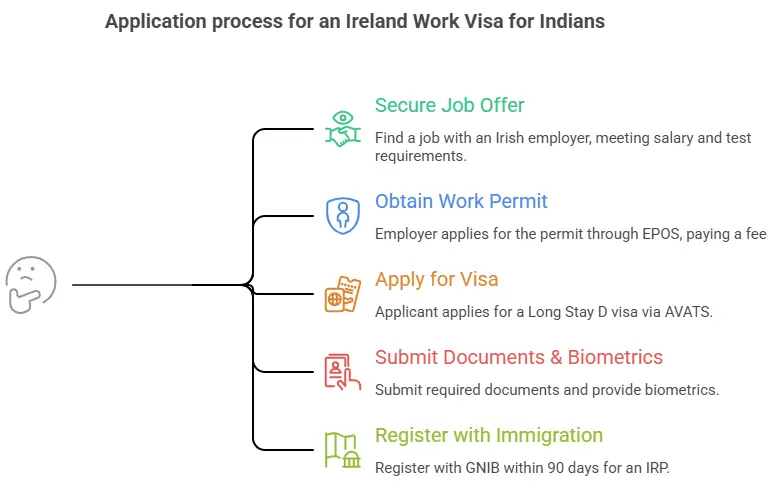
An application for an Irish work visa can be submitted by you (the overseas employee) or your firm.
Your home country employer can also file the application on your behalf if you transfer from a foreign company to its Irish branch (intra-company transfer).
You (or your employer) must submit your application for an Ireland work permit through EPOS, the Employment Permits Online System.
Read more...
How to apply for an Ireland work visa?
Top In-Demand Occupations in Ireland (Critical Skills List)
Ireland is one of the emerging work abroad destinations in the world. The country has an increasing demand for skilled foreign professionals in high-demand industries. Ireland is known as one of the high-paying countries in Europe, with notable opportunities in sectors such as IT, engineering, and healthcare.
| Occupation | Average Annual Salary (EUR) |
|---|---|
| Software Engineers & Developers | €45,000 – €90,000 |
| Cyber Security Analysts | €50,000 – €85,000 |
| Data Scientists / AI Engineers | €55,000 – €95,000 |
| Medical Practitioners (GPs, Consultants) | €80,000 – €220,000+ |
| Nurses & Midwives | €33,000 – €55,000 |
| Civil & Structural Engineers | €45,000 – €80,000 |
| Quantity Surveyors | €40,000 – €75,000 |
| Skilled Trades | €35,000 – €60,000 |
| Accountants & Finance Managers | €40,000 – €80,000 |
| Pharmacists / Pharmaceutical Scientists | €40,000 – €65,000 |
Highest paying Jobs in Ireland for Indians
Key Industries Hiring in Ireland
The Irish job market is currently hiring across top industries such as healthcare, pharma, technology, and construction. There are approximately 30,200 job vacancies in Ireland with a high demand for skilled foreign workers.
The top industries in Ireland that are recruiting an overseas workforce are as follows:
- Information Technology
- Pharma & Life Sciences
- MedTech
- Healthcare & Nursing
- Financial Services & FinTech
- Construction & Engineering
- Green Economy & Renewable Energy
- Business & Professional Services
Ireland Job Market: Trends & Job Opportunities
Average Salary in Ireland for In-Demand Jobs
Salaries in Ireland vary based on work experience, occupation, industry, and job type. Skilled workers with a valid employment permit can earn competitive salaries in high-demand sectors like technology, pharma, financial services, and healthcare.
The table below has a detailed overview of the average annual salary offered to entry-level, mid-level, and senior-level professionals in Ireland:
| Experience Level | Average Salary (EUR per year) | Approx. Salary (INR per year) |
|---|---|---|
| Entry Level | €34,000 – €42,000 | ₹31–38 LPA |
| Mid-Level | €50,000 – €75,000 | ₹46–68 LPA |
| Senior Level | €90,000 – €130,000+ | ₹82–118 LPA+ |
Want to work in Ireland? Avail Y-Axis Resume Marketing Services to find the right job that matches your profile.
Minimum Salary Thresholds for Ireland Employment Permits (Updated March 2026)
You are required to meet the minimum salary threshold to apply for an Irish employment permit. Starting March 2026, the DETE has announced a 7.66% increase in the minimum salary threshold for various Irish employment permits.
| Permit Type | Current Salary (Until 28 Feb 2026) | New Salary (From 1 Mar 2026) |
|---|---|---|
| Critical Skills Employment Permit (CSEP) – With Relevant Degree | €38,000/yr | €40,904/yr |
| Critical Skills Employment Permit (CSEP) – Without Degree (Experience Route) | €64,000/yr | €68,911/yr |
| General Employment Permit (GEP) – Standard Route | €34,000/yr | €36,605/yr |
| General Employment Permit (GEP) – Graduate Route (Irish third-level, Level 8+, within last 12 months) | — | €34,009/yr |
| Critical Skills Employment Permit (CSEP) – Graduate Route (recognised institution, Level 8+ relevant degree, within last 12 months) | — | €36,848/yr |
| Intra-Company Transfer (ICT) Permit | €46,000/yr | €49,523/yr |
| Sector-Specific Roles (Healthcare Assistants, Home Carers & Agri-Food) | €30,000/yr | €32,691/yr |
Note: The following salary thresholds apply from 1 March 2026 and will increase annually through 2030 under DETE's Minimum Applicable Rates (MAR) Roadmap. These thresholds will continue to increase each year — verify current figures at enterprise.gov.ie before submitting your application.
Is Ireland open for work permits?
Jobs in Ireland (2025–2035)
Ireland is expected to witness strong job growth across key sectors over the next 5–10 years. Digital transformation, a shift towards a green economy, an ageing population, and rising demand in healthcare and construction all point to a growing need for skilled foreign workers to contribute to the Irish workforce.
Here are some of the main Ireland jobs and workforce projections for the next 5–10 years:
- The ICT sector in Ireland is set to create 89,590 new jobs over the next 5 years, with high demand for cybersecurity, cloud computing, machine learning, and AI specialists. Reports suggest that foreign workers occupy more than 40% of the ICT workforce.
- The health and social care system in Ireland currently has 166,000+ staff, with an increasing demand for general practitioners. The increase in demand is set to grow by 25 to 30% between 2033 and 40.
- The wind and renewable energy sector in Ireland has more than 5,000 job vacancies, which will grow by 3,000 over the next 4 years. Ireland aims to generate at least 80% of its overall electricity from renewable sources by 2030, under the national Climate Action Plan.
Read more...
What are the most in-demand jobs in Ireland for the next 10 years?
Pathway to Permanent Residency in Ireland
According to the updated policies, skilled foreign workers living in Ireland may be eligible for Long-term Residency (Stamp 4) after completing 60 months (5 years) of legal residency with a verified employment permit. CSEP holders can fast-track their R pathway by applying for Stamp 4 and qualifying for permanent residence after 21 months.
With a Stamp 4, visa holders can reside and work in Ireland without requiring an additional employment permit. Individuals who have resided in Ireland for 5 years can apply for Irish citizenship or naturalization, which confers full EU citizenship benefits and the flexibility to live and work anywhere in the EU.
Employment Permits Act 2024: Key Changes for Indian Workers in Ireland
The Employment Permits Act 2024, which came into effect on 2 September 2024, introduced landmark protections and new rights for non-EU workers in Ireland, including Indian professionals on CSEP and GEP permits. Here are the five key changes that directly affect Indian workers:
- Right to Change Employers After 9 Months: This is the most significant change for Indian workers already in Ireland. After completing 9 months of employment with your current employer, you now have the legal right to move to a new Irish employer without losing your permit status. You must notify DETE of the change. This is commonly referred to as the '9-month rule.'
- Promotions and Internal Transfers Without a New Permit: If you receive a promotion or are transferred internally within the same company, you are no longer required to apply for a new employment permit — provided the role remains within the same occupation category. This removes a significant administrative barrier for Indian professionals moving into senior roles.
- Job Advertisements Must Be Posted on Two Online Platforms Including EURES: Employers must now advertise roles on at least two online platforms, including EURES (the European job mobility portal), before hiring a non-EU national. National newspaper advertising is no longer required. This change makes Ireland's labour market test faster and more straightforward for Indian employers and candidates.
- 50:50 EEA Staffing Rule Relaxed for New Companies: The requirement that at least 50% of a company's workforce must be EEA nationals has been relaxed for companies in their first 2 years of operation. This opens more permit opportunities for Indian professionals joining early-stage Irish companies and startups.
- New Seasonal Worker Scheme Introduced: A formal seasonal worker permit has been introduced for sectors with cyclical labour demand. This is primarily relevant for agri-food, horticulture, and hospitality — less commonly used by Indian professionals but expanding the overall permit landscape.
Source: DETE enterprise.gov.ie; citizensinformation.ie; Lewis Silkin Employment Law Update, January 2026.
Are you an Indian worker in Ireland looking to change employers under the 9-month rule? Y-Axis Ireland immigration experts can guide your employer transfer process.
How Y-Axis can help?
As the world's No. 1 immigration consultancy, Y-Axis provides comprehensive support throughout your immigration journey. We can help you with document checklist, application process, assist in filling the application with the embassy and follow-ups.
Our services include:
- Resume Writing Services for a strong professional profile.
- Expert assistance with Ireland visas
- Document review & visa application support
- Complete application processing
- Resume Marketing Services to help you find suitable jobs in Ireland.
Treat your visa petition as an investment for the future – yours and your children. Apply for it now, watch it mature later. Avail of the benefits all your life.
Other Work Visas:
Y-Axis snapshot
1M
Successful applicants
1500+
Experienced counselors
20Y+
Expertise
50+
Offices
Don't know what to do ?
Get Free Counseling
Looking for Inspiration
Explore what Global Indians have to say about Y-Axis in shaping their future