


Don't know what to do ?
Get Free Counseling
Last Updated 21 July 2026
Highest Paying Job Opportunities in Europe
Europe has many high-paying jobs for skilled Indians in IT, engineering, finance, and healthcare. Job vacancies in Europe reached around 2.5%, showing high demand for professionals. Countries like Germany, Netherlands, Italy and Sweden have millions of openings, especially in tech and engineering. Professionals in Europe earn between €50,000 and €90,000 a year on average, depending on their skills and country, which is much higher than salaries offered for similar roles in India. Many Indian professionals are moving to Europe for better pay, career growth, and international experience. With skill shortages and high demand, Europe offers excellent opportunities for Indians to build successful global careers.
Some of the highest paying job in Europe are listed below:
| Occupation | Average Annual Salary |
|---|---|
| IT and Software | €110,000 |
| Engineering | €95,000 |
| Accounting and Finance | €100,000 |
| Human Resource Management | €70,000 |
| Hospitality | €68,000 |
| Sales and Marketing | €66,028 |
| Healthcare | €120,000 |
| STEM | €30,000–€100,000+/year (Graduate entry: €30,000–€55,000; mid to senior roles: €60,000–€100,000+, depending on location and specialization.) |
| Teaching | €85,000 |
| Nursing | €35,000–€100,000/year (EU average: €35,000–€65,000, with higher salaries available for specialized and senior nursing roles.) |
Source: Talent site
Note: Salary figures are indicative ranges across Europe. Actual earnings vary significantly by country, experience level, and specialisation. Western and Northern European countries — Switzerland, Luxembourg, Germany, Netherlands — offer the highest ranges. Source: Eurostat, OECD Taxing Wages 2026, Google/IE University data.
Why Indian IT Professionals Are Choosing Europe in 2026
The US H-1B landscape changed dramatically in September 2025 when a $100,000 supplemental fee was introduced for new petitions filed from outside the United States. Although a US court challenged the fee in June 2026, the situation remains unstable — and the broader shift in Indian IT professional interest toward European alternatives is already well underway.
Indians accounted for 71% of all H-1B visas issued in FY2024 — making any instability in the H-1B system disproportionately felt by Indian IT professionals. Europe offers structured, employer-independent alternatives that many Indian professionals are now actively researching for the first time.
| Why Europe Over the US Right Now | Detail |
|---|---|
| No Lottery System | EU Blue Card and national work permits are not lottery-based. Qualified candidates with valid job offers are assessed and approved on merit. |
| No Employer Lock-In After 12 Months | EU Blue Card holders can relocate to a second EU country after 12 months without facing long green card backlogs. |
| Faster Permanent Residency | EU Blue Card holders may qualify for permanent residency in as little as 21–33 months, compared to the decades-long EB green card backlog for many Indian applicants in the US. |
| No Supplemental Fees | Government fees for most EU work permits typically range from €50–€150, unlike costs that can exceed $100,000 in some US immigration pathways. |
| Strong IT Demand | Germany alone reported 109,000 unfilled IT positions as of August 2025. |
Note: The $100,000 H-1B fee situation is subject to ongoing litigation and policy changes. Indian IT professionals should consult Y-Axis for the latest US vs. Europe comparison before making any career decisions.
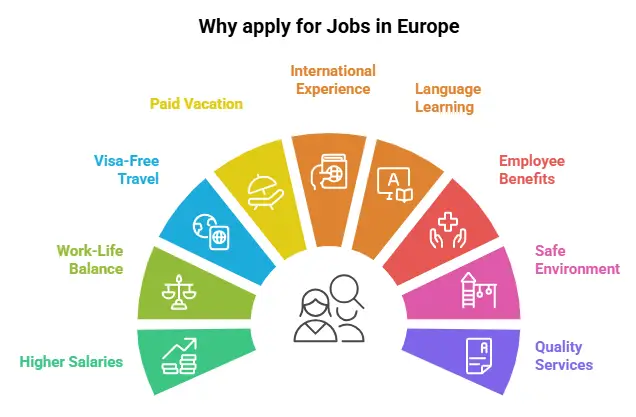
Why apply for Jobs in Europe?
- Higher salaries when compared to India
- Better work-life balance
- Travel within the continent without a visa
- Enjoy paid vacation once every year
- Opportunity to learn foreign languages
- Strong employee benefits and social security in many countries
- Safe and secure living environment
- Access to quality healthcare and education in most European nations
Job Openings in Europe
Europe has great job opportunities for people from outside the EU. Some countries offer good pay, plenty of jobs, and a healthy work-life balance. The table below shows the best countries to work, the number of job vacancies in Europe:
| Country | Approximate Job Vacancies | Benefits of Working |
|---|---|---|
| Germany | 1,000,000+ | Largest EU economy, high demand for skilled workers, and a strong industrial base. |
| United Kingdom | 750,000+ | Diverse job opportunities, a strong economy, and an English-speaking environment. |
| France | 500,000+ | Strong economy, excellent work-life balance, and a vibrant culture. |
| Netherlands | 210,000+ | High English proficiency, a thriving tech sector, and excellent infrastructure. |
| Austria | 29,000+ | High quality of life, good work-life balance, and strong social welfare benefits. |
| Italy | 700,000+ (2025 annual new hires – ISTAT) | Rich cultural heritage with growing opportunities in manufacturing and IT. |
| Luxembourg | 6,867 | High salaries, a strong financial sector, and a multilingual work environment. |
| Finland | 28,900 | Excellent quality of life, world-class education, and a healthy work-life balance. |
| Portugal | 57,357 | Expanding technology and tourism industries with a comparatively lower cost of living. |
| Spain | 23,984+ | Growing economy with an affordable cost of living. |
| Malta | 9,158 | Strong demand for professionals in healthcare, IT, and professional services, with an English-speaking environment. |
Note: The United Kingdom is not part of the European Union — it left the EU in January 2021 (Brexit). UK work visa rules are entirely separate from EU work permits. Indian professionals targeting the UK must apply under the UK Skilled Worker Visa system.
Note: Job vacancy figures are approximate annual estimates based on Eurostat and national statistical institute data (ISTAT for Italy, Destatis for Germany). Figures vary by quarter and methodology. Source: Eurostat Job Vacancy Statistics Q1 2026; ISTAT Employment and Unemployment Report April 2026.
How to find Jobs in Europe from India?
Follow these steps to find a Job in Europe:
Step 1: Choose a country and job sector where your skills are in demand.
Step 2: Prepare a European-style CV and cover letter highlighting your experience.
Step 3: Search for job openings on trusted job portals, company websites, and visa-sponsoring employers.
Step 4: Apply for jobs online and keep track of your applications.
Step 5: Prepare and attend interviews with companies, online or in-person.
Step 6: Receive a job offer that meets visa or work permit requirements.
Step 7: Apply for the correct work visa or permit with all necessary documents.
Step 8: Move to the country, register locally if needed, and start working legally.
Coming in 2027 — EU Talent Pool
The EU Talent Pool is a new Commission-managed digital platform that will directly connect non-EU professionals with EU employers in shortage sectors. The regulation was formally adopted in March 2026 and the platform is expected to launch in 2027.
Key details Indian professionals should know now:
| Feature | Detail |
|---|---|
| What It Is | A free digital job-matching platform that connects non-EU jobseekers with employers across the European Union. |
| Who Can Register | Non-EU nationals, including Indian professionals. |
| Cost | Free for both employers and jobseekers. |
| Focus Sectors | Shortage occupations across all 27 EU member states. |
| India Connection | A pilot Legal Gateway Office has been launched specifically for India to support the mobility of specialized professionals. |
| Expected Launch | 2027. |
| Important Caveat | Registration does not guarantee a work permit. Applicants must still complete the applicable national immigration procedures. |
Note: Indian IT professionals planning a European career move should monitor the European Commission's official announcements for the EU Talent Pool launch date. Contact Y-Axis for guidance on which EU shortage occupations match your profile ahead of the 2027 launch.
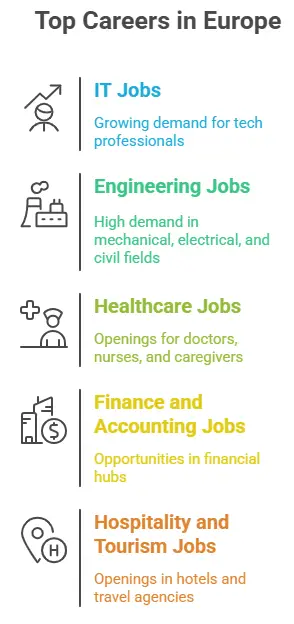
Top Careers in Europe
IT Jobs in Europe
Europe’s tech industry is growing fast, creating strong demand for IT professionals. Over 30% of companies in the EU plan to hire more tech workers this year. Skilled professionals in software development, cybersecurity, cloud computing, and AI have excellent opportunities.
According to Robert Half, top roles include .NET developers, IT project managers, and IT operations managers. Job growth in Europe’s IT sector is five times higher than in other industries, and salaries continue to rise steadily.
Engineering Jobs in Europe
Engineering professionals are highly sought after across Europe, especially in mechanical, electrical, civil, and chemical fields. Germany leads the continent with huge demand for engineers, thanks to its strong industrial and manufacturing base. Other countries like France, Spain, and the Netherlands also provide attractive job opportunities and competitive pay for skilled engineers.
Healthcare Jobs in Europe
Europe’s healthcare sector offers thousands of openings for doctors, nurses, physiotherapists, and medical technicians. An ageing population and increasing healthcare needs have boosted demand for caregivers, home health aides, and specialists in elderly and rehabilitation care.
Countries such as Germany, Ireland, and the Netherlands are actively hiring international healthcare professionals to fill skill gaps.
Finance and Accounting Jobs in Europe
Europe has a strong financial sector that offers rewarding opportunities for accountants, auditors, analysts, and banking professionals. Cities like London, Frankfurt, Zurich, and Luxembourg are major financial hubs offering high salaries and international exposure.
With growing demand for professionals skilled in financial planning, risk management, and compliance, Indian finance experts have excellent career prospects in Europe.
Hospitality and Tourism Jobs in Europe
Europe’s tourism and hospitality industry continues to thrive, with openings in hotels, restaurants, travel agencies, and event management. Countries like Spain, Italy, France, and Portugal have a constant need for chefs, hotel managers, front-office staff, and tour guides.
This sector offers flexible working options, good earnings, and a chance to work in some of the world’s most popular tourist destinations.
Migrate with a European work visa
A Europe Work Visa allows foreign professionals to live and work legally in European countries for a specific period. It is issued to individuals who have a job offer from an employer in a European nation. With this visa, you can enter the country, work for your employer, and enjoy employment benefits similar to local workers.
Each country in Europe has its own work visa rules and types, such as the EU Blue Card, Skilled Worker Visa, or Temporary Work Permit. These visas are mainly for skilled professionals in fields like IT, engineering, healthcare, finance, and education.
It’s best to apply at least 2 months before your joining date, as embassies usually take 6 to 12 weeks to process the visa. A Europe work visa is generally valid for one year, and you can extend or renew it as long as you have a valid job offer and meet the country’s requirements.
Europe Work Permit
The visa requirements in Europe are different for EU and non-EU citizens. If you belong to a country that is part of the EU, then there are no restrictions, and you can work in any EU country without a work visa. However, if you are not a citizen of any EU country, you should get a work visa to search for a job and work in any European country.
Types of Work Permits in Europe
In Europe, non-EU citizens need a work permit to live and work legally. The type of visa depends on the country you are working, kind of job, the duration of work, and the applicant’s skills. Here are the main types of work permits in Europe:
- Temporary Work Permit: For short-term or contract-based jobs, usually valid for a few months to a year.
- Permanent Work Permit: For foreign workers who have lived and worked in an EU country for several years and want to settle permanently.
- Seasonal Work Permit: For people working in seasonal jobs like farming, hospitality, or tourism.
- Intra-Company Transfer Permit: For employees of international companies who are transferred to an office in another EU country.
- Freelancer or Self-Employment Permit: For people who work for themselves or run their own business in Europe.
- Research or Academic Work Permit: For researchers, scientists, or teachers working in educational or research institutions.
EU Blue Card
The EU Blue Card is a visa that allows skilled professionals from non-EU countries to live and work in Europe. It gives benefits like easy travel within the EU, bringing family members, and a chance to get permanent residency. To apply, you need a university degree, job offers, and a salary that meets the country’s rules.
The card is available in 25 EU countries, but Denmark and Ireland do not take part in the EU Blue Card program. It is valid for up to four years, depending on your job contract. After 12 months of legal residence in your first EU country, EU Blue Card holders can move to a second EU member state under simplified intra-EU mobility rules — no labour market test required in the new country. (Reduced from 18 months under EU Directive 2021/1883, effective November 2023.)"
Requirements for Europe work visa
The visa requirements in Europe are different for EU and non-EU citizens. If you belong to a country that is part of the EU, then there are no restrictions, and you can work in any EU country without a work visa. However, if you are not a citizen of any EU country, you should get a work visa to search for a job and work in any European country.
To obtain a work visa in Europe, the following requirements are needed:
- Valid passport
- Completed Application form
- Two passport-sized photographs
- Travel health insurance
- Proof of accommodation
- A job offer letter from an employer in the EU
- Proof of academic qualifications
- Proof of proficiency in the local language
- Health and conduct certificates
- Applying through online job portals
Work Visa and Residence Permit
Research indicates that the sectors with the most job opportunities are IT, healthcare and construction. There is a demand for technical professionals as well. People with a STEM background and qualified doctors and nurses have better chances of finding a job here. The jobs in Europe for Indians can be found in these sectors.
Getting a job in Europe as an Indian professional requires a targeted approach. Focus on sectors where EU countries face documented shortages — IT, engineering, healthcare, finance, and construction consistently appear on ADEM, EURES, and national shortage occupation lists. Roles on these lists benefit from simplified and faster work permit procedures, giving Indian applicants a structural advantage over candidates in non-shortage fields. Research the specific country's permit requirements before applying — Germany, Netherlands, Luxembourg, and Ireland each have distinct processes, salary thresholds, and timelines.
Steps to Apply for a Work Visa in Europe
Step 1: Choose Your Country you want to work in
Step 2: Ensure you meet the country’s requirements
Step 3: Apply for jobs through online portals, company websites, or recruitment agencies, and
Step 4: Secure a confirmed job offer from an employer.
Step 5: Gather your passport and other required documents.
Step 6: Apply at the embassy, consulate, or online portal of the country where you will work
Step 7: Attend an Interview if required
Step 8: Wait for Visa Approval
Step 9: Once approved, travel to the country, register with local authorities if needed, and start your job legally.
How can Y-Axis assist you?
Y-Axis is the best route to get to work in Europe. Our services include
- Expert Guidance & Counseling
- Resume Marketing services to find a job in Europe.
- Resume writing, marketing, LinkedIn marketing, and resume zapping to make your profile stand out to top European companies and increase your chances of getting the right job.
- Guidance on preparing applications
- Coaching Services: IELTS/TOEFL and German coaching to meet language requirements for European jobs.
- End-to-End Career Support
- For free Career Counseling book your session today
In-Demand Jobs for Indians Abroad
Y-Axis snapshot
1M
Successful applicants
1500+
Experienced counselors
25Y+
Expertise
50+
Offices
Don't know what to do ?
Get Free Counseling
Looking for Inspiration
Explore what Global Indians have to say about Y-Axis in shaping their future