


Don't know what to do ?
Get Free Counseling
Last Updated 31 July 2026
Top in demand occupations in Estonia
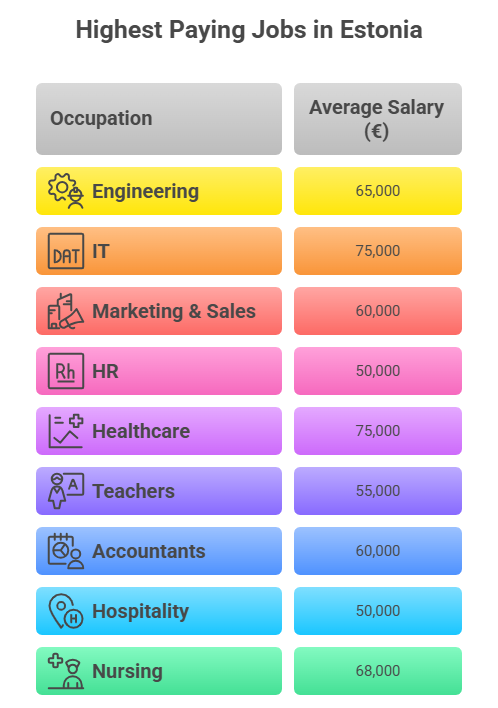
Estonia has a rapidly expanding job market with more than 1,00,000 job openings expected between 2026 and 2030. The country is experiencing strong demand for skilled professionals, especially in technology, engineering, management, and other high-skill sectors. The average salary in Estonia continues to rise, with high-demand roles offering €45,000 to €75,000 per year, depending on the industry and experience level.
For Indian professionals with strong technical expertise or leadership experience, Estonia offers excellent career opportunities, competitive salaries, and a high standard of living, making it an increasingly popular destination for global talent.
| Occupations | Average Salaries per annum | INR/Year (at ₹109/EUR) |
|---|---|---|
| Engineering | € 65,000 | ₹70.85 lakh |
| IT | €40,000–€43,000 | ₹43.60–₹46.87 lakh |
| Marketing & Sales | € 60,000 | ₹65.40 lakh |
| HR | € 50,000 | ₹54.50 lakh |
| Healthcare | € 75,000 | ₹81.75 lakh |
| Teachers | € 55,000 | ₹59.95 lakh |
| Accountants | € 60,000 | ₹65.40 lakh |
| Hospitality | € 50,000 | ₹54.50 lakh |
| Nursing | €20,000–€26,000 | ₹19.62–₹30.52 lakh |
Note: INR values calculated at 1 EUR ≈ ₹109 (July 2026). Exchange rates fluctuate — verify the current rate before financial planning.
Source: Statistics Estonia (stat.ee), Q1 2026 wage data by economic sector
Job Vacancy in Estonia
Estonia’s job market is growing fast, supported by its strong tech industry, digital economy, and need for skilled workers. The country is facing a talent shortage in IT, engineering, healthcare, and education. By 2030, Estonia is expected to see thousands of new job openings as businesses expand and foreign investment increases. With over 13,000 job vacancies already reported, Estonia offers strong opportunities for global professionals.
The table below shows the estimated number of job vacancies in Estonia by 2030 across major sectors:
| Occupation / Sector | Estimated Job Opportunities by 2030 |
|---|---|
| Information Technology (IT) & Software | 10,000 – 12,000 |
| Engineering & Manufacturing | 8,000 – 9,000 |
| Healthcare & Nursing | 7,000 – 8,000 |
| Education & Research | 4,000 – 5,000 |
| Finance & Business Services | 3,000 – 4,000 |
| Construction & Infrastructure | 2,500 – 3,000 |
| Tourism & Hospitality | 2,000 – 2,500 |
Note: Job opening projections are indicative estimates based on current sector growth trends and industry hiring patterns. Sector-specific figures to 2030 are not officially published by Töötukassa (Estonian Unemployment Insurance Fund) or Statistics Estonia. For official labour market forecasting, see OSKA (oska.kutsekoda.ee), Estonia's national skills forecasting body. One verified projection: Estonia's ICT sector is expected to employ approximately 50,000 people by 2030 — around 10% of total national employment, up from 31,561 in 2020.
Also, read...
What are the most in-demand jobs in Estonia for the next 10 years?
Step-by-Step Guide to Job Search in Estonia
Step 1: Look for job openings in Estonia on trusted websites.
Step 2: Check for companies that hire international candidates or offer visa sponsorship for skilled professionals.
Step 3: Make a short and clear CV highlighting your education, work experience, and skills.
Step 4: Apply directly through company websites or recruitment platforms.
Step 5: Prepare for online or in-person interviews.
Step 6: Once selected, the employer applies for your work permit.
Step 7: After the visa is approved, travel to Estonia and begin working.
Also, read...
Why Work in Estonia?
- The cost of living is reasonable
- The education is excellent
- Public transport is free for resident
- Excellent Healthcare System
- It’s a digital society
- Social security benefits
Estonia is a great place to work and live. The cost of living is affordable, education is high quality, and residents enjoy free public transport and excellent healthcare.
Want to apply for an Estonia work visa? Let Y-Axis help you with the steps.
Migrate with Estonia Work Visa
If you want to work but do not belong to the EU, you will have to apply for a D visa, but in this case, you will only be able to work for up to a year. Your employer must register you as an employee before applying for the visa.
If you are not from the EU and want to work for more than a year, you must apply for a residence permit. After living in Estonia for 5 years, you can get a long-term residence permit.
Types of Estonia Work Visas
Smart S Visa: For startup founders and tech professionals. Valid for 6 months, 1 year, or 2 years.
Smart T Visa: For digital nomads and remote workers earning from foreign companies.
Eligibility for an Estonia Work Visa
- The employer must register your employment before applying.
- A valid job offer or work contract is required.
- The applicant must have the skills, education, or qualifications for the position.
- Applicant must be in good health.
- A clean criminal record is required.
Documents required for Estonia Work Visa
- Valid passport
- Proof of funds
- Proof of accommodation
- Proof of health insurance
- Work certificates and testimonials
- Proof of language proficiency
- Biometric submission
- Degree certificates
- Birth certificate
- Recent photograph
- Average annual income documents
- Research activity documents
- Awards & recognitions
Benefits of Working in Estonia
- Clean and green environment (90% forests)
- Legal job benefits under labour laws
- Paid annual leave
- Pension & insurance benefits
- Penalties for employers who violate labour laws
List of professions facing labor shortages in Estonia
- Livestock farm laborers
- Heavy truck and lorry drivers
- Mechanical machinery assemblers
- Electrical mechanics and fitters
- Agricultural and industrial machinery mechanics
- Metal working machine tool operators
- Sheet metal workers
- Welders
- Painters
- Security guards
- Health care assistants
- Construction supervisors
- Manufacturing supervisors
- Civil engineering technicians
- Software developers
- Web developers
- Systems analysts
- Special needs teachers
- Early childhood educators
- Teachers
- Nursing professionals
- Medical practitioners
- Civil engineers
Cost of Living in Estonia
The cost of living in Estonia is lower than in many nations. The average price of living is about EUR 1430 for a single person and EUR 3780 for a family of four in a city Centre area.
How can Y-Axis help you?
- Identify and collect all your documents
- Complete the visa documents checklist
- Create your application package
- Fill the various forms accurately
- Updates & follow up
- Interview preparation
Y-Axis snapshot
1M
Successful applicants
1500+
Experienced counselors
25Y+
Expertise
50+
Offices
Don't know what to do ?
Get Free Counseling
Looking for Inspiration
Explore what Global Indians have to say about Y-Axis in shaping their future