


Don't know what to do ?
Get Free Counseling
Last Updated: 03-September-2026
MBA in Spain: Top Universities, Fees, Scholarships and Application
Spain is one of the best countries in Europe for studying an MBA and building a successful career. The country has famous business schools like IESE Business School, IE Business School, and ESADE Business School, which are known for high-quality education and strong global rankings. MBA programs in Spain help students improve leadership, business, and management skills through practical learning and real business projects.
Many MBA programs are available in English, making it easier for international students to study in Spain. Students also get good networking opportunities, internships, and connections with international companies. Spain gives access to both European and Latin American job markets, which increases career opportunities after graduation. There are around 56 universities in Spain offering MBA programs, giving students many good options to choose from.
*Wish to study in Spain? Y-Axis is here to offer you guidance.
Why Study MBA in Spain?
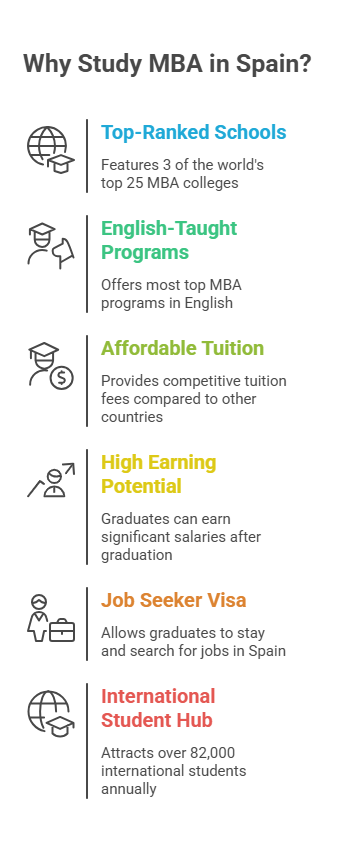
- Spain has 3 of the world’s top 25 MBA colleges – IESE Business School, IE Business School, and ESADE Business School.
- IESE Business School is ranked #11 in the world in the Financial Times MBA Rankings 2026.
- Most top MBA programs in Spain are taught completely in English.
- MBA tuition fees in Spain usually range from EUR 40,000 to EUR 93,500 in leading business schools.
- MBA graduates in Spain can earn around INR 70–90 lakh (EUR 70,000–90,000) per year on average.
- Students can apply for a 1-year Job Seeker Visa after graduation to search for jobs in Spain.
- More than 82,000 international students choose Spain every year for higher education.
Top Universities for MBA Degree in Spain
Spain is one of the best countries in Europe to study an MBA. It has both public and private business schools that offer world-class education and strong career opportunities. MBA programs in Spain focus on practical learning, leadership skills, and real business experience.
Private business schools such as IESE, IE, and ESADE are globally recognized and ranked among the top MBA programs worldwide. Public universities are more affordable and offer quality programs with strong local industry connections. Most MBA programs in Spain require 2–3 years of work experience and take 11 to 24 months to complete. After graduation, students can benefit from Spain's growing economy and a 12-month Job Seeker Visa.
Spanish business schools are known for their high academic standards and strong ties with global companies. Many MBA programs include internships, company projects, and networking events that help students gain real industry exposure. Barcelona and Madrid are major business hubs in Europe, giving students direct access to multinational companies, startups, and consulting firms.
Below is the list of top 10 MBA Universities in Spain:
| University | FT Global MBA 2026 | QS Global MBA 2026 | Duration | Approx. Tuition Fee (EUR) |
|---|---|---|---|---|
| IESE Business School | #4 | 13 | 15–19 months | €93,500 |
| ESADE Business School | #7 | 21 | 12–18 months | €75,000 |
| IE Business School | #21 | 111 | 11 months | €87,800 |
| EAE Business School | — | 121–130 | 15 months | €40,000–€50,000 |
| Universidad Carlos III de Madrid | — | 131–140 | 11 months | €19,800 (Non-EU) / €13,500 (EU) |
| EADA Business School | — | 151–200 | 11 months | €43,000 |
| ESIC Business & Marketing School | — | 151–200 | 12–15 months | €25,000–€35,000 |
| GBSB Global Business School | — | 151–200* | 15 months | €19,650 per year |
5 Top-ranked Universities in Spain
Advantages of Studying an MBA in Spain
Top-Ranked Business Schools
Spain has some of the best business schools in the world, including IESE Business School, IE Business School, and ESADE Business School. These schools are ranked among the top MBA colleges globally in the Financial Times and QS rankings. They offer high-quality education, internationally recognized degrees, and strong alumni networks that help students find jobs in Europe, Asia, and Latin America.
Top MBA Specializations
Spain offers many MBA specializations for different career goals and industries. Popular MBA specializations include:
- Finance & Banking
- Marketing & Digital Business
- Entrepreneurship & Innovation
- Technology Management
- International Business
- Supply Chain Management
These programs help students gain practical knowledge and industry skills. Most MBA courses in Spain are taught fully in English, which is helpful for international students. Learning basic Spanish can also improve communication and job opportunities in Spain and Latin America.
Practical and High-Quality Education
Business schools in Spain focus more on practical learning instead of only theory. Students learn through:
- Real business case studies
- Industry projects and consulting work
- Leadership and management training
- Entrepreneurship and innovation programs
Students also study in a multicultural environment with classmates from more than 80 countries. This helps them build international friendships and professional networks.
Good Career Opportunities
Spain has strong industries in technology, consulting, finance, tourism, and business services. Many international companies in cities like Madrid and Barcelona hire MBA graduates. Top recruiters include McKinsey & Company, Boston Consulting Group (BCG), Amazon, Google, Accenture, and Goldman Sachs. MBA graduates in Spain can earn around EUR 70,000 to EUR 105,000 per year on average.
Access to Europe and Latin America
Studying in Spain gives students career opportunities in both Europe and Latin America. Spain has strong business and cultural connections with many Spanish-speaking countries. This makes Spain a good place for students who want international career options after graduation.
Post-Study Work Opportunities
After finishing an MBA in Spain, international students can stay in the country for up to 12 months with a Job Seeker Visa to search for work or start a business.
After getting a job, graduates can apply for:
- Spanish Work and Residence Permit
- Highly Skilled Professional Visa
- Permanent Residency after 5 years of legal stay
Spain’s growing economy, modern cities like Madrid and Barcelona, and good lifestyle make it a great place to build a successful career and future.
In-Demand MBA Courses in Spain
Spain offers many MBA programs for international students. Private business schools usually have higher tuition fees, but they provide globally recognized degrees, strong industry connections, and good job opportunities after graduation. Public universities are more affordable, but they offer fewer full-time MBA programs.
MBA programs in Spain help students improve business knowledge, leadership skills, and international work experience. Students can choose specializations based on their career goals and interests.
|
Programme Name |
Duration |
Popular Specializations |
Approx. Annual Tuition Fee |
|
MBA in International Business |
11–18 months |
Global Business, Cross-Cultural Management, International Trade |
€15,000 – €45,000 |
|
MBA in Finance & Banking |
12–18 months |
Investment Banking, Corporate Finance, Financial Management |
€20,000 – €50,000 |
|
MBA in Marketing & Digital Business |
12–18 months |
Digital Marketing, Brand Management, E-Commerce |
€15,000 – €40,000 |
|
MBA in Entrepreneurship & Innovation |
11–15 months |
Startup Management, Innovation Strategy, Venture Capital |
€20,000 – €50,000 |
|
MBA in Technology Management |
12–18 months |
Digital Transformation, AI & Data, Technology Strategy |
€20,000 – €45,000 |
|
MBA in Human Resource Management |
12–18 months |
Talent Management, Organizational Behaviour, Leadership |
€15,000 – €35,000 |
|
MBA in Supply Chain Management |
12–18 months |
Logistics, Operations Management, Global Supply Chain |
€15,000 – €40,000 |
|
Executive MBA (EMBA) |
12–24 months (Part-time) |
Leadership, Strategy, Senior Management |
€35,000 – €70,000 |
*Confused to choose which course to pursue? Avail Y-Axis course recommendation services to choose the best.
Types of MBA Programs in Spain
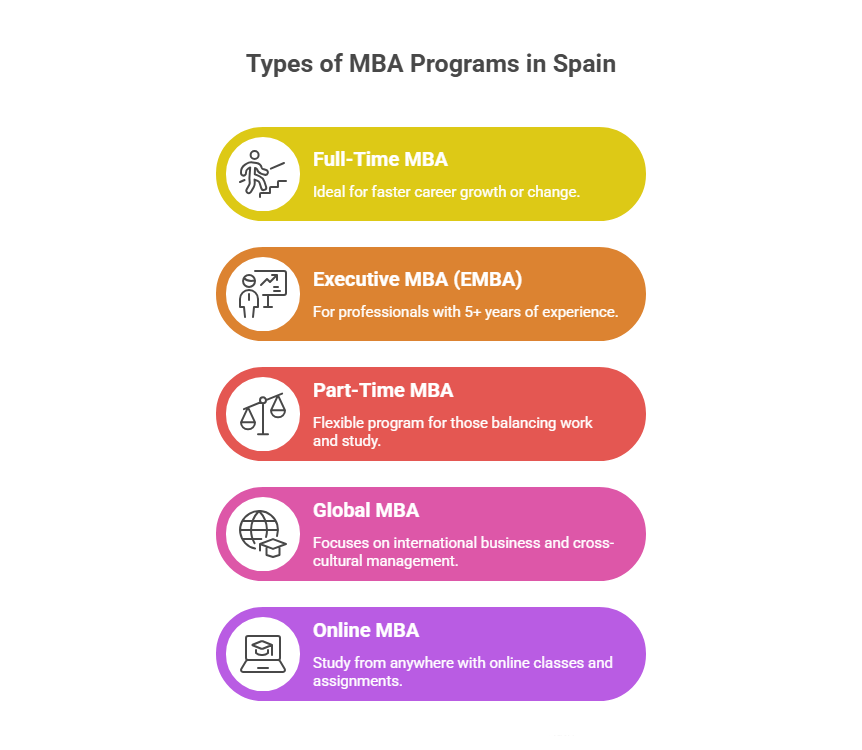
Full-Time MBA
A Full-Time MBA in Spain usually lasts between 11 and 19 months and is ideal for students who want faster career growth or a career change. The program provides complete business and management knowledge through case studies, internships, industry projects, and leadership training. Many top business schools in Spain offer globally recognized full-time MBA programs with strong career support.
Executive MBA (EMBA)
An Executive MBA (EMBA) is designed for professionals with around 5 or more years of work experience. This program allows students to continue working while studying. It mainly focuses on leadership, business strategy, decision-making, and senior management skills. Classes are usually conducted on weekends or in flexible modules for working professionals.
Part-Time MBA
A Part-Time MBA is a flexible program for students and professionals who want to continue their jobs while studying. Classes are mostly held during evenings or weekends, making it easier to balance work and education. The program generally takes about 2 to 3 years to complete.
Global or International MBA
A Global or International MBA focuses on international business, global markets, and cross-cultural management. These programs often include international projects, exchange programs, and study trips. Students learn with classmates from different countries, helping them build a strong global professional network.
Online MBA
An Online MBA allows students to study from anywhere through online classes and assignments. It is a flexible option for working professionals and international students who want to manage work, personal life, and education at the same time. Online MBA programs are becoming popular because they offer convenience and career growth opportunities.
Cost of Studying an MBA in Spain
The total cost of studying an MBA in Spain depends on the university and the type of MBA program you choose. Private business schools usually have higher tuition fees because they offer globally ranked MBA programs and strong placement support. Public universities are more affordable for international students.
MBA Tuition Fees in Spain
MBA tuition fees at top business schools in Spain usually range from EUR 40,000 to EUR 93,500 for the complete program. In Indian currency, this is around INR 36 lakh to INR 84 lakh. Public universities in Spain are cheaper and may charge around EUR 1,000 to EUR 12,000 per year.
Cost of Living in Spain
Apart from tuition fees, students also need to plan for living expenses such as accommodation, food, transport, and health insurance. The average living cost in Spain is around EUR 800 to EUR 1,200 per month, which is approximately EUR 9,600 to EUR 14,400 per year. Spain is considered more affordable than many other European countries like the UK or France.
|
Expense |
Estimated Monthly Cost (EUR) |
|
Accommodation |
€350 – €650 |
|
Food |
€200 – €300 |
|
Health Insurance |
€80 – €150 |
|
Study Materials |
€20 – €40 |
|
Transport |
€40 – €80 |
|
Internet & Mobile |
€20 – €50 |
|
Other Personal Expenses |
€100 – €200 |
Total Estimated Cost of MBA in Spain
The overall cost of studying an MBA in Spain depends on the type of university:
- Public university MBA: Around EUR 15,000 – EUR 40,000 including living expenses
- Private top-ranked MBA: Around EUR 55,000 – EUR 100,000 or more including living expenses
Spain also allows international students to work up to 30 hours per week while studying. This helps students manage their daily expenses and reduce financial pressure. Part-time jobs in Spain usually pay around EUR 10 to EUR 14 per hour.
*Read more....
Top Scholarships for Indian Students to Study MBA in Spain
MBA students in Spain can apply for several scholarships offered by the government, foundations, and business schools. Many of Spain's top schools offer merit-based scholarships – ESADE awards scholarships to 47% of admits, IE to 42%, and IESE to 38%.
Below is a list of scholarships available for Indian students to study MBA in Spain:
| School / Funding Body | Scholarship Name | Scholarship Amount | Merit / Need | Application Deadline* |
|---|---|---|---|---|
| Spanish Government | Spanish Government Scholarship | Covers tuition fees, travel, living expenses, and health insurance | Merit-based | Varies by call (usually Feb–Apr 2026) |
| European Union | Erasmus Mundus Scholarship | Covers tuition fees, travel costs, and monthly living allowance | Merit-based | Jan–Feb 2026 (program-specific) |
| IESE Business School | IESE Global Leaders Fellowship | Up to €20,000 | Merit-based | With MBA admission application (final round: Apr 30, 2026) |
| IE Business School | IE Women in Business Scholarship | Partial tuition fee waiver | Merit-based | Rolling; apply before May 31, 2026 for September intake |
| ESADE Business School | ESADE Excellence Scholarship | Average award of €12,000 (around 47% of MBA students receive financial aid) | Merit-based | With MBA admission application (Apr 30, 2026) |
| EADA Business School | EADA Talent Scholarship | 10%–30% tuition fee waiver | Merit-based | Jun 30, 2026 (October intake) |
| Multiple Universities | University-Specific MBA Scholarships | 10%–50% tuition fee waiver | Merit- and need-based | Varies by university; generally submitted with the MBA application |
*Also Read...
Scholarships in Spain for Indians
MBA Intake Dates and Deadlines 2026
Knowing the right intake windows and application deadlines is important for planning your MBA journey in Spain. Most top business schools have one main intake in September/October. Some universities offer a second intake in January or February. It is best to apply early, as seats fill up quickly at popular schools. Early applications are also preferred for scholarship consideration.
Below is the intake and deadline information for top MBA universities in Spain for 2026:
| Business School | Average GMAT Accepted | Competitive Minimum | GMAT Waiver / Alternative |
|---|---|---|---|
| IESE Business School | 660 (accepted range: 545–715) | ~600 | GMAT or GRE required; no general waiver |
| IE Business School | 680 (typical range: 650–710) | ~600 | Accepts the IE Global Admissions Test (ieGAT) instead of the GMAT |
| ESADE Business School | 660 (GMAT Focus average: 615; middle 80%: 580–660) | ~600 | GRE accepted; waivers considered case-by-case for strong applicants |
| EADA Business School | GMAT optional | N/A | Internal admission test accepted instead of the GMAT |
| EAE Business School | Not required | N/A | Admission based on interview and internal assessment |
| ESIC Business & Marketing School | Not mandatory | N/A | Internal entrance test and interview accepted |
Eligibility Requirements to Pursue MBA in Spain
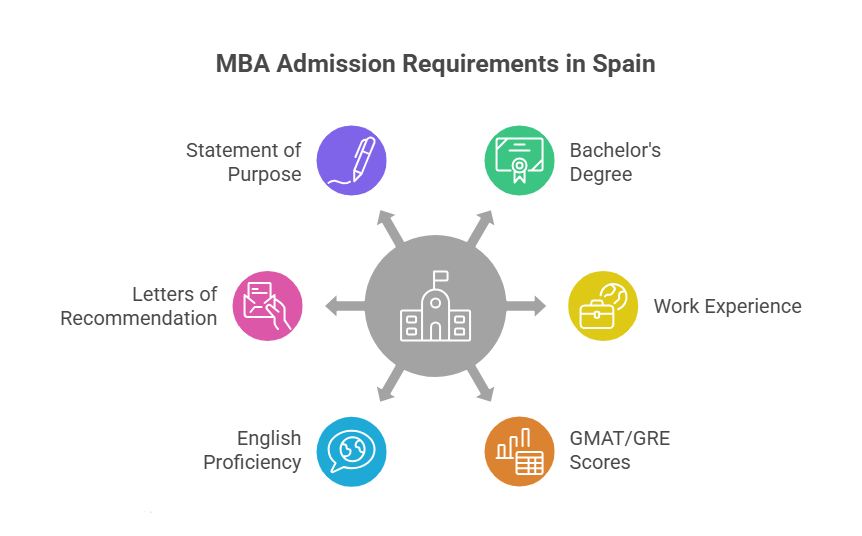
Every university in Spain has its own admission rules, but most MBA programs follow similar requirements. Indian students usually need good academic scores, work experience, and English language skills to get admission into an MBA program in Spain.
Bachelor’s Degree
Students must have a recognized bachelor’s degree from a reputed university. Most universities accept both 3-year and 4-year undergraduate degrees, depending on the program requirements.
Work Experience
Most MBA universities in Spain prefer students with 2 to 5 years of work experience. Top business schools like IESE Business School usually prefer candidates with more professional experience.
GMAT / GRE Scores
Many top MBA colleges ask for GMAT or GRE scores during admission. A GMAT score between 600 and 700 is generally considered good for leading business schools. Some universities may give waivers or conduct their own entrance tests. IE Business School also accepts its own Global Admissions Test instead of GMAT in some cases.
English Language Proficiency
Students applying for English-taught MBA programs must prove their English language skills. Common minimum scores include:
- IELTS: 6.5 – 7.0
- TOEFL: 90 – 100
Letters of Recommendation (LOR)
Most universities ask for 2 to 3 recommendation letters from professors or employers. These letters should explain the student’s academic performance, work skills, and professional abilities.
Statement of Purpose (SOP)
Students must submit a Statement of Purpose (SOP) explaining why they want to study an MBA, their career goals, and why they selected that university.
GMAT Score Requirements for Top MBA Schools in Spain
GMAT requirements vary across Spanish business schools. While top-ranked MBA programs generally expect a competitive GMAT or GRE score, many universities now accept alternative admission tests or do not require the GMAT at all.
| Business School | Average GMAT Accepted | Competitive Minimum | GMAT Waiver / Alternative |
|---|---|---|---|
| IESE Business School | 660 (accepted range: 545–715) | ~600 | GMAT or GRE required; no general waiver |
| IE Business School | 680 (typical range: 650–710) | ~600 | Accepts the IE Global Admissions Test (ieGAT) instead of the GMAT |
| ESADE Business School | 660 (GMAT Focus average: 615; middle 80%: 580–660) | ~600 | GRE accepted; waivers considered case-by-case for strong applicants |
| EADA Business School | GMAT optional | N/A | Internal admission test accepted instead of the GMAT |
| EAE Business School | Not required | N/A | Admission based on interview and internal assessment |
| ESIC Business & Marketing School | Not mandatory | N/A | Internal entrance test and interview accepted |
MBA in Spain Without GMAT
Several Spanish business schools offer MBA programs without requiring a GMAT score. These institutions evaluate applicants based on academic performance, work experience, interviews, and internal admission tests.
| Business School | GMAT Requirement |
|---|---|
| IE Business School | Accepts the IE Global Admissions Test (ieGAT) instead of the GMAT |
| EAE Business School | No GMAT required; admission through interview and internal assessment |
| ESIC Business & Marketing School | GMAT not mandatory; internal entrance test accepted |
| EU Business School (Barcelona) | No GMAT required; bachelor's degree, English proficiency, and interview required |
| OBS Business School | Online and hybrid MBA programs with no GMAT requirement |
| EADA Business School | GMAT optional; applicants may take the school's internal admission test |
Note: Highly ranked MBA programs at IESE Business School and ESADE Business School generally expect applicants to submit a competitive GMAT or GRE score. A strong GMAT score can also improve your chances of receiving merit-based MBA scholarships.
Documents Required for MBA in Spain
Indian students usually need the following documents while applying for an MBA program in Spain:
- Completed application form
- Bachelor’s degree certificate
- Academic transcripts and mark sheets
- Updated resume or CV
- Work experience certificates
- Statement of Purpose (SOP)
- Letters of Recommendation (2–3)
- Valid passport copy
- GMAT or GRE score report (if required)
- IELTS or TOEFL score certificate
- Student health insurance proof
- Proof of financial support (around EUR 8,000 – 10,000 per year)
- Criminal record certificate for long-term stay programs
Steps to Apply for MBA in Spain
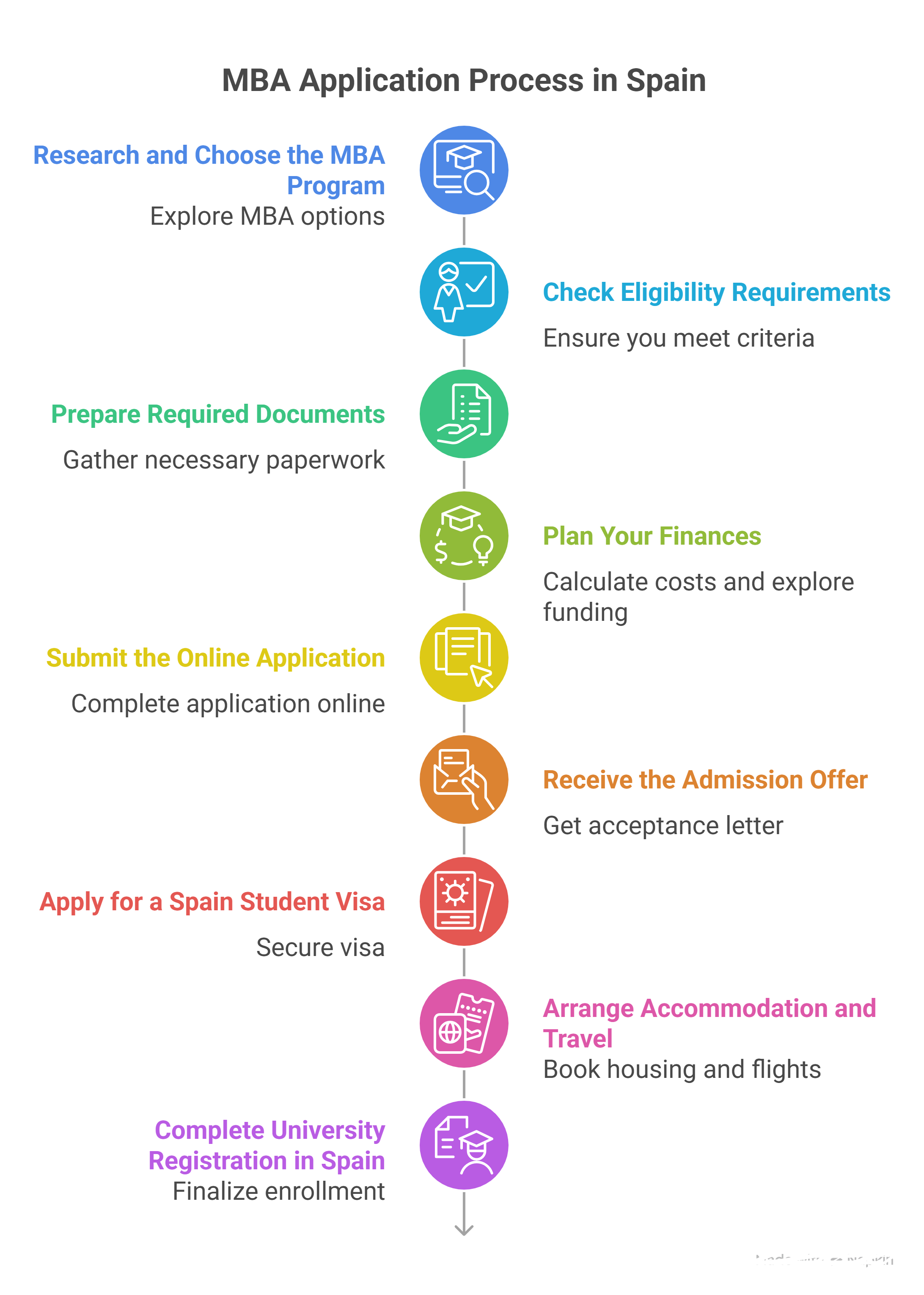
Applying for an MBA in Spain involves a few important steps. Students should start planning early and complete each step carefully for a smooth admission process.
Step 1: Research and Choose the MBA Program
Compare universities based on tuition fees, course duration, specializations, rankings, and whether the program is taught in English.
Step 2: Check Eligibility Requirements
Make sure you meet the academic qualifications, work experience requirements, English language scores, and GMAT or GRE score requirements if needed.
Step 3: Prepare Required Documents
Collect your degree certificate, transcripts, resume, SOP, LORs, and passport copy. Make sure all documents are clear and properly scanned for online submission.
Step 4: Plan Your Finances
Calculate your tuition fees and living expenses before applying. Students can also look for scholarships or education loans if needed.
Step 5: Submit the Online Application
Apply through the university's official website or online application portal. Upload all required documents and pay the application fee if necessary.
Step 6: Receive the Admission Offer
If selected, the university will send an admission or offer letter. Students may need to accept the offer and pay a deposit amount to confirm their seat.
Step 7: Apply for a Spain Student Visa
Apply for a Spain Student Visa through the Spanish Embassy or Consulate in India at least 2 months before the course start date.
Step 8: Arrange Accommodation and Travel
Once the visa is approved, book accommodation near your university and plan your travel to Spain.
Step 9: Complete University Registration in Spain
After arriving in Spain, complete university enrolment, register your local address, and apply for the Foreigner Identity Card (TIE).
*Want to apply for Spain Student Visa? Contact Y-Axis for complete process
Work Permit After MBA in Spain for Indian Students
Spain offers good opportunities for international students to stay and work after completing their MBA. Indian students can move from a student visa to a work permit and later apply for permanent residency if they meet the requirements.
Job Seeker Visa
After completing an MBA in Spain, students can apply for a 12-month Job Seeker Visa to look for jobs related to their studies. Students usually need to apply within 90 days after finishing their course. During this period, they can also explore business or startup opportunities in Spain.
Work and Residence Permit
Once students get a job offer related to their qualifications, they can apply for a Spanish Work and Residence Permit. In most cases, the employer helps with the work permit process. This permit is generally valid for 2 years and can later be renewed.
Highly Skilled Professional Visa
MBA graduates who get managerial or high-level professional jobs may qualify for a Highly Skilled Professional Visa. This visa is useful for skilled workers and provides better long-term career opportunities in Spain.
Permanent Residency in Spain
After living and working legally in Spain for 5 years, international graduates can apply for permanent residency. Spain is a popular country for long-term settlement because of its strong economy, good work opportunities, modern cities, and high quality of life.
Are MBA Programs in Spain Available in English?
Yes, most top MBA programs in Spain are taught fully in English. Famous business schools like IESE Business School, IE Business School, ESADE Business School, EADA Business School, and ESCP Business School offer English-taught MBA programs for international students.
This makes it easy for Indian students and other international students to study in Spain without knowing Spanish. In many MBA classrooms, students come from more than 80 countries, and English is used for classes, assignments, presentations, and exams.
However, learning Spanish can still be very helpful if students want to stay and work in Spain after completing their MBA. Knowing Spanish can help students:
- Find better job opportunities in Spain
- Communicate easily in daily life and at work
- Improve chances of long-term settlement
- Access career opportunities in Latin American countries
So, Spanish language skills are not compulsory for studying an MBA in Spain, but learning the language can improve career and job opportunities after graduation.
MBA in Spain vs Germany vs UK vs France vs USA
Spain is one of the most affordable MBA destinations in Europe, offering internationally recognized business schools, one-year MBA programs, and strong career opportunities. The table below compares Spain with other leading MBA destinations based on tuition fees, salaries, program duration, post-study work options, language, and major industries.
| Feature | Spain | Germany | United Kingdom | France | USA |
|---|---|---|---|---|---|
| Average MBA Tuition Fees | €15,000–€93,500 | €10,000–€50,000 | €35,000–€100,000 | €20,000–€98,000 | €60,000–€150,000 |
| Average Salary After MBA | €70,000–€105,000 | €65,000–€100,000 | €80,000–€120,000 | €70,000–€110,000 | €120,000–€160,000 |
| Typical Program Duration | 11–19 months | 12–24 months | 12–15 months | 12–16 months | 24 months |
| Post-Study Work Option | 12-month Job Seeker Residence Permit | 18-month Job Seeker Residence Permit | 2-year Graduate Route | 12-month APS (up to 24 months for eligible Master's graduates) | Optional Practical Training (OPT) for up to 12 months, with STEM extension for eligible graduates |
| Language Requirement | English-taught programs widely available | English available; German is helpful for employment | English | English available; French is helpful for employment | English |
| Popular Industries | Consulting, Technology, Tourism, Finance | Engineering, Automotive, Technology | Finance, Consulting, Technology | Luxury, Finance, Consulting | Technology, Finance, Consulting |
Post-MBA Salary and Career Opportunities in Spain
Spain is a popular choice for MBA studies because it offers good career opportunities and competitive salaries after graduation. Cities like Madrid and Barcelona have many international companies that hire MBA graduates in consulting, technology, finance, marketing, and consumer goods. According to the Financial Times Global MBA Rankings 2026, graduates from Spain's leading business schools earn strong median salaries: IESE Business School – €105,000, IE Business School – €98,000, and ESADE Business School – €92,000.
Post-MBA Salaries in Spain by Sector
| Sector | Entry-Level Salary (EUR/year) | Salary After 5 Years (EUR/year) |
|---|---|---|
| Consulting | €60,000–€80,000 | €100,000–€130,000 |
| Finance & Banking | €55,000–€70,000 | €90,000–€110,000 |
| Technology | €58,000–€72,000 | €90,000–€120,000 |
| Marketing | €48,000–€60,000 | €70,000–€90,000 |
| Operations & Supply Chain | €48,000–€62,000 | €75,000–€95,000 |
| Entrepreneurship & Innovation | €50,000–€65,000 | €80,000–€110,000 |
MBA Placement Rates and Salary Outcomes at Top Business Schools in Spain
| Business School | FT Global MBA 2026 Rank | Median Salary (EUR/year) | Employed Within 3 Months | Top Hiring Sectors |
|---|---|---|---|---|
| IESE Business School | #4 | €105,000 | ~80% | Consulting, Finance, Technology |
| ESADE Business School | #7 | €92,000 | ~91% | Consulting, Technology, Consumer Goods |
| IE Business School | #21 | €98,000 | 90%+ | Technology, Consulting, Finance |
Return on Investment of MBA in Spain
Return on Investment (ROI) is one of the most important factors when deciding where to pursue an MBA. Spain offers an excellent ROI due to the combination of globally ranked schools, relatively lower tuition fees compared to the USA or UK, and strong post-MBA salaries.
Total Investment for an MBA in Spain
The total cost for a full MBA in Spain includes tuition fees and living expenses. Here is a realistic estimate based on the type of university:
| Cost Component | Public University (EUR) | Private University (EUR) | Approx. INR |
|---|---|---|---|
| Tuition Fees (full program) | €1,000 – €12,000 | €40,000 – €70,000 | INR 90K – 63L |
| Living Expenses (1.5 years) | €14,400 – €28,800 | €14,400 – €28,800 | INR 13L – 26L |
| Total Estimated Investment | €15,000 – €40,000 | ~€55,000 – €98,800 | INR 14L – 89L |
Payback Period Calculation
A top private MBA in Spain costs around EUR 90,000 (about INR 81 lakh). After graduation, MBA graduates usually earn EUR 92,000–EUR 105,000 (about INR 83–95 lakh) per year. This means most students can recover the money they spent on their MBA in about 1.5 to 2.5 years. Students who study at public universities usually spend much less on tuition, so they can recover their investment even faster.
Student Life During MBA in Spain
Life as an MBA student in Spain is enjoyable, exciting, and full of new experiences. Students get a good balance between studies, work, travel, and social life. Spain is known for its friendly culture, modern cities, good food, and relaxed lifestyle, which makes student life comfortable for international students.
Housing
Finding accommodation in Spain is easier if students plan early. Many universities help students find shared apartments or student housing. Rent usually costs around EUR 350 to EUR 650 per month depending on the city and location. Cities like Barcelona and Madrid are more expensive, while cities like Valencia and Seville are more affordable for students.
Transportation
Spain has a good public transport system with metro, buses, and local trains in major cities. Students can travel easily and safely using public transport. Monthly transport passes usually cost around EUR 40 to EUR 80. Students can also travel to other European countries using affordable flights and train services.
Social Life and Student Activities
MBA student life in Spain is active and social. Business schools have many student clubs related to consulting, finance, entrepreneurship, sports, and cultural activities. These clubs organize networking events, competitions, workshops, and social programs. International student groups also help new students adjust quickly to life in Spain. Students can enjoy beaches, festivals, music, art, food, and travel during their free time.
Part-Time Work Opportunities
International students in Spain can work up to 30 hours per week during their studies. Many students take part-time jobs in restaurants, retail stores, customer service, or university support roles. Part-time jobs usually pay around EUR 10 to EUR 14 per hour. Working part-time helps students manage living expenses, improve Spanish language skills, and gain local work experience.
Build Your Management Career in Spain
Studying an MBA in Spain is a good option for students who want a globally recognized degree, strong career opportunities, and international work experience. Spain has top business schools like IESE Business School, IE Business School, and ESADE Business School, which are known for high-quality education, practical learning, and good job placements.
MBA programs in Spain are often more affordable than similar MBA programs in countries like the United States and the United Kingdom. Students also get the chance to study with classmates from many countries and build strong professional networks.
After completing the MBA, students can apply for a Job Seeker Visa to search for work in Spain. With the right planning, university selection, and preparation, an MBA in Spain can help students improve management skills, gain international exposure, and build a successful long-term career in Europe or other global markets.
How Can Y-Axis Help You?
Y-Axis provides complete support for students who want to study in Spain. We offer clear, step-by-step guidance and personalized assistance throughout your study abroad journey.
Our services include:
Don't know what to do ?
Get Free Counseling
Looking for Inspiration
Explore what Global Indians have to say about Y-Axis in shaping their future