

Don't know what to do ?
Get Free Counseling
Last Updated: 10-Aug-2026
Why Study a Vocational Course in Japan?
Japan’s Professional Training Colleges (Senmon Gakkō), approved by the Ministry of Education, Culture, Sports, Science and Technology (MEXT), offer global-standard, hands-on learning programs designed for international students and professionals seeking practical skills and global career opportunities.
These programs bridge the gap between academics and the real world, providing students with technical expertise, professional certifications, and direct employment pathways.
Key Advantages
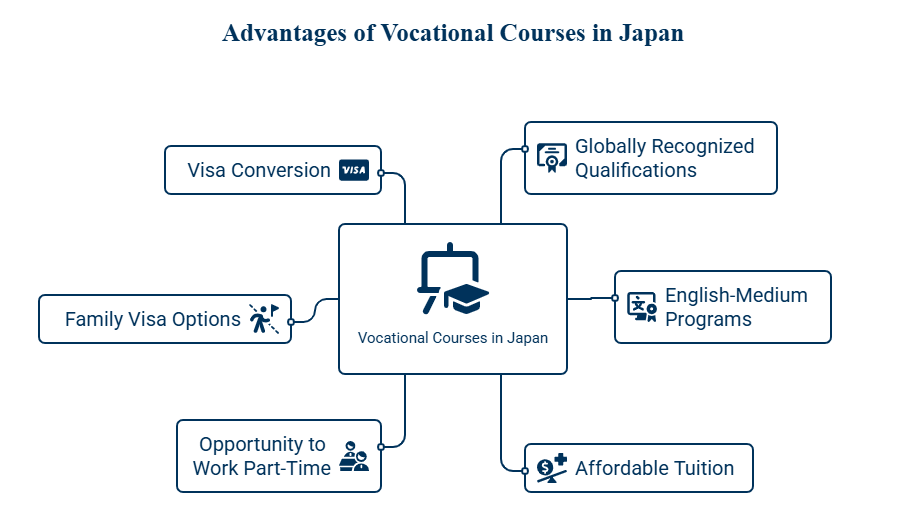
- Globally recognized Diploma and Advanced Diploma qualifications
- English-medium programs available in major Japanese cities
- Affordable tuition compared to Western destinations
- Opportunity to work part-time (up to 28 hours per week)
- Option to bring your family on a Dependent Visa
- Convert your Student Visa into a Work Visa after course completion
English-Medium Courses & Language Requirements
- Japan offers select English-taught diploma programs in fields such as IT, business, engineering, design, and tourism.
- Japanese language is not mandatory for English-medium courses.
- Basic Japanese proficiency (JLPT N5–N4) is recommended for daily communication and part-time jobs.
- Advanced proficiency (JLPT N2/N1) is required only for Japanese-taught programs.
- Many institutions provide free Japanese language support during your studies to help with integration and work readiness.
Course Duration & Qualifications
| Course Type | Duration | Qualification Awarded |
|---|---|---|
| Diploma (Senmonshi) | 2 years | Vocational Diploma |
| Advanced Diploma | 3–4 years | Advanced Diploma / University-equivalent |
| Specialized / Semi-Skilled (SSW / TITP) | 6 months – 1 year | Skill Certificate / Employment-Linked Training |
To qualify for a Work Visa in Japan, students must complete at least two years of study in a recognized diploma or higher program, or complete an approved SSW/TITP skill-based training with certification.
Eligibility to Apply for a Student Visa in Japan
| Program Type | Age Limit | Education | Language Requirement | Course Duration | Scholarship Eligibility | Key Notes |
|---|---|---|---|---|---|---|
| Specialized / Semi-Skilled (SSW / TITP) | 18–35 years | 10th/12th pass (based on trade) | JLPT N5 or JFT-Basic (mandatory) | 6 months – 1 year | NSDC–Japan Skill Mobility Grant | Employment after skill exam & sponsorship |
| Vocational Diploma (Senmonshi) | 18–30 years | 12th pass (10+2 or equivalent) | IELTS 5.5+ or JLPT N4–N5 | 2 years | MEXT, JASSO & Private Scholarships | Pathway to Skilled Work Visa after completion |
| Advanced Diploma / Specialized Course | 18–35 years | Diploma / Bachelor’s degree | JLPT N2/N1 or IELTS 6.0+ | 3–4 years | MEXT & University Grants | Eligible for employment or university transfer |
| General Criteria | — | Proof of funds (₹10–15 lakh), medical fitness | — | — | — | Must apply with a valid Certificate of Eligibility (COE) |
Japan Student Visa Overview
Visa Highlights
- Validity: 1–2 years (renewable)
- Work Rights: 28 hours/week (part-time)
- Post-Study Visa Conversion: 4–8 weeks processing
- Family Eligibility: Spouse and children can accompany
- Health Insurance: National Health Insurance (NHI) covers 70% of medical costs
Immigration & Visa Fees
| Visa Type | Fee (JPY) | Approx. INR | Duration |
|---|---|---|---|
| Student Visa (Single Entry) | 3,000 – 5,000 | ₹1,600 – ₹2,800 | 1–2 years |
| Multiple-Entry Visa | 6,000 | ₹3,300 | 1–5 years |
| Dependent (Family Stay) Visa | 3,000 – 5,000 | ₹1,600 – ₹2,800 | Linked to Student Visa |
Tuition Fees
| Course Type | Annual Tuition (JPY) | Approx. INR |
|---|---|---|
| Vocational Diploma (2 years) | ¥820,000 – ¥1,200,000 | ₹4.5 – ₹6.6 lakh/year |
| Advanced Diploma (3–4 years) | ¥1,000,000 – ¥1,400,000 | ₹5.5 – ₹7.7 lakh/year |
| Short-Term / Specialized Course | ¥400,000 – ¥800,000 | ₹2.2 – ₹4.4 lakh (6–12 months) |
Payment Options:
- Institutions offer semester-wise or installment payments.
- Entrance fee + first semester fee must be paid during admission.
- Some colleges allow monthly installment options for international students.
Switching Courses or Institutions
- You can change your course or institution with official permission.
- A new Certificate of Eligibility (COE) must be obtained for transfers.
- Transfers are typically allowed between semesters, not during an active term.
Health Insurance for Students and Family
All international students and dependents staying for more than three months must enroll in Japan’s National Health Insurance (NHI).
| Member | Monthly Premium (JPY) | Approx. INR | Coverage |
|---|---|---|---|
| Student | 1,500 – 2,500 | ₹825 – ₹1,375 | 70% of medical expenses |
| Spouse | 1,500 – 2,500 | ₹825 – ₹1,375 | Same coverage |
| Child | 1,000 – 2,000 | ₹550 – ₹1,100 | Same coverage |
Family and Dependent Benefits
Spouse Work Rights
- A spouse holding a Dependent Visa may apply for permission to work part-time (up to 28 hours per week).
- Full-time employment requires a separate work visa.
Children’s Education
- Public Schools: Japanese-medium instruction, low-cost.
- International Schools: English-medium, tuition around ₹6–₹15 lakh per year.
Scholarships for International Students
| Scholarship | Benefits (JPY/month) | Approx. INR/month |
|---|---|---|
| MEXT (Government of Japan) | 117,000 | ₹64,000 |
| JASSO Exchange Support Program | 48,000 | ₹26,000 |
| Local Govt & Private Grants | 30,000 – 250,000 | ₹16,500 – ₹1.4 lakh |
| NSDC–Japan Mobility Grant (for SSW) | One-time | ₹50,000 – ₹1 lakh |
Intakes for Vocational Courses in Japan
| Intake | Application Period | Programs Offered |
|---|---|---|
| April (Main Intake) | October – February | All Diploma, Advanced Diploma & SSW/TITP programs |
| October (Secondary Intake) | April – August | English-taught and short-term skill programs |
| January / July (Short-Term) | August – November / March – May | Specialized or 6-month training courses |
Career Path & Job Opportunities
| Stage | Visa Type | Duration | Work Rights |
|---|---|---|---|
| Study Period | Student Visa | 1–2 years | 28 hrs/week (part-time) |
| Post-Study Job Search | Designated Activities Visa | 6–12 months | Full-time after job offer |
| Employment | Work Visa (Engineer / Humanities / International Services) | 1–5 years | Full-time employment |
| SSW / TITP Graduates | Specified Skilled Worker Visa | 1–5 years | Full-time, renewable |
Expected Salary Range:
- Semi-Skilled (SSW/TITP): ¥180,000–¥250,000/month (₹1.0–₹1.4 lakh)
- Skilled Diploma Graduate: ¥250,000–¥350,000/month (₹1.4–₹1.9 lakh)
- Advanced Diploma Graduate: ¥350,000–¥450,000/month (₹1.9–₹2.5 lakh)
Popular Vocational Fields in Japan
| Field | Example Programs |
|---|---|
| Engineering & IT | Software Development, Network Systems, Robotics |
| Business & Management | International Trade, Finance, Marketing |
| Creative Design & Media | Animation, Game Design, Fashion Design |
| Healthcare | Nursing Care, Physical Therapy, Medical Support |
| Tourism & Culinary Arts | Hotel Management, Culinary Science |
| Communication & Culture | Japanese Language, Cross-Cultural Studies |
How can I get admission in Japan through Y-Axis?
- Expert guidance on selecting the right vocational course and college
- Complete support for visa filing and dependent applications
- Assistance with basic Japanese language preparation
- Relocation and accommodation support in Japan
- Post-study career guidance to help convert your Student Visa to Work Visa
Don't know what to do ?
Get Free Counseling
Looking for Inspiration
Explore what Global Indians have to say about Y-Axis in shaping their future