


Don't know what to do ?
Get Free Counseling
Last Updated: 23-Jun-2026
Why Study Bachelor’s in Japan?
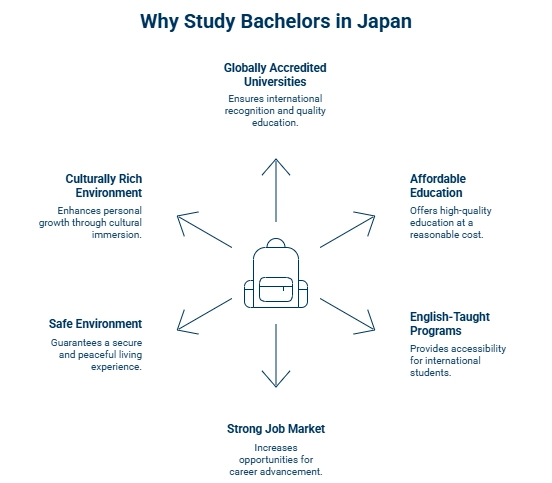
- Globally accredited universities: Japanese degrees are internationally recognized and valued by employers and academic institutions worldwide.
- Affordable and high-quality education: Japan offers top-tier education with relatively lower tuition and living costs compared to Western countries.
- English-taught programs: Many universities offer Bachelor’s degrees entirely in English, making it easier for international students to adapt.
- Strong job market: Japan’s booming economy and leading industries in technology, engineering, and business create excellent job prospects.
- Safe and culturally rich environment: Japan’s low crime rate, organized lifestyle, and cultural harmony provide a supportive environment for students.
Top 10 Universities to Study Bachelor’s in Japan
Japan hosts more than 700 universities, including prestigious national, public, and private institutions that welcome international students.
| Sno | University | Approx. Annual Tuition (UG) | Est. Living Expenses (per year) | Part-Time Work | Scholarships | Top Programs |
|---|---|---|---|---|---|---|
| 1 | Nagoya University (G30 Program) | ¥535,800 – ¥600,000 (≈ ₹2.9 – ₹3.3 L) | ¥700,000 – ¥1,000,000 | Up to 28 hrs/week | MEXT, G30 Tuition Waiver (50–100%) | Engineering, Chemistry, Social Sciences |
| 2 | Kyoto University (iUP Program) | ¥535,800 (≈ ₹2.9 L) | ¥800,000 – ¥1,000,000 | 28 hrs/week | Kyoto iUP Scholarships (Full/Partial Tuition + Stipend) | Economics, Engineering, Agriculture |
| 3 | Waseda University (School of International Liberal Studies) | ¥1,150,000 – ¥1,300,000 (≈ ₹6.3 – ₹7.1 L) | ¥1,000,000 | 28 hrs/week | Waseda University Partial Fee Waiver | Liberal Arts, Political Science, Business |
| 4 | International Christian University (ICU) | ¥1,043,000 (≈ ₹5.7 L) | ¥900,000 – ¥1,000,000 | 28 hrs/week | ICU Peace Bell & Honors Scholarships | Liberal Arts, International Relations |
| 5 | Temple University Japan (TUJ) | ¥1,600,000 – ¥1,800,000 (≈ ₹8.8 – ₹9.9 L) | ¥1,200,000 | 28 hrs/week | TUJ Merit Scholarships (20–50%) | Business, Communication, International Studies |
| 6 | Osaka University (Global 30 Program) | ¥535,800 (≈ ₹2.9 L) | ¥800,000 – ¥1,000,000 | 28 hrs/week | MEXT, Osaka Univ. International Student Scholarship | Science, Engineering, Human Sciences |
| 7 | Tokyo International University (TIU – E-Track) | ¥1,670,000–¥1,770,000 (≈ ₹8.5 – ₹8.6 L) | ¥900,000 | 28 hrs/week | TIU Tuition Reduction (30–100%) | Business, Economics, International Relations |
| 8 | Ritsumeikan Asia Pacific University (APU) | ¥1,300,000 (≈ ₹7.1 L) | ¥900,000 | 28 hrs/week | APU Tuition Reduction Scholarship (30–100%) | International Management, Tourism, Culture |
| 9 | Hiroshima University (Global Program) | ¥535,800 (≈ ₹2.9 L) | ¥800,000 – ¥950,000 | 28 hrs/week | Hiroshima Univ. Special Scholarship | Science, Engineering, Global Studies |
| 10 | Yokohama National University (YNU) | ¥535,800 – ¥600,000 (≈ ₹2.9 – ₹3.3 L) | ¥850,000 – ¥950,000 | 28 hrs/week | JASSO Honors Scholarship | Engineering, Business, Economics |
Popular Bachelor’s Courses in Japan
- Engineering and Technology
- Business and Economics
- Computer Science and Artificial Intelligence
- International Relations
- Architecture and Design
- Liberal Arts and Humanities
- Environmental Studies
- Media and Communication
- Japanese Language and Culture
Eligibility Criteria for Bachelor’s in Japan
To apply for a Bachelor’s degree in Japan, international students must meet the following requirements:
- Educational qualification: Completion of 12 years of schooling or an equivalent qualification recognized by Japanese universities.
- Language proficiency:
- For English-taught programs: IELTS, TOEFL, or equivalent English proficiency test scores.
- For Japanese-taught programs: Japanese Language Proficiency Test (JLPT) scores are mandatory.
- Entrance examination: Some universities require students to take the Examination for Japanese University Admission for International Students (EJU).
- Documents required: Academic transcripts, Statement of Purpose (SOP), letters of recommendation, and a valid passport.
- Proof of financial resources: Evidence of funds to support tuition and living expenses during the study period.
How to Get Admission to a Japanese University for Bachelor’s
Applying for a Bachelor’s program in Japan involves multiple steps that must be followed carefully to ensure successful admission.
- Step 1: Choose Your Program and University
Research universities that offer the program of your choice. Check whether they offer English-taught programs (E-Track, G30, or iUP). - Step 2: Check Eligibility and Requirements
Confirm that you meet the academic and language requirements. Prepare standardized test scores such as IELTS, TOEFL, or JLPT as needed. - Step 3: Prepare Required Documents
Gather the necessary documents including:- Academic transcripts and certificates
- Passport copy
- Statement of Purpose (SOP)
- Letters of recommendation
- Proof of financial capability
- Step 4: Take the EJU (if required)
Some universities require students to take the Examination for Japanese University Admission for International Students (EJU), which assesses academic ability and language proficiency. - Step 5: Submit the Application
Most universities accept online applications. Submit your completed application form and documents before the deadline (typically 6–9 months before the intake). - Step 6: Attend an Interview (if applicable)
Some universities may conduct interviews or written tests to evaluate candidates. These can be held online for international applicants. - Step 7: Receive the Offer Letter
If selected, you’ll receive an official offer letter or conditional acceptance. Accept the offer and pay the initial tuition or admission fee. - Step 8: Apply for a Student Visa
Once the university issues the Certificate of Eligibility (COE), you can apply for a student visa through the nearest Japanese embassy or consulate. - Step 9: Arrange Accommodation and Pre-departure Plans
Plan your travel, book student housing, and attend pre-departure orientations before your move to Japan.
Duration of a Bachelor’s in Japan
A Bachelor’s degree in Japan typically takes four years to complete. However, some professional programs such as medicine or engineering may extend to five or six years, depending on the field of study.
Intakes and Application Deadlines
Japanese universities generally offer two main intakes:
- Spring Intake: April
- Autumn Intake: September or October
It is recommended that students apply 6–9 months in advance of their preferred intake to allow ample time for application review and visa processing.
Cost of Studying Bachelor’s in Japan
Tuition Fees:
- Public and national universities charge around ¥500,000–¥600,000 per year, while private universities cost between ¥800,000–¥1,200,000 depending on the program.
Living Expenses:
- The average annual living cost for international students ranges from ¥800,000 to ¥1,500,000, covering accommodation, food, transport, and utilities.
Scholarships for International Students
Japan provides generous scholarship opportunities for international students pursuing undergraduate studies. These scholarships can include tuition waivers, monthly stipends, and housing support.
Popular scholarships include:
- MEXT (Japanese Government) Scholarship
- JASSO Honors Scholarship
- University-based Merit Scholarships
- Private Foundation Scholarships
Work Opportunities for Students
International students in Japan are permitted to work part-time while studying, provided they obtain official authorization from the Immigration Bureau. Students can work up to 28 hours per week during semesters and 40 hours per week during vacations.
Common part-time roles include tutoring, hospitality, retail, and customer service—helping students manage living costs while gaining valuable cultural and professional experience.
Post-Study Work Opportunities
Graduating with a Bachelor’s in Japan opens pathways to employment in Japan’s thriving industries. After graduation, students can apply for a Work Visa or Designated Activities Visa to continue living and working in Japan.
Top industries hiring international graduates:
- Information Technology and AI
- Engineering and Robotics
- Manufacturing and Automotive
- Business and Finance
- Research and Education
- International Trade and Consulting
How can Y-Axis help you?
Y-Axis offers end-to-end support for students aspiring to pursue their Bachelor’s in Japan. Our expert consultants assist with:
- Choosing the right course and university.
- Preparing and submitting applications to top universities.
- Guidance on scholarships and tuition waivers.
- Student visa application and interview preparation.
- Pre-departure and post-arrival assistance in Japan.
Explore Bachelor’s Programs in Other Countries
Don't know what to do ?
Get Free Counseling
Looking for Inspiration
Explore what Global Indians have to say about Y-Axis in shaping their future