


Don't know what to do ?
Get Free Counseling
Last Updated 12 August 2026
Why Australia Work Permit?
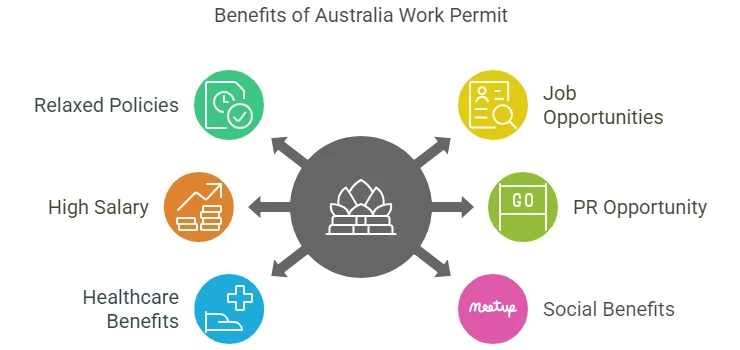
- Relaxed Policies for Skilled Workers
- 400,000 Job opportunities
- Earn an average annual salary of AUD 85,000 - 95,000
- Great chance to get an Australia PR
- Access to Healthcare benefits
- Enjoy social benefits
Australia Work Permit
A work permit for Australia is an important document issued by the Australian government that allows foreign nationals to work there. The Australian work permit validates your right to work legally in the country. There are two types of Australian work visas, temporary and permanent work visas and the type of visa you apply for will depend on your requirements and employment type.
Australia Work Visa for Indians
The Australian work visa for Indians helps to explore diverse work opportunities and access to settle in the Land Down Under. As one of the world’s most dynamic countries, Australia has an immense requirement for skilled talent. Make the most of this opportunity by applying for an Australian Work Visa. Having years of experience in Australian immigration processes, Y-Axis is the best consultant to launch your career in Australia.
* Want to work in Australia? Start here to get expert guidance with Migrate to Australia Flipbook.
Work in Australia for a high standard of living
There are two types of Australian work visas. Temporary work visas and Permanent Work Visas. These are designed to encourage overseas applicants to obtain sponsorship through an employer or to secure the nomination. Many skilled professionals choose to work in Australia because of the career growth, employment opportunities, and salaries offered.
Australia Permanent Work Permits
| Permanent Work Permit Type | Description |
|---|---|
| Employer Nomination Scheme (ENS) visa | Skilled workers nominated by employers can live and work in Australia permanently. |
| Regional Sponsored Migration Scheme (RSMS) visa | Effectively closed. The modern pathway for regional employer sponsorship is Subclass 494 leading to Subclass 191 permanent residency. |
| Skilled Independent visa | For invited skilled workers and eligible New Zealand citizens to live and work permanently in Australia. |
| Skilled Nominated visa | Skilled workers nominated by a state or territory can live and work as permanent residents. |
| National Innovation Visa (formerly Distinguished Talent visa) | Permanent visa for individuals with internationally recognized exceptional achievements in a profession, sport, arts, or research. |
Australia Temporary Work permit Visa
| Temporary Work Permit Type | Description |
|---|---|
| SID Visa (Skills In-Demand) | Allows individuals to work in Australia for 2 to 4 years based on employer needs. Employers must demonstrate a shortage of local talent. Applicants typically require relevant work experience. No age limit applies. |
| Skilled Regional (Provisional) visa | Temporary visa for skilled workers to live and work in regional Australia, with a pathway to permanent residency. |
| Temporary Work (Short Stay Specialist) visa | For short-term, highly specialized work in Australia. |
| Working Holiday Visa — Subclass 462 | Allows Indian nationals aged 18–35 to work while holidaying in Australia for up to 12 months. Available under the India–Australia Working Holiday agreement. Visa fee: AUD 635 (~₹34,500). Work rights included; no employer sponsorship required. |
Australia's New Core Skills Occupation List (CSOL)
Australia released a new Core Skills Occupation List (CSOL), replacing Subclass 482 Temporary Shortage Visa. The CSOL will apply to the Direct Entry Stream of the Subclass 186 visa and the Core Stream of the new Skills In Demand visa.
*Click on this page for the Core Skills Occupation List (CSOL) to work in Australia.
Benefits of an Australia Working Visa
Below are the benefits of working in Australia:
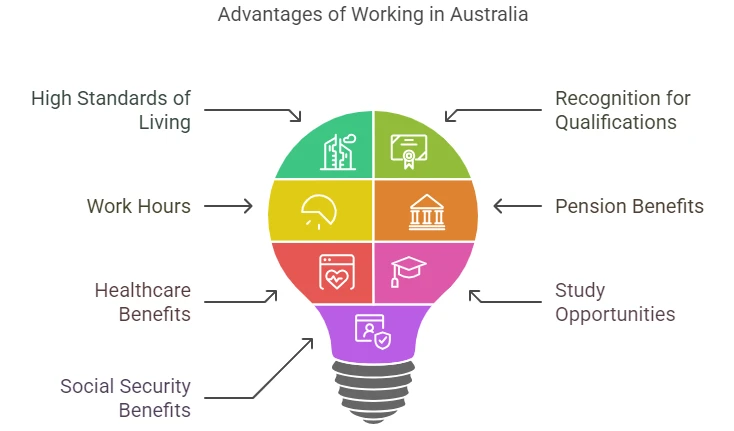
- High standards of living
- Recognition for your qualifications
- Work 38.5 hours/week
- Access to pension benefits
- Healthcare benefits
- Great opportunity to study
- Social security benefits
Jobs in Australia
As per the recent reports, there are 8 lakh jobs in Australia. The top-in-demand occupations in Australia of various sectors and the average annual salaries paid are mentioned in the table below:
| Assessing Authority | Occupations Assessed | Approximate Cost | Typical Timeline |
|---|---|---|---|
| ACS – Australian Computer Society | IT, software engineering, data science, cybersecurity, AI, networking | AUD 530 (~₹29,000) | 4–8 weeks |
| TRA – Trade Recognition Australia | Electricians, plumbers, carpenters, welders, HVAC technicians | AUD 450 (~₹24,500) | 6–12 weeks |
| VETASSESS | Chefs, early childhood educators, business analysts, other professional and technical occupations | AUD 715 (~₹39,000) | 8–12 weeks |
| Engineers Australia | Civil, mechanical, electrical, chemical, structural, mining engineers | AUD 890 (~₹48,500) | 8–12 weeks |
| ANMAC | Registered nurses, enrolled nurses, midwives | AUD 750 (~₹41,000) | 8–16 weeks |
| AMC – Australian Medical Council | Doctors, general practitioners, specialists | AUD 1,090 (~₹59,500) | 12–26 weeks |
| CPA Australia | Accountants, auditors, financial analysts | AUD 735 (~₹40,000) | 6–10 weeks |
| CA ANZ | Accountants, management accountants, tax professionals | AUD 735 (~₹40,000) | 6–10 weeks |
| AHPRA | Dentists, pharmacists, physiotherapists, occupational therapists, psychologists | AUD 300 – 1,000+ (varies by profession) | 2–6 months (depends on registration pathway) |
Average Salary Levels in Australia
Salaries in Australia vary based on experience, industry, and job role. Entry-level professionals typically earn lower salaries, while mid-level and senior professionals with advanced skills and experience receive significantly higher pay. These salary ranges are common across sectors such as IT, Healthcare, Engineering, Construction, Manufacturing, and Hospitality. Highly specialized roles like AI engineers, cybersecurity experts, and senior IT professionals can earn even higher salaries.
| Experience Level | Average Salary |
|---|---|
| Entry Level | AUD 60,000 – 75,000 per year (₹33–41 LPA) |
| Mid Level | AUD 80,000 – 110,000 per year (₹44–60 LPA) |
| Senior Level | AUD 120,000 – 180,000+ per year (₹66–99 LPA) |
In-Demand White-Collar Occupations in Australia
Australia continues to experience strong demand for skilled professionals across technology, healthcare, finance, marketing, sales, and human resources. These occupations offer competitive salaries, excellent career growth, and opportunities for skilled migrants through employer-sponsored visas and skilled migration programs. The table below highlights the average annual salary ranges for some of Australia's most in-demand white-collar occupations.
| Occupation | Annual Salary Range (AUD) |
|---|---|
| AI Solutions Architect | AUD $160,000 – $260,000+ |
| AI / ML Engineer | AUD $130,000 – $200,000 |
| Cloud / DevOps Engineer | AUD $130,000 – $200,000+ |
| Cybersecurity Lead | AUD $150,000 – $220,000 |
| Software Developer | AUD $140,000 – $170,000 |
| Data Scientist | AUD $120,000 – $160,000 |
| General Practitioner (GP) | AUD $180,000 – $225,000 |
| Registered Nurse (RN) | AUD $85,000 – $110,000 |
| AI Financial Controller / FP&A | AUD $120,000 – $170,000 |
| Risk & Compliance Manager | AUD $130,000 – $180,000 |
| Marketing Manager | AUD $95,000 – $140,000 |
| Sales Director | AUD $140,000 – $200,000 |
| HR Business Partner | AUD $100,000 – $140,000 |
Jobs in Australia for Indians
It is always challenging for Indians who are willing to move to Australia or are planning to settle in Australia. This is usually because of the unawareness of immigrants’ jobs in demand.
Australia, being one of the most strong and dynamic countries, is one of the popular destinations for Indian students and professionals who are looking for career growth. Australia has a strong economy with a fixed political climate, clean nature and outstanding growth, making it an attractive destination for job seekers. Many individuals who migrate to Australia find it difficult to find a stable job there.
How to get a job in Australia from India
Step 1: Research the Australian job market
Whether looking for on-site or remote jobs in Australia, you must first begin with proper research on the Australian job market. Searching for job opportunities within sectors with higher growth potential will assure faster career growth. There are plenty of Australian job portals where you can research between different sectors.
Step 2: Build an ATS-friendly resume
Once you have identified the sector that matches your qualifications and work experience, the next step is to prepare a powerful resume and cover letter.
Most employers in Australia are using ATS (Applicant Tracking System) to filter the right candidates. This software makes the hiring process easier; all the resumes are scanned. Application Tracking System filters the applications based on specific keywords, resume formats profiles with photos, proper alignment, etc. Always prepare a resume that is ATS-friendly.
Step 3: Apply for jobs
Once your resume is ready, apply for jobs on Australian job portals and the company’s official website. Additionally, you can reach out to HR firms and a few trusted recruitment agencies to make your process faster. These firms offer paid services, so it is worth taking their job assistance.
Step 4: Apply for a suitable visa
Another important step is to get a job in Australia from India. You must select the right visa category based on your preferences and initiate the Australian work visa application process. The application process and the eligibility criteria may differ based on the type of visa you are selecting. Therefore, understand your requirements before proceeding with your application.
Step 5: Receive your electronic visa grant
"After your Australia Work visa application gets approved, you will receive an electronic visa grant — there is no physical stamp. You can verify your visa status anytime via VEVO (Visa Entitlement Verification Online) at border.gov.au/vevo. Once confirmed, schedule your flight and you are ready to move to Australia."
Eligibility to Work in Australia
India-Australia Economic Cooperation and Trade Agreement (AI-ECTA)
The Australia-India Economic Cooperation and Trade Agreement (AI-ECTA), which entered into force in December 2022, includes provisions that directly benefit Indian professionals seeking to work in Australia. Under AI-ECTA, Australia and India have committed to enhanced mutual recognition of qualifications and skills for Indian professionals in key sectors — including engineering, accounting, and healthcare. Key implications for Indian applicants:
- Engineers: Engineers Australia and Indian engineering bodies are working towards streamlined mutual recognition — reducing the documentation burden for Indian-qualified engineers applying for skills assessment
- Accountants: CPA Australia and CA ANZ are engaged in recognition discussions with ICAI (Institute of Chartered Accountants of India) — Indian CA qualification holders may benefit from partial exemptions in the assessment process
- Healthcare professionals: Mutual recognition provisions support faster pathway assessment for Indian-qualified nurses (ANMAC) and medical practitioners (AMC) meeting Australian registration standards
- General benefit: AI-ECTA signals a strengthening bilateral relationship that is progressively reducing barriers for Indian skilled professionals across all visa categories
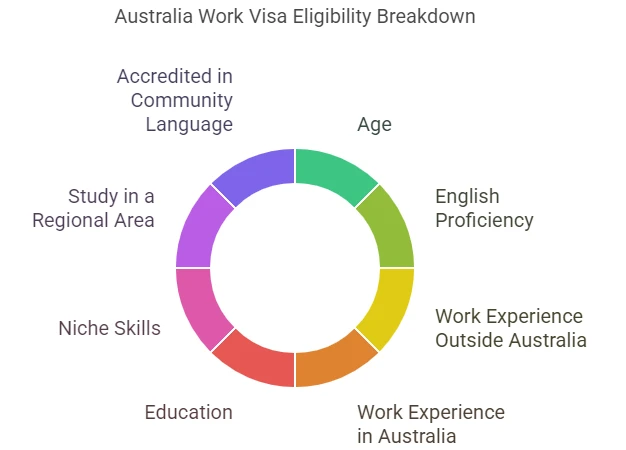
The eligibility criteria for the The eligibility criteria for the General Skilled Migration (GSM) Program — Subclass 189, 190 and 491 visas — include the following:
| GSM Points Criteria | Maximum Points |
|---|---|
| Age (25–32 years) | 30 points |
| English proficiency (IELTS 8 or equivalent) | 20 points |
| Work Experience outside Australia (8–10 years) | 15 points |
| Work Experience in Australia (8–10 years) | 20 points |
| Education (Doctorate degree) | 20 points |
| Specialist education qualification (Master’s by research or PhD in Australia) | 10 points |
| Study in a regional area | 5 points |
| Accredited in community language | 5 points |
| Professional Year Program in Australia | 5 points |
| State nomination (Subclass 190 visa) | 5 points |
| Skilled spouse or partner (age, skills & English met) | 10 points |
| Spouse or partner with competent English only | 5 points |
| Single applicant or spouse is Australian citizen/PR | 10 points |
| Regional or family sponsorship (Subclass 491 visa) | 15 points |
Note: The points table above applies only to GSM (Subclass 189, 190, 491). The Skills in Demand (SID) Visa (Subclass 482) does not use a points system. It requires employer sponsorship, a job offer, an occupation on the Core Skills Occupation List (CSOL), at least 1 year of relevant work experience, and must meet the minimum salary threshold set by the Australian Government.
Australia Work Permit Visa Requirements
The Australian government devised the General Skilled Migration program (Skillselect) in 2013 to replace the Skilled work visa Australia. The Skillselect is designed to assess the skills of applicants under a point-based system so that immigrants with the right skills can be selected. The applicants are given points under the following criteria:
- Age: Those between the ages of 25 and 32 score the most points while those above 45 do not gain any points.
- English language proficiency: Applicants are required to take the IELTS test. If they score 8 bands or more, you get 20 points.
- Skilled employment: If you have experience in an occupation that is listed in the Skilled Occupations List you will get points based on the years of experience. 20 is the maximum points you can gain.
- Educational qualification: To get points under this category, your qualification must be related to your nominated occupation. 20 points is the maximum you can score if you have a doctorate while a bachelor’s or master’s degree will give you 15 points.
- Australian qualifications: You can get five points if you have an Australian qualification from an Australian educational institute.
- Regional study: You can gain an additional 5 points if you have lived and studied in regional Australia.
- Community language skills: You will gain another 5 points if you have translator/ interpreter level skills in one of the country’s community languages.
- Spouse/partner skills and qualifications: If you have included your spouse/partner in the application and he/she is not an Australian resident/citizen, then their skills are eligible to be counted towards your total points. You will gain an additional five points if your spouse/partner must meet the basic requirements of the Australian General Skilled Migration.
- Professional year: You will stand to gain another 5 points if you have completed a Professional Year in Australia for a period of at least 12 months in the last four years from either ACS/CPA/CAANZ/IPA/Engineers Australia. You must score a minimum of 65 points to submit an Expression of Interest (EOI) via SkillSelect. However, scoring 65 points alone is unlikely to result in an invitation in 2025. Competitive invitation scores in the current round are typically 80–90+ points, depending on your occupation and the state or territory nominating you. The higher your points score, the greater your chances of receiving an Invitation to Apply (ITA).
- Skilled Independent Visa: You can be eligible for this visa if you have the necessary skills and qualifications for specific occupations listed in the Core Skills Occupation List (CSOL).This visa does not require the sponsorship of an employer. You can use the SkillSelect tool to find out if your skills are in demand.
- Employer Nomination Scheme: Under this scheme, a permanent Working visa for Australia is given to workers sponsored by their companies.
- Skills in Demand (SID) Visa (Subclass 482): Under this visa, skilled workers can work in Australia for up to 4 years, depending on the employer’s requirement. The visa replaced the former Temporary Skill Shortage (TSS) visa on 7 December 2024. Applicants must have relevant skills, qualifications, and at least 1 year of work experience (reduced from 2 years). There is no age limit for this visa. Employers must demonstrate a genuine skill shortage and are required to pay workers market salary rates or meet minimum salary thresholds set by the Australian Government.
Australia Work Visa Fees Updated
The visa application fees for Australian work visas are set by the Department of Home Affairs and are subject to change. The fees below are current as of 2026.
| Visa Type | Primary Applicant Fee | Secondary Applicant (Adult) | Secondary Applicant (Child) |
|---|---|---|---|
| Skills in Demand (SID) Visa — Subclass 482 | AUD 3,115 (~₹1,70,000) | AUD 3,115 (~₹1,70,000) | AUD 780 (~₹42,500) |
| Employer Nomination Scheme — Subclass 186 | AUD 4,770 (~₹2,60,000) | AUD 2,385 (~₹1,30,000) | AUD 1,195 (~₹65,000) |
| Skilled Independent — Subclass 189 | AUD 4,770 (~₹2,60,000) | AUD 2,385 (~₹1,30,000) | AUD 1,195 (~₹65,000) |
| Skilled Nominated — Subclass 190 | AUD 4,770 (~₹2,60,000) | AUD 2,385 (~₹1,30,000) | AUD 1,195 (~₹65,000) |
| Skilled Work Regional — Subclass 491 | AUD 4,770 (~₹2,60,000) | AUD 2,385 (~₹1,30,000) | AUD 1,195 (~₹65,000) |
| Working Holiday — Subclass 417 / 462 | AUD 635 (~₹34,500) | Not applicable | Not applicable |
Australia Work Visa Processing Times [Updated]
Processing times are estimated by the Department of Home Affairs based on completed applications. Times shown are for 50th percentile (median) and 75th percentile of applications processed.
| Visa Subclass | Visa Type | 50th Percentile (Median) | 75th Percentile |
|---|---|---|---|
| Subclass 482 | Skills in Demand (SID) Visa | 8 months | 12 months |
| Subclass 186 | Employer Nomination Scheme | 12 months | 18 months |
| Subclass 189 | Skilled Independent | 12 months | 18+ months |
| Subclass 190 | Skilled Nominated | 9 months | 15 months |
| Subclass 491 | Skilled Work Regional | 9 months | 15 months |
| Subclass 417 / 462 | Working Holiday | 1 month | 2 months |
Minimum Salary Requirement for the SID Visa (TSMIT)
The Temporary Skilled Migration Income Threshold (TSMIT) is the minimum salary an employer must pay a sponsored worker on the Skills in Demand (SID) Visa — Subclass 482. The TSMIT is set by the Australian Government and reviewed annually.
| SID Visa Stream | Minimum Annual Salary Required |
|---|---|
| Core Skills Stream (most trade, tech, and professional roles) | AUD 73,150 per year (~₹39,90,000) |
| Specialist Skills Stream (senior, highly specialised roles) | AUD 135,000 per year (~₹73,60,000) |
| Labour Agreement Stream (negotiated government agreements) | As specified in the labour agreement |
Skills in Demand (SID) Visa — Three Streams Explained
The Skills in Demand (SID) Visa — Subclass 482 — replaced the former Temporary Skill Shortage (TSS) visa in December 2024. It is divided into three distinct streams, each with different occupation, salary, and skills assessment requirements. Indian professionals must identify the correct stream before applying.
Stream 1 — Core Skills Stream
The Core Skills Stream is the most commonly used SID Visa pathway for Indian professionals across trade, technology, healthcare, engineering, and construction sectors.
| Factor | Details |
|---|---|
| Occupation Requirement | Occupation must be listed on the Core Skills Occupation List (CSOL) |
| Minimum Salary (TSMIT) | AUD 73,150 per year (~₹39,90,000) — or market salary rate, whichever is higher |
| Skills Assessment | Required for most occupations (ACS for IT, TRA for trades, VETASSESS for others) |
| Work Experience | Minimum 1 year of relevant work experience |
| Visa Duration | Up to 4 years |
| PR Pathway | Eligible for Subclass 186 Employer Nomination Scheme after 2 years with the same employer |
| Age Limit | No age limit |
| Who It Is For | IT professionals, engineers, healthcare workers, tradespeople, teachers, and other skilled professionals with CSOL-listed occupations |
Stream 2 — Specialist Skills Stream
The Specialist Skills Stream is designed for highly specialised, senior professionals in niche roles. It has no occupation list requirement and no mandatory skills assessment — making it the fastest SID Visa route for senior Indian AI engineers, surgeons, C-suite executives, and other top-tier specialists.
| Factor | Details |
|---|---|
| Occupation Requirement | No CSOL requirement — any occupation can qualify (subject to salary threshold) |
| Minimum Salary | AUD 135,000 per year (~₹73,60,000) |
| Skills Assessment | Not required |
| Work Experience | Demonstrated expertise in the nominated occupation |
| Visa Duration | Up to 4 years |
| PR Pathway | Eligible for Subclass 186 Employer Nomination Scheme after 2 years with the same employer |
| Age Limit | No age limit |
| Who It Is For | Senior AI engineers, specialist surgeons, C-suite executives, investment bankers, niche research scientists, and other highly paid specialists |
Stream 3 — Essential Skills Stream
The Essential Skills Stream is specifically designed for lower-paid occupations in industries facing critical workforce shortages — including aged care, disability care, agriculture, and hospitality. This stream has not yet been fully operationalised as of 2025 and will be activated by the Australian Government for specific sectors as needed.
| Factor | Details |
|---|---|
| Occupation Requirement | Designated lower-paid shortage occupations as specified under labour agreements |
| Minimum Salary | Below TSMIT — specific thresholds defined per occupation and sector agreement |
| Skills Assessment | Required (varies by occupation and agreement) |
| Work Experience | As specified per occupation and labour agreement |
| Visa Duration | Up to 4 years |
| PR Pathway | Depends on the specific labour agreement and sector pathway |
| Age Limit | No age limit |
| Who It Is For | Aged care workers, disability support workers, farm workers, hospitality staff in critical shortage regions |
SID Visa Three Streams — Quick Comparison
| Factor | Core Skills Stream | Specialist Skills Stream | Essential Skills Stream |
|---|---|---|---|
| Occupation List Required | Yes — Core Skills Occupation List (CSOL) | No occupation list required | Yes — designated shortage occupations |
| Minimum Salary | AUD 73,150 per year | AUD 135,000 per year | Below TSMIT — sector-specific thresholds |
| Skills Assessment Required | Yes | No | Yes |
| PR Pathway | Eligible for Subclass 186 | Eligible for Subclass 186 | To be confirmed (depends on sector agreements) |
| Best For | Most Indian skilled professionals | Senior specialists and high-income professionals | Lower-paid critical shortage roles |
| Status (2025) | Fully operational | Fully operational | Not yet fully operationalised |
Australia Skills Assessment
Skill assessment is an integral part of Australian work visa application process. One must select an occupation that is listed in Australia’s Occupational Demand List. This list will mention occupations that face a skill shortage in the country. Every occupation in the list has its own skill-assessing authority. Every occupation on the Core Skills Occupation List (CSOL) has a designated skills assessing authority. Indian applicants must obtain a positive skills assessment from the correct authority before lodging most Australian work visa applications. The table below covers all major assessing bodies, the occupations they assess, approximate costs, and typical processing timelines.
An applicant should have a positive skill assessment for the next steps in the Australian work visa process. To get their skill assessment done, candidates must meet the required conditions outlined by the assessing authority, which is evaluating their occupation. The candidate should have the related qualifications and experience to get a positive assessment.
The first requirement for a positive skill assessment is that your occupation must be related to your work experience. If there is a mismatch, you will not get the required points. The candidate must submit every additional detail requested by the assessing authority.
| Assessing Authority | Occupations Assessed | Approximate Cost | Typical Timeline |
|---|---|---|---|
| ACS — Australian Computer Society | IT, software engineering, data science, cybersecurity, AI, networking | AUD 530 (~₹29,000) | 4–8 weeks |
| TRA — Trade Recognition Australia | Trade occupations — electricians, plumbers, carpenters, welders, HVAC technicians | AUD 450 (~₹24,500) | 6–12 weeks |
| VETASSESS | Professional and technical occupations not covered by specialist bodies (e.g., chefs, early childhood educators, business analysts) | AUD 715 (~₹39,000) | 8–12 weeks |
| Engineers Australia | All engineering disciplines — civil, mechanical, electrical, chemical, structural, mining | AUD 890 (~₹48,500) | 8–12 weeks |
| ANMAC — Australian Nursing and Midwifery Accreditation Council | Registered nurses, enrolled nurses, midwives | AUD 750 (~₹41,000) | 8–16 weeks |
| AMC — Australian Medical Council | Medical doctors, general practitioners, specialists | AUD 1,090 (~₹59,500) | 12–26 weeks |
| CPA Australia | Accountants, auditors, financial analysts | AUD 735 (~₹40,000) | 6–10 weeks |
| CA ANZ — Chartered Accountants Australia and New Zealand | Accountants, management accountants, tax professionals | AUD 735 (~₹40,000) | 6–10 weeks |
| AHPRA — Australian Health Practitioner Regulation Agency | Dentists, pharmacists, physiotherapists, psychologists, optometrists, chiropractors, and other registered health practitioners | AUD 490 (~₹26,700) | 4–8 weeks |
Which Skills Assessment Authority Do I Need? — Quick Guide for Indians
| If You Are A... | Your Assessing Authority |
|---|---|
| Software developer, IT professional, data scientist, AI engineer | ACS — Australian Computer Society |
| Electrician, plumber, welder, carpenter, HVAC technician | TRA — Trade Recognition Australia |
| Civil, mechanical, electrical, or structural engineer | Engineers Australia |
| Registered nurse or midwife | ANMAC — Australian Nursing and Midwifery Accreditation Council |
| Medical doctor or general practitioner | AMC — Australian Medical Council |
| Accountant, auditor, or financial analyst | CPA Australia or CA ANZ |
| Dentist, pharmacist, physiotherapist, psychologist | AHPRA — Australian Health Practitioner Regulation Agency |
| Chef, early childhood educator, business analyst, or other professional roles | VETASSESS |
Australia vs Canada vs UK vs Germany vs New Zealand: Which Country is Best for Indian Professionals?
Choosing the right country to migrate to depends on your occupation, salary expectations, PR timeline, and long-term settlement goals. The comparison below covers the five most popular destinations for Indian skilled professionals across key migration factors.
| Factor | Australia | Canada | United Kingdom | Germany | New Zealand |
|---|---|---|---|---|---|
| PR Pathway Timeline | 2 to 4 years (Subclass 189/190); 2 years via Subclass 482 to 186 | 1 to 3 years via Express Entry (FSWP/CEC) | 3 years (Global Talent Visa); 5 years (Skilled Worker Visa) | 4 years standard; 21 to 27 months via EU Blue Card with B1 German | 2 to 5 years via Skilled Migrant Category |
| Employer-Sponsored Route | SID Visa (Subclass 482) → Subclass 186 PR | LMIA-backed Work Permit → Express Entry PR | Skilled Worker Visa → ILR after 5 years | Skilled Worker Visa → PR after 4 years | Accredited Employer Work Visa → Skilled Migrant Category |
| Points System | Yes — GSM (65 minimum; 80–90+ competitive) | Yes — CRS (470–550+ competitive) | No — employer sponsorship or Global Talent route | No — qualification recognition + job offer required | Yes — SMC points system (160 minimum) |
| Average Salary Potential (INR) | ₹33 to 99 LPA | ₹40 to 115 LPA | ₹36 to 137 LPA | ₹42 to 139 LPA | ₹30 to 82 LPA |
| Tax-Free Income | No | No | No | No | No |
| Indian Community Size | Very large — 700,000+ Indian-born residents | Very large — 1.6M+ Indian-origin population | Large — 1.8M+ Indian-origin population | Growing — 200,000+ Indian-origin population | Small but growing — 60,000+ Indian-born residents |
| Language Requirement | IELTS 6.0–7.0 | CLB 7 (IELTS ~6.0) | B2 English (from 2026) | A2–B1 German; English accepted in some roles | IELTS 6.5 |
| Skills Assessment Required | Yes — ACS, Engineers Australia, ANMAC, TRA, VETASSESS | Yes — WES (ECA) | No — employer-based | Yes — Anabin/ZAB | Yes — NZQA |
| Citizenship Timeline | 4 years after PR | 3 years after PR | 6 years total residence | 5 years after PR | 5 years after PR |
| Best For Indians Who... | Want direct PR via points; high salaries; large Indian community | Want fastest PR; strong Indian network; no language barrier | Prefer Global Talent or employer route; high-paying tech roles | Want EU access; engineering/manufacturing roles | Prefer smaller cities; balanced lifestyle; growing opportunities |
Quick Verdict — Best Country by Priority for Indian Professionals
| Your Priority | Best Country | Why |
|---|---|---|
| Fastest PR | Canada | Express Entry PR achievable in 1–3 years |
| Highest Salary Potential | Germany / United Kingdom | High earning potential across tech and engineering roles |
| No Employer Sponsorship Needed | Australia / Canada | Subclass 189 and Express Entry FSWP do not require a job offer |
| Largest Indian Community | United Kingdom | 1.8M+ Indian-origin population |
| No Language Barrier | Australia / Canada / United Kingdom | English-speaking countries with minimal additional language requirements |
| Best for Engineers | Australia / Germany | Strong demand with structured migration pathways (e.g., Engineers Australia, EU Blue Card) |
| Best for IT Professionals | Australia / Canada | High demand in tech sectors; recognised assessments like ACS and WES |
| Best for Nurses | Australia / United Kingdom | Active international recruitment; recognised bodies like ANMAC and NMC |
| Best for Accountants | Australia / Canada | Global recognition through CPA Australia, CA ANZ, and CPA Canada |
| Best Work-Life Balance | New Zealand / Australia | Balanced lifestyle, shorter workweeks, and strong labour protections |
Y-Axis snapshot
1M
Successful applicants
1500+
Experienced counselors
25Y+
Expertise
50+
Offices
Don't know what to do ?
Get Free Counseling
Looking for Inspiration
Explore what Global Indians have to say about Y-Axis in shaping their future