


Don't know what to do?
Get Free Counselling
Last Updated 19 August 2026
Canada Tourist Visa (TRV) for Indians— Complete Guide
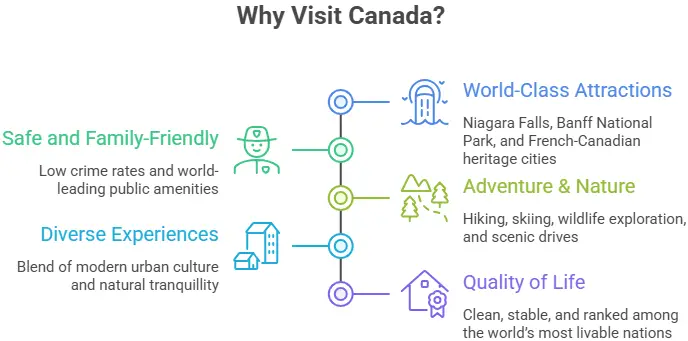
- World-Class Attractions: Niagara Falls, Banff National Park, and French-Canadian heritage cities like Montreal and Quebec.
- Safe and Family-Friendly: Low crime rates and world-leading public amenities.
- Adventure & Nature: Hiking, skiing, wildlife exploration, and scenic drives.
- Diverse Experiences: Blend of modern urban culture and natural tranquillity.
- Quality of Life: Clean, stable, and ranked among the world’s most livable nations.
Canada TRV Update — August 2026: Visa fee CAD 100 (~INR 6,800) + Biometrics CAD 85 (~INR 5,780) per person │ Biometrics collected by VFS Global in India (10 cities) │ Indian passport holders are NOT eligible for the Canadian eTA — a full TRV is required │ Super Visa requires CAD 100,000 Canadian medical insurance │ Check current IRCC processing times at ircc.canada.ca/english/information/times/
IMPORTANT: Indian passport holders are NOT eligible for the Canadian eTA (Electronic Travel Authorization) — regardless of prior UK or US visa stamps, unless a specific exception applies (see below). All Indian nationals require a Temporary Resident Visa (TRV)
Canada Visa for Indians
Indian passport holders must apply for a Temporary Resident Visa (TRV) — Canada's official visitor visa — to enter Canada for tourism, leisure, or short stays. Indian nationals are not eligible for the Canadian eTA in most cases, regardless of travel history to other countries. The TRV allows stays of up to 6 months per visit, with a multiple-entry visa typically valid for up to 10 years or until passport expiry, whichever comes first. Applications are submitted online through IRCC at ircc.canada.ca, with biometrics collected by VFS Global at 10 locations across India.
Can Indian Passport Holders Use the Canadian eTA?
No — Indian passport holders are not eligible for the Canadian Electronic Travel Authorization (eTA) in most cases. All Indian nationals must obtain a Temporary Resident Visa (TRV) from IRCC at ircc.canada.ca, regardless of other country visa stamps or travel history.
The one exception: Indian nationals who currently hold a valid U.S. nonimmigrant visa, or who have held a valid Canadian TRV within the past 10 years, may be eligible to apply for an eTA instead — but only when travelling to Canada by air. This does not apply to land or sea entry. Verify your specific eligibility at canada.ca/en/immigration-refugees-citizenship/services/visit-canada/eta/eligibility.html before assuming eTA applies to you.
Common mistake: Indian travellers sometimes assume that holding a valid UK visa unlocks eTA eligibility for Canada. It does not — only a current US nonimmigrant visa or a Canadian TRV held within the last 10 years qualifies for the exception.
What Are the Types of Canada Visitor Visa?
| Visa Type | Purpose / Key Features | Eligibility Criteria (General) | Main Requirements & Funds Proof | Notes / Stay Duration |
|---|---|---|---|---|
| Standard Visitor Visa (Temporary Resident Visa – TRV) | For tourism, visiting family or friends, and short-term business visits. | Valid passport Good health (medical exam may be required) No criminal or immigration issues Proof of intent to leave Canada |
Valid passport, application forms, proof of sufficient funds, travel itinerary, invitation letter if applicable, biometrics, and visa fee. | Stay usually up to 6 months per visit. Note: 6 months is the general rule, but it is not guaranteed as the final decision rests with the border services officer at the port of entry. |
| Multiple-Entry Visitor Visa | Allows multiple entries into Canada during visa validity. | Same eligibility as Standard TRV | Same requirements as Standard TRV, including biometrics. | Each stay generally up to 6 months. |
| Single-Entry Visitor Visa | Allows only one entry into Canada. | Same eligibility as Standard TRV | Same requirements as Standard TRV, including biometrics. | Suitable for one-time visits. |
| Super Visa (Parents & Grandparents) | Multiple-entry visa for parents and grandparents of Canadian citizens or PRs, valid up to 10 years. | Relationship to sponsor required; sponsor's income must meet or exceed the Low Income Cut-Off (LICO) for their family size, for two consecutive tax years (effective March 2026); medical exam mandatory for the applicant. | TRV requirements plus mandatory Canadian medical insurance — minimum CAD 100,000 coverage, minimum 1-year validity, from a Canadian insurance company only. | Stay up to 5 years per entry (extendable by 2 years while inside Canada). |
What is Canada Super Visa for Indian Parents and Grandparents?
Canada Super Visa allows parents and grandparents of Canadian citizens and permanent residents to stay in Canada for up to 5 years per entry — compared to just 6 months on a standard TRV. It's a multiple-entry visa valid for up to 10 years.
Eligibility: Parents and grandparents of Canadian citizens or PRs. The Canadian host (sponsor) must meet or exceed the Low Income Cut-Off (LICO) plus a required margin for their family size.
2026 income update: As of March 31, 2026, sponsors must meet the LICO threshold for two consecutive tax years, not just the most recent one. Sponsors can also use either of the past two tax years if one was stronger. As of the same update, the visiting parent or grandparent's own Canadian-earned income can now count toward meeting the threshold if the sponsor falls slightly short — foreign income does not qualify.
2026 LICO reference figures (verify current amounts at ircc.canada.ca before applying):
- Family of 1 (sponsor only): approximately CAD 30,500
- Family of 4: approximately CAD 56,700
- Each additional family member: approximately CAD 8,200 more
Mandatory insurance: A minimum CAD 100,000 medical insurance policy, valid for at least 1 year from the date of entry, purchased from a Canadian insurance company. Indian travel insurance policies are not accepted.
Medical exam: Mandatory for the visiting parent or grandparent.
Processing time: Varies significantly — recent estimates have ranged from around 8 weeks to well over 100 days. Check current Super Visa processing times at ircc.canada.ca/english/information/times/.
Y-Axis manages both the Canadian sponsor's LICO documentation and the Indian parent or grandparent's complete Super Visa application — with a dedicated Canada office to verify sponsor eligibility directly.
What Insurance Is Required for Canada Super Visa?
Canada Super Visa requires a minimum CAD 100,000 medical insurance policy from a Canadian insurance company — Indian travel insurers are not accepted. The policy must be valid for at least 1 year from the date of entry into Canada.
- Approved provider types: Major Canadian insurers offering Super Visa–compliant policies include Manulife, Sun Life Financial, Desjardins, Blue Cross (provincial variants), and GMS (Guard.me Medical Services). All accept online applications from India.
- Approximate cost: Ranges from around CAD 1,000 to CAD 3,500+ per year depending on the applicant's age and pre-existing conditions — older applicants and those with pre-existing conditions generally pay more.
- Refund policy: Most Canadian insurers offer a full refund if the Super Visa application is refused — confirm this with the specific insurer before purchasing.
Understanding LICO for Super Visa Sponsors
LICO (Low Income Cut-Off) is the minimum income threshold a Canadian sponsor must meet to qualify for Super Visa sponsorship. As of 2026, sponsors must meet this threshold for two consecutive tax years. Family size includes the sponsor, their spouse, dependent children, and the parent(s)/grandparent(s) being sponsored.
Sponsors must provide a CRA Notice of Assessment for the relevant years, along with an employment letter and recent pay stubs. A spouse or common-law partner can act as a co-signer, combining income to meet the threshold. As of March 2026, if the sponsor's income falls slightly short, the visiting parent or grandparent's own Canadian-earned income may also be counted.
Benefits of a Visit Visa to Canada
- Simplified Global Access: Travel freely to Canada for leisure, family, or business under one visa.
- Extended Validity: Enjoy multi-year access without repeated reapplication.
- Convenient Online Filing: Easy, transparent, and trackable digital process.
- Independent Application: Apply without sponsor or invitation, if financially self-sufficient.
- Safe and Family-Friendly: Canada offers a secure, welcoming environment for visitors.
- Professional Visa Support: Y-Axis ensures document accuracy and compliance, enhancing approval confidence.
*Want to apply for a Canada Dependent Visa? Talk to experts at Y-Axis to help you with the steps.
Top 5 Best Places to Visit in Canada
Canada is one of the most diverse destinations in the world, known for its vast natural landscapes, vibrant multicultural cities, and rich indigenous and colonial heritage. From the rugged peaks of the Canadian Rockies to the cosmopolitan streets of Toronto, the best places to visit in Canada offer a unique and memorable experience for every kind of traveller.
Here are the top places to visit in Canada for Indian travellers:
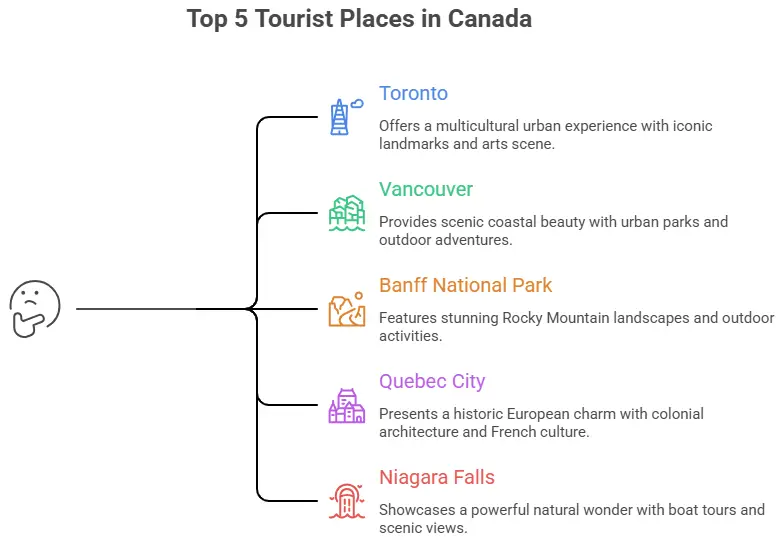
- Toronto: The largest city in Canada and one of the most multicultural cities in the world, Toronto is home to nearly 100 ethnic communities, making it a truly global destination. The city is home to iconic landmarks such as the CN Tower, the tallest free-standing structure in the Western Hemisphere, the historic Distillery District, and the bustling St. Lawrence Market. If you are an arts and culture enthusiast, the Art Gallery of Ontario and the Royal Ontario Museum are must-visit institutions. Toronto is also famous for its annual Toronto International Film Festival, one of the most prestigious film festivals in the world.
- Vancouver: Situated between the Pacific Ocean and the Coast Mountains, Vancouver is one of the most scenic cities in Canada and a gateway to some of the country's most spectacular natural landscapes. The city is home to Stanley Park, one of the largest urban parks in North America, the vibrant Granville Island Public Market, and the world-famous Capilano Suspension Bridge. Vancouver is also renowned for its thriving arts scene, diverse culinary culture, and as the host city of the 2010 Winter Olympic Games. The nearby Sea-to-Sky Highway, connecting Vancouver to Whistler, is considered one of the most scenic drives in the world.
- Banff National Park: Located in the heart of the Canadian Rockies in Alberta, it is Canada's oldest and most visited national park, attracting nearly 4 million visitors each year. The park is home to the iconic turquoise waters of Lake Louise, the stunning Icefields Parkway, and the historic Banff Upper Hot Springs. Adventure enthusiasts can enjoy hiking, skiing, and wildlife spotting, while the Banff Gondola offers panoramic views of the surrounding mountain peaks. Banff is consistently ranked among the tourist places in Canada that every international traveller must experience at least once.
- Quebec City: Founded in 1608, Quebec City is one of the oldest cities in North America and the only fortified city north of Mexico, with its well-preserved colonial architecture and cobblestone streets recognised as a UNESCO World Heritage Site. The city's iconic Château Frontenac, towering over the historic Old Quebec neighbourhood, is one of the most photographed hotels in the world. Quebec City is also celebrated for its vibrant French-speaking culture, world-class cuisine, and its annual Winter Carnival, one of the largest winter festivals in the world. For Indian travellers visiting Canada, Quebec City offers a uniquely European cultural experience within North America.
- Niagara Falls: One of the most iconic natural wonders in the world and one of the most popular places to visit in Canada, Niagara Falls attracts nearly 12 million visitors every year. Located on the border of Ontario and New York State, the falls comprise three sections, Horseshoe Falls, American Falls, and Bridal Veil Falls, collectively producing one of the most powerful and visually stunning waterfalls on earth. Visitors can experience the falls up close on the iconic Maid of the Mist boat tour or explore them from behind through the Journey Behind the Falls experience. The wider Niagara region also offers scenic hiking trails, wineries, and a range of year-round outdoor activities.
Canada Visit Visa: Key Travel Statistics and Trends
- Strong Post-Pandemic Recovery: Canada welcomed over 22 million international visitors in 2024, generating CAD 32 billion in visitor spending (Statistics Canada, 2025).
- India Among Top 5 Source Markets:
- Over 370,000 Indian arrivals in 2024 (↑18% YoY).
- CAD 2.1 billion in total travel expenditure by Indian visitors.
- VFR & Family Travel Growth: Canada’s Indian diaspora (1.8M+) drives strong Visiting Friends & Relatives (VFR) travel demand.
- Enhanced Air Connectivity: Direct flights between Delhi, Mumbai, Amritsar and Toronto, Vancouver, Montreal continue to expand.
- Event Tourism: International sports events, film festivals, and university convocations attract recurring Indian travellers.
Apply For Your Canada Visit Visa Online In 2 Minutes
Get your Canada Visit Visa now, click here to apply. 👉
Who Is Eligible for a Canada Visitor Visa?
To qualify for a Canada Visitor Visa, applicants must meet the following mandatory eligibility requirements as per Immigration, Refugees and Citizenship Canada (IRCC) guidelines:
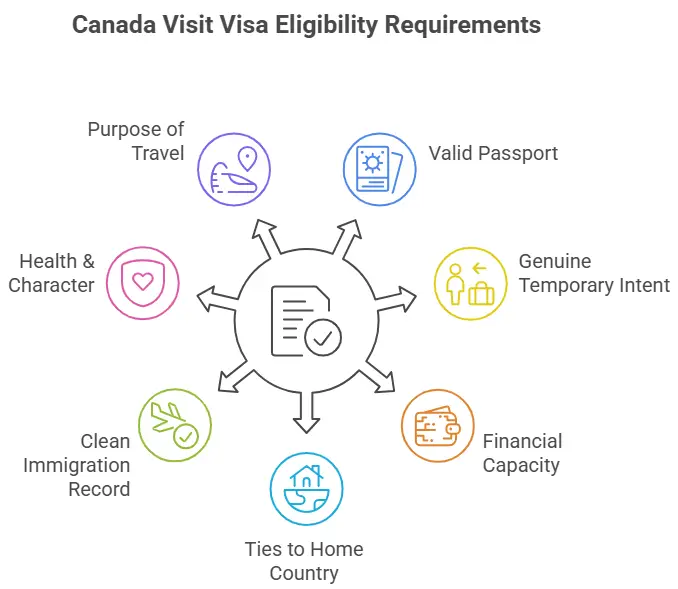
- Valid Passport: Must hold a current passport valid for the entire intended stay in Canada.
- Genuine Temporary Intent: Must demonstrate clear intent to visit Canada temporarily and return home after the authorized stay.
- Financial Capacity: Must show sufficient funds to cover travel, accommodation, and living expenses during the visit.
- Ties to Home Country: Must provide evidence of strong ties—such as employment, family, property, or business—to confirm intent to return.
- Clean Immigration Record: Must have no previous visa overstays, deportations, or immigration violations in Canada or any other country.
- Health & Character Requirements: Must be in good health and, if requested, undergo a medical examination; must have no criminal record and provide police clearance if required.
- Purpose of Travel: Must clearly outline the reason for visiting Canada—tourism, family, or short-term business—and provide relevant documentation or invitation letters where applicable.
- Biometrics: Applicants aged 14-79 must provide fingerprints and a photograph as part of the application. Biometrics are valid for 10 years from the date of collection.
Note: Additional requirements may apply based on nationality, travel history, and personal circumstances.
Where Do Indians Submit Biometrics for Canada Visa?
In India, Canada visa biometrics are collected by VFS Global, which operates the official Canada Visa Application Centres (VACs) across 10 Indian cities: New Delhi, Mumbai, Bengaluru, Chennai, Hyderabad, Kolkata, Ahmedabad, Chandigarh, Jalandhar, and Pune.
Who needs biometrics: Most applicants aged 14–79.
- Validity: Biometrics are valid for 10 years. If you've given biometrics for a Canada application within the last 10 years, you may not need to re-enrol — your Biometric Instruction Letter (BIL) will confirm this.
- Fee: CAD 85 per person (approximately INR 5,780), capped at CAD 170 for a family applying together.
- Booking: Book through the official VFS Global Canada portal at visa.vfsglobal.com/ind/en/can, after receiving your Biometric Instruction Letter (BIL) from IRCC. The BIL typically gives a 30-day window to complete biometrics — missing this deadline can result in refusal.
- At the appointment: Fingerprints and a digital photograph are collected — no documents are reviewed, since the full application is submitted online beforehand.
What Documents Are Required for a Canada Visitor Visa?
The documents required for a Canada Visitor Visa are as follows:
- Valid Passport – A valid passport with a minimum validity of 6 months beyond your intended travel date and at least 2 blank pages for visa and entry stamps.
- Visa Application Form – Completed and signed Canada visitor visa application form.
- Photographs – A recent digital photograph as per IRCC specifications.
- Proof of Funds – Bank statements, income tax returns, salary slips, or sponsorship letter showing financial ability to cover expenses.
- Travel Itinerary – Flight bookings, hotel reservations, and planned activities in Canada.
- Letter of Invitation (if applicable) – From a host in Canada, including their details and purpose of visit.
- Ties to Home Country – Employment letter, No Objection Certificate (NOC), business ownership proof, property documents, or family commitments to demonstrate intent to return to India after the visit.
- Medical Examination (if required) – Health check-up for long stays or applicants from certain countries. Note: It is not typical for standard visits unless IRCC instructs applicants.
- Police Clearance Certificate (if required) – Proof of no criminal record.
- Visa Fee Payment Receipt – Proof of payment for visa processing.
Note: Police certificates/medical exams are only required if IRCC requests. Up-front medicals are generally not needed for typical short visits. Additional documents may be required based on individual circumstances.
Also, read…
Important points to know about the Canadian Visitor Visa
How Do Indian Applicants Apply for a Canada Visitor Visa?
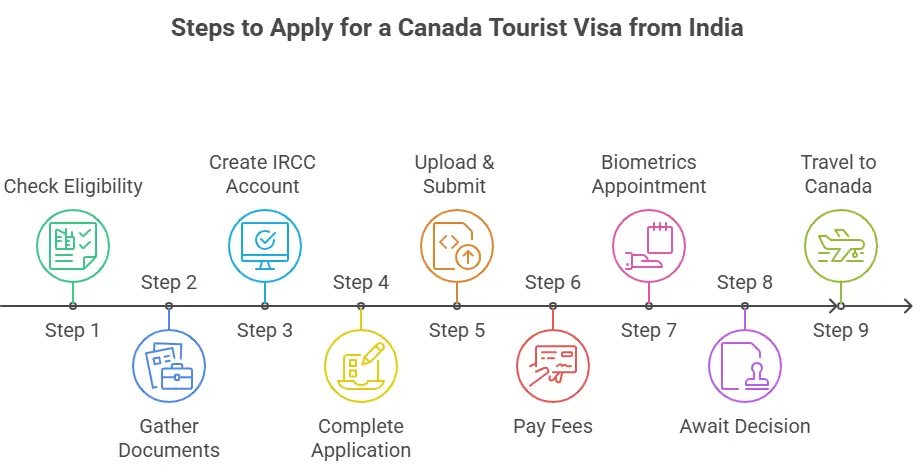
Step 1: Check Eligibility
Ensure you meet all the requirements set by IRCC, including financial stability, travel history, and clear intent of visit.
Step 2: Gather Documents
Prepare all necessary documents, including a passport, financial proof, a travel itinerary, an invitation letter (if applicable), and any supporting paperwork.
Step 3: Create an IRCC Account
Create an account on the official IRCC portal before proceeding with the application.
Step 4: Complete the Application
Fill out the Canada visitor visa application form online through your IRCC account.
Step 5: Upload Documents and Submit Application
Upload all required documents and submit your application through the IRCC portal.
Step 6: Pay the Visa Fee
Pay the required visa processing fee and biometrics fee online through the IRCC portal.
Step 7: Biometrics Appointment
Schedule and attend a biometrics appointment at the nearest Visa Application Centre (VAC) in India upon receiving your Biometric Instruction Letter (BIL).
Step 8: Await a decision
If approved, you will receive a request to submit your passport to the Visa Application Centre for visa stamping.
Step 9: Travel to Canada
Once your visa is issued, you may proceed with your travel arrangements to fly to Canada.
*Want to apply for a visit visa? Let Y-Axis guide you with the steps.
How Long Does a Canada Tourist Visa Take From India?
The processing time for a Canadian Tourist Visa from India is typically 2 to 3 months. However, according to the latest IRCC update, the current processing time for Indian applicants is 57-71 days.
Note: The processing times vary by country and are updated regularly on the official IRCC website.
Read more…
IRCC speeds up Canada Work Visas and Tourist Visas for Indians. Check your eligibility for Canada!
How Much Does a Canada Visitor Visa Cost for Indians?
| Fee Type | CAD | Approx. INR* |
|---|---|---|
| TRV (visitor visa), per person | CAD 100 | ~INR 6,800 |
| Biometrics, per person | CAD 85 | ~INR 5,780 |
| Family visa fee (5+ applying together) | CAD 500 max | ~INR 34,000 |
| Family biometrics (applying together) | CAD 170 max | ~INR 11,560 |
| Super Visa application fee | CAD 100 | ~INR 6,800 |
| Super Visa insurance (per year, varies by age) | CAD 1,000–3,500+ | ~INR 68,000–238,000+ |
*Approximate conversion at 1 CAD ≈ INR 68 (August 2026) — check xe.com for the live rate.
Fees are non-refundable and paid online through the IRCC portal. Confirm the current fee schedule at ircc.canada.ca before applying, as government fees are periodically revised.
Financial Evidence for Canada Visitor Visa
IRCC does not publish a fixed minimum bank balance for the TRV. As an informal reference point, applicants often prepare evidence sufficient for a trip of the planned length — commonly cited around CAD 2,500–5,000 for a 2-week visit. What matters most:
- 3–6 months of consistent bank statements showing regular income (sudden large deposits can raise questions and should be explained)
- Income Tax Return (ITR) filings for the last 2–3 years
- Salary slips for the last 3–6 months
- Property ownership documents or fixed deposit certificates, where relevant
For sponsored visits, an invitation letter from the Canadian host, along with proof of their immigration status and financial capacity, supports the application. For Super Visa applicants, the Canadian sponsor's LICO-qualifying income replaces the need for the parent's
Common Reasons for Canada TRV Refusal
- Financial inconsistency or insufficient evidence of funds
- Weak ties to India (no clear reason to return)
- Unclear or poorly documented purpose of travel
- Prior visa violations or undisclosed previous refusals
- Failed medical examination (where required)
- Missing or incomplete documents
- For Super Visa applications, sponsor LICO or insurance documentation issues own extensive financial evidence.
How Can Y-Axis Help You?
Y-Axis is one of the world’s leading visa and immigration companies. Our experience and expertise in the Canada visit visa process makes us your partner of choice for your visa application. Our teams will help you with:Immigration documents checklist
- Complete application processing
- Forms, documentation & application filing
- Assistance with booking appointments for Interviews
- Preparing the client to face the Interview at the Consulate
- Updates & Follow-up
Y-Axis snapshot
1M
Successful applicants
1500+
Experienced counselors
25Y+
Expertise
50+
Offices
Don't know what to do?
Get Free Counselling
Looking For Inspiration
Explore What Global Indians have to say about Y-axis