


Posted on August 07 2025
What are the most in-demand jobs in Australia for the next 10 years?

By , Editor
Updated February 11 2026
What are the most in-demand jobs in Australia for the next 10 years?
The most in-demand jobs in Australia over the next 10 years are expected to be in the healthcare, skilled trades, engineering, and construction sectors. Job roles such as registered nurses, tradespeople, engineers, and ICT professionals will be listed as some of the most sought-after jobs in Australia. Skilled foreign workers looking to live, work, and settle in Australia over the next decade can find plenty of job opportunities in sectors with skill shortages. The country’s growing economy, newly announced government policies and initiatives, and the growing opportunities in the regional Australian areas are some factors favouring foreign workers.
*Want to apply for an Australian work visa? Let Y-Axis help you with the process.
List of high-demand Jobs in Australia in the next 10 years
Australia currently has over 330,000 job vacancies, and this number is expected to increase in the future, creating more job vacancies for foreign workers. According to reports, engineering, Healthcare, IT, trades, and construction will have the highest-demand jobs in Australia in the next 10 years.
The table below has the most in-demand jobs in Australia for the next 10 years:
|
Sector |
Job Role |
|
Healthcare |
Registered Nurses |
|
Biomedical Engineers |
|
|
Occupational Therapists & Physiotherapists |
|
|
Information Technology (IT) |
Software Developers & Engineers |
|
Cybersecurity Specialists |
|
|
Data Analysts & Business Intelligence |
|
|
Data Analysts & Business Intelligence |
|
|
Engineering |
Civil Engineers |
|
Renewable Energy Engineers |
|
|
Mechanical Engineers |
|
|
Construction |
Construction Managers |
|
Tradespeople |
|
|
Other In-Demand Areas |
Chefs |
|
Accountants |
|
|
Childcare Workers |
|
|
Project Managers |
Also, read...
1 Million Jobs in Australia Over the Next Decade: Job Outlook and Work Visa Options
Top 5 factors that are attracting skilled foreign workers to Australia
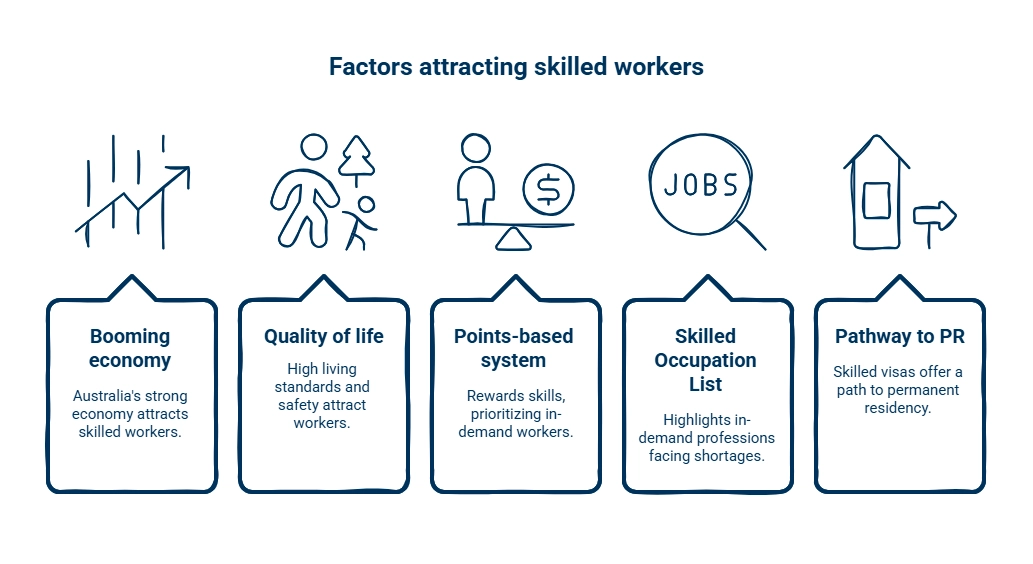
Australia is one of the most popular destinations for skilled foreign workers looking to settle abroad. The country’s booming economy, high standards of living, and a points-based system that focuses more on in-demand skills are some of the major factors that drive foreign workers to Australia.
Given below is a detailed overview of the top 5 factors that attract skilled foreign workers to Australia:
- Booming economy: Australia has a diverse and strong economy with a low unemployment rate and a high per capita income.
- Quality of life: The country has a high standard of living and continuously ranks in the global quality of life index. Australia has a good education and healthcare system, and provides a safe environment for foreign nationals.
- Points-based immigration system: Australia has a points-based system that rewards points based on age, language proficiency, education, skill proficiency, etc., prioritizing skilled workers with in-demand skills.
- Skilled Occupation List (SOL): The Australian government regularly updates the SOL, which prioritizes the country's labor market needs. The list highlights professions that are currently in demand and facing skill shortages.
- Pathway to PR: Most skilled migration visas in Australia offer a direct path to PR, giving skilled workers a chance for long-term settlement.
*Want to work in Australia? Avail Y-Axis Resume marketing services to find the right one.
Immigration pathways for High Demand Jobs in Australia
| Title | Link |
|---|---|
| How can I migrate to Australia as a Civil Engineer? | https://www.y-axis.com/blog/how-can-i-migrate-to-australia-as-a-civil-engineer/ |
| How can I migrate to Australia as a Registered Nurse? | https://www.y-axis.com/blog/how-can-i-migrate-to-australia-as-a-registered-nurse/ |
| How to Immigrate to Australia as a Social Worker? | https://www.y-axis.com/blog/how-to-immigrate-to-australia-as-a-social-worker/ |
| How can I migrate to Australia as an Architect? | https://www.y-axis.com/blog/migrate-to-australia-as-architect/ |
Immigration pathways for High Demand Jobs in Australia
*Are you looking for step-by-step assistance with Australian immigration? Contact Y-Axis, the world’s No. 1 overseas immigration consultancy, for end-to-end assistance!
FAQs
1. Which companies in Australia are hiring for in-demand jobs and offering visa sponsorship?
Many employers in Australia hire overseas professionals and support work visas, particularly in sectors facing skill shortages. Companies offering visa sponsorship are most common in IT, engineering, healthcare, construction, mining, and aged care. Large employers, government contractors, hospital networks, and regional businesses regularly sponsor skilled workers when local talent is unavailable. Visa sponsorship depends on occupation eligibility, skills assessment, and salary thresholds.
2. Which regional areas in Australia have the highest demand for education professionals?
The strongest demand for education professionals is in regional and remote Australia, including parts of Queensland, New South Wales, Western Australia, Northern Territory, and South Australia. Teachers specialising in secondary maths, science, special education, and early childhood education are particularly sought after. Regional roles often come with incentives such as relocation support and migration benefits.
3. What are the fastest-growing in-demand jobs in Australia in 2026?
In 2025, Australia’s fastest-growing in-demand jobs are driven by digital transformation, infrastructure investment, and the clean energy transition. High-growth roles include:
- Cybersecurity specialists
- Software engineers and developers
- Registered nurses and aged care workers
- Renewable energy technicians
- Construction managers and engineers
- Data analysts and AI specialists
These occupations align closely with Australia’s skilled migration priorities.
4. Where can I find current job openings in Australia’s cybersecurity sector?
Cybersecurity job openings are commonly listed on major Australian job portals, professional networking platforms, and employer career pages. Demand is strong across banking, government, defence, healthcare, and technology companies. Roles such as security analysts, SOC analysts, cloud security engineers, and penetration testers are consistently advertised nationwide.
5. Which in-demand jobs in Australia require project management skills?
Project management skills are highly valued across multiple in-demand occupations in Australia. Common roles include:
- IT project managers
- Construction and infrastructure project managers
- Engineering project managers
- Business transformation and change managers
- Healthcare and digital transformation project leads
Professionals with formal project management certifications often have stronger employment prospects.
6. Where can I find job listings for registered nurses in Australia?
Job listings for registered nurses are widely available through hospital networks, aged care providers, state health departments, and national job portals. Australia has ongoing demand for nurses across acute care, aged care, mental health, and regional healthcare services. Overseas nurses must meet registration and skills assessment requirements before employment.
7. Are there strong employment opportunities in Australia for renewable energy technicians?
Yes. Australia’s transition to clean energy has created strong demand for renewable energy technicians, including solar installers, wind turbine technicians, and energy maintenance specialists. Job growth is particularly strong in regional areas where large-scale solar and wind projects are expanding.
8. What are the top 10 in-demand jobs in Australia right now?
The most consistently in-demand jobs in Australia currently include:
- Registered nurses
- Software engineers and developers
- Cybersecurity specialists
- Electricians and skilled tradespeople
- Construction managers
- Aged care and disability support workers
- Mechanical and civil engineers
- Data analysts and data scientists
- Teachers (especially secondary and early childhood)
- Renewable energy technicians
These roles reflect long-term skill shortages across the economy.
9. How do starting salaries compare between software engineers and registered nurses in Australia?
Starting salaries for software engineers in Australia are generally higher than for registered nurses. Graduate software engineers typically earn AUD 70,000–90,000, while entry-level registered nurses usually earn AUD 65,000–75,000, depending on location and employer. Nurses benefit from structured pay scales, penalties, and strong job security, while software roles often offer faster salary growth.
Salary figures are indicative averages and may vary by employer, location, and experience.
10. What are the best job search websites for skilled tradespeople in Australia?
Skilled tradespeople can find in-demand job listings through major Australian job portals, industry-specific platforms, labour-hire agencies, and employer career pages. Trades such as electricians, plumbers, carpenters, and mechanics are especially sought after, particularly in regional and infrastructure-driven projects.
11. How does Australia’s skills shortage list influence job demand?
Australia’s skills shortage lists play a major role in identifying occupations that lack sufficient local workers. These lists are updated based on labour market data and employer demand across states and regions. Jobs included on these lists often receive priority in migration programs, state nominations, and employer sponsorship. Over the next decade, occupations consistently appearing on shortage lists—such as healthcare, engineering, construction, and technology roles—are expected to remain in demand. For skilled professionals, aligning their experience with these occupations can significantly improve job prospects and long-term settlement opportunities in Australia.
12. Which industries in Australia will create the most long-term employment opportunities?
Industries expected to create sustained employment include healthcare and aged care, construction and infrastructure, education, information technology, renewable energy, and professional services. Population growth, urban development, digital transformation, and climate-focused investments are driving demand across these sectors. Unlike short-term hiring spikes, these industries are supported by long-term government policies and economic planning. For job seekers and migrants, choosing careers within these sectors offers better job stability, career progression, and stronger alignment with Australia’s future workforce needs.
13. How does regional migration policy affect job demand in Australia?
Australia’s regional migration policy encourages skilled workers to live and work outside major cities. Many regional areas face acute labour shortages in healthcare, education, trades, agriculture, and community services. To address this, the government offers incentives such as extra PR points, faster visa processing, and dedicated regional visas. As a result, job demand in regional Australia is expected to remain strong over the next decade. Migrants willing to work regionally often experience less competition, better employer access, and clearer pathways to permanent residency.
14. What role does replacement demand play in Australia’s future job market?
Replacement demand refers to job openings created when existing workers retire or leave the workforce. In Australia, a large portion of future job opportunities will come from replacement demand rather than new job creation. Many professionals in healthcare, education, public administration, and skilled trades are approaching retirement age. Even during periods of slower economic growth, employers must fill these positions to maintain services. This creates consistent employment opportunities and makes Australia’s job market more resilient for long-term workers and migrants.
15. How important is English proficiency for securing in-demand jobs in Australia?
English proficiency is a key requirement for most in-demand jobs in Australia, especially in healthcare, education, and customer-facing roles. Strong language skills improve workplace communication, safety, and productivity. Many employers also view good English proficiency as a sign of adaptability and professionalism. For migrants, meeting English language requirements not only improves employability but also increases points for skilled migration visas. Investing time in improving English skills can significantly enhance job prospects and career growth in Australia.
16. Are mid-career professionals in demand in Australia?
Yes, Australia places strong value on mid-career professionals with practical experience. Many industries prefer candidates who can contribute immediately with minimal training. Professionals with 5–15 years of experience are particularly attractive in sectors such as engineering, IT, healthcare, construction, and management. Mid-career workers often qualify for senior or specialist roles, which are harder to fill locally. This makes them highly competitive in both the job market and skilled migration programs over the next decade.
17. How do licensing and accreditation affect access to in-demand jobs in Australia?
Licensing and accreditation are important factors for regulated professions such as healthcare, engineering, teaching, and trades. While these requirements can add time to the job search process, they also ensure quality standards and worker protection. Australia provides structured pathways, assessments, and bridging programs to help overseas-trained professionals meet local standards. Once licensed, workers often benefit from strong job security and career mobility. Understanding accreditation requirements early helps candidates plan their migration and employment journey effectively.
18. What impact will population growth have on job demand in Australia?
Australia’s population growth is a major driver of job demand across multiple sectors. As the population increases, so does the need for healthcare, housing, education, transportation, and public services. This creates employment opportunities in construction, healthcare, teaching, urban planning, and community services. Migrants play a critical role in supporting population growth and filling workforce gaps. Over the next 10 years, population-driven demand will continue to shape Australia’s labour market and employment priorities.
19. How does Australia support workforce upskilling for future jobs?
Australia invests heavily in workforce development through vocational training, higher education, and government-funded upskilling programs. As industries evolve, workers are encouraged to upgrade their skills to meet new demands, particularly in digital, technical, and sustainability-focused roles. Employers also support training and certifications to retain skilled staff. For migrants and local workers alike, continuous learning improves employability and career resilience. This focus on upskilling ensures Australia’s workforce remains competitive and adaptable over the next decade.
20. Is Australia’s job market suitable for long-term career planning?
Yes, Australia offers a stable and structured job market suitable for long-term career planning. Strong labour laws, clear career pathways, and consistent demand across key industries provide job security. Many roles also offer progression into leadership or specialist positions. Combined with permanent residency options, access to healthcare, education, and social benefits, Australia provides a supportive environment for professionals and families seeking long-term settlement and career growth.
Tags:
Most in-demand jobs in Australia in the next 10 years
Jobs in Australia
Jobs in Australia
Work in Australia
most in-demand jobs in Australia
most in-demand occupations in Australia
Australian immigration
Migrate to Australia
Share
Y - Axis services

Get it on your mobile

Get News Alerts

Contact Y-Axis
Latest Article
Popular Post
Trending Article

Posted On February 20 2026
How to Migrate to Germany as a Registered Nurse?