

Posted on October 16 2026
Life in Thailand for Immigrants: Jobs, Visas, Cost of Living & Residency

By , Editor
Updated October 16 2026
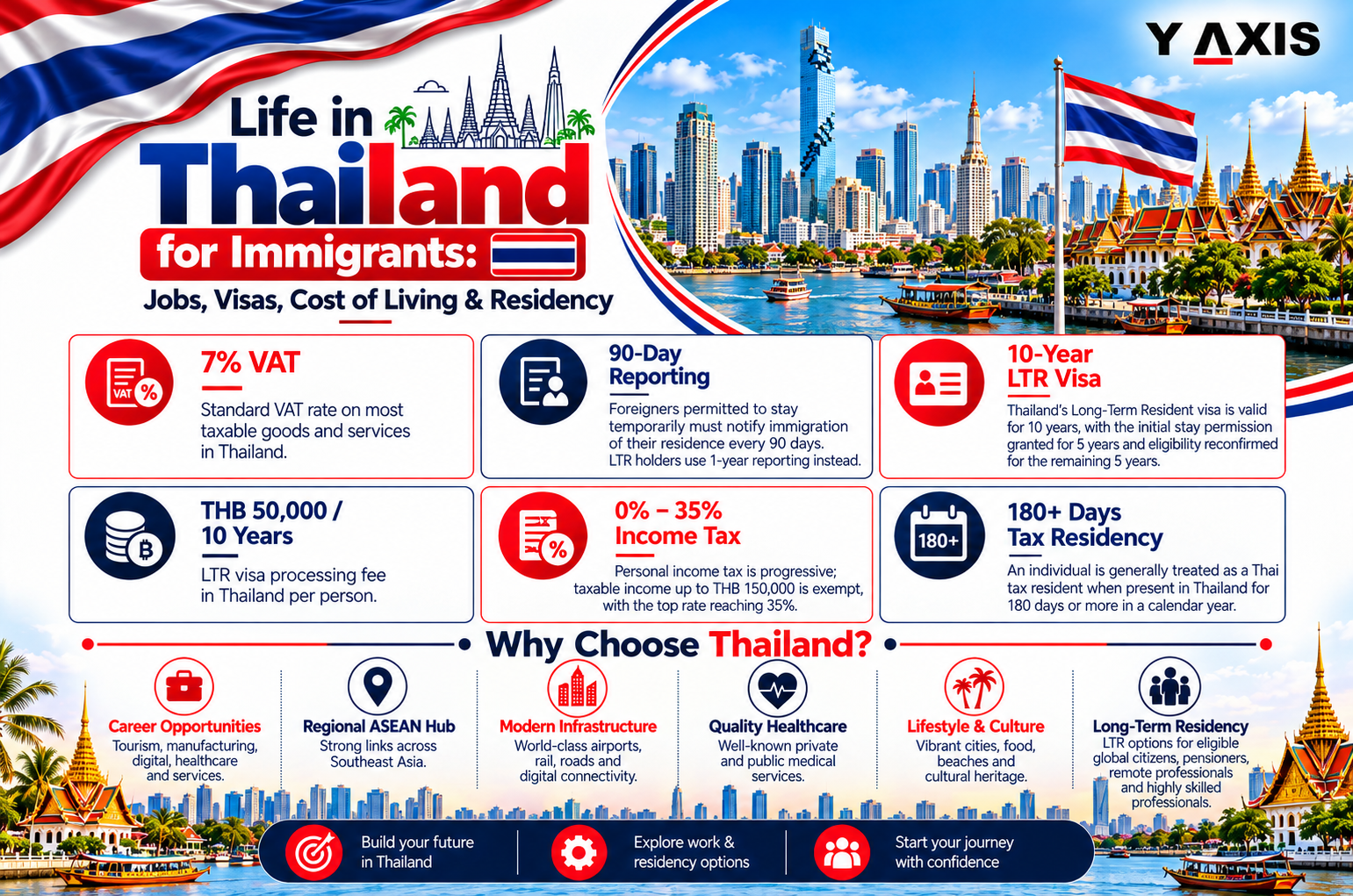
Life for immigrants in Thailand offers a low cost of living, a warm climate, and a growing job market in tourism, manufacturing, and technology. Most Indian professionals move on a Non-Immigrant B visa with a work permit, which needs a job offer from a Thai employer. Highly skilled professionals can apply for the 10-year Long-Term Resident (LTR) visa, which offers a flat 17% personal income tax rate. Remote workers can use the Destination Thailand Visa (DTV). Permanent residency is possible after 3 consecutive years on a work-based visa, but places are limited by a yearly quota. Sukhumvit, Sathorn, Chiang Mai, Phuket, and Pattaya are popular areas for expats.
Some quick facts about Thailand are as follows:
|
Population |
Approximately 66 million registered residents |
|
Capital |
Bangkok (Thailand's capital and largest city) |
|
Official Language |
Thai (English is widely used in international companies, tourism, and international schools) |
|
Currency |
Thai Baht (THB) |
|
Popular Immigrant Hubs |
Bangkok (Sukhumvit, Sathorn, Silom), Chiang Mai, Phuket, Pattaya |
|
Economy |
Strong tourism, automotive, electronics, and food-processing sectors; growing demand for IT, engineering, and hospitality professionals |
|
Typical Route to Long Stay |
Non-Immigrant B visa with a work permit, or the 10-year Long-Term Resident (LTR) visa for highly skilled professionals |
|
Long-Term Residency |
Permanent residency after 3 consecutive years on a work-based visa, subject to a yearly quota; citizenship by naturalisation after holding permanent residency |
*Want to settle in Thailand? Sign up with Y-Axis for end-to-end assistance.
Why Choose Thailand to Migrate Abroad?
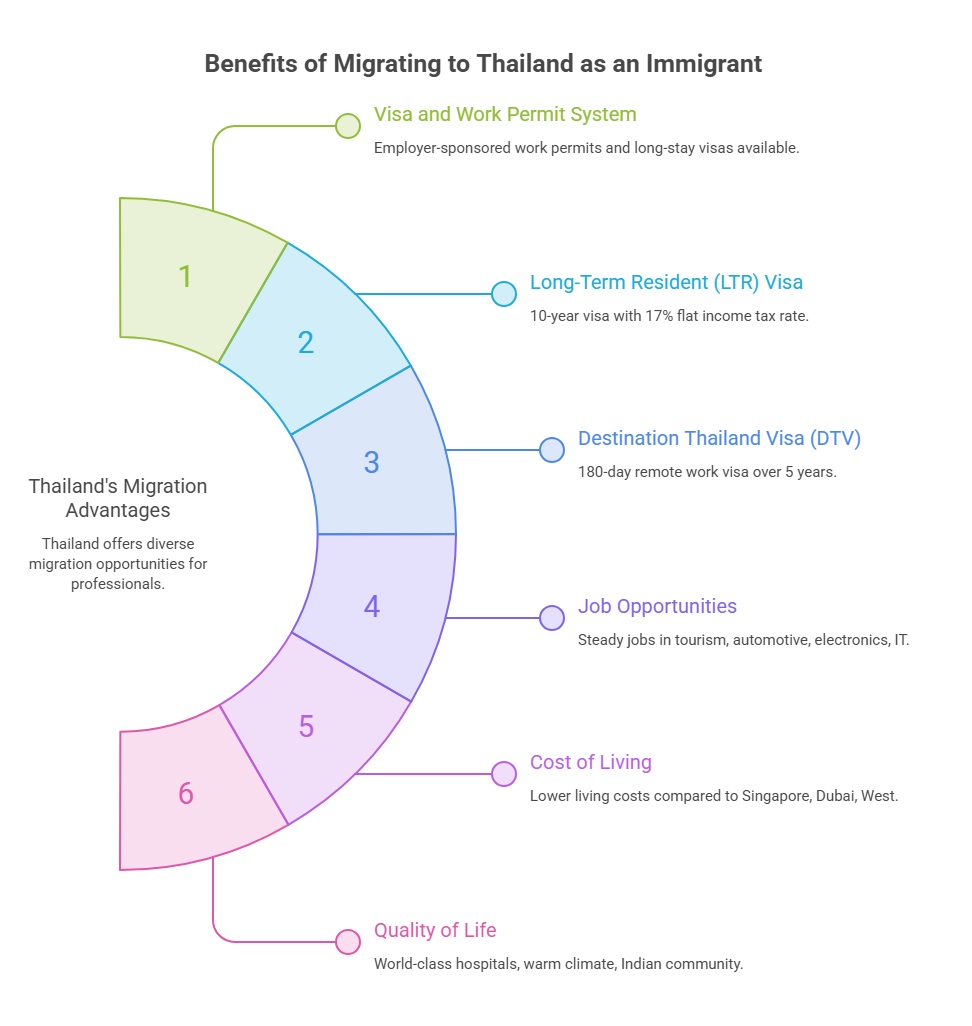
Thailand runs an employer-sponsored work permit system for foreign professionals. It also offers long-stay visas for highly skilled workers, remote workers, and investors.
Here is why you should choose a life in Thailand:
- The Non-Immigrant B visa and work permit cover a wide range of professional jobs with Thai employers.
- The 10-year Long-Term Resident (LTR) visa offers a flat 17% income tax rate for eligible highly skilled professionals.
- The Destination Thailand Visa (DTV) lets remote workers stay for up to 180 days per entry over 5 years.
- Tourism, automotive, electronics, and IT offer steady jobs for skilled professionals.
- Living costs are much lower than in Singapore, Dubai, or most Western countries.
- World-class private hospitals, a warm climate, and a large Indian community make settling in easier.
Note: Indian passport holders can visit Thailand visa-free for up to 30 days for tourism only. Anyone with a job offer must get the correct work visa and must not use the visa exemption. All visitors must complete the Thailand Digital Arrival Card (TDAC) online within 72 hours before arrival.
*Want to work in Thailand? Let Y-Axis assist you with the process.
Can I Move to Thailand as an Indian Immigrant?
Most Indians move to Thailand on a Non-Immigrant B visa with a work permit, which needs a confirmed job offer. Highly skilled professionals can apply for the 10-year LTR visa instead.
The steps to migrate to Thailand as an Indian professional are as follows:
Step 1: Secure a job offer from a Thai employer, since the work visa and work permit need this before you apply
Step 2: Select a suitable pathway, such as the Non-Immigrant B visa, the LTR visa, or the Destination Thailand Visa
Step 3: Your employer prepares the company documents needed for your visa and work permit
Step 4: Apply for your visa through Thailand's official e-visa website or a Royal Thai Embassy or Consulate in India
Step 5: Travel to Thailand once your visa is approved
Step 6: Apply for your work permit with the Ministry of Labour before you start working
Step 7: Open a local bank account, register with the Social Security Office, and get a Thai mobile number
Also, read...
Highest Paying Job Opportunities in Thailand
Best Visa Options to Live in Thailand
Thailand offers several routes depending on your job offer, income, skills, and investment profile. The table below shows the main options and their route to long-term residence.
|
Visa Type |
Best For |
Duration |
Long-Term Pathway |
|
Non-Immigrant B Visa + Work Permit |
Job offer from a Thai employer that meets company and salary rules |
Usually 1 year, renewable |
Can lead to permanent residency after 3 consecutive years |
|
Long-Term Resident (LTR) Visa |
Highly skilled professionals, remote workers, wealthy individuals, and retirees who meet income or asset rules |
10 years (5 + 5) |
Long-term stay; flat 17% tax rate for eligible highly skilled professionals |
|
Destination Thailand Visa (DTV) |
Remote workers and digital nomads with proof of funds of at least THB 500,000 |
5 years, up to 180 days per entry |
Does not lead to permanent residency |
|
Thailand Privilege Visa |
Applicants who pay a membership fee for long-stay benefits |
5 to 20 years, depending on the package |
Long-term stay; does not allow work by itself |
Also, read...
The Thailand Job Market Outlook
Best Areas to Live in Thailand
Thailand's job market and living costs vary by area. Choosing the right neighbourhood can influence your commute, cost of living, housing expenses, and overall quality of life.
The table below highlights the major Thailand areas and their best qualities for settlement abroad:
|
Area |
Best For |
Sightseeing |
Average Rent |
Job Market |
How Much You Can Save |
|
Sukhumvit (Bangkok) |
Corporate professionals & expats |
Benjakitti Park, EmQuartier and Terminal 21 malls |
THB 20,000-45,000/mo (1BR condo) |
Strong, MNCs, IT & services |
Moderate, higher rents |
|
Sathorn & Silom (Bangkok) |
Finance & business professionals |
Lumpini Park, Mahanakhon SkyWalk |
THB 18,000-40,000/mo (1BR condo) |
Strong, banking, finance & corporate HQs |
Moderate savings potential |
|
Chiang Mai (Nimman area) |
Remote workers & families |
Doi Suthep Temple, Old City |
THB 10,000-20,000/mo (1BR condo) |
Moderate, education, IT & tourism |
Good savings potential |
|
Phuket |
Hospitality professionals & families |
Patong Beach, Old Phuket Town |
THB 15,000-35,000/mo (1BR condo) |
Good, hotels, tourism & international schools |
Moderate savings potential |
|
Pattaya & Eastern Seaboard |
Manufacturing & engineering professionals |
Sanctuary of Truth, Jomtien Beach |
THB 10,000-25,000/mo (1BR condo) |
Good, automotive & industrial estates |
Good savings potential |
Note: Most Thai rentals need a security deposit of 2 months plus 1 month of rent in advance. Figures vary by building age, size, and distance from BTS or MRT stations. Confirm current listings before budgeting.
Also, read...
What Are the Most In-Demand Jobs in Thailand for the Next 10 Years?
Cost of Living in Thailand
Thailand's cost of living changes by location. Central Bangkok and Phuket cost the most, while Chiang Mai and smaller cities are more affordable.
Below is a breakdown of average monthly expenses for a single adult living outside the most premium areas:
|
Rent (1BR condo, outside prime area, e.g. Chiang Mai/Pattaya) |
THB 10,000-20,000/month |
|
Utilities (electricity, water & internet) |
THB 2,000-4,000/month |
|
Groceries |
THB 6,000-10,000/month |
|
Public Transport (BTS / MRT / buses) |
THB 1,500-3,000/month |
|
Healthcare |
Employees join the Social Security Fund through their employer and pay 5% of salary up to a monthly cap; most expats also take private health insurance |
|
Dining Out (per meal) |
THB 60-150 (local food), THB 300-600 (mid-range restaurant) |
|
Mobile & Internet |
THB 700-1,500/month |
|
Entertainment & Leisure |
THB 3,000-8,000/month |
Also, read...
What are the Eligibility Requirements for a Thailand Work Visa?
Is Thailand Expensive Compared to Malaysia or Singapore?
Thailand is much cheaper than Singapore, especially for rent, food, and transport. Living costs in Bangkok are broadly similar to Kuala Lumpur.
Salaries for foreign professionals are good compared to local living costs. Many immigrants can save well, especially outside central Bangkok and Phuket.
Central Bangkok and Phuket are the priciest areas. However, they also offer the most jobs in multinational companies, finance, and hospitality.
Work in Thailand
Thailand's job market is led by tourism, automotive, electronics, and food processing. Leading employers include Toyota Thailand, Delta Electronics, Agoda, CP Group, and international hotel chains.
The table below shows some of the most in-demand jobs in Thailand for immigrants.
|
Occupation |
Average Monthly Salary |
Demand Level |
Average Savings |
|
IT & Software Development |
THB 60,000-150,000 |
High |
THB 20,000-60,000/month |
|
Automotive & Electronics Engineering |
THB 50,000-120,000 |
High |
THB 15,000-45,000/month |
|
Finance & Shared Services |
THB 45,000-120,000 |
High |
THB 12,000-40,000/month |
|
International School Teaching |
THB 35,000-100,000 |
Moderate |
THB 8,000-30,000/month |
|
Hospitality & Tourism Management |
THB 40,000-100,000 |
High |
THB 10,000-30,000/month |
|
Digital Marketing |
THB 40,000-90,000 |
Moderate |
THB 10,000-25,000/month |
Settling in Thailand
Once you arrive in Thailand, you need to get your work permit, register with social security, enrol children in school, and set up your day-to-day essentials.
Here is a quick overview of what to expect during your first weeks in the country:
|
Housing |
Healthcare |
Education for Children |
Banking & Financial Essentials |
|
Search via portals like DDproperty and Hipflat, or English-speaking agents; condos near BTS and MRT stations are in high demand |
Employees join the Social Security Fund, which covers treatment at a registered hospital |
International schools teach in English, with British, American, and IB curriculum options |
Open an account with Bangkok Bank, Kasikornbank, SCB, or Krungthai Bank |
|
Landlords usually ask for a 2-month deposit plus 1 month of rent in advance; your landlord must report your address to immigration (TM30) |
Private hospitals such as Bumrungrad, Bangkok Hospital, and Samitivej offer high-quality care |
International school fees range from around THB 400,000 to THB 1,000,000+ a year |
Banks usually ask for your passport, visa, and work permit or an employer letter |
|
Allow 1-3 weeks to find a rental; most leases run for 6-12 months |
Most expats take private health insurance for wider cover |
Apply for school places early; popular international schools have waitlists |
Basic accounts can often be opened on the same day with the right documents |
Permanent Residency and Long-Term Residency in Thailand
Long-term residency in Thailand is mainly available through the 10-year LTR visa and Thai permanent residency, which has a yearly quota.
|
Non-Immigrant B Visa + Work Permit |
Renewed every year with continuous employment; counts towards permanent residency |
|
Long-Term Resident (LTR) Visa |
Valid for 10 years (5 + 5) for eligible highly skilled professionals and other qualifying groups |
|
Thai Permanent Residency |
Needs 3 consecutive years on a Non-Immigrant visa with extensions, a work permit, and minimum income or tax records |
|
Permanent Residency Quota |
Thailand accepts a limited number of applications each year, with a cap per nationality |
|
Thai Citizenship (Naturalisation) |
Generally needs permanent residency, years of residence, Thai language skills, and good conduct |
Important note: To apply for Thai permanent residency, you usually need at least 3 consecutive years on a Non-Immigrant visa with yearly extensions and a valid work permit. Applicants must also meet minimum income or tax requirements. Applications are accepted only during a yearly window, and each nationality has a limited quota, so approval can take time. The LTR visa offers a 10-year stay but does not count as permanent residency. Thai citizenship requires Thai language skills and other conditions. India does not allow dual citizenship.
Dependent Benefits for Immigrants in Thailand
Thailand allows work permit holders and LTR visa holders to bring their spouse and children on a dependent visa.
Here are the benefits of securing a Thailand dependent visa:
- Spouses and children can join you on a Non-Immigrant O dependent visa
- Dependent children can study in Thai schools or international schools
- LTR visa holders can bring a spouse and children under 20 as dependants
- Dependants need their own work permit before taking up a job
- Family members can be added to private health insurance plans for wider cover
Practical Settlement Checklist for Indians Moving to Thailand
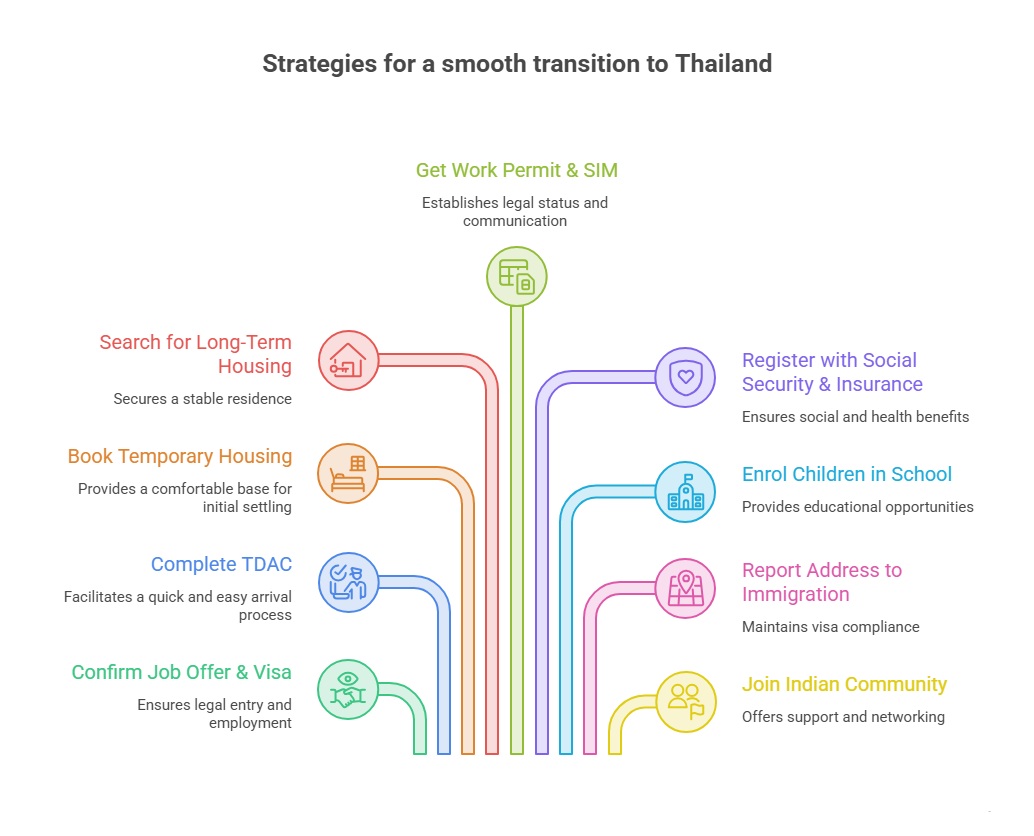
The steps for smooth transition to Thailand for Indians are as follows:
Step 1: Confirm your job offer and work visa before travelling, and do not use the tourist visa exemption to start work
Step 2: Complete the Thailand Digital Arrival Card (TDAC) online within 72 hours before arrival
Step 3: Book temporary accommodation, such as a serviced apartment, for your first few weeks
Step 4: Search for long-term housing via DDproperty, Hipflat, or English-speaking agents
Step 5: Get your work permit, open a bank account, and buy a local mobile SIM
Step 6: Register with the Social Security Office through your employer and arrange private health insurance
Step 7: Enrol children in school as early as possible, given high demand for international schools
Step 8: Report your address to immigration every 90 days, as required for long-stay visa holders
Step 9: Join Indian community associations in Bangkok and Chiang Mai for support and networking
*Are you looking for step-by-step assistance with Thailand immigration? Contact Y-Axis, the world's No. 1 overseas immigration consultancy!
FAQs
What is the easiest way for Indians to move to Thailand?
Most Indians move on a Non-Immigrant B visa with a work permit, which needs a confirmed job offer from a Thai employer. Highly skilled professionals with strong salaries can apply for the 10-year Long-Term Resident (LTR) visa. Remote workers can use the Destination Thailand Visa, which does not allow work for Thai employers.
What is the LTR visa in Thailand?
The Long-Term Resident (LTR) visa is a 10-year visa for highly skilled professionals, remote workers, wealthy individuals, and retirees. Eligible highly skilled professionals can pay a flat 17% personal income tax rate. LTR holders can also bring their spouse and children under 20 as dependants.
Can I move to Thailand without a job offer?
Yes, but not to work for a Thai employer. The Destination Thailand Visa lets remote workers stay for up to 180 days per entry. The LTR visa also has categories for remote workers and wealthy individuals. To work for a Thai company, you need a job offer, a work visa, and a work permit.
Is healthcare free for immigrants in Thailand?
No. Employees join the Social Security Fund and pay 5% of their salary up to a monthly cap. This covers treatment at a registered hospital. Most expats also take private health insurance to use private hospitals such as Bumrungrad, Bangkok Hospital, or Samitivej.
What is the average salary for skilled workers in Thailand?
Salaries vary by sector and experience. IT professionals typically earn THB 60,000-150,000 a month, and engineers earn THB 50,000-120,000 a month. Thailand's personal income tax is progressive, from 0% to 35%, while eligible LTR holders can pay a flat 17%.
Can I bring my family to Thailand on a work visa?
Yes. Work permit holders can bring their spouse and children on a Non-Immigrant O dependent visa. Children can study in Thai or international schools. Dependants need their own work permit before taking up a job in Thailand.
Which area in Thailand is best for Indian immigrants?
Sukhumvit and Sathorn in Bangkok offer the most jobs and expat-friendly living, though they cost more. Chiang Mai suits remote workers and families looking for lower costs. Pattaya and the Eastern Seaboard suit engineers working in automotive and industrial estates.
How much does it cost to live in Thailand?
Thailand's cost of living varies by area. In Sukhumvit, a one-bedroom condo costs around THB 20,000-45,000 a month. In Chiang Mai or Pattaya, similar housing costs about THB 10,000-25,000. Groceries, utilities, and transport add around THB 10,000-17,000 a month.
How do I get permanent residency in Thailand?
You usually need 3 consecutive years on a Non-Immigrant visa with yearly extensions and a work permit, plus minimum income or tax records. Applications are accepted only during a yearly window, and each nationality has a limited quota. Approval can take a long time, so plan early.
How can I get Thai citizenship?
Thai citizenship by naturalisation generally needs permanent residency, years of residence, Thai language skills, a steady income, and good conduct. The process is strict and can take several years. India does not allow dual citizenship, so you would need to give up your Indian citizenship.
Tags:
Thailand immigration
Thailand work visa
Thailand LTR visa
Living in Thailand
Cost of living in Thailand
Best areas in Bangkok
Jobs in Thailand for Indians
Healthcare in Thailand
Housing in Thailand
Settle in Thailand
Share
Y - Axis services

Get it on your mobile

Get News Alerts

Contact Y-Axis
Latest Article
Popular Post
Trending Article
Posted On October 16 2026
Life in Thailand for Immigrants: Jobs, Visas, Cost of Living & Residency