

Posted on July 30 2026
Life in Switzerland for Immigrants: Jobs, Housing, Healthcare & PR

By , Editor & Director
Updated August 01 2026
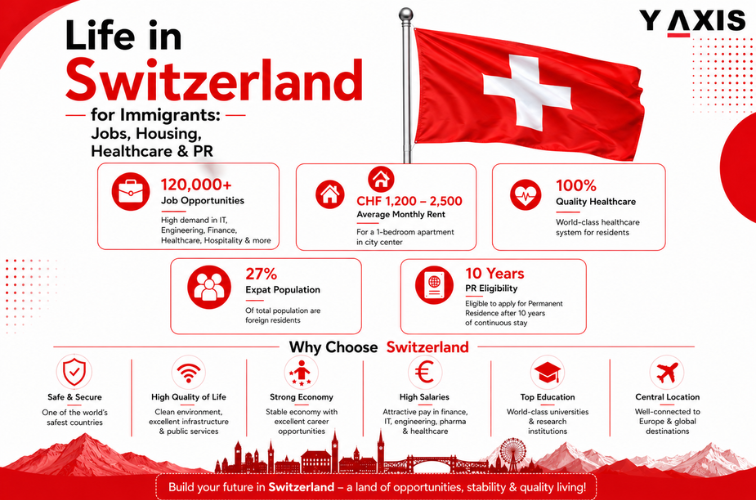
Life for immigrants in Switzerland is shaped by one of the world's highest-paying economies, a genuine shortage of skilled workers, and full access to the Schengen Area. Switzerland faces persistent skill shortages, and 35% of its workforce is currently sourced from foreign countries including India. Zurich and Geneva offer the strongest job markets in finance and international organisations, while Basel, Zug, and Lausanne offer strong sector-specific demand in pharma, low-tax business, and research. Switzerland suits immigrants who want top-tier salaries, world-class healthcare, and are prepared for a genuinely longer path to permanent residence.
Some quick facts about Switzerland are as follows:
|
Population |
Approximately 8.9 million |
|
Capital |
Bern |
|
Official Language |
German, French, Italian, Romansh (English widely used in business) |
|
Currency |
Swiss Franc (CHF) |
|
Popular Immigrant Hubs |
Zurich, Geneva, Basel, Zug, Bern, Lausanne |
|
Economy |
Unemployment around 2-3%, among the lowest in Europe; over 600,000 job openings typically advertised; strong in finance, pharma, tech, and engineering |
|
Typical Route to Long Stay |
Employer-sponsored B Permit, subject to a strict annual quota for non-EU/EFTA nationals |
|
Permanent Residence |
C settlement permit after 10 years of continuous legal residence (5 years for EU/EFTA nationals); Swiss citizenship after 10 years, including 3 of the last 5 years |
*Want to settle in Switzerland? Sign up with Y-Axis for end-to-end assistance.
Why Choose Switzerland to Migrate Abroad?
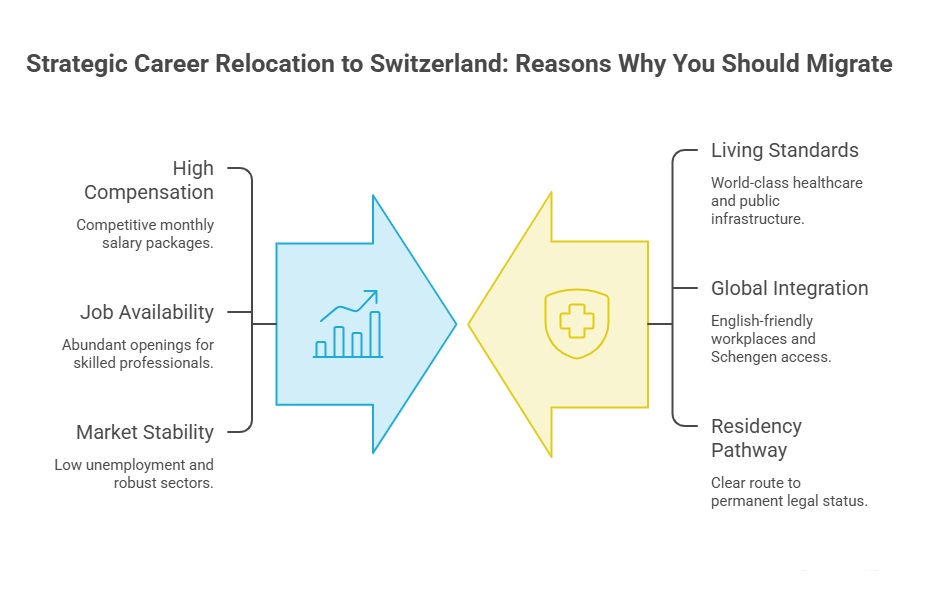
Switzerland runs one of the world's most stable and highest-paying economies. It faces a genuine shortage of skilled workers. The country offers steady demand in finance, pharma, tech, and engineering, plus some of the highest average salaries anywhere in the world.
Here is why you should choose a life in Switzerland:
- One of Europe's lowest unemployment rates, consistently around 2-3%.
- Over 600,000 job openings typically advertised at any time, with 35% of the workforce already foreign-born.
- A median gross salary of around CHF 6,500-6,700 per month, among the highest in the world.
- World-class healthcare, safety, and infrastructure, consistently ranked among the best globally.
- English is widely used at multinational employers in finance, pharma, and tech, even though German, French, and Italian are the national languages.
- Full Schengen Area access once you hold a valid Swiss residence permit.
- A clear, if lengthy, pathway to permanent residence after 10 years, or 5 years for EU/EFTA nationals.
*Want to work in Switzerland? Let Y-Axis assist you with the process.
Can I Move to Switzerland as an Indian Immigrant?
Most Indian nationals move to Switzerland through employer-sponsored work permits. You must meet the requirements set by the State Secretariat for Migration (SEM) and your cantonal authorities, including a valid job offer and proof of relevant qualifications.
Here is what you need to do to migrate to Switzerland:
Step 1: Secure a valid job offer from a Switzerland-based employer, since there is no job-seeker visa or independent work permit route
Step 2: Your employer must show that no suitable Swiss or EU/EFTA candidate was available for the role, Switzerland's labour market test
Step 3: Your employer applies for your B Permit or L Permit through the cantonal and federal authorities
Step 4: Hold recognised qualifications and relevant work experience, since non-EU applicants are generally expected to be highly qualified
Step 5: Apply for your visa at a Swiss consulate or visa centre in India before travelling, if required
Step 6: Hold a valid passport, proof of accommodation, and a clean police clearance certificate
Step 7: Explore family reunification for your spouse and children once your permit is granted
Also, read...
What are the most in-demand jobs in Switzerland for the next 10 years?
Best Visa Options to Live in Switzerland
Switzerland offers several permits based on your job, nationality, and personal circumstances. The table below shows the main visa options for skilled workers and their route to long-term residence.
|
Visa Type |
Best For |
Duration |
Long-Term Pathway |
|
L Permit |
Short-term contracts under 12 months |
Tied to a fixed-term contract; subject to annual quota (4,000 for non-EU/EFTA in 2026) |
Does not lead directly to permanent residence |
|
B Permit |
Skilled workers with a confirmed job offer of 12 months or longer |
Valid up to 5 years, renewable; subject to annual quota (4,500 for non-EU/EFTA in 2026) |
Counts toward the 10-year C Permit eligibility (5 years for EU/EFTA) |
|
C Permit (Settlement Permit) |
Long-term residents who have completed the required residence period |
Indefinite; does not require employer sponsorship |
Switzerland's equivalent of permanent residence |
|
EU/EFTA Permit |
EU/EFTA nationals with a confirmed job offer |
B EU/EFTA valid 5 years; L EU/EFTA for contracts of 3-12 months |
No quota or labour market test; counts toward the C Permit at 5 years |
|
Cross-Border (G) Permit |
Workers living in a neighbouring country who commute to Switzerland |
Tied to employment; renewable |
Does not lead to Swiss permanent residence |
Also, read...
Switzerland job market 2026-30
Best Areas to Live in Switzerland
Switzerland's job market and living conditions vary significantly by canton and city. Choosing the right area can influence your career opportunities, cost of living, housing expenses, and overall quality of life.
The table below highlights the major Swiss areas and their best qualities for settlement abroad:
|
Area |
Best For |
Sightseeing Attractions |
Average Rent |
Job Market |
How Much You Can Save |
|
Zurich |
Finance, tech & banking |
Lake Zurich, Old Town, Uetliberg |
CHF 1,900-3,000/mo (1BR) |
Strongest, largest employment pool |
Moderate, highest cost of living |
|
Geneva |
International organisations & private banking |
Jet d'Eau, Lake Geneva, UN Office |
CHF 1,800-2,800/mo (1BR) |
Strong, multilingual environment |
Moderate |
|
Basel |
Pharma, chemistry & life sciences |
Basel Minster, Rhine riverside |
CHF 1,400-2,200/mo (1BR) |
Strong, dense scientific hub |
Good savings potential |
|
Zug |
Finance, crypto & low-tax business |
Zug Old Town, Lake Zug |
CHF 1,700-2,600/mo (1BR) |
Strong, family-friendly expat community |
Good, lowest cantonal taxes |
|
Bern |
Federal administration, education & healthcare |
Zytglogge clock tower, Bear Park |
CHF 1,300-2,000/mo (1BR) |
Steady, more modest market |
Good savings potential |
|
Lausanne |
Tech, research & startups |
Olympic Museum, Lake Geneva waterfront |
CHF 1,400-2,100/mo (1BR) |
Growing, strong EPFL research cluster |
Good savings potential |
Also, read...
Highest Paying Jobs in Switzerland for Indians
Cost of Living in Switzerland
Switzerland's cost of living changes by canton. Zurich and Geneva cost the most, though Switzerland overall ranks among the most expensive countries in Europe.
Below is a breakdown of average monthly expenses for a single adult in Zurich:
|
Rent (1BR apartment, city centre) |
CHF 1,900-3,000/month |
|
Utilities (electricity, water, heating) |
CHF 150-300/month |
|
Groceries |
CHF 450-650/month |
|
Public Transport |
No free transport; a half-fare travel card or monthly pass typically costs CHF 80-120/month |
|
Mandatory Health Insurance (LAMal/KVG) |
CHF 350-500/month per adult |
|
Dining Out (per meal) |
CHF 15-30 |
|
Mobile & Internet |
CHF 40-70/month |
|
Entertainment & Leisure |
CHF 100-250/month |
Also, read...
What is the cost and processing time for a Switzerland work visa for Indian applicants?
Is Switzerland Expensive Compared to Other EU Nations?
Yes, Switzerland is genuinely one of the most expensive countries in Europe, ranking alongside Norway and Iceland. Rent, groceries, and mandatory health insurance all cost meaningfully more than in Germany, France, or Italy.
Salaries for skilled foreign professionals in Switzerland are proportionally high, though, and a median gross salary of CHF 6,500-6,700 a month still allows many immigrants to build real savings, particularly outside Zurich and Geneva.
Cantons like Ticino, Valais, and parts of Bern cost noticeably less than Zurich or Geneva. This makes Switzerland a strong choice for immigrants who prioritise top-tier salaries, world-class healthcare, and safety, and who are prepared for a genuinely high cost of living in exchange.
Also, read...
Visa Sponsorship Jobs in Switzerland – In-Demand Jobs, Top Employers & How to Apply
Work in Switzerland
Switzerland's job market runs on finance, pharma, IT, and engineering, supported by internationally recognised employers. The country has over 600,000 job openings typically advertised, and employers rely heavily on foreign workers to fill them.
The table below shows some of the most in-demand jobs in Switzerland for immigrants.
|
Occupation |
Average Annual Salary |
Demand Level |
Average Savings |
|
Finance & Banking (Wealth Management, Compliance) |
CHF 90,000-160,000+ |
High |
CHF 15,000-30,000/year |
|
Pharma & Life Sciences |
CHF 85,000-140,000 |
Very High |
CHF 14,000-28,000/year |
|
IT / Software Engineering |
CHF 85,000-135,000 |
Very High |
CHF 14,000-26,000/year |
|
International Organisations (NGOs, UN) |
CHF 80,000-130,000 |
High (Geneva-specific) |
CHF 12,000-24,000/year |
|
Engineering & Manufacturing |
CHF 80,000-125,000 |
High |
CHF 12,000-22,000/year |
|
Healthcare (Doctors, Nurses) |
CHF 75,000-150,000+ |
Very High |
CHF 12,000-25,000/year |
Also, read...
Jobs in Switzerland for Indians: How to Land a Job & Apply for a Work Visa
Settling in Switzerland
Once you arrive in Switzerland, you need to find housing, register for mandatory health insurance, enrol children in school, and set up banking.
Here is a quick overview of what to expect during your first weeks in the country:
|
Housing |
Healthcare |
Education for Children |
Banking & Financial Essentials |
|
Search via Homegate, ImmoScout24, or Comparis; competitive rental market, especially in Zurich and Geneva |
Purchase mandatory basic health insurance (LAMal/KVG) within 3 months of arrival |
Enrol in free public schools taught in the local cantonal language, or international schools in Zurich, Geneva, and Basel |
Open an account with UBS, PostFinance, or a cantonal bank (Kantonalbank) |
|
Landlords typically ask for up to 3 months' deposit, held in a blocked rental deposit account |
Premiums vary by canton, age, and chosen deductible (Franchise) |
International schools charge CHF 20,000-35,000/year; state schools are free but taught in German, French, or Italian depending on canton |
A residence permit and proof of address are usually required to open an account |
|
Allow 2 to 4 months to secure a rental in Zurich or Geneva, given high demand |
Register with a health insurer soon after arrival to stay compliant with the mandatory deadline |
Apply for school places early; popular international schools have limited seats |
Basic accounts can typically be opened within a few days once documents are ready |
Also, read...
Permanent Residence in Switzerland
Permanent residence in Switzerland follows one of the longer timelines in Europe, split clearly between EU/EFTA and non-EU/EFTA nationals. Legal residence on a B Permit counts toward the same milestones, provided you genuinely live and work in Switzerland throughout.
The table below shows the average timeline for the main routes to Swiss permanent residence and citizenship:
|
Stage |
Requirement |
Approx. Timeline |
|
Work Permit Holder |
Hold a valid B Permit or L Permit; renewable while employed |
Ongoing, renewable |
|
C Permit (Settlement / Permanent Residence) |
10 years of continuous legal residence for non-EU/EFTA nationals (5 years for EU/EFTA nationals); clean record and integration required |
10 years (5 years EU/EFTA) |
|
Swiss Citizenship (Naturalisation) |
At least 10 years of residence, including 3 of the last 5 years; strong integration, language, and civic knowledge required |
10+ years, plus processing |
|
Cross-Border (G) Permit Track |
Does not count toward Swiss PR or citizenship, regardless of duration |
Does not lead to PR |
|
Marriage to a Swiss Citizen |
Facilitated naturalisation possible after 5 years of marriage and 3 years of residence in Switzerland |
Reduced timeline for spouses |
Also, read...
Can I get a Switzerland work visa without a job offer?
Dependent Benefits for Immigrants in Switzerland
Switzerland allows eligible visa holders to bring immediate family members. This applies once dependent visa rules are met.
Here are the benefits of securing a Switzerland dependent visa:
- Spouses and children of B Permit holders can generally join through family reunification once the principal applicant has suitable accommodation and sufficient income
- Family members registered in Switzerland must also purchase mandatory health insurance individually
- Children of visa holders have the right to attend free public schools, taught in the local cantonal language
- Family members can open local bank accounts once they hold a valid residence permit
- Switzerland does not offer a large-scale investor family-inclusion programme, so each dependent generally follows the principal applicant's permit category
*Want to apply for Switzerland work dependent visa? Let Y-Axis assist you with the steps.
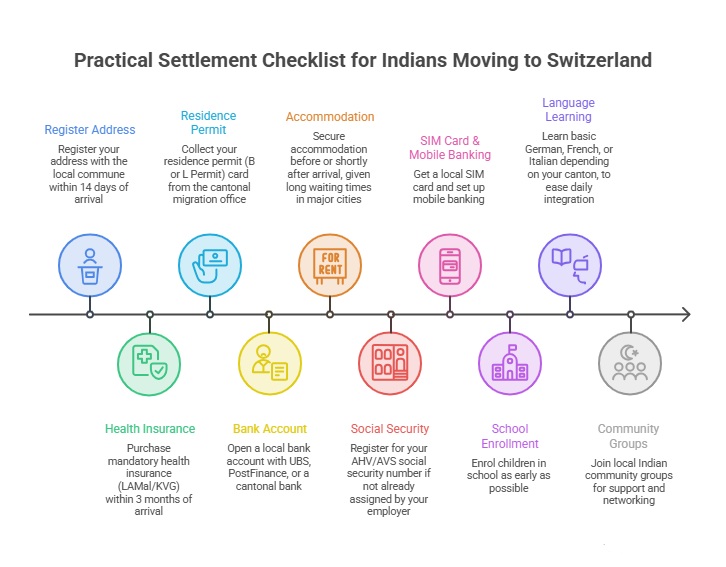
Practical Settlement Checklist for Indians Moving to Switzerland
Moving to Switzerland involves a few key steps. Complete them in order to avoid delays.
Follow the steps below for a smooth move to Switzerland:
Step 1: Register your address with the local commune (Gemeinde/Commune) within 14 days of arrival
Step 2: Purchase mandatory health insurance (LAMal/KVG) within 3 months of arrival
Step 3: Collect your residence permit (B or L Permit) card from the cantonal migration office
Step 4: Open a local bank account with UBS, PostFinance, or a cantonal bank
Step 5: Secure accommodation before or shortly after arrival, given long waiting times in major cities
Step 6: Register for your AHV/AVS social security number if not already assigned by your employer
Step 7: Get a local SIM card and set up mobile banking
Step 8: Enrol children in school as early as possible
Step 9: Learn basic German, French, or Italian depending on your canton, to ease daily integration
Step 10: Join local Indian community groups for support and networking
*Are you looking for step-by-step assistance with overseas immigration? Contact Y-Axis, the world's No. 1 overseas immigration consultancy!
FAQs
What is the easiest way for Indians to move to Switzerland?
There is no job-seeker visa or independent work permit route in Switzerland, so the easiest way is to secure a confirmed job offer from a Switzerland-based employer. The employer then applies for your B Permit or L Permit. Non-EU applicants are generally expected to be highly qualified because employers must demonstrate that no suitable Swiss or EU/EFTA candidate is available for the role.
How long does it take to get permanent residency in Switzerland?
Permanent residency in Switzerland takes longer than in many European countries. Non-EU/EFTA nationals are generally eligible for a C Settlement Permit after 10 years of continuous legal residence, while EU/EFTA nationals may qualify after 5 years. Swiss citizenship through naturalisation usually requires 10 years of residence, including 3 of the last 5 years, along with language proficiency and successful integration.
Is healthcare free for immigrants in Switzerland?
No. Healthcare in Switzerland is mandatory but not free. All residents, including immigrants, must purchase basic health insurance (LAMal/KVG) within 3 months of arrival. Premiums typically range from CHF 350–500 per month per adult, depending on the canton, age, and deductible selected. Dental care is generally not included under the basic insurance plan.
What is the average salary for skilled workers in Switzerland?
Switzerland offers some of the world's highest salaries. The median gross salary is approximately CHF 6,500–6,700 per month. Professionals in finance and pharmaceuticals generally earn between CHF 85,000 and CHF 160,000 annually, while IT and engineering professionals typically earn CHF 80,000–135,000 per year. Zurich and Geneva offer the highest salaries but also have the highest living costs.
Can I bring my family to Switzerland on a work visa?
Yes. Spouses and dependent children of B Permit holders can generally join through family reunification if the primary applicant has suitable accommodation and sufficient financial resources. Family members must obtain their own mandatory health insurance. Children can attend public schools free of charge or enrol in international schools where available.
Which area in Switzerland is best for Indian immigrants?
Zurich is the preferred destination for many Indian immigrants because of its strong finance and technology sectors and its large international community. Geneva is ideal for international organisations, Basel is a major pharmaceutical hub, and Zug is known for lower cantonal taxes. The best location depends on your profession, budget, and lifestyle preferences.
How much does it cost to live in Switzerland?
Switzerland has one of the highest costs of living in Europe. In Zurich, a one-bedroom apartment typically costs between CHF 1,900 and CHF 3,000 per month. Mandatory health insurance costs around CHF 350–500 monthly, while groceries generally cost CHF 450–650 per month. Living expenses are usually lower in cantons such as Ticino, Valais, and parts of Bern.
What is Switzerland's work permit quota system?
Switzerland limits work permits for non-EU/EFTA nationals through an annual federal quota. For 2026, the government has allocated 4,500 B Permits and 4,000 L Permits, unchanged from 2025. These quotas are distributed among the cantons and are often filled within the first few months of the year. EU/EFTA nationals are not subject to these quotas or labour market testing.
Do I need to speak German, French, or Italian to live in Switzerland?
Not always. Many multinational companies in finance, pharmaceuticals, and technology operate primarily in English. However, approximately 70% of advertised jobs still prefer candidates who know German or French. Learning the local cantonal language also makes daily life easier and is important for permanent residence and Swiss citizenship applications.
Can I apply for Swiss citizenship after getting permanent residence?
Yes. After obtaining a C Settlement Permit, you may apply for Swiss citizenship once you complete at least 10 years of legal residence, including 3 of the last 5 years. Applicants must also demonstrate language proficiency, successful integration into Swiss society, and knowledge of Swiss civic life. Switzerland generally permits dual citizenship for naturalised citizens.
Tags:
Switzerland immigration
Switzerland work visa
Switzerland permanent residency
Living in Switzerland
Cost of living in Switzerland
Best areas in Switzerland
Jobs in Switzerland for Indians
Healthcare in Switzerland
Housing in Switzerland
Share
Y - Axis services

Get it on your mobile

Get News Alerts
Contact Y-Axis
Latest Article
Popular Post
Trending Article
Posted On September 18 2026
Top 10 Countries to Work Abroad as a Graphic Designer