

Posted on June 26 2026
Visa Sponsorship Jobs in Switzerland – In-Demand Jobs, Top Employers & How to Apply

By , Editor & Director
Updated August 19 2026
Switzerland is one of the most popular countries for skilled professionals who want to work abroad. It has been ranked #1 in the world for innovation by the Global Innovation Index for 14 years in a row. The country has a strong economy and offers some of the highest salaries in the world. The average gross salary is around CHF 95,000–100,000 per year (approximately ₹1.11–1.17 crore). Even with these high salaries, Switzerland is facing a growing shortage of skilled workers in many industries. According to a 2026 Manpower Switzerland report, the shortage of skilled workers is the biggest challenge for Swiss employers.
The biggest worker shortages are in healthcare and technology. During 2024–25, 72% of Swiss employers said they found it difficult to hire software developers and IT professionals. This is the highest level ever recorded, according to digitalSwitzerland's Digital Skills Barometer. The healthcare sector also needs tens of thousands of nurses, specialist doctors, and care workers over the next 10 years because Switzerland's population is getting older. In the pharmaceutical industry, the growing use of cell and gene therapy has created a high demand for skilled specialists, and there are not enough trained workers in the country.
For Indian professionals and other skilled workers, this creates excellent job opportunities. Swiss employers, especially in pharmaceuticals, IT, finance, and engineering, are actively hiring qualified international workers. Companies such as Novartis, Roche, Nestlé, UBS, and ABB regularly sponsor work permits for skilled foreign professionals.
Switzerland allows employers to sponsor non-EU/EFTA workers through two main work permits:
- B Permit – for long-term jobs and residence.
- L Permit – for short-term jobs.
These permits are issued under yearly quotas set by the Swiss Federal Council. In 2026, 4,500 B permits and 4,000 L permits are available for non-EU nationals. Although competition is high, skilled professionals working in high-demand sectors have a good chance of getting a visa-sponsored job in Switzerland.
*Want to work in Switzerland? Let Y-Axis guide you with the process.
Why Apply for Visa Sponsorship Jobs in Switzerland?
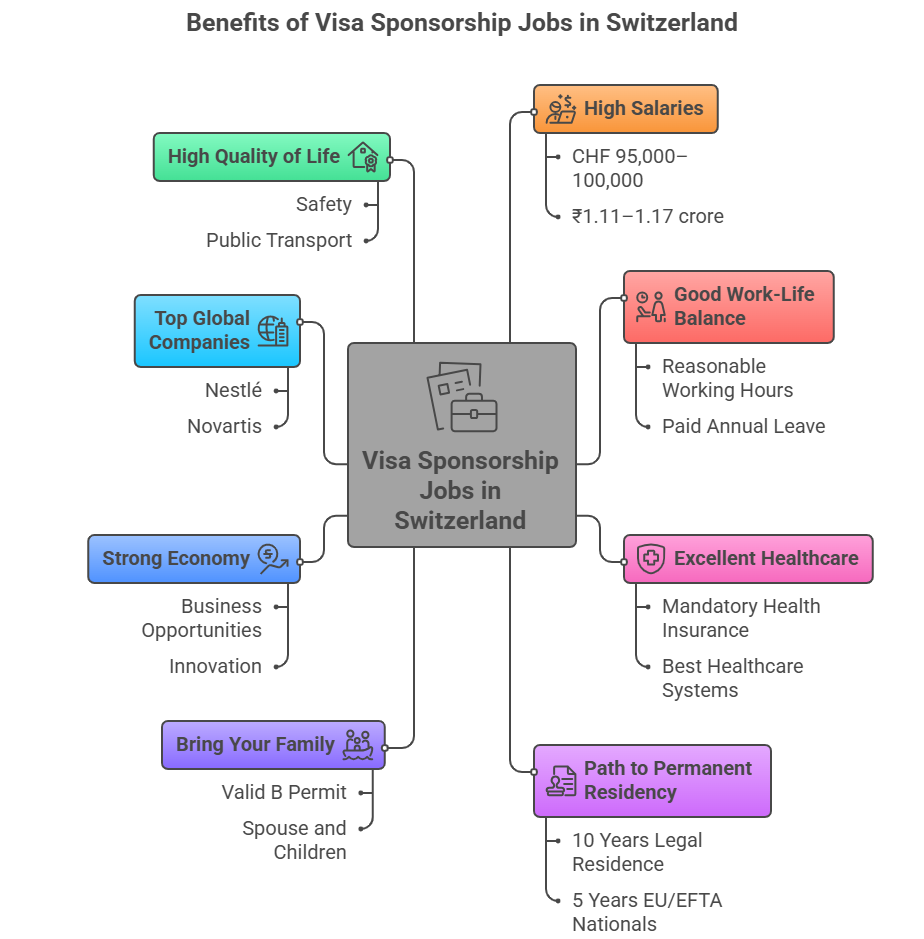
- High salaries: Switzerland offers some of the highest salaries in the world. The average gross salary is around CHF 95,000–100,000 per year (approximately ₹1.11–1.17 crore).
- Good work-life balance: Employees enjoy reasonable working hours, paid annual leave, and strong labour rights.
- Excellent healthcare: Workers have access to one of the best healthcare systems in the world through Switzerland's mandatory health insurance system.
- Path to permanent residency: After 10 years of legal residence (or 5 years for eligible EU/EFTA nationals), you may apply for a C Permit (settlement permit) if you meet the eligibility requirements.
- Bring your family: Workers with a valid B Permit can apply to bring their spouse and dependent children to Switzerland through family reunification.
- Strong and stable economy: Switzerland has a strong economy and is one of the world's leading countries for business, innovation, and job opportunities.
- Work with top global companies: Many well-known companies, such as Nestlé, Novartis, Roche, UBS, and ABB, hire skilled international professionals and offer good career growth.
- High quality of life: Switzerland is one of the safest countries in the world and offers excellent public transport, education, clean cities, and a high standard of living.
What are Visa Sponsorship Jobs in Switzerland?
Visa sponsorship jobs in Switzerland are jobs where a Swiss employer helps a foreign worker get a Swiss work permit. In most cases, you cannot apply for a Swiss work permit on your own. A Swiss employer must offer you a job and sponsor your work permit application.
Before hiring a worker from outside the EU/EFTA, the employer must first show that they could not find a suitable Swiss or EU/EFTA candidate for the job. This is called the Priority Principle. If the application is approved by the cantonal labour authority, the employer can sponsor the worker's work permit. The employer submits the required documents to the Swiss State Secretariat for Migration (SEM) and supports the worker during the work permit and visa process.
A visa-sponsored job usually includes:
- A confirmed job offer from a Swiss employer.
- A valid employment contract.
- A salary that meets Swiss wage standards.
- Employer support with the work permit and visa application process.
Both fresh graduates with specialised skills and experienced professionals can apply for visa sponsorship jobs in Switzerland if they have the qualifications and experience needed for high-demand roles.
In-Demand Visa Sponsorship Jobs in Switzerland for Indians
Switzerland has a high demand for skilled professionals in many industries because of labour shortages and a growing economy. Employers in sectors such as IT, healthcare, engineering, pharmaceuticals, banking, and manufacturing are actively hiring qualified international workers and offering visa sponsorship. Professionals with the right skills, qualifications, and work experience have better chances of finding a sponsored job. The table below lists the most in-demand sectors, popular job roles, and their average annual salaries in Switzerland.
| In-Demand Sector | Most In-Demand Job Roles | Average Annual Salary (CHF) |
|---|---|---|
| Information Technology (IT) | Software Engineer, Full-Stack Developer, Cloud Engineer, Cybersecurity Specialist, DevOps Engineer | CHF 100,000 – 140,000 |
| Artificial Intelligence & Data | AI Engineer, Machine Learning Engineer, Data Scientist, Data Engineer, AI Researcher | CHF 110,000 – 180,000 |
| Healthcare | Registered Nurse, Specialist Doctor, General Practitioner, Physiotherapist, Medical Laboratory Technologist | CHF 80,000 – 200,000 |
| Pharmaceuticals & Life Sciences | Pharmacist, Bioprocess Engineer, Clinical Research Associate, Quality Assurance Specialist, Regulatory Affairs Specialist | CHF 90,000 – 140,000 |
| Engineering | Civil Engineer, Mechanical Engineer, Electrical Engineer, Automation Engineer, Structural Engineer | CHF 90,000 – 130,000 |
| Banking & Financial Services | Financial Analyst, Risk Analyst, Investment Analyst, Compliance Officer, Accountant | CHF 95,000 – 130,000 |
| Manufacturing & Advanced Manufacturing | Production Engineer, Manufacturing Engineer, Quality Engineer, Process Engineer, Automation Technician | CHF 85,000 – 120,000 |
| Construction & Infrastructure | Construction Manager, Project Manager, Site Engineer, Quantity Surveyor, Building Services Engineer | CHF 90,000 – 130,000 |
| Logistics & Supply Chain | Supply Chain Manager, Logistics Manager, Procurement Specialist, Warehouse Manager, Demand Planner | CHF 85,000 – 120,000 |
| Hospitality & Tourism | Hotel Manager, Executive Chef, Restaurant Manager, Front Office Manager, Guest Relations Manager | CHF 60,000 – 90,000 |
| Education & Research | University Lecturer, Research Scientist, Postdoctoral Researcher, Laboratory Manager | CHF 90,000 – 140,000 |
| Renewable Energy & Sustainability | Energy Engineer, Environmental Engineer, Sustainability Consultant, Renewable Energy Project Manager | CHF 95,000 – 140,000 |
*Read more....
Highest Paying Job Opportunities in Switzerland
Switzerland consistently ranks among the top countries in the world for salaries. Whether you work in banking, healthcare, or technology, the earning potential is exceptional. Below are the highest-paying jobs available in Switzerland.
| Job Title | Average Annual Salary (CHF) | Average Annual Salary (INR) |
|---|---|---|
| Neurosurgeon | CHF 250,000 – 430,000 | ₹2.93 Cr – ₹5.03 Cr |
| Investment Banker | CHF 200,000 – 350,000 | ₹2.34 Cr – ₹4.10 Cr |
| Chief Financial Officer (CFO) | CHF 200,000 – 300,000 | ₹2.34 Cr – ₹3.51 Cr |
| Private Banker / Wealth Manager | CHF 150,000 – 360,000 | ₹1.75 Cr – ₹4.21 Cr |
| Medical Specialist (General) | CHF 180,000 – 250,000 | ₹2.11 Cr – ₹2.93 Cr |
| Pharmaceutical Research Director | CHF 150,000 – 250,000 | ₹1.75 Cr – ₹2.93 Cr |
| AI / ML Engineer | CHF 130,000 – 200,000 | ₹1.52 Cr – ₹2.34 Cr |
| Software Architect | CHF 130,000 – 170,000 | ₹1.52 Cr – ₹1.99 Cr |
| Bioinformatics Specialist | CHF 120,000 – 160,000 | ₹1.40 Cr – ₹1.87 Cr |
| Data Scientist | CHF 110,000 – 150,000 | ₹1.29 Cr – ₹1.75 Cr |
| Senior Electrical Engineer | CHF 100,000 – 140,000 | ₹1.17 Cr – ₹1.64 Cr |
| Specialized Registered Nurse | CHF 90,000 – 105,000 | ₹1.05 Cr – ₹1.23 Cr |
Read about: What are the most in-demand jobs in Switzerland for the next 10 years?
Top Sectors and Companies Offering Visa Sponsorship Jobs in Switzerland
Many leading Swiss companies hire skilled international professionals and sponsor work permits when they cannot find suitable local or EU/EFTA candidates. Visa sponsorship is most common in industries facing skill shortages, such as pharmaceuticals, information technology, banking, engineering, healthcare, and manufacturing. The table below lists the top sectors, companies that commonly sponsor work visas, and the job roles they frequently hire for.
| Top Sector | Companies Offering Visa Sponsorship | Common Roles Offered |
|---|---|---|
| Pharmaceuticals & Life Sciences | Novartis, Roche, Lonza Group, Johnson & Johnson | Clinical Research Associate, Bioprocess Engineer, Pharmacist, Quality Assurance Specialist, Regulatory Affairs Specialist, Research Scientist |
| Information Technology & Software | Google Switzerland, Amazon Zurich, Microsoft Switzerland, IBM Switzerland | Software Engineer, Cloud Engineer, Data Scientist, AI/ML Engineer, DevOps Engineer, Cybersecurity Specialist |
| Banking & Financial Services | UBS, Credit Suisse (UBS Group), Julius Baer, Swiss Re, Zurich Insurance Group | Financial Analyst, Risk Analyst, Investment Analyst, Compliance Officer, Software Developer, Actuary |
| Engineering & Industrial Technology | ABB Group, Siemens Switzerland, Schindler Group, GE Vernova Switzerland | Electrical Engineer, Mechanical Engineer, Automation Engineer, Civil Engineer, Project Engineer |
| Healthcare & Medical Technology | Johnson & Johnson, Roche Diagnostics, Medtronic Switzerland, B. Braun Switzerland | Registered Nurse, Specialist Doctor, Medical Laboratory Technologist, Clinical Specialist, Biomedical Engineer |
| Food & Beverage | Nestlé, Barry Callebaut, Emmi Group | Food Technologist, Supply Chain Manager, Production Manager, Quality Manager, R&D Specialist |
| Manufacturing & Automation | ABB Group, Georg Fischer (GF), Bühler Group, Oerlikon | Manufacturing Engineer, Process Engineer, Production Engineer, Quality Engineer, Maintenance Engineer |
| Management Consulting & Professional Services | McKinsey & Company, Deloitte Switzerland, KPMG Switzerland, PwC Switzerland, EY Switzerland | Management Consultant, Technology Consultant, Auditor, Tax Consultant, Business Analyst |
| Logistics & Supply Chain | Kühne + Nagel, DHL Switzerland, DSV Switzerland | Supply Chain Manager, Logistics Manager, Procurement Specialist, Warehouse Manager, Operations Manager |
| Commodities & Energy | Glencore, Vitol, Mercuria Energy Group, Trafigura | Commodity Trader, Operations Analyst, Supply Chain Specialist, Finance Manager, Energy Analyst |
Eligibility Requirements for Visa Sponsorship Jobs in Switzerland
To qualify for a visa sponsorship job in Switzerland, you must meet the following requirements:
- Have a valid passport with at least 6 months of validity beyond your intended stay.
- Obtain a confirmed job offer and signed employment contract from a registered Swiss employer.
- Hold a recognized university degree, diploma, or professional qualification related to the job.
- Have 2–5 years of relevant work experience, depending on the job role and industry.
- Meet the language requirements for the job. Knowledge of German, French, or Italian may be required, depending on the canton, while many multinational companies accept English.
- Meet any health requirements if applying for certain healthcare or public-facing jobs.
- Have a clean criminal record and provide a police clearance certificate if requested.
- Be hired for a position where the employer has shown that no suitable Swiss or EU/EFTA candidate was available (Priority Principle).
- Receive a salary that meets Swiss regional and industry wage standards.
Documents Required for a Sponsored Work Visa in Switzerland
You will generally need the following documents to apply for a sponsored work visa:
- A valid passport.
- A job offer letter or signed employment contract from a Swiss employer.
- The employer's approved work permit application.
- Educational certificates, including degrees, diplomas, and professional qualifications.
- Work experience letters from previous employers.
- An updated CV or resume.
- A police clearance certificate.
- A medical certificate is required for the job.
- Recent passport-sized photographs that meet Swiss visa specifications.
- A completed National Visa (Type D) application form.
- Proof of accommodation in Switzerland, such as a rental agreement or employer-provided housing.
- A language proficiency certificate, such as Goethe-Zertifikat (German), DELF (French), or another accepted certificate, if required for the role.
*Read more...
Switzerland Job Market: Trends & Job Opportunities
How to Get a Visa Sponsorship Job in Switzerland?
Getting a visa sponsorship job in Switzerland requires the right qualifications, a job offer from a Swiss employer, and approval for a work permit. Follow these steps to apply:
Step 1: Research the Swiss job market and identify occupations that are in high demand, such as IT, healthcare, engineering, pharmaceuticals, finance, and manufacturing.
Step 2: Prepare a professional CV that follows Swiss standards. Keep it clear and concise, highlighting your education, work experience, skills, and achievements.
Step 3: Search for visa sponsorship jobs on platforms such as jobs.ch, LinkedIn, Indeed Switzerland, Glassdoor, and company career websites. Look for jobs that mention visa sponsorship, work permit support, or relocation assistance.
Step 4: Apply directly to Swiss employers and multinational companies. Customize your CV and cover letter for each job to increase your chances of being shortlisted.
Step 5: Attend online or in-person interviews. Be prepared to discuss your qualifications, work experience, and your eligibility to work in Switzerland.
Step 6: If selected, accept the job offer and review your employment contract carefully. Make sure it includes your salary, job title, start date, and confirmation that the employer will sponsor your work permit.
Step 7: Your employer will submit your work permit application to the cantonal labour authority. Once approved, the application is forwarded to the State Secretariat for Migration (SEM) for final approval.
Step 8: After your work permit is approved, apply for a Swiss National Visa (Type D) at the nearest Swiss embassy or consulate. The visa process usually takes 6–8 weeks.
Step 9: Once you receive your visa, travel to Switzerland, register with your local commune within 14 days of arrival, collect your residence permit, and begin working according to your employment contract.
Work Visa Options for Foreign Workers in Switzerland
| Visa / Permit Type | Purpose | Validity |
|---|---|---|
| L Permit (Short-Term Residence) | For fixed-term employment contracts of less than 12 months | Up to 1 year; extendable up to 24 months total |
| B Permit (Residence Permit) | For employment contracts exceeding 1 year or of unlimited duration | 5 years (renewable) |
| C Permit (Settlement Permit) | For long-term residents who have lived in Switzerland for 10 years | Permanent (subject to conditions) |
| G Permit (Cross-Border Commuter) | For EU/EFTA residents who work in Switzerland but return home regularly | Up to 5 years |
| Ci Permit (Residence with Gainful Activity) | For accompanying spouses of diplomats or international officials who wish to work | Same duration as the spouse's permit |
| Type D National Visa | Entry visa required before collecting B or L permit; applied at Swiss embassy | Valid for permit collection and initial entry |
FAQs
What are visa sponsorship jobs in Switzerland?
Visa sponsorship jobs in Switzerland are positions where a Swiss employer actively supports a foreign worker's work permit application. Since Switzerland requires employer sponsorship for non-EU/EFTA nationals, an employer must apply to the cantonal labour authority and the State Secretariat for Migration (SEM) on the worker's behalf. This includes filing the permit, proving no local candidate was available, and ensuring salaries meet Swiss standards before the foreign worker can legally start employment.
Can Indian professionals get visa sponsorship jobs in Switzerland?
Yes, Indian professionals can get visa sponsorship jobs in Switzerland, provided they have the right qualifications and skills in demand. Switzerland prioritises non-EU/EFTA workers only after demonstrating that no Swiss or EU/EFTA candidate is available. Indians working in IT, healthcare, engineering, pharmaceuticals, and finance have the best chances. The annual quota system limits the number of permits, so having in-demand skills significantly improves your prospects.
Which companies in Switzerland sponsor foreign workers?
Leading Swiss employers known for sponsoring foreign workers include Novartis, Roche, Nestlé, UBS, ABB Group, Google Switzerland, Amazon Zurich, Swiss Re, Glencore, Zurich Insurance, Lonza Group, and Johnson & Johnson. Multinational consulting firms such as McKinsey, Deloitte, and KPMG also regularly hire international talent. These companies have the infrastructure and legal teams to handle the complex Swiss immigration sponsorship process efficiently.
Which jobs are easiest to get with visa sponsorship in Switzerland?
Jobs in healthcare (registered nurses, specialist doctors), IT (software engineers, data scientists, AI/ML engineers), engineering (mechanical, electrical, automation), and pharmaceuticals (bioprocess engineers, research scientists) are the easiest to secure with visa sponsorship in Switzerland. These are classified as shortage occupations where demand consistently exceeds local supply. Workers in these fields are prioritised during the work permit quota allocation process.
What are the highest-paying visa sponsorship jobs in Switzerland?
The highest-paying sponsored jobs in Switzerland include Neurosurgeon (CHF 250,000–430,000), Investment Banker (CHF 200,000–350,000), Chief Financial Officer (CHF 200,000–300,000), Private Banker (CHF 150,000–360,000), and Pharmaceutical Research Director (CHF 150,000–250,000). AI/ML Engineers and Software Architects also command CHF 130,000–200,000 per year. These salaries translate to ₹1.52 Crore to ₹5 Crore annually at current exchange rates.
What qualifications are required for visa sponsorship jobs in Switzerland?
Swiss employers typically require a recognized university degree or professional qualification in the relevant field. For healthcare roles, Swiss or EU-recognized medical or nursing certifications are required. For IT roles, a bachelor's or master's degree in computer science or engineering is preferred. For finance roles, qualifications such as CFA, CPA, or an MBA are valued. Vocational training certifications are also accepted for trades and skilled worker positions.
Do I need work experience for visa sponsorship jobs in Switzerland?
In most cases, yes. Swiss employers prefer candidates with 2–5 years of relevant professional experience, particularly for sponsored roles. This is because the "Priority Principle" requires employers to justify hiring someone from outside the EU/EFTA — having niche expertise or significant experience strengthens this justification. However, candidates with specialized academic qualifications or in-demand technical skills (such as AI or bioinformatics) may be considered for entry-level or graduate-level sponsored positions.
Is IELTS required for visa sponsorship jobs in Switzerland?
IELTS is not a standard requirement for Swiss visa applications. Switzerland has four national languages German, French, Italian, and Romansh but many multinational employers in Zurich and Geneva operate in English. However, if you are applying for roles in German-speaking or French-speaking cantons, language proficiency (Goethe-Zertifikat for German, DELF for French) may be required. Check with each employer regarding their specific language requirements.
How long does the Swiss work permit process take?
The overall process from job offer to arrival in Switzerland typically takes 8–16 weeks. After the employer applies at the cantonal authority, the SEM reviews and approves the permit usually 4–8 weeks. Once approved, you apply for a Type D national visa at the Swiss embassy in your country, which takes an additional 4–6 weeks. Starting the process early and having all documents ready can reduce delays significantly.
Can my family accompany me to Switzerland on a sponsored work permit?
Yes. Once you hold a valid B Permit long-term residence permit, you can apply to bring your spouse and dependent children under the age of 18 to Switzerland under family reunification. Your family members will receive their own residence permits. Your salary must meet the financial sufficiency requirements, and you must be able to provide suitable housing for your family.
Can a visa sponsorship job lead to Permanent Residency in Switzerland?
Yes. Holding a B Permit and living legally in Switzerland for 10 consecutive years makes you eligible to apply for a C Permit (Settlement Permit), which is equivalent to permanent residency. You must have maintained your permit, respected Swiss laws, and show integration into Swiss society. For certain nationalities and in exceptional circumstances, the residency requirement may be reduced. Once you have the C Permit, you no longer need employer sponsorship to stay in Switzerland.
Which industries hire the most foreign workers in Switzerland?
The industries with the highest demand for foreign workers in Switzerland are information technology, healthcare and nursing, pharmaceuticals and life sciences, banking and finance, engineering and manufacturing, construction and infrastructure, hospitality and tourism, and academic research. Shortage occupations in IT and healthcare are the most consistently sponsored. Life sciences have grown significantly in recent years due to Switzerland's role as a global pharma hub.
How can I find visa sponsorship jobs in Switzerland?
You can find visa sponsorship jobs in Switzerland through platforms such as jobs.ch, LinkedIn, Indeed Switzerland, Glassdoor, and EURES (EU employment portal). Directly checking the careers pages of major Swiss employers like Novartis, Roche, and Nestlé is also effective. Working with international recruitment agencies or consultancies like Y-Axis can also connect you with employers who are actively open to sponsoring international talent.
Are healthcare jobs in high demand in Switzerland?
Yes, healthcare is Switzerland's most critical shortage sector. There is severe and growing demand for specialist doctors, registered nurses, elderly care workers, ICU nurses, radiology technologists, and lab staff. Population ageing, long training pipelines, and staff burnout are driving this structural shortage. Healthcare professionals from India and other countries who hold recognized qualifications or are willing to complete equivalency assessments are strongly encouraged to explore opportunities in Swiss hospitals and clinics.
Are IT jobs available with visa sponsorship in Switzerland?
Absolutely. IT is one of Switzerland's fastest-growing shortage sectors. In 2024, digitalSwitzerland's survey found that 72% of employers struggled to fill software development and IT roles. Demand exists for software engineers, data scientists, AI/ML engineers, cloud architects, cybersecurity specialists, and DevOps professionals. Major tech offices of Google, Amazon, IBM, and Microsoft in Zurich regularly sponsor international IT professionals. Swiss fintech and insurtech companies also actively hire from abroad.
Can fresh graduates apply for visa sponsorship jobs in Switzerland?
Fresh graduates can apply for visa sponsorship jobs in Switzerland, but it is more challenging compared to experienced professionals. Swiss employers prefer candidates who bring specific, hard-to-source skills or advanced academic qualifications (such as a PhD or Master's in engineering, AI, or life sciences). Multinational companies like Novartis and Roche do run graduate programmes for international talent. Having niche technical expertise and applying in shortage occupations improves a fresh graduate's chances significantly.
What is the average salary for sponsored jobs in Switzerland?
The average salary for sponsored professionals in Switzerland ranges from CHF 80,000 to CHF 150,000 per year approximately ₹93.6 Lakhs to ₹1.75 Crore, depending on the industry, role, and experience level. Healthcare professionals average CHF 80,000–120,000, IT professionals average CHF 105,000–145,000, and finance professionals can earn upwards of CHF 150,000. All sponsored salaries must comply with Swiss sector-specific minimum wage standards set by the SEM.
What documents are required for a sponsored work visa in Switzerland?
Key documents include a valid passport, signed employment contract, employer's work permit application, attested educational certificates, work experience letters, an updated CV, police clearance certificate (apostilled), passport-sized photographs, a completed Type D national visa application form, and proof of accommodation in Switzerland. Depending on the role, a medical certificate and language proficiency test results may also be required. All foreign documents may need to be officially translated into German, French, or English.
Can I change employers after getting a sponsored work permit in Switzerland?
Yes, but with conditions. If you hold an L Permit (short-term), you are generally tied to the sponsoring employer for the duration of your permit. With a B Permit, you can change employers, but you must notify your cantonal authority and ensure the new employer meets Swiss employment requirements. In some cases, the permit may need to be reissued. After 5 years in Switzerland, you gain more flexibility. It is advisable to consult a Swiss immigration expert before changing jobs on a sponsored permit.
How can Y-Axis help me get a visa sponsorship job in Switzerland?
Y-Axis offers comprehensive end-to-end support for professionals seeking visa sponsorship jobs in Switzerland. Our services include Swiss-standard resume and cover letter writing, job search and employer referral assistance, visa and work permit application guidance, documentation support, and interview coaching. Our team of experienced immigration consultants stays updated on Swiss immigration rules, quota changes, and employer requirements to give you the best possible chance of securing a sponsored role in Switzerland.
📞 Call: +91-7670800000
📩 Email: info@y-axis.com
🌐 Visit: https://www.y-axis.com
Tags:
Visa sponsorship jobs in Switzerland 2026
Switzerland work visa sponsorship for Indians
Switzerland sponsored jobs
Switzerland work permit jobs
In-demand jobs in Switzerland with visa sponsorship
Switzerland jobs for foreign workers
Top companies hiring international workers in Switzerland
Switzerland employer-sponsored jobs
Switzerland work visa for skilled professionals
Switzerland jobs for Indians
Share
Options for you by Y-Axis

Get it on your mobile

Get News alerts

Contact Y-Axis
Latest Article
Popular Post
Trending Article
Posted On September 24 2026
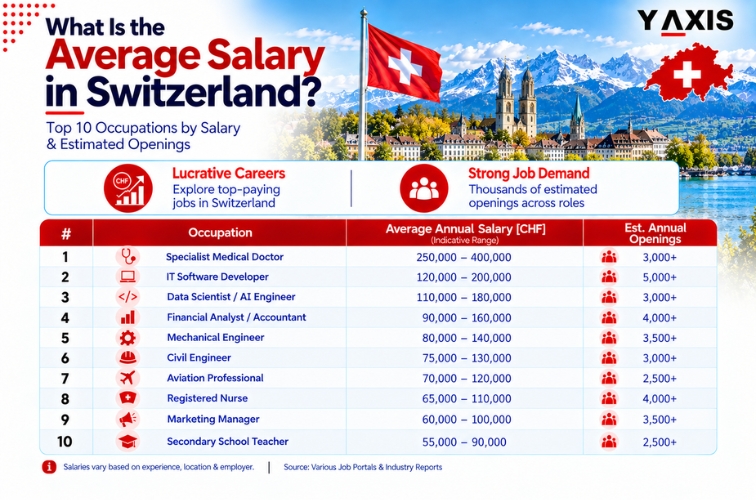
What Is the Average Salary in Switzerland?