


Don't know what to do ?
Get Free Counseling
Last Updated 03 June 2026
About the Switzerland Work Dependent Visa
The Switzerland work dependent visa formally called the Family Reunification Permit (Familiennachzug) allows the spouse, registered partner, and dependent children under 18 of a skilled worker in Switzerland to join them and reside legally in Switzerland.
Unlike dependent visa routes in many countries, the Swiss family reunification permit grants the spouse or registered partner full and unrestricted work rights from the date their permit is issued. There is no need to apply for a separate work authorisation. This is one of the most significant advantages of the Switzerland work dependent route for Indian families.
Family reunification in Switzerland is governed by the Foreign Nationals and Integration Act (AIG — Ausländer- und Integrationsgesetz) and administered by the cantonal migration authorities (Migrationsamt). Applications are submitted directly to the canton where the sponsor resides. Indian nationals must also obtain a Swiss national visa (Type D) before travelling to Switzerland.
India is consistently among the top non-European source countries for skilled professionals in Switzerland's technology, pharmaceutical, financial services, and engineering sectors. The Switzerland work dependent visa gives Indian professionals a structured, legally robust pathway to bring their families while building long-term careers in Switzerland.
Switzerland Work Dependent Visa: Key Facts at a Glance
| Category | Details |
|---|---|
| Visa / Permit Type | Family Reunification Permit (Familiennachzug) — biometric residence permit card (B or C Permit) issued in Switzerland |
| Applicable For | Spouse, registered partner, and unmarried children under 18 of a non-EU/EFTA skilled worker holding a valid Swiss B or C Permit |
| Sponsor Category | Non-EU/EFTA skilled worker or specialist holding a valid Swiss B Permit (Residence Permit) or C Permit (Settlement Permit) |
| Work Rights — Spouse / Partner | Yes — full and unrestricted work rights included; the family reunification permit is sufficient to work for any employer; no separate work authorisation required |
| Work Rights — Children under 18 | Not typically applicable — Swiss minimum working age is 15 for light work and 18 for full-time employment |
| Study Rights | Yes — all dependents may enrol in Swiss educational institutions; school-age children attend Swiss state schools at no cost |
| Access to Public Healthcare | Yes — permit holders registered in the commune are entitled to Swiss public healthcare after obtaining mandatory health insurance (Krankenkasse) |
| Permit Duration | Mirrors the sponsor's permit — typically annual for B Permit; multi-year for C Permit; renewed via the cantonal Migrationsamt |
| Path to Permanent Residence | C Permit (permanent settlement) available after 5 years of continuous legal residence for EU/EFTA nationals; 10 years for third-country nationals (including Indians) |
*Want to apply for a Switzerland work dependent visa? Sign up with Y-Axis for end-to-end assistance.
Switzerland Work Dependent Visa: Overview
The Switzerland work dependent visa falls under Switzerland's family reunification framework, governed by the AIG and implemented at the cantonal level. The permit allows non-EU/EFTA family members of Swiss work permit holders to reside, work, and study in Switzerland for the duration of the sponsor's permit.
The permit is not tied to a specific employer. The dependent spouse or partner can work for any employer in any canton without any additional authorisation. This unrestricted access to the Swiss labour market is one of the most important features of this permit category for Indian families.
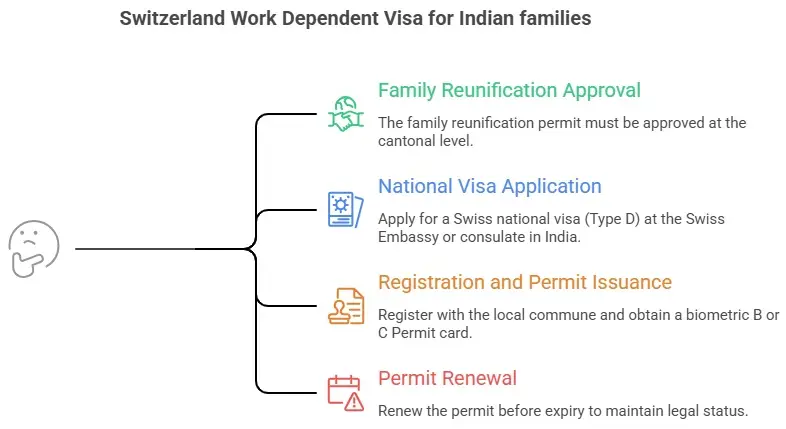
After the family reunification permit is approved at the canton level, the dependent applies for a Swiss national visa (Type D) at the Swiss Embassy or consulate in India. On arrival in Switzerland, the dependent registers with the local commune (Einwohnerkontrolle / contrôle des habitants). A biometric B or C Permit card is then issued by the cantonal Migrationsamt. The card must be renewed before expiry in line with the sponsor's permit.
Also, read...
Jobs in Switzerland for Indians: How to Land a Job & Apply for a Work Visa
Explore Job Opportunities and Work Visas in Switzerland
Switzerland offers some of the highest salaries in Europe and continues to attract skilled professionals across sectors such as healthcare, engineering, finance, artificial intelligence, and life sciences. Understanding the Swiss job market and work permit requirements can help foreign nationals identify suitable employment opportunities and plan their career pathway effectively.
Watch this video to learn about Switzerland's in-demand occupations, salary expectations, work visa process, and key factors employers consider when hiring international talent. The insights can help prospective applicants better understand the Swiss employment landscape and prepare for future work opportunities in the country.
Watch to Know More:
Benefits of the Switzerland Work Dependent Visa for Indian Families
The Switzerland work dependent visa offers Indian families a comprehensive set of rights and privileges. Key benefits include:
- Full work rights for spouse or partner: No separate work permit is needed. The family reunification permit includes unrestricted employment rights from the date of issue — for any employer in any canton.
- Study rights for all dependents: Spouse, partner, and children may enrol in Swiss educational institutions including universities, polytechnics (ETH, EPFL), and vocational colleges.
- Free school education for children: School-age children may attend Swiss state primary and secondary schools at no cost in the canton of residence.
- German/French/Italian language integration support: Cantons offer integration programmes and language courses that directly support PR eligibility under Swiss integration criteria.
- Access to mandatory public healthcare: Family permit holders who register with the commune and obtain Krankenkasse (mandatory health insurance) are entitled to Switzerland's world-class public healthcare system.
- Path to permanent residence: After 5 years (EU/EFTA) or 10 years (Indians and other third-country nationals) of continuous legal residence, dependents can apply for a C Permit (permanent settlement).
- Path to Swiss citizenship: After 10 years of legal residence in Switzerland (including 3 years between ages 8 and 18), citizenship may be applied for subject to integration and language criteria.
- High quality of life: Switzerland consistently ranks among the top countries globally for quality of life, safety, healthcare, and education, with Zurich, Geneva, and Basel regularly topping world livability indices.
- Multilingual, internationally connected environment: English is widely used in multinational workplaces across Zurich, Geneva, and Basel, making the transition practical for Indian families.
- Central European location: Switzerland's central location provides easy access to EU countries, professional opportunities, and international travel.
*Want to apply for a Switzerland work visa? Let Y-Axis guide you with the process.
Who Is Eligible to Sponsor a Dependent in Switzerland?
Switzerland's family reunification rules specify which permit holders qualify as sponsors. The following must be confirmed before filing an application with the cantonal Migrationsamt.
Work Permit Holders Who CAN Sponsor Family
The following non-EU/EFTA work permit holders in Switzerland are eligible to sponsor immediate family members for a family reunification permit:
- B Permit (Residence Permit) holders: the primary category for Indian professionals in IT, pharma, finance, and engineering; must have resided in Switzerland for the qualifying period
- C Permit (Settlement Permit) holders: strongest family reunification right; immediate right to sponsor spouse and children under 18
- Intra-Company Transfer permit holders: eligible to sponsor dependents subject to subsistence and housing requirements
- Researcher Permit holders under bilateral agreements
- Qualified professionals on employer-sponsored assignments of more than one year
Permit Holders Who MAY NOT Be Eligible to Sponsor
- L Permit (Short-Term Permit) holders: typically valid for under 12 months; family reunification rights are severely limited and generally not available
- G Permit (Cross-Border Commuter) holders: cross-border commuters do not reside in Switzerland and therefore cannot sponsor dependent residence
- Persons who have not yet met the financial subsistence threshold: income and accommodation requirements must be confirmed before the application is filed
- Those receiving social assistance (Sozialhilfe) : sponsors who have received Swiss social assistance benefits may be disqualified from sponsoring
Note: Eligibility rules are administered at the cantonal level and subject to revision by the State Secretariat for Migration (SEM). Always verify current requirements with the relevant cantonal Migrationsamt before applying.
Sponsor Requirements
| Requirement | Details |
|---|---|
| Work Permit Type | Must hold a valid Swiss B Permit or C Permit — L Permit holders are generally not eligible; G Permit holders are not eligible |
| Financial Subsistence Requirement | Sponsor's income must be sufficient to support the entire family without reliance on Swiss social assistance (Sozialhilfe); income thresholds vary by canton, family size, and cost of living in the relevant canton |
| Accommodation in Switzerland | Must have suitable accommodation appropriate for the size of the family; evidence required at time of application — tenancy agreement, property ownership document, or employer accommodation letter |
| No Social Assistance Dependency | Sponsor must not have received Sozialhilfe (cantonal social assistance) within the reference period specified by the relevant canton |
| Residence in Switzerland | Must be residing in Switzerland and maintaining valid immigration status at the time of the family reunification application |
| Integration Requirement | Depending on the canton, B Permit holders may need to demonstrate integration — language competency (A1 level for some cantons), civic knowledge, or evidence of integration into Swiss working life |
| Valid Permit | Current Swiss permit must remain valid throughout the dependent's application process; applications submitted close to permit expiry may face complications |
Dependent Eligibility Requirements
| Requirement | Details |
|---|---|
| Eligible Dependents | Legally married spouse or registered partner; unmarried dependent children under 18 (biological, adopted, or step-children) |
| Relationship Evidence | Marriage certificate for spouse; registration certificate for partner; birth certificate for children; relationship must be genuine and subsisting |
| Visa Requirement for Indians | Indian nationals must apply for a Swiss National Visa (Type D) from the Swiss Embassy in New Delhi or the Swiss Consulate in Mumbai after the canton approves the family reunification permit |
| Entry Into Switzerland | Must enter Switzerland on the basis of the approved National Visa (Type D); prior unauthorised stay in Switzerland may result in refusal |
| Residence with Sponsor | Must reside with the sponsor in Switzerland after arrival; cohabitation with the sponsor is a condition of the permit |
| Good Character | Must be a person of good character; must disclose all previous visa refusals from any country |
| Previous Refusals | All previous visa or permit refusals from any country must be declared; relevant documentation must be submitted with the application |
Work Rights for Switzerland Work Dependent Visa Holders
This is the most important distinction of the Switzerland work dependent visa. The Swiss family reunification permit includes full and unrestricted work rights for the spouse or partner — there is no need for a separate work permit or employer sponsorship.
| Activity | Permitted for Dependent? |
|---|---|
| Full-time or Part-time Employment | Yes — the family reunification permit includes full work rights for the spouse or partner; employment is permitted with any employer, in any sector, and in any canton without a separate work permit |
| Self-employment or Freelance Work | Yes — self-employment and freelance activities are permitted; however, registration as a self-employed person with the relevant cantonal authorities may be required depending on the nature of the activity |
| Study and Education | Yes — dependents may enrol in Swiss educational institutions, including universities such as ETH Zurich, EPFL, cantonal universities, and vocational schools |
| Access to Public Healthcare | Yes — permit holders who register with their commune and obtain mandatory Swiss health insurance (Krankenkasse) are entitled to access Switzerland’s healthcare system |
| Access to Swiss Social Benefits | Limited — eligibility for Swiss social benefits such as AHV/IV pensions and unemployment insurance depends on employment history and contribution records; applicants should consult their cantonal AHV office for specific entitlements |
| Children Under 15 – Work | Not applicable — the minimum working age in Switzerland is 15 for light work and 18 for full-time employment |
| Work Rights After Sponsor Obtains a C Permit | Full and unrestricted work rights continue; the dependent’s C Permit mirrors the sponsor’s status and provides the same employment rights without restrictions |
Note: The right to work is stated on the biometric permit card issued after registration with the commune. The spouse or partner may begin working as soon as the permit card is collected. No employer sponsorship, additional work permit, or endorsement is needed.
Also, read...
Switzerland Job Market in 2026–30
Study Rights for Switzerland Work Dependent Visa Holders
All dependents holding a Swiss family reunification permit may study. There are no restrictions on enrolment in Swiss educational institutions for family reunification permit holders.
| Study Aspect | Details for Dependents |
|---|---|
| Spouse / Partner | May enrol in any Swiss educational institution, including universities, polytechnics, universities of applied sciences (Fachhochschulen), and vocational programmes |
| School-age Children | May attend Swiss state primary and secondary schools; education is free and compulsory for resident children up to approximately 15–16 years of age, depending on the canton |
| Language Integration Courses | Cantons offer integration and language courses in German, French, or Italian depending on the region; completing these courses can support permit renewal and permanent residence eligibility |
| University / Higher Education | Dependents may apply to any Swiss university or university of applied sciences; tuition fees for non-EU/EFTA students vary by institution and should be verified directly with the chosen institution |
| Vocational Training | No restrictions apply; dependents may enrol in vocational education and training (VET) programmes through Swiss vocational colleges, which are internationally recognised for their quality |
| Swiss Student Finance | Cantonal grants (Stipendien) may be available to eligible dependents who meet residency requirements; eligibility criteria vary by canton and should be confirmed with the relevant cantonal education department |
*Want to study in Switzerland? Let Y-Axis guide you with the process.
Switzerland Work Dependent Visa Fees
| Fee Type | Amount (CHF) | Amount (INR Approx.) |
|---|---|---|
| Family Reunification Permit – Adult (Spouse / Partner) | CHF 65–100 per applicant (cantonal fee) | INR 6,100–9,400 approx. |
| Family Reunification Permit – Child Under 18 | CHF 65 per child (cantonal fee) | INR 6,100 approx. |
| Swiss National Visa (Type D) – Per Applicant | CHF 100 per person | INR 9,400 approx. |
| Biometric Enrolment at Swiss Embassy / VFS Global India | VFS service charge applies | Verify applicable charges with VFS Global Switzerland |
| Certified Translation of Documents (Per Document) | CHF 80–300 approx., depending on document length | INR 7,500–28,200 approx. |
| MEA Apostille (Per Document – India) | INR 100–500 per document | As applicable |
| Y-Axis Professional Consultancy Fee | As per service package | As per service package |
Note: Cantonal fees vary across Switzerland's 26 cantons. 1 CHF ≈ INR 94 (indicative only; rates fluctuate). National visa fee set by the Swiss Confederation. Always verify current cantonal fees with the relevant Migrationsamt before applying.
Switzerland Work Dependent Visa Processing Time
| Stage | Estimated Time |
|---|---|
| Gathering and Organising Supporting Documents | 2–6 weeks, depending on document availability and apostille processing requirements in India |
| Submission to Cantonal Migrationsamt | 1–3 days once all required documents have been completed and assembled |
| Cantonal Processing – Family Reunification Permit | Approximately 8–16 weeks; processing times vary by canton, case volume, and the completeness of the submitted documentation |
| Permit Approval Issued by Canton | Written approval notification from the cantonal Migrationsamt authorising the dependent to proceed with the Swiss national visa application |
| Swiss National Visa (Type D) Application at Swiss Embassy India | Approximately 2–4 weeks after cantonal approval has been granted and the visa application has been submitted |
| Biometrics at Swiss Embassy New Delhi or VFS Global India | 1–3 weeks, depending on appointment availability |
| Travel to Switzerland After Visa Approval | At the applicant’s convenience within the validity period of the issued national visa |
| Commune Registration After Arrival | Must be completed within 14 days of arrival in Switzerland at the local commune registration office (Einwohnerkontrolle) |
| Biometric Permit Card Issued by Cantonal Migrationsamt | Approximately 2–4 weeks after commune registration is completed |
| Total Estimated Timeline (Application to Permit Card) | Approximately 4–7 months, depending on canton workload, document completeness, and visa processing times |
Note: Processing times are indicative. Swiss cantonal authorities process applications based on submission order and officer availability. Submitting a complete and accurate document set at the time of application significantly reduces the risk of delays. Do not travel to Switzerland before the national visa (Type D) is issued.
Also, read...
What is the cost and processing time for a Switzerland work visa for Indian applicants?
Documents Required for the Switzerland Work Dependent Visa
Documents for Spouse / Registered Partner
• Valid passport
• Recent passport-sized photographs as per cantonal or Swiss Embassy specifications
• Completed family reunification application form (cantonal form — varies by canton)
• Marriage certificate or registered partnership certificate — certified and apostilled by MEA India
• Proof of genuine and subsisting relationship — photographs, correspondence, shared financial records
• Sponsor's Swiss permit card (B or C Permit) copy
• Sponsor's recent payslips (last 3–6 months) and most recent Swiss tax assessment (Steuerveranlagung)
• Proof of suitable accommodation in Switzerland — tenancy agreement, property deed, or employer accommodation letter
• Sponsor's employment contract with Swiss employer
Documents for Dependent Children Under 18
- Valid passport for each child
- Recent colour passport photographs for each child
- Full birth certificate showing both parents' names — certified and apostilled by MEA India
- Court order confirming sole custody where one parent has sole custody
- Sworn declaration from the non-travelling parent consenting to child's relocation where joint custody applies
- Sponsor's Swiss permit and payslips confirming subsistence for the child
- Evidence of accommodation in Switzerland for the child
Sponsor's Supporting Documents
- Copy of all pages of the sponsor's current passport
- Copy of the sponsor's current Swiss permit card (B or C Permit)
- Employment contract with current Swiss employer showing salary, position, and duration
- Payslips from the last 3–6 months
- Most recent Swiss tax assessment (Steuerveranlagung) from the cantonal tax authority
- Proof of suitable accommodation in Switzerland for the sponsor and all family members
- Proof of cantonal language integration (if required by the canton — typically A1 level)
Note: All documents not in German, French, or Italian must be accompanied by a certified translation into the official language of the relevant canton. Documents issued in India must be apostilled by the Ministry of External Affairs (MEA) or the relevant state authority before submission.
Also, read...
What are the Switzerland work visa requirements
How to Apply for the Switzerland Work Dependent Visa from India
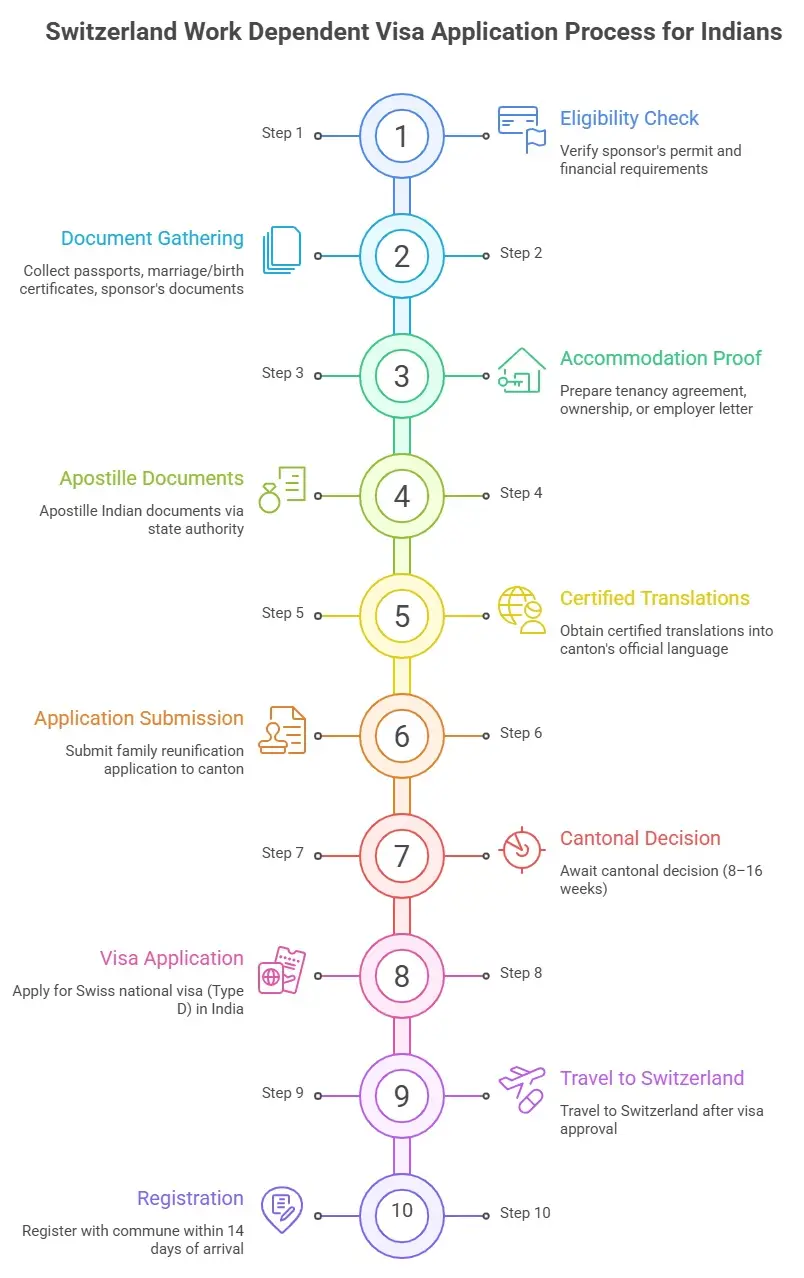
The step-by-step process to apply for the Switzerland family reunification permit from India is as follows:
Step 1: Verify that the sponsor's Swiss permit type (B or C) qualifies for family reunification and that the financial subsistence requirement is met for the specific canton.
Step 2: Gather all required documents such as passports, marriage or partnership certificate, birth certificates for children, sponsor's payslips, employment contract, tax assessment, and accommodation evidence.
Step 3: Prepare accommodation proof such as tenancy agreement, property ownership document, or employer accommodation letter.
Step 4: Apostille all Indian documents including marriage certificate, birth certificates, and other official papers via relevant state authority.
Step 5: Obtain certified translations into the official language of the canton where the application is filed.
Step 6: Submit the family reunification application to the canton where the sponsor resides.
Step 7: Await cantonal decision which typically takes around 8–16 weeks.
Step 8: Apply for Swiss national visa (Type D) in India after cantonal approval.
Step 9: Travel to Switzerland after visa approval.
Step 10: Register with the commune in Switzerland within 14 days of arrival to obtain the biometric card.
Financial Requirements for the Switzerland Work Dependent Visa
The sponsor must meet Switzerland's financial subsistence requirement before a family reunification permit will be granted. This requirement ensures the sponsor can support the entire family without drawing on Swiss social assistance (Sozialhilfe).
| Financial Requirement | Details |
|---|---|
| Subsistence Requirement | Sponsor’s income must be sufficient to support the entire family. Income thresholds vary by canton, family size, and local cost of living, and income verification is mandatory. |
| What Counts as Income | Salary from a Swiss employer, self-employment income, and investment income may be considered. All income sources must be documented and verifiable through payslips, employment contracts, and the most recent cantonal tax assessment. |
| Tax Assessment (Steuerveranlagung) | The latest cantonal tax assessment serves as strong supporting evidence of income and is generally required together with recent payslips. |
| Social Assistance Restriction | The sponsor must not have received Sozialhilfe (cantonal social assistance) during the applicable reference period. Receipt of social assistance is a disqualifying factor in most cantons. |
| No Reliance on Public Funds | The family must be financially self-sufficient and should not rely on Swiss public benefits. This requirement is assessed both at the time of application and during permit renewals. |
| Bank Statements | Recent payslips covering the last 3–6 months and the employment contract are typically required. Some cantons may also request bank statements as supplementary evidence of financial stability. |
Accommodation Requirements for the Switzerland Work Dependent Visa
The sponsor must provide evidence of suitable accommodation in Switzerland for themselves and all dependent family members. This is a mandatory requirement at the time of the application and is assessed by the cantonal Migrationsamt before the permit is granted.
Acceptable proof of accommodation includes a signed tenancy agreement in the sponsor's name showing the property address in Switzerland, an employer-provided accommodation letter, or a property ownership deed. The accommodation must meet the standards appropriate for the number of family members who will reside there.
Accommodation that does not meet cantonal housing standards — including overcrowded properties — may result in the application being refused. Switzerland applies relatively strict housing adequacy standards that vary by canton. If the sponsor is moving to a new address, updated accommodation evidence must be submitted promptly.
Permit Status for Switzerland Work Dependent Visa Holders
After arriving in Switzerland and registering with the local commune, dependents receive the following permit status and rights:
| Dependent | Permit Status | Key Conditions |
|---|---|---|
| Spouse / Registered Partner | Family Reunification Permit (B or C Permit) – Biometric residence permit card issued by the cantonal Migrationsamt | Includes full work and study rights; mandatory Swiss health insurance (Krankenkasse) must be obtained; permit must be renewed before expiry; validity is linked to the sponsor’s permit status |
| Dependent Children Under 15 | Family Reunification Permit (B or C Permit) – Children Category | Eligible to attend Swiss schools; employment rights do not apply; permit validity is linked to the sponsor’s permit |
| Dependent Children Aged 15–18 | Family Reunification Permit (B or C Permit) – Children Category | May undertake light work subject to Swiss labour regulations and school commitments; may study; permit validity is linked to the sponsor’s permit |
Note: All family permit holders must maintain cohabitation with the sponsor and notify the cantonal Migrationsamt of any significant change in circumstances, including the sponsor's change of employer, change of canton, or change in permit status.
What Happens After PR: Planning Your Family's Future in Switzerland
Switzerland offers a clear long-term pathway for work permit holders and their families. Here is what to expect at each stage:
- After 5 years of continuous legal residence for EU/EFTA nationals, or 10 years for Indian and other third-country nationals on a valid family reunification permit, the dependent can apply for a C Permit (permanent settlement). Third-country nationals may qualify after 5 years if they meet Switzerland's integration criteria — including B1-level language proficiency and financial self-sufficiency.
- The C Permit grants the right to reside and work in Switzerland indefinitely without permit renewal. It is Switzerland's closest equivalent to permanent residence and is issued at the cantonal level.
- After 10 years of legal residence in Switzerland — including at least 3 years between ages 8 and 18 — the dependent may apply for Swiss citizenship (Einbürgerung / naturalisation). Cantonal and municipal naturalisation fees apply, along with language (C1 level in the local language), integration, and self-sufficiency requirements.
- Work rights held under the family reunification permit continue unchanged into the C Permit, with no restrictions on employment at any stage.
- If the sponsor transitions to a different permit category — for example from a B Permit to a C Permit — the dependent's permit can typically be upgraded in line with the sponsor's new status.
Also, read...
Highest Paying Jobs in Switzerland for Indians
Market Trends: Switzerland Work Dependent Visa
- India is consistently among the top non-European source countries for skilled professionals in Switzerland, particularly in IT, pharmaceutical and life sciences, financial services, and precision engineering. This drives consistent and growing demand for the Switzerland work dependent visa from Indian families.
- Switzerland's technology hubs in Zurich and Basel and the financial hub in Geneva continue to attract senior Indian IT, banking, and pharma professionals, generating sustained family reunification activity.
- Switzerland's pharmaceutical and life sciences sector — home to global companies such as Novartis, Roche, and Lonza — employs large numbers of non-EU/EFTA specialists whose families regularly use the family reunification route.
- The Swiss government has maintained its family reunification framework with no recent restrictions on spouse work rights for B and C Permit holders, making Switzerland consistently attractive for Indian dual-income professional families.
- Growing numbers of Indian professionals in Switzerland are transitioning to C Permits and Switzerland citizenship after completing the required 10-year residency threshold, with family members following the same timeline on the dependent track.
- Switzerland's AHV/IV pension and social security system provides meaningful long-term benefits for family reunification permit holders in employment — including old-age pension contributions, disability insurance, and parental leave entitlements — creating long-term financial stability for Indian families settling in Switzerland.
Also, read...
Can I get a work visa in Switzerland without a job offer
How Can Y-Axis Help with Your Switzerland Work Dependent Visa?
As the world's No. 1 overseas immigration consultancy, Y-Axis has been providing reliable, personalised immigration services for 25+ years with over 10 lakh clients assisted. Our Switzerland immigration experts provide complete, end-to-end assistance including:
- Free eligibility assessment — confirm whether the sponsor's Swiss permit qualifies for family reunification and whether the financial subsistence requirement is met
- Personalised document checklist for the sponsor and all dependent family members — spouse, partner, or children
- Cantonal Migrationsamt application guidance, review, and submission support — including canton-specific requirements
- MEA apostille and certified translation coordination for all Indian documents
- Accommodation evidence support — helping document suitable housing in Switzerland
- Swiss national visa (Type D) application support at the Swiss Embassy New Delhi or Swiss Consulate General Mumbai
- Commune registration (Einwohnerkontrolle) guidance after arrival in Switzerland
- Annual permit renewal guidance — ensuring timely renewal with the cantonal Migrationsamt
- Language and integration course guidance — supporting PR eligibility under the Swiss integration points system
- C Permit (permanent settlement) application support after the qualifying residency period
- Long-term Switzerland immigration roadmap — from work dependent visa through C Permit to Swiss citizenship
- Switzerland work permit applications for the sponsor — including employer sponsorship guidance and permit renewal
- Resume writing assistance for the dependent spouse or partner
|
Join over 10 lakh clients served by Y-Axis. Book a Free Switzerland Visa Consultation today. Call +91-7670800000 │ Email: info@y-axis.com │ Website: www.y-axis.com |
Y-Axis snapshot
1M
Successful applicants
1500+
Experienced counselors
25Y+
Expertise
50+
Offices
Don't know what to do ?
Get Free Counseling
Looking for Inspiration
Explore what Global Indians have to say about Y-Axis in shaping their future