


Posted on September 01 2026
World needs 85 Million Skilled Workers. Indians are in High Demand. Apply now!

By , Editor & Director
Updated September 05 2026
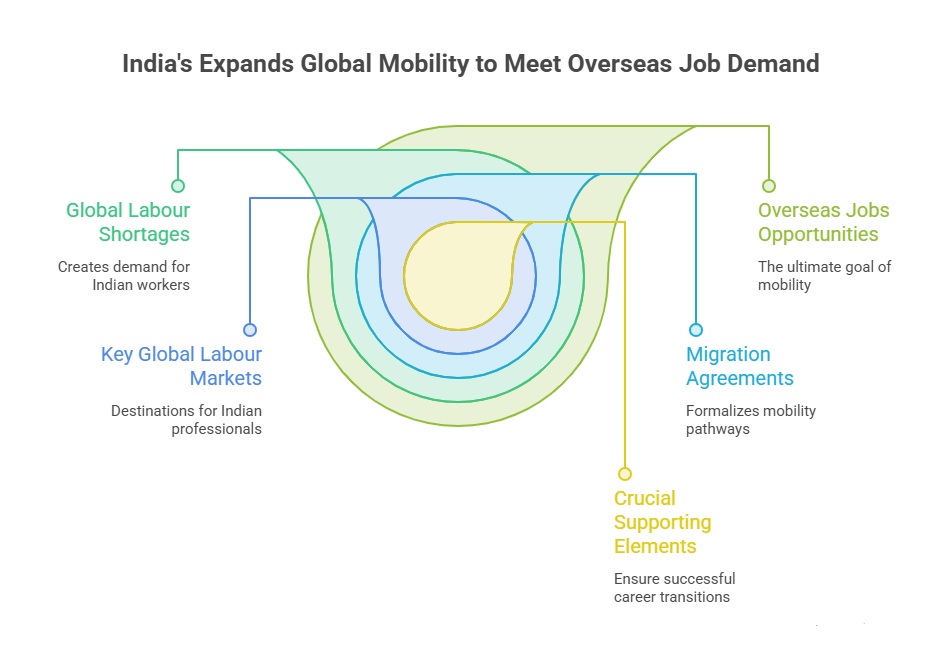
Highlights: India Expands Global Mobility Pathways Amidst Growing Overseas Job Opportunities
- India has signed 28 migration and mobility agreements or equivalent arrangements with 26 countries to expand overseas opportunities for its workforce.
- New mobility pathways are opening for Indian professionals across the EU, New Zealand, Japan, Russia, Israel and other major global labour markets.
- Global labour shortages have created millions of vacancies across Europe, the US, GCC, Japan, the UK, Canada and Australia creating steady opportunities for Indians
- India received $135.4 billion in remittances in FY25, with structured migration expected to further boost overseas earnings.
- Experts say qualification recognition, visa predictability and transparent recruitment remain crucial to turning mobility agreements into real careers.
*Interested to work abroad? Let Y-Axis assist you with the process.
India Creates Global Mobility Network to meet Global Demand
In a major development for Indian professionals and workers, the nation is rapidly expanding its network of migration and mobility partnerships to connect its growing talent pool with countries facing severe labour shortages. External Affairs Minister S. Jaishankar recently announced that India has signed 28 Migration and Mobility Partnership Agreements (MMPAs) or equivalent arrangements with 26 countries, with discussions underway with more nations.
The growing network is opening structured pathways for Indian students, skilled professionals and semi-skilled workers across major global markets. From Europe and New Zealand to Japan, Russia and Israel, countries facing ageing populations and shrinking workforces are increasingly looking towards India to address shortages in healthcare, technology, engineering, manufacturing, caregiving and other sectors.
India's labour mobility strategy is increasingly linked with its wider economic and trade partnerships. Recent agreements and arrangements are creating new opportunities for Indians to study, work and gain international experience through structured and legal migration channels.
|
Country/Region |
Key mobility development for Indians |
|
European Union |
2026 mobility pact aims to ease movement of Indian students, workers and professionals across 27 EU member states |
|
New Zealand |
5,000 skilled Indian professionals can work for up to 3 years under the Temporary Employment Entry pathway |
|
New Zealand |
1,000 young Indians can access Work and Holiday visas each year |
|
New Zealand |
STEM graduates can receive 3-year post-study work visas, while doctorate holders can receive up to 4 years |
|
Japan |
Action Plan aims to facilitate movement of 500,000 people over five years, including 50,000 skilled and semi-skilled Indian workers |
|
Russia |
Agreement on Temporary Labour Activity supports manpower exchange, vocational training and employment cooperation |
|
Israel |
Latest 2026 pact aims to facilitate deployment of up to 50,000 additional Indian workers over five years |
|
United Kingdom |
Existing partnership allows up to 3,000 Indians aged 18–30 to live and work for up to 2 years annually |
Also, read...
In-demand Job Sectors Abroad for Indian workers
The growing demand is not limited to highly skilled technology professionals. Labour shortages across developed economies are creating opportunities across a wide range of sectors.
The in-demand job sectors with substantial opportunities for Indians abroad are as follows:
- Healthcare and nursing
- IT and digital technology
- Engineering
- Construction
- Manufacturing
- Caregiving and eldercare
- Hospitality and services
- Renewable energy
- Artificial intelligence and fintech
- Education and vocational sectors
Note: Experts believe the care economy could become one of the largest future opportunities for India. Countries with ageing populations are increasingly facing shortages of nurses, caregivers, childcare professionals and eldercare workers, creating the potential for structured training and overseas employment.
Also, read...
New Zealand revamps its Seasonal Worker Scheme with major reforms from 2027. Check your eligibility!
Global Labour Shortages Creating Millions of Job Opportunities for Indian Workers
The scale of global labour shortages demonstrates why international demand for Indian workers is rising. According to vacancy data cited in NITI Aayog's working paper, major global labour markets collectively have millions of unfilled positions.
|
Region/Country |
Approximate job vacancies |
|
Europe |
105 lakh |
|
United States |
72 lakh |
|
GCC |
27 lakh |
|
Japan |
9 lakh+ |
|
United Kingdom |
8 lakh+ |
|
Canada |
5 lakh |
|
Australia |
2 lakh |
Note: Germany is among the top countries facing significant workforce shortages. The country reportedly needs around 300,000 skilled foreign workers annually, with more than 260,000 positions currently unfilled in shortage sectors. Healthcare, construction, IT and engineering remain among the sectors facing strong demand.
Also, read...
Germany sees a 17.5% rise in Indian students in one year. Start your study-abroad journey now!
Labour Mobility to Strengthen India's Remittance Economy
India's growing mobility network is also important for the country's economy. In FY25, India received $135.4 billion in remittances, making it the world's largest recipient of remittance inflows. During the same period, India's gross FDI inflows stood at approximately $81.4 billion, highlighting the significant role overseas workers play in supporting India's external finances.
The opportunity could grow further if more Indian workers are able to migrate through safe, formal and regulated channels. Experts believe mobility agreements can help reduce dependence on informal recruitment networks, protect workers from excessive recruitment fees and wage exploitation, and ensure that more of their overseas earnings can be sent home.
The table below highlights India's overseas mobility network at a glance:
|
Indicator |
Latest figure |
|
Mobility agreements or equivalent arrangements |
28 |
|
Countries covered |
26 |
|
Remittances received by India in FY25 |
$135.4 billion |
|
India's projected remittance potential by 2029 |
$160 billion |
|
Gross FDI inflows in FY25 |
Approximately $81.4 billion |
|
Japan mobility target |
500,000 people over 5 years |
|
Skilled and semi-skilled Indian workers targeted under Japan plan |
50,000 |
|
Additional Indian workers planned for Israel |
Up to 50,000 over 5 years |
|
New Zealand skilled professional pathway |
5,000 workers |
Also, read...
EU Immigrant Employment Hits Record High of 68.7% in 2025, New Study Finds
What could be India’s Next Move?
While Indian mobility agreements create the framework for overseas opportunities, experts say signing an agreement is only the first step. The real challenge is converting quotas and commitments into actual jobs through transparent recruitment, faster visa processing and stronger worker protections.
Key areas requiring attention include:
- Qualification recognition: Indian degrees and professional credentials need wider recognition through Mutual Recognition Agreements.
- Social security portability: Workers should be able to manage and transfer applicable social security benefits across countries.
- Visa predictability: Faster processing and clear visa issuance timelines are needed to prevent delays.
- Transparent recruitment: Licensed and accountable recruitment channels can reduce exploitation and illegal fees.
- Worker protection: Employers should bear appropriate sponsorship and skilling costs rather than shifting them to workers.
- Skills development: Training programmes must align with the specific needs of overseas labour markets.
Also, read...
Why is there a rising demand for Indian professionals abroad?
Global demographic changes, widespread labour shortages and changing skill requirements are driving demand for Indian professionals and workers across international markets. Many developed economies have ageing populations and shrinking working-age workforces, while employers are struggling to find qualified workers locally.
India, on the other hand, has a large and growing pool of skilled, semi-skilled and young workers. As global economies face shortages in healthcare, technology, engineering, construction and caregiving, Indian talent is becoming an increasingly important source of international workforce supply.
Here is why the demand for Indian professionals is increasing in the overseas job market:
- Ageing populations: Countries such as Japan and several European nations are facing rapidly ageing populations.
- Shrinking workforces: Fewer working-age people are available to fill essential jobs in many developed economies.
- Growing skills shortages: The World Economic Forum estimates that nearly 40% of workers' core skills could change by 2030.
- Strong demand for healthcare workers: Doctors, nurses and caregivers are needed across multiple countries.
- Technology opportunities: IT, AI, engineering, fintech and digital skills continue to be in demand.
- Care economy expansion: Ageing populations are increasing demand for eldercare, nursing and childcare professionals.
- Construction and manufacturing shortages: Major labour gaps are creating opportunities for skilled and semi-skilled workers.
- India's large talent pool: India's young workforce provides countries with access to professionals across multiple skill levels.
- Higher overseas salaries: Wage differences continue to make international employment attractive for Indian workers.
- More formal migration pathways: Mobility agreements are helping create safer and more structured routes for Indians seeking opportunities abroad.
*Are you looking for step-by-step assistance with overseas immigration? Contact Y-Axis, the world’s No. 1 overseas immigration consultancy!
For recent immigration updates, check out Y-Axis News Page!
FAQs
How many migration and mobility agreements has India signed?
India has signed 28 Migration and Mobility Partnership Agreements, or equivalent arrangements, with 26 countries, according to External Affairs Minister S. Jaishankar. These agreements are designed to facilitate the legal and structured movement of Indian students, professionals and workers abroad. India is also reportedly holding discussions with additional countries to expand international labour mobility opportunities and strengthen economic cooperation.
Which countries are opening new opportunities for Indian workers?
Indian workers and professionals are gaining opportunities across several major destinations, including European countries, New Zealand, Japan, Russia, Israel and the United Kingdom. These countries are expanding mobility arrangements or creating structured pathways for Indian talent. Opportunities vary depending on the country and may include jobs in healthcare, technology, engineering, manufacturing, caregiving, construction, hospitality and other sectors facing labour shortages.
What opportunities does the India-EU mobility pact offer Indians?
India and the European Union signed a mobility pact in 2026 aimed at easing the movement of Indian students, workers and professionals across the EU's 27 member countries. The arrangement is intended to support structured mobility and strengthen economic cooperation. Officials have also indicated an uncapped mobility commitment for Indian students, although individual immigration and visa rules will continue to apply.
What new opportunities are available for Indians in New Zealand?
India and New Zealand have introduced several mobility opportunities for Indian students and professionals. The Temporary Employment Entry pathway provides opportunities for 5,000 skilled Indian professionals to work in New Zealand for up to three years. Additionally, 1,000 young Indians can access Work and Holiday visas annually, while eligible STEM graduates and doctorate holders may benefit from longer post-study work opportunities.
How many Indian workers could move to Japan under the new plan?
The India-Japan Action Plan on Human Resources aims to facilitate the movement of 500,000 people between the two countries over five years. This includes 50,000 skilled and semi-skilled Indian workers, particularly in sectors such as healthcare, manufacturing, caregiving, hospitality and services. The initiative is designed to address Japan's workforce shortages while creating structured employment and training opportunities for Indian workers.
Why is global demand for Indian professionals increasing?
Global demand for Indian professionals is rising because many countries are facing ageing populations, shrinking workforces and growing skills shortages. Healthcare, IT, engineering, construction, caregiving and manufacturing are among the sectors experiencing shortages. India has a large pool of young, skilled and semi-skilled workers, making the country an increasingly important source of international talent for economies struggling to fill essential positions.
How many job vacancies are available in major global markets?
Vacancy data cited in a NITI Aayog working paper shows significant labour shortages across major economies. Europe reportedly has around 105 lakh vacancies, followed by the United States with approximately 72 lakh and the GCC region with nearly 27 lakh. Japan has more than 9 lakh vacancies, while the UK, Canada and Australia also have substantial workforce gaps.
How can labour mobility agreements increase India's remittances?
Labour mobility agreements can create safer and more formal pathways for Indian workers to access overseas jobs, potentially increasing their earnings and remittances sent home. India received $135.4 billion in remittances in FY25. Experts believe future growth will depend on structured migration channels that reduce exploitative recruitment fees, wage theft and irregular migration while helping workers retain and remit more of their overseas income.
What challenges do Indian workers face when moving abroad?
Indian workers can face several barriers when seeking overseas employment, including non-recognition of qualifications, unpredictable visa processing, high recruitment costs and inadequate worker protections. Experts have called for stronger qualification recognition agreements, social security portability and transparent recruitment systems. Faster visa processing and employer-funded sponsorship and skilling costs could also help make international migration safer and more accessible for Indian workers.
What should India do to turn mobility agreements into real jobs?
India needs to focus on implementation after signing mobility agreements. This includes improving international recognition of Indian qualifications, developing skills based on global labour demand and strengthening transparent recruitment channels. Faster visa processing, social security portability and stronger worker welfare protections are also important. A coordinated system involving governments, employers, training institutions and licensed recruiters could help convert mobility quotas into sustainable overseas careers.
Tags:
Work Opportunities for Indians abroad
work abroad
overseas immigration
migrate abroad
global demand for Indian professionals
overseas immigration news
Migration and Mobility Partnership Agreements
Overseas jobs for Indians
Indian workers in Europe
Share
Options for you by Y-Axis

Get it on your mobile

Get News alerts

Contact Y-Axis
Latest Article
Related Post
Trending Article

Posted On October 15 2026
India-Switzerland Mobility Pact Opens New Work, Study and Travel Opportunities for Indians. Check Your Eligibility!