


Posted on August 03 2026
New Zealand revamps its Seasonal Worker Scheme with major reforms from 2027. Check your eligibility!

By , Editor & Director
Updated August 07 2026
Highlights: New Zealand Streamlines Seasonal Worker Scheme Introducing New Benefits for Skilled Workers
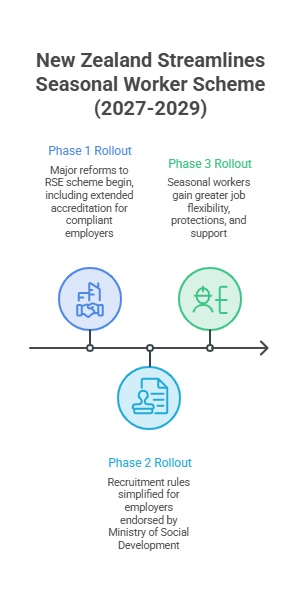
- New Zealand will roll out major reforms to its Recognised Seasonal Employer scheme in phases from 2027 to 2029.
- Employers in New Zealand with strong compliance records will be eligible for extended accreditation of up to six years.
- Recruitment rules for foeign workers in New Zealand will be simplified, reducing hiring requirements for employers endorsed by the Ministry of Social Development.
- Seasonal workers from abroad will gain greater job flexibility, stronger protections, and improved support against exploitation in the country.
- The RSE scheme currently supports around 17,000 seasonal workers across 207 recognised employers in New Zealand.
*Want to work in New Zealand? Let Y-Axis guide you with the process.
New Zealand unveils major updates to its Seasonal Worker Scheme for 2027
In a major update, New Zealand has announced a comprehensive overhaul of its Recognised Seasonal Employer (RSE) scheme, with the reforms set to be implemented in phases between 2027 and 2029. The changes are aimed at simplifying recruitment procedures, reducing administrative requirements for employers, strengthening worker protections, and introducing greater flexibility within the seasonal workforce system.
The revamped framework will streamline employer accreditation and recruitment processes while enhancing safeguards for overseas workers, particularly those from Pacific nations. The government has also introduced measures to improve complaint mechanisms, clarify cost recovery rules, and allow workers to take on related tasks, ensuring that the nearly two-decade-old scheme remains effective in meeting labour demands across New Zealand's horticulture and viticulture sectors.
|
Category |
Details |
|
Implementation timeline |
Reforms will be rolled out from early 2027 to 2029 |
|
Employer accreditation |
Validity extended to one, three, or six years based on compliance |
|
Recruitment process |
Simplified hiring rules for employers endorsed by the Ministry of Social Development |
|
Worker mobility |
Easier movement between accredited employers in specific situations |
|
Worker protections |
Stronger safeguards against exploitation and improved support systems |
|
Additional flexibility |
Workers can undertake incidental tasks related to their primary role |
|
Industry impact |
The scheme supports around 17,000 workers across 207 employers annually |
Also, read...
New Zealand eases Business Investor Work Visa rules to attract global investors. Apply now!
Benefits of New Zealand's RSE Scheme Reforms for Foreign Workers
The latest reforms to New Zealand's Recognised Seasonal Employer (RSE) scheme are expected to benefit both employers and overseas workers by simplifying recruitment procedures, enhancing worker protections, and increasing workplace flexibility. The changes are designed to reduce administrative burdens while ensuring that seasonal workers continue to receive fair treatment and better support.
The major benefits of the reforms for overseas professionals are as follows:
- Faster and simpler recruitment and accreditation processes for employers.
- Longer accreditation periods of up to six years for compliant employers.
- Reduced hiring requirements for employers endorsed by the Ministry of Social Development.
- Greater flexibility for seasonal workers to move between accredited employers.
- Stronger safeguards and support mechanisms for workers facing exploitation.
- Improved transparency regarding salary deductions and cost recovery arrangements.
- Permission for workers to undertake incidental tasks related to their primary role.
- Better alignment between labour demand and workforce availability in the horticulture and viticulture sectors.
*Are you looking for step-by-step assistance with overseas immigration? Contact Y-Axis, the world’s No. 1 overseas immigration consultancy!
For recent immigration updates, check out the Y-Axis News Page!
FAQs
What changes has New Zealand announced to its Recognised Seasonal Employer (RSE) scheme?
New Zealand has announced a series of reforms to its Recognised Seasonal Employer (RSE) scheme to simplify recruitment, strengthen worker protections, and provide greater flexibility for employers. The reforms include changes to employer accreditation, streamlined recruitment requirements, improved support systems for workers, and clearer rules regarding cost recovery. The changes will be implemented in phases from early 2027 to 2029, while the current system will remain unchanged until then.
When will the new RSE scheme reforms come into effect?
The New Zealand government plans to introduce the RSE scheme reforms in stages between 2027 and 2029. Existing rules and requirements will continue to apply until the rollout begins. The phased implementation is intended to give employers, workers, and government agencies enough time to adapt to the updated framework and ensure a smooth transition to the revised seasonal employment system.
What is the Recognised Seasonal Employer (RSE) scheme in New Zealand?
The Recognised Seasonal Employer (RSE) scheme allows employers in New Zealand's horticulture and viticulture sectors to hire overseas workers when suitable local candidates are unavailable. The programme primarily recruits workers from Pacific countries to address seasonal labour shortages. Established nearly two decades ago, the scheme supports around 17,000 seasonal workers every year and plays a crucial role in meeting the country's agricultural labour demands.
How will the reforms affect employer accreditation under the RSE scheme?
Under the new reforms, employer accreditation will become more flexible and compliance-based. New employers will initially receive accreditation for one year, while businesses with strong compliance records may qualify for accreditation periods of three or six years. These changes reduce administrative burdens for compliant employers while maintaining worker welfare standards.
What recruitment changes have been introduced under the new RSE reforms?
The reforms simplify the Agreement to Recruit process for eligible employers. Businesses endorsed by New Zealand's Ministry of Social Development will no longer need to prove they advertised job vacancies locally before recruiting overseas workers. Employers without endorsement must still demonstrate that vacancies were listed with the ministry before international recruitment.
How will the new rules improve protections for seasonal workers?
The updated RSE framework introduces stronger safeguards by improving complaint mechanisms, strengthening worker support systems, and providing clearer rules for deductions and employer cost recovery. Employers must also provide standard cost recovery agreements before workers travel to New Zealand, ensuring greater transparency and protection.
Will seasonal workers be able to change employers under the revised scheme?
Yes. Under the revised RSE scheme, workers will find it easier to transfer between accredited employers in specific situations. The reforms provide greater employment flexibility while ensuring workers continue to receive fair treatment and stable job opportunities throughout New Zealand's horticulture and viticulture sectors.
What additional work can RSE workers undertake under the new rules?
The revised scheme allows seasonal workers to perform incidental tasks related to their primary duties. For example, workers employed for harvesting may also operate machinery or complete other associated activities where appropriate. This flexibility helps employers improve productivity while making better use of seasonal labour.
How many workers and employers currently participate in the RSE scheme?
According to the New Zealand government, the RSE scheme currently supports approximately 17,000 seasonal workers each year across around 207 recognised employers. The programme remains a key solution for addressing labour shortages in New Zealand's horticulture and viticulture industries.
Why is New Zealand reforming its seasonal worker programme?
New Zealand is modernising the RSE scheme after nearly 20 years to simplify recruitment, reduce compliance requirements, improve worker protections, and provide employers with greater operational flexibility. The reforms also ensure that New Zealand workers continue to receive first priority for available jobs while maintaining a sustainable seasonal workforce.
Tags:
New Zealand work visa
work in New Zealand
foreign workers in New Zealand
New Zealand immigration news
overseas immigration
New Zealand Seasonal Worker Scheme
RSE worker protection
Seasonal worker recruitment in New Zealand
Share
Options for you by Y-Axis

Get it on your mobile

Get News alerts

Contact Y-Axis
Latest Article
Related Post
Trending Article

Posted On September 16 2026
Belarus Makes Travel Easier for Indians With New E-Visa Facility. Apply Now!