


Posted on January 03 2026
What are the new UK Visa Rules in 2026?

By , Editor
Updated January 05 2026
Highlights: UK Revises Visa and Immigration Policies for 2026
- The UK is introducing significant changes to immigration policies for 2026, streamlining the migration rate to prioritise skilled workers.
- Applicants for UK work visas must have a proficient English background, with the requirements for professionals, Scale-up, and High Potential Individual visas increasing from B1 to B2, commencing from January 8, 2026.
- Prior digital approval is mandatory for visa-free travellers as the ETA becomes compulsory from February 25, 2026, for visitors from 85+ countries, including the EU, Canada, and the US.
- Approval for permanent residence may take longer under the new rules, as the UK has decided to extend the standard ILR period from 5 to 10 years for immigrants.
- The higher salary range remains unchanged, with the minimum threshold of £41,700 introduced in 2025 continuing into 2026.
*Want to apply for a UK visa? Let Y-Axis guide you with the steps.
Latest UK Visa and Immigration Updates for 2026
The new immigration rules in the UK will take effect from January 8, 2026, for B1 to B2 visas for professionals, Scale-up, and High Potential Individual visas. The latest updates will affect international travellers and skilled workers planning for long-term settlement in the UK. Revised policies for 2026 are part of the ongoing reforms announced in the 2025 Immigration White Paper, which aim to prioritise skilled migration.
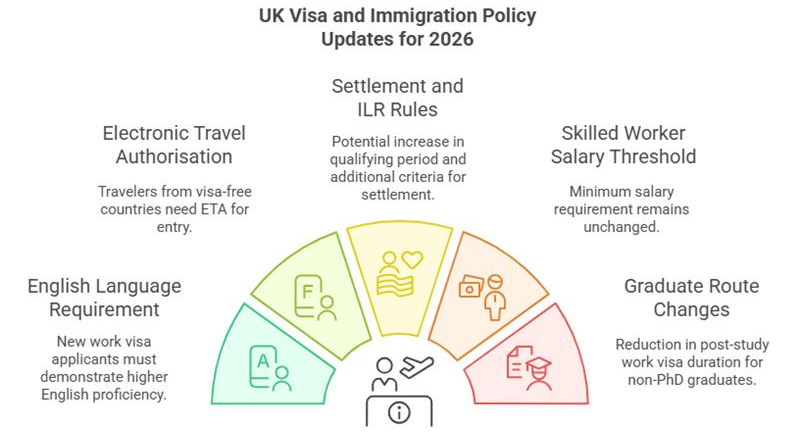
The key changes in UK Visa and Immigration policies are as follows:
- Higher English language requirement for work visas: Applicants for the Skilled Worker, Scale-up, and High Potential Individual (HPI) visas must demonstrate CEFR Level B2 English proficiency from January 8, 2026. Current visa holders can continue with B1 proficiency in English.
Read more…
UK’s Tougher English Tests from 2026: Will You Still Qualify for a Skilled Visa?
- Mandatory requirement for Electronic Travel Authorisation (ETA): It is compulsory for travellers from 85+ countries to secure an ETA before visiting the UK, effective from February 25, 2026. Airlines will deny boarding without proof of ETA approval.
Also, read…
UK Announces HPI Visa Expansion Effective November 4, 2025. Apply now!
- Increased ILR qualifying period: The standard ILR qualifying period is likely to extend from 5 years to 10 years for immigrants from April 2026, with the UK consulting on an earned settlement model. The new rules also include additional criteria, such as B2-level English proficiency, a steady income, and proof of contribution.
Read more…
UK Proposes Extending ILR Qualifying Period to 10 Years. Check If You’re Affected!
- Unchanged salary threshold for skilled professionals: The salary requirements are to remain unchanged, with a minimum salary threshold of £ 41,700, introduced in 2025, and to continue in 2026.
Read more…
Big Changes to UK Skilled Worker Visa! Are You Still Eligible?
- Graduate Route to shorten from 2027: Although applicable from 2027, students arriving in the UK in 2026 should note that the work visa validity post completion of the degree will reduce to 18 months for non-PhD graduates, affecting long-term settlement goals.
Also, read…
How will the updated immigration policies in the UK affect Indian applicants?
The latest updates to visa and immigration policies in the UK have focused on strengthening integration and attracting foreign skilled workers. Indian professionals and students should prepare early to meet the high English language standards, seek ETA travel approval, and go through the evolving PR rules.
Planning to work, study, or travel in the UK?
- Check the eligibility criteria to plan for avoiding visa delays/rejection.
- Stay updated about recent policy changes to apply with document accuracy and relevance.
*Are you looking for step-by-step assistance with UK immigration? Contact Y-Axis, the world’s No.1 overseas immigration consultancy!
For recent immigration updates on the UK, check out Y-Axis UK immigration News!
FAQs
What are the major UK immigration rule changes coming into effect in 2026?
The UK immigration system is undergoing major reforms in 2026 to reduce net migration and prioritise highly skilled and long-term contributors. Key changes include higher English language requirements across multiple visa routes, stricter eligibility criteria for work and study visas, tighter rules for dependants, and enhanced background and suitability checks. The government is also introducing a contribution-based settlement system that rewards sustained employment, tax contributions, and compliance with immigration rules. These reforms aim to improve workforce quality, reduce abuse of visa routes, and ensure migration better supports the UK economy and public services.
When do the new UK visa rules take effect?
Most UK immigration changes are scheduled to come into force from January 2026, although some measures may be implemented gradually throughout the year. Certain reforms, particularly those related to settlement pathways and contribution-based assessments, may continue to evolve into late 2026 or 2027. Applicants planning to study, work, or settle in the UK should prepare well in advance, as applications submitted after the implementation dates will be assessed under the new rules. Staying informed about transitional arrangements is crucial for those already holding UK visas.
How has the English language requirement changed for UK visas?
From 2026, the UK has raised English language requirements for several visa categories, including Skilled Worker, Scale-Up, and High Potential Individual visas. The minimum requirement has increased from B1 to B2 level, meaning applicants must demonstrate stronger proficiency in speaking, listening, reading, and writing. This change reflects the government’s focus on better workplace integration and communication standards. Applicants may need to take approved English language tests or provide recognised qualifications to meet this requirement, making early preparation essential for future visa applicants.
What changes are being made to the UK Graduate Route for international students?
The UK Graduate Route is being revised to shorten the post-study work period for international students. From 2026, non-PhD graduates will be allowed to stay in the UK for 18 months instead of the current two years. PhD graduates are expected to retain longer post-study stay rights. The change is designed to encourage graduates to transition more quickly into skilled employment or other eligible work visa routes. Students planning to study in the UK should factor this reduced timeframe into their career and visa planning strategies.
Will the rules for Indefinite Leave to Remain (ILR) change in 2026?
Yes, the UK plans to introduce a contribution-based settlement system that may significantly alter Indefinite Leave to Remain eligibility. Under the proposed model, many migrants could be required to live in the UK for up to 10 years before qualifying for settlement, compared to the traditional five-year route. Settlement decisions may consider factors such as continuous employment, tax contributions, English proficiency, and compliance with visa conditions. The aim is to ensure that permanent residency is granted to migrants who demonstrate long-term economic and social contribution.
How are UK work visas being affected by the 2026 immigration changes?
UK work visa routes are becoming more selective under the 2026 reforms. Changes include higher skill thresholds, increased salary requirements, stricter suitability checks, and tighter compliance monitoring for sponsored workers. The government aims to reduce reliance on lower-skilled migration while attracting professionals who can fill genuine skill shortages. Applicants may face increased competition and stricter eligibility assessments, making it essential to secure skilled roles that meet updated requirements. Employers must also adapt to new sponsorship obligations and workforce planning challenges.
Do the new UK immigration rules affect dependants and family visas?
Yes, dependants and family members will be more affected under the 2026 immigration reforms. The UK is tightening rules around who qualifies as a dependant and how settlement rights are granted. In some cases, dependants may no longer automatically qualify for settlement alongside the main applicant and could be required to meet independent eligibility criteria. Financial requirements and relationship assessments may also become more stringent. These changes aim to reduce long-term migration through family routes while ensuring that dependants are economically and socially integrated.
What impact will the new rules have on UK employers sponsoring overseas workers?
UK employers sponsoring foreign workers will face stricter compliance requirements under the 2026 immigration changes. These include higher sponsorship costs, increased salary thresholds, more rigorous monitoring, and stronger penalties for non-compliance. Employers will need to demonstrate genuine skills shortages and ensure sponsored roles meet updated criteria. Workforce planning, recruitment strategies, and HR compliance will become increasingly important for businesses relying on international talent. Companies may also need to invest more in domestic workforce development to reduce dependency on overseas hiring.
How will international students be impacted by the UK immigration changes in 2026?
International students will experience several changes under the new UK immigration rules. These include higher English language requirements, stricter financial maintenance criteria, and a shorter post-study work period under the Graduate Route. Opportunities to switch from a student visa to a work visa may also require earlier job offers that meet higher skill and salary thresholds. Students will need to plan their studies, career pathways, and visa transitions more strategically to maximise their chances of long-term employment and settlement in the UK.
Will visitors to the UK need new travel authorisations in 2026?
The UK is expanding its Electronic Travel Authorisation system, which means many visitors from visa-free countries will need to obtain prior approval before travelling. The ETA is designed to enhance border security by pre-screening travellers before arrival. While it is not a visa, failure to obtain an ETA could result in denied boarding or entry. This change adds an extra step for tourists and short-term visitors and highlights the UK’s broader move toward stricter entry controls across all migration categories.
Tags:
UK visa rules
UK immigration updates
UK immigration news
UK visas
Latest UK immigration policies
UK visa rules in 2026
Updated UK visa rules
UK visa changes
Migrate to the UK
Study in the UK
Work in the UK
UK Skilled worker visa
UK work visa
Share
Options for you by Y-Axis

Get it on your mobile

Get News alerts

Contact Y-Axis
Latest Article
Related Post
Trending Article

Posted On April 02 2026
Canada Introduces Eight Major Immigration Changes from April 1, Impacting PR Applicants and Newcomers. Check Your Eligibility Now!