


Posted on March 07 2026
South Korea Expands Visas for Foreign Talent – Check Your Eligibility Now!

By , Editor
Updated March 07 2026
Highlights: South Korea Introduces New Visa Pathways for Skilled Professionals
- South Korea announces new immigration pathways for high-tech professionals on March 3, 2026.
- Under the updated visa policies, South Korea aims to attract skilled foreign technicians to address the declining population and workforce shortage.
- The new measures are announced as a part of the broader immigration strategies for 2030.
- According to the recent visa expansion rules, skilled workers in science and technical fields are now eligible to apply for top-tier work visas.
- South Korea has also launched a K-Core Visa for foreign skilled workers with intermediate technical qualifications.
*Want to apply for South Korea work visa? Let Y-Axis guide you with the steps.
South Korea Announces Expansion of Work Visas for Skilled Technicians from Abroad
The Ministry of Justice in South Korea has announced new changes to its immigration strategy to attract more skilled technicians from abroad. The announcement of visa expansion was made on March 3, 2026, with the country planning to expand its visa benefits for high-tech foreign professionals to address the workforce shortage. New visa pathways will come into effect for skilled professionals as part of the broader immigration strategies for 2030.
Justice Minister Jung Sung-ho outlined new measures allowing foreign technicians to apply for a top-tier visa and the newly announced K-Core Visa for South Korean immigration. The following changes were announced for South Korea’s visa expansion:
Expansion of Top-tier Visa
According to the proposal made last Tuesday, the country will streamline its eligibility criteria for the top-tier visa, which were currently issued to professionals working in companies across eight advanced industries such as semiconductors, artificial intelligence, and robotics. The new top-tier visa scheme will also include professors and researchers from a scientific and technical background.
Introduction of K-Core Visa
The immigration authorities have also planned to grant the K-Core visa to foreign workers with intermediate technical skills. The Justice Minister, Jung Sung-ho, announced that domestic technical colleges will be allowed to train international students, channeling them into sectors facing labour shortages, such as manufacturing.
Read more...
South Korea Introduces K-STAR Visa to Attract Global STEM Professionals. Apply now!
Additional implementations for overseas immigration
South Korea has decided to develop strategies to encourage regional immigration, in addition to addressing declining populations across different regions, apart from major cities. Further information about employment and entrepreneurship opportunities in sparsely populated areas of South Korea will soon be provided to foreign immigrants. In addition to regional immigration support, the government will also offer social integration programmes and childcare services.
A pilot program will be launched to leverage foreign workers for small regional businesses. A separate visa scheme is also under consideration to aid long-term employment of skilled workers across fields such as fisheries and agriculture.
Also, read...
High paying jobs in South Korea for Indians
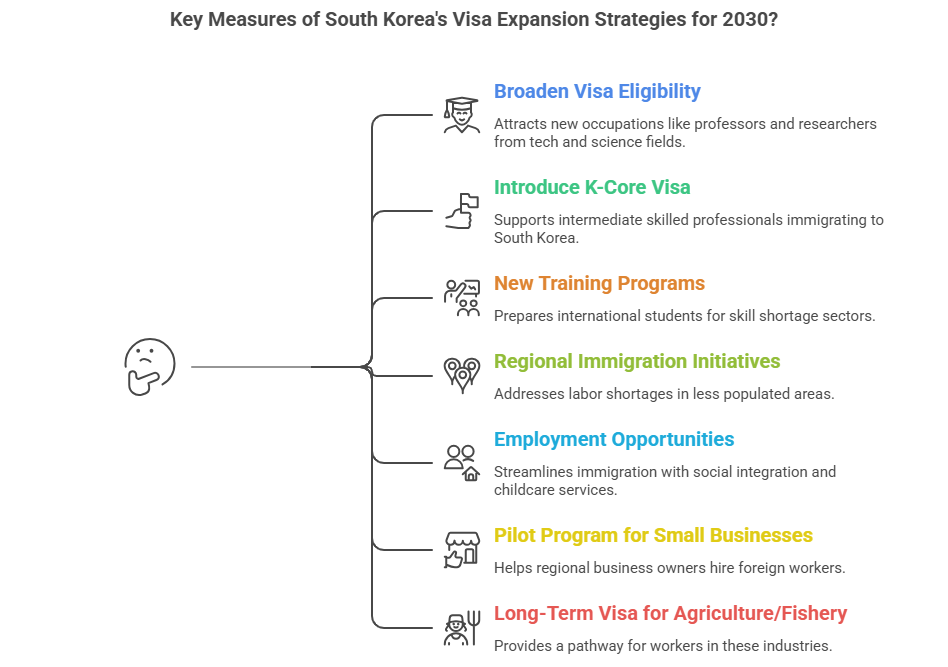
Summary of South Korea’s Visa Expansion Strategies for 2030
South Korea recently expanded its visa policies for foreign high-tech professionals as a part of its bigger immigration policy roadmap for the 2030s.
The country’s Ministry of Justice announced the following new measures at a press briefing at the government complex in Gwacheon:
- Broaden the eligibility criteria for top-tier visas to attract new occupations, such as professors and researchers from the tech and science fields.
- Introduction of the K-Core Visa for intermediate-skilled professionals to immigrate to South Korea.
- New training programs in regional technical colleges to prepare international students to join South Korea’s skill shortage sectors after graduating.
- Initiatives for regional immigration to address labour shortage in less populated areas of South Korea, apart from major cities.
- New employment and entrepreneurship opportunities, including social integration programmes and childcare services, are being offered to streamline the immigration process for foreigners.
- A new pilot program to help small business owners in regional areas of South Korea hire foreign workers.
- A separate visa pathway for foreign workers for long-term engagement in the agriculture and fishery industries in South Korea.
The latest measures to expand work visas for foreign high-tech professionals highlight South Korea’s intention to address population decline and a significant workforce shortage affecting the country’s economy. The newly implemented policies for the immigration strategy 2030 will strengthen South Korea’s economy and stabilize the workforce amid an ageing population and one of the world’s lowest birth rates.
Are you looking for step-by-step assistance with overseas immigration? Contact Y-Axis, the world’s No. 1 overseas immigration consultancy!
For recent immigration updates, check out Y-Axis News Page!
FAQs
What is South Korea’s new immigration strategy for the 2030s?
South Korea’s new immigration strategy for the 2030s aims to address the country’s declining population and increasing labour shortages by attracting more foreign professionals and skilled workers. The Ministry of Justice has proposed expanding visa options for high-tech experts and creating new pathways for skilled technicians. The plan includes widening eligibility for the existing top-tier visa and launching a new K-Core visa programme to train and recruit foreign technical workers. In addition to filling workforce gaps, the government also plans to encourage immigrants to settle in regional areas experiencing population decline by offering integration support and employment opportunities.
What is the South Korea Top-Tier Visa?
The South Korea Top-Tier Visa is a visa programme designed to attract highly skilled global professionals working in advanced industries. It is typically granted to foreign experts employed in sectors such as semiconductors, artificial intelligence, robotics, and other technology-driven fields. Under the new immigration roadmap, the government plans to expand eligibility for this visa to include professors and researchers in science and technology disciplines. By broadening access to the Top-Tier Visa, South Korea aims to strengthen its innovation ecosystem and ensure that its industries remain competitive by bringing in global expertise and specialized talent.
What is the newly proposed K-Core Visa in South Korea?
The K-Core Visa is a newly proposed immigration pathway designed for foreign workers with intermediate technical skills. Unlike visas aimed at highly specialized professionals, the K-Core Visa focuses on technicians who can contribute to industries facing labour shortages, particularly manufacturing and industrial sectors. The programme will involve collaboration with domestic technical colleges, which will train international students in technical skills before connecting them with employers. This approach allows South Korea to build a skilled workforce pipeline while giving foreign workers structured training and employment opportunities in sectors that require practical and technical expertise.
Why is South Korea expanding visas for foreign workers?
South Korea is expanding visas for foreign workers mainly to address demographic challenges and labour shortages. The country is experiencing one of the world’s fastest-declining birth rates, which has led to a shrinking working-age population. Many industries, particularly technology and manufacturing, are struggling to find sufficient skilled labour. By expanding visa programmes and creating new immigration pathways, the government hopes to attract global professionals, technicians, and researchers who can support economic growth. These measures are also intended to strengthen innovation, maintain industrial competitiveness, and help sustain regional economies that are experiencing population decline.
Which industries in South Korea are expected to benefit from the visa expansion?
Several high-tech and industrial sectors in South Korea are expected to benefit from the visa expansion. Key industries include semiconductors, artificial intelligence, robotics, advanced manufacturing, and other technology-driven fields. These sectors require specialized knowledge and skilled technicians, and the domestic workforce alone is not sufficient to meet demand. By expanding visa eligibility for foreign experts and technicians, the government aims to strengthen its technological capabilities and ensure continued industrial growth. Additionally, manufacturing companies that require technical workers may also benefit from the introduction of the K-Core visa programme.
Who can apply for the South Korea Top-Tier Visa under the new rules?
Under the expanded policy, the South Korea Top-Tier Visa will be available to more categories of highly skilled foreign professionals. In addition to experts working in advanced industries such as semiconductors and artificial intelligence, the government plans to extend eligibility to professors and researchers specializing in science and technology fields. Applicants generally need advanced qualifications, specialized expertise, or significant professional experience in their respective industries. By expanding eligibility criteria, South Korea aims to attract world-class talent who can contribute to research, innovation, and technological advancement across multiple sectors.
How will the K-Core Visa help skilled technicians work in South Korea?
The K-Core Visa is designed to create a structured pathway for foreign technicians to study, train, and work in South Korea. Under this programme, international students may enroll in domestic technical colleges where they receive specialized training in technical fields. After completing their training, they can be placed in industries facing workforce shortages, especially in manufacturing and technical services. This system benefits both employers and workers, as companies gain access to trained employees while foreign workers receive practical education, industry experience, and employment opportunities within South Korea’s growing industrial sectors.
Will South Korea encourage immigrants to settle outside major cities?
Yes, South Korea plans to encourage immigrants to settle in regional areas outside major cities. Many smaller regions are experiencing population decline as young residents move to large urban centers for jobs. To address this imbalance, the government intends to provide foreign residents with information about employment and entrepreneurship opportunities in these regions. Additional support programmes such as social integration assistance, childcare services, and community support initiatives may also be introduced. These measures aim to attract foreign workers and families to regional areas while helping local economies remain stable and sustainable.
What support will foreign workers receive under the new immigration plan?
Foreign workers arriving under South Korea’s new immigration strategy may receive various forms of support to help them integrate into society and the workforce. The government plans to provide guidance on employment opportunities, entrepreneurship options, and settlement assistance. Regional immigration programmes may also include social integration initiatives, language support, childcare services, and community programs that help newcomers adjust to life in the country. These measures aim to make South Korea a more attractive destination for global professionals while ensuring that foreign residents can adapt smoothly to their new environment.
When will South Korea’s new visa programmes be implemented?
The new visa initiatives are part of South Korea’s broader immigration policy roadmap for the 2030s. While the government has announced the plan and outlined key proposals such as the expansion of the Top-Tier Visa and the introduction of the K-Core Visa, the exact timeline for full implementation may depend on policy approvals and administrative preparations. Authorities are expected to gradually roll out these programmes as part of long-term efforts to strengthen the workforce, support technological innovation, and address the country’s demographic challenges over the coming years.
Tags:
South Korea work visa
work in South Korea
Migrate to South Korea
South Korea immigration
Jobs in South Korea
South Korea immigration strategy
High tech professionals in South Korea
high demand jobs in South Korea
foreign workers in South Korea
Share
Options for you by Y-Axis

Get it on your mobile

Get News alerts

Contact Y-Axis
Latest Article
Related Post
Trending Article
Posted On March 07 2026
South Korea Expands Visas for Foreign Talent – Check Your Eligibility Now!