


Posted on February 21 2026
Japan surpasses 4 lakh international student enrolment target, achieves 2033 goal ahead of schedule

By , Editor
Updated February 25 2026
Highlights: Japan Achieves 4 Lakh International Student Target Ahead of 2033 Plan
- Japan has officially met its 2033 goal, welcoming 4 lakh international students in 2025, restoring its status as a fast-growing global study destination.
- A total of 435,200 international students were enrolled across various Japanese universities as of June 2025, surpassing the 4 lakh target eight years ahead of schedule.
- The total enrolment had risen by 8.2% in 2025, highlighting steady year-on-year growth in international student enrolment.
- With more than 180,000 first-time international students joining Japanese institutions, the country crossed its estimated benchmark.
- Japan also recorded a total of 4 million foreign residents and over 866,000 highly skilled foreign workers, reflecting its continuous effort to attract global talent.
*Want to apply for a Japan student visa? Let Y-Axis guide you with the process.
Japan Exceeds its International Student Enrolment Target of 4 Lakh, 8 years Early
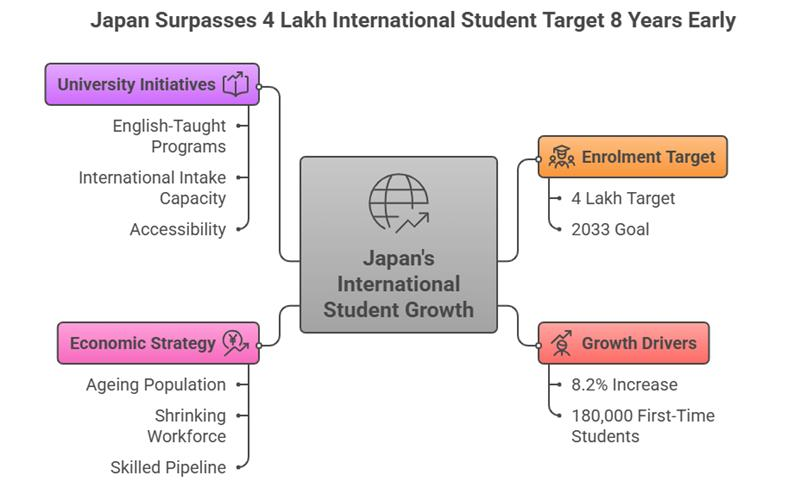
Japan has officially confirmed that its enrolment of international students will exceed 4 lakh in 2025, surpassing the 2033 target. A total of 435,200 international students were welcomed by Japanese institutions in June 2025, achieving the targeted milestone eight years ahead of time. The latest records reflect an increase of 8.2% in student intake compared to 2024, with around 180,000 first-time international students admitted in 2025. The achieved milestone reflects Japan’s firm intention to establish itself as a global leader in higher education and a leading study destination in Asia.
The rapid acquisition of foreign talent and international students is part of a broader strategy to address the growing concern over the country’s aging population and workforce stabilisation. By welcoming more international students, Japan aims to create a pipeline to help graduates transition into long-term employment. The majority of universities in Japan offer courses in English to boost international enrollment and make the country more accessible to students from countries like India seeking postgraduate education abroad.
Also, read…
Can Indian Students Work Part-Time While Studying in Japan?
Introduction of English-translated Programs Encourages Indian Students to Migrate to Japan
Japan is not only expanding its annual enrolment of international students but also transforming its education system to align with students’ expectations. Factors such as greater student intake, more English-taught programs, and streamlined career pathways at top universities across the country are influencing international students to select Japan as a long-term academic and employment destination. The latest educational reforms in the country are especially beneficial for international students from India seeking quality education, global exposure, and post-study work opportunities.
- Top universities in Japan, such as Tohoku University, Hiroshima University, and the University of Tsukuba, have been permitted to enhance international student intake from 2026.
- Introduction of more English-taught programs will eliminate the language barrier for students from abroad.
- Tuition caps were discontinued in 2024, allowing universities to revise their fee structures to remain competitive in the global market.
- With over 866,000 highly skilled foreign professionals currently employed in Japan, the country continues to encourage experienced workers from abroad to join its workforce.
Also, read…
Japan plans to introduce new migration programme for foreign nationals. Check your eligibility!
Japan Enters New Growth Phase with Integration and Policy Updates
While Japan steadily welcomes more international students, policymakers in the country are also focused on integration and long-term sustainability. Public discussion on migration, residency rules, and social integration is widespread, with a total of 4 million foreign residents in June 2025. The government has acknowledged the need to balance international immigration and talent attraction through a structured approach.
The concerned authorities have expressed their interest in extending Japanese language training and settlement support to newcomers, such as students and professionals, to improve their adaptability. There is a possibility that the timeline for Japan PR acquisition will be revised, extending the eligibility period.
Indian students planning to migrate to Japan should consider recent updates and integration reforms when structuring their long-term goals in the country. While Japan remains open and competitive, it is essential to stay up to date on evolving integration policies, visa regulations, residency pathways, and post-study options to find the right opportunity.
*Are you looking for step-by-step assistance with overseas immigration? Contact Y-Axis, the world’s No. 1 overseas immigration consultancy!
For recent immigration updates, check out the Y-Axis News Page!
FAQs
What does it mean that Japan has surpassed 4 lakh international student enrolments ahead of its 2033 target?
Japan has officially crossed 400,000 international student enrolments, reaching approximately 435,200 students by mid-2025. This means the country has achieved its 2033 target nearly eight years early. The increase reflects Japan’s strategy to internationalise its higher education system and attract global talent to address labour shortages caused by its ageing population. For prospective students, this signals expanded academic opportunities, stronger institutional support for foreign learners, and a more welcoming environment for international applicants planning to study in Japan in the coming years.
Why is Japan encouraging more international students to study there?
Japan is facing a declining birth rate and a rapidly ageing population, leading to workforce shortages in several sectors. By attracting international students, the government aims to build a skilled talent pipeline that can transition into long-term employment in Japan after graduation. International students are viewed as potential contributors to innovation, research, and economic growth. This policy direction makes Japan an increasingly attractive destination for students who wish to combine quality education with future career opportunities in a stable and technologically advanced economy.
How many international students are currently studying in Japan?
As of June 2025, Japan recorded around 435,200 international students enrolled across universities and other institutions. This represents an 8.2% increase compared to the previous year. A significant portion of this growth came from approximately 180,000 first-time international students. These numbers highlight Japan’s growing popularity as a global study destination and demonstrate the country’s success in attracting overseas talent through policy reforms, expanded academic programs, and improved post-study employment prospects.
Are more English-taught programs being introduced in Japan?
Yes, many Japanese universities are expanding English-medium programs to attract a broader international audience. Since Japanese is considered a challenging language for many foreign students, offering courses in English makes higher education more accessible. Several institutions are strengthening their global competitiveness by introducing more English-based degrees, particularly at the master’s and research levels. However, students are still encouraged to learn basic Japanese to improve integration, employment opportunities, and overall daily life experiences while living in Japan.
Has Japan increased tuition fees for international students?
Some Japanese universities have been permitted to revise tuition structures for international students. In recent years, the cap limiting foreign student tuition to 1.2 times domestic fees was lifted. Certain national universities have announced higher annual tuition fees starting from upcoming academic intakes. Despite these increases, tuition fees in Japan remain comparatively lower than many major global study destinations such as the US or UK. Students should check specific university websites for the latest fee details and scholarship opportunities before applying.
Will international students be encouraged to work in Japan after graduation?
Yes, Japan views international graduates as an important talent pool for its economy. The government encourages skilled graduates to transition into the workforce, especially in sectors experiencing shortages. Many students can apply for post-study work opportunities by changing their visa status once they secure employment. Japan’s growing demand for highly skilled professionals, including in technology, engineering, and research fields, makes it a promising destination for students seeking long-term career prospects after completing their studies.
Are there any changes to permanent residency rules for foreign nationals in Japan?
Recent policy discussions indicate that Japan is reviewing certain immigration and residency regulations. Authorities have announced stronger language support measures for international students and workers to improve integration. At the same time, there have been indications that the time required to qualify for permanent residency may be adjusted. Students planning long-term settlement should stay updated through official Immigration Services Agency announcements to understand the latest eligibility requirements and timelines.
Which universities in Japan are increasing international student intake?
Japan’s Ministry of Education has allowed selected national universities to admit more international students beyond previous quota limits. Institutions such as Tohoku University, Hiroshima University, and the University of Tsukuba have received permission to expand their intake in selected programs. This flexibility allows universities to respond to global demand and strengthen their international presence. Prospective students should monitor official university admissions pages for updated program availability and intake numbers.
Is Japan still affordable compared to other popular study destinations?
Even with gradual tuition revisions at certain universities, Japan remains relatively affordable compared to countries like the United States, the United Kingdom, or Australia. In addition to moderate tuition costs, Japan offers various government and institutional scholarships to support international students. Living expenses vary by city, with Tokyo being more expensive than regional areas. Overall, Japan continues to balance affordability with high-quality education, advanced research facilities, and strong employment prospects.
What should students consider before applying to study in Japan?
Students should review program language requirements, tuition fees, scholarship availability, visa regulations, and post-study work options. Learning basic Japanese can significantly enhance daily life and career prospects. It is also important to understand university admission timelines and required documents, including academic transcripts and language proficiency scores. With Japan actively strengthening its international education framework, students who plan carefully and apply early can benefit from expanded opportunities in one of Asia’s leading academic and economic hubs.
Tags:
Study in Japan
Japan student visa
study abroad
internal students in Japan
Indian students in Japan
foreign students in Japan
overseas immigration
Japan immigration news
Japan immigration policy
Japan International Student Enrolment
Share
Options for you by Y-Axis

Get it on your mobile

Get News alerts

Contact Y-Axis
Latest Article
Related Post
Trending Article

Posted On February 27 2026
Israel to Hire 50,000 Indian Skilled Professionals by 2030 – Apply Now!