


Posted on May 05 2026
France has announced revised tuition fees for non-EU students from 2026, creating new opportunities for your study abroad journey. Apply now!

By , Editor & Director
Updated May 11 2026
Highlights: France Announces New Tuition Fees for Non-EU students, Encouraging Global Education Plans
- France is set to implement new tuition fees for international students starting their academic year in 2026-27.
- The country has revised the fees for bachelor's programs to €2,895 and for master's degrees to €3,941 annually.
- The French government intends to allocate 60% of scholarships to priority fields such as digital technologies, artificial intelligence, quantum studies, and biotechnology.
- The new reforms will offer tuition fee exemptions to up to 10% of eligible applicants.
- France aims to reshape international student recruitment by encouraging uniform study costs.
*Want to apply for a France student visa? Let Y-Axis guide you with the process.
France Rolls Out New Tuition Fee Structure for Non-EU Students in 2026
France has officially announced major changes to its higher education framework for international students in 2026. The French government will introduce a new tuition fee structure to encourage uniformity in study costs for international students. This new reform is part of a broader strategy to reshape international student recruitment to strengthen the global positioning of French universities.
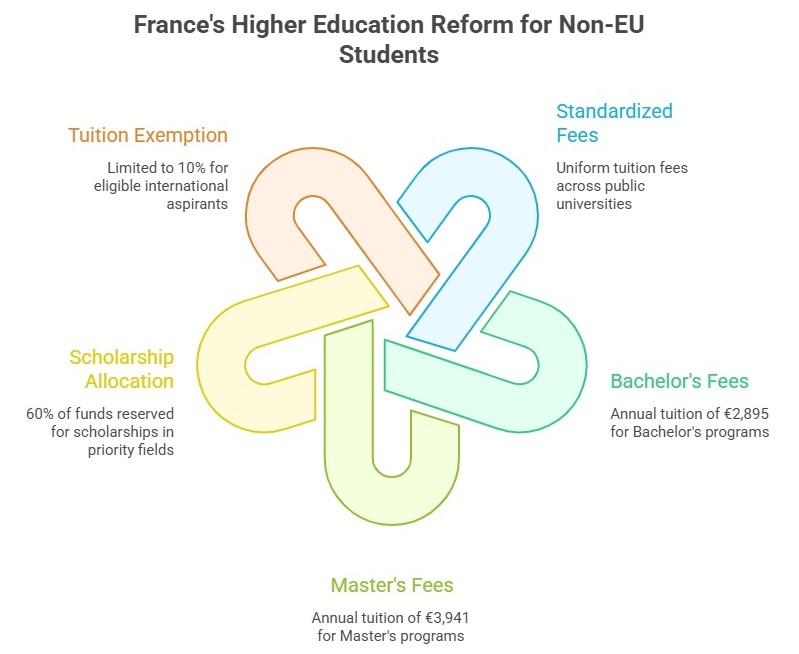
The major highlights of France’s educational reform in 2026 are as follows:
- Standardized fee structure across all public French universities.
- Revised annual tuition of approx. €2,895 for Bachelor’s programs and €3,941 for Master’s programs annually.
- Up to 60% of funds are reserved for scholarships in priority fields such as digital technologies, artificial intelligence, quantum studies, and biotechnology.
- Tuition fee exemption will be limited to 10% for eligible international aspirants.
Also, read...
France Plans to Welcome 30,000 Indian Students by 2030 – Modi-Macron Education Boost
What are the benefits of Reformed Educational Pathways in France for Foreign Aspirants?
France has updated its educational framework, introducing new tuition fees for international applicants. The latest reforms aim to prioritize quality, transparency, and global competitiveness, making France one of the top study-abroad destinations.
The key benefits of studying in France in 2026-27 are as follows:
- Increased funding through revised tuition for better infrastructure and research development.
- Standardized fee structure for improved academic investment.
- Boost of international value and credibility of French degrees.
- Reduction in inconsistencies across universities, allowing students to plan their finances.
- Expanded scholarship opportunities( almost 60%) for international talent.
- Increased institutional funding can lead to stronger industry collaborations.
- Improve student services, including accommodation support, career guidance, and integration programs.
*Are you looking for step-by-step assistance with overseas immigration? Contact Y-Axis, the world’s No. 1 overseas immigration consultancy!
For recent Schengen immigration updates, check out the Y-Axis Schengen News Page!
FAQ's
What is the new tuition fee structure for non-EU students in France from 2026?
France will introduce a revised tuition framework for non-EU students starting in the 2026–27 academic year. Public universities are expected to adopt a more standardized fee structure, replacing the earlier system where many institutions offered reduced or waived fees. This means international students will pay higher, more uniform tuition across most public universities. The goal is to create consistency, improve funding, and enhance the overall academic ecosystem. While the fees are increasing, they still remain subsidized compared to private institutions and many global destinations, making France a balanced choice for affordability and quality education.
Why is France increasing tuition fees for international students?
France is revising its tuition policy to strengthen the quality and global standing of its higher education system. By increasing fees for non-EU students, the government aims to generate additional funding that can be reinvested into universities. This includes improving infrastructure, hiring top faculty, expanding research opportunities, and enhancing student services. The move also aligns France with other leading study destinations where international students pay differentiated fees. Ultimately, the objective is to maintain competitiveness while ensuring that institutions can sustain high academic standards and offer better outcomes for both domestic and international students in the long run.
How much will international students pay in France after 2026?
From 2026 onwards, non-EU students enrolling in public universities in France are expected to pay approximately €2,895 per year for bachelor’s programs and around €3,941 per year for master’s programs. These figures serve as general benchmarks under the new standardized system, though exact fees may vary slightly depending on the university or specialized course. Even with the increase, these costs remain significantly lower than tuition fees in countries like the US, UK, or Australia. Students should also consider additional expenses such as accommodation, health insurance, and living costs while planning their overall study budget.
Will current international students be affected by the new tuition rules?
The revised tuition structure is primarily aimed at new students enrolling from the 2026–27 academic year. Current international students who are already studying in France are generally expected to continue paying fees under the existing system that applied at the time of their admission. This ensures stability and fairness for those who have already committed financially to their education. However, students should stay updated with official university communications, as policies may vary slightly by institution. Overall, the change is designed to impact future applicants rather than disrupt ongoing academic journeys for existing students.
Are scholarships available for international students in France after the fee increase?
Yes, scholarships and financial aid options are expected to play an even more important role after the tuition increase. The French government, along with universities and external organizations, offers a wide range of scholarships for international students based on merit, academic excellence, and financial need. Popular programs like the Eiffel Excellence Scholarship and institution-specific grants can significantly reduce the financial burden. Additionally, some universities may introduce new funding schemes to attract global talent despite higher fees. Students are encouraged to research and apply early to maximize their chances of securing financial support.
Is France still an affordable study destination after the fee hike?
Even with the revised tuition structure, France remains one of the more affordable study destinations among developed countries. Public universities continue to receive government subsidies, keeping tuition fees relatively low compared to nations like the US, UK, or Canada. Additionally, students benefit from affordable public services, student discounts, and access to subsidized housing options in many cities. When combined with the quality of education, cultural exposure, and career opportunities, France offers strong value for money. Careful financial planning and exploring scholarships can further enhance affordability for international students.
What are the benefits of studying in France under the new system?
The updated system is expected to bring several benefits, including improved academic quality, better infrastructure, and enhanced research opportunities. With increased funding, universities can invest in modern facilities, industry collaborations, and global partnerships. Students may also experience improved support services such as career counseling, internship placements, and integration programs. Additionally, a standardized fee structure increases transparency, helping students plan more effectively. Degrees from French institutions are likely to gain stronger international recognition, boosting employability. Overall, the reforms aim to create a more competitive and rewarding educational environment for international students.
When should I apply to study in France to avoid higher tuition fees?
If you want to benefit from the current lower tuition structure, it is advisable to apply for intakes before the 2026–27 academic year. Universities typically have multiple intake cycles, so early planning is essential to secure admission under existing fee policies. This includes preparing required documents, meeting language proficiency requirements, and submitting applications well in advance. However, even if you apply after the changes take effect, France still offers competitive tuition rates compared to many countries. Evaluating timelines carefully can help you make the most cost-effective decision for your study abroad journey.
What documents are required to apply for universities in France?
To apply to French universities, international students generally need a set of essential documents. These include academic transcripts, certificates of previous education, a valid passport, and proof of language proficiency such as IELTS, TOEFL, or French language tests depending on the program. Additional requirements may include a statement of purpose, letters of recommendation, and a detailed resume. Some courses may also require portfolios or entrance exams. For visa purposes, financial proof, accommodation details, and health insurance are also necessary. Requirements can vary by institution, so checking specific university guidelines is important.
How can I check my eligibility to study in France in 2026?
Eligibility to study in France depends on several factors, including your academic background, chosen program, language proficiency, and financial readiness. Most universities require a minimum academic score and proof of English or French language skills. Additionally, you must demonstrate the ability to cover tuition and living expenses for visa approval. To assess your chances accurately, you can consult study abroad experts or use professional evaluation tools. Early assessment helps you identify suitable programs, prepare required documents, and plan finances effectively, ensuring a smoother application process for the 2026 intake and beyond.
📞 Call: +91-7670800000
📩 Email: info@y-axis.com
🌐 Visit: https://www.y-axis.com
Tags:
International students in France
France student visa
study in France
France immigration news
France Educational Policy
Higher education in France
France visas
migrate to France
Share
Options for you by Y-Axis

Get it on your mobile

Get News alerts

Contact Y-Axis
Latest Article
Related Post
Trending Article

Posted On September 16 2026
Belarus Makes Travel Easier for Indians With New E-Visa Facility. Apply Now!