

Posted on December 01 2025
Canada Opens Study Permits for Families of Students & Workers. Check If You’re Eligible!

By , Editor
Updated January 13 2026
Highlights: Canada Introduces Open Study Permits for families of International students and workers
- Canada now offers open study permits to accompanying family members of students and foreign workers, allowing them to study anywhere in the country.
- No LOA or PAL is required, allowing spouses and dependent children can apply without securing admission first.
- These family members are exempt from Canada’s study permit cap, helping them avoid DLI deposits and allocation limits.
- Each open study permit remains valid until the same expiry date as the principal applicant’s study or work permit.
- Eligible applicants include spouses, common-law partners, and dependent children accompanying the primary student or worker.
*Want to study in Canada? Let Y-Axis guide you with the process.
Canada Now Allows Families of Students & Workers to Get Open Study Permits
Canada has rolled out a major immigration update that directly supports international students, foreign workers, and their families. Under the new rule, accompanying family members, including spouses, common-law partners, and dependent children, can now apply for an open study permit without meeting the usual admission requirements. This change aims to make family movement easier, reduce financial pressure, and simplify the pathway to education in Canada.
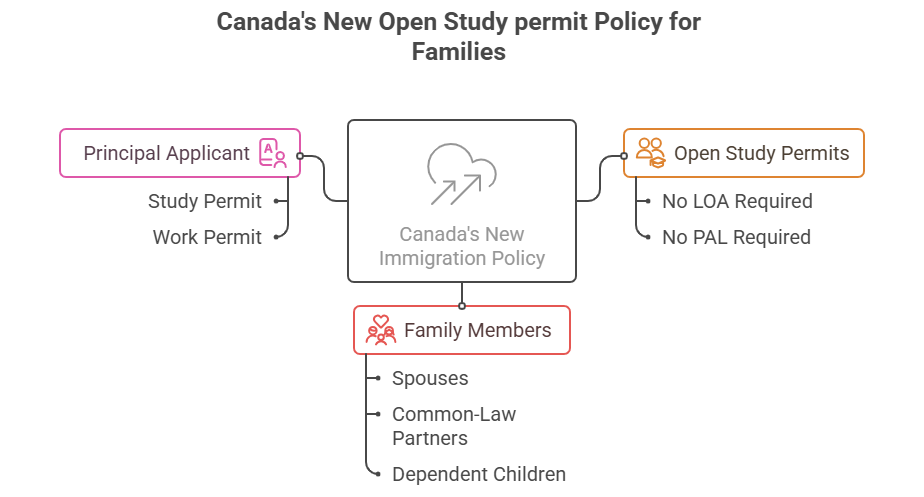
The policy removes two major barriers that Indian applicants often face:
- The need for a Letter of Acceptance (LOA) from a Canadian college or university, and
- The requirement of a Provincial Attestation Letter (PAL), which became mandatory in 2024 for most study permit applicants.
Instead, accompanying family members can apply for a study permit as long as the principal applicant’s study or work permit has already been approved in writing before they enter Canada. This allows families to move together without waiting for separate admission decisions or paying large tuition deposits in advance.
*Want to apply for a Canada study permit? Sign up with Y-Axis to guide you with the process.
Breaking Down How the New Open Study Permit Works for Spouses & Children
This new rule is expected to benefit thousands of Indian families who plan to study or work in Canada, making the process far smoother and more affordable. Canada, which already hosts over 400,000 Indian students, continues to strengthen its position as one of the world’s most welcoming destinations for families seeking education and career growth.
What This Means in Practice
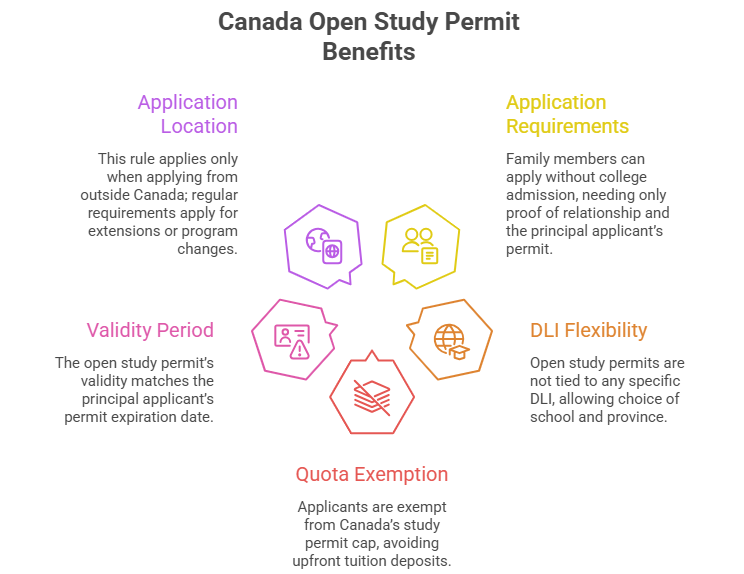
- Family members can apply without securing college admission first: They only need to submit proof of relationship and a copy of the principal applicant’s permit approval.
- Open study permits are not tied to any specific DLI: Spouses and children can choose any school, in any province, after arriving in Canada.
- Applicants are exempt from Canada’s study permit cap: Since accompanying family members do not count toward provincial student quotas, they may avoid upfront tuition deposits demanded by DLIs to reserve a seat.
- Validity matches the principal applicant’s permit: The open study permit will expire on the same date as the primary student or worker’s permit.
- This rule applies only when applying from outside Canada: If the family member later extends their permit or changes their program, regular requirements, including LOA and PAL—will apply.
Also, read…
Canada is welcoming 408,000 students in 2026. Apply now!
What Indian Families Should Know Before Applying
Here are the key points families should understand before applying for the new open study permit:
- Family members must apply for the open study permit from outside Canada, and only after the principal applicant’s study or work permit has been approved in writing.
- The LOA and PAL exemption applies only to the first study permit application. Any later extensions, school changes, or program changes will require a new study permit with a valid LOA and PAL (if applicable).
- Although the study permit is open and not tied to a specific DLI, schools in Canada still have their own admission requirements, fees, and deadlines, which applicants must meet after arrival.
- The open study permit will be valid only until the same expiry date as the principal applicant’s study or work permit. If the main applicant’s permit ends, the family member’s permit ends as well.
- Study permit processing times for India remain high, so applicants should prepare complete documentation and plan timelines accordingly to avoid delays.
*Are you looking for step-by-step assistance with Canadian immigration? Contact Y-Axis, the world’s No. 1 overseas immigration consultancy!
For recent Canadian immigration updates, check out Y-Axis Canada immigration News!
FAQs
What is the new open study permit option introduced for family members of international students and foreign workers?
Canada has introduced a special open study permit that allows family members of international students and foreign workers to study in the country without needing a Letter of Acceptance at the time of application. This permit gives spouses, partners, and dependent children more flexibility by allowing them to choose a school later, after arriving in Canada. It is meant to make family reunification easier and support families who plan to live in Canada temporarily. The permit is issued without listing any specific institution, giving the holder the freedom to select a suitable study program when they are ready.
Who is eligible as an “accompanying family member” under this policy?
Eligible accompanying family members include the spouse, common-law partner, and dependent children of an international student or foreign worker. Children of a spouse or partner also qualify. To be considered “accompanying,” the individual must apply as part of the family unit and intend to live in Canada with the principal applicant. The principal applicant’s study or work permit must already be approved before the family member applies. This policy ensures that families can stay together in Canada and access education more easily while supporting the primary student or worker during their stay.
What conditions must be met for a family member to qualify for this open study permit?
To qualify, the principal applicant’s work or study permit must already be approved in writing. The family member must apply for their open study permit before entering Canada, and the application must clearly indicate that they are an accompanying family member. Unlike regular study permits, they do not need a Letter of Acceptance or PAL/TAL during initial submission. However, they must still meet general requirements such as proving intent to study, showing sufficient funds, and demonstrating ties to their home country. Once approved, they gain the flexibility to pursue education at any Canadian institution of their choice.
Do family members need a Letter of Acceptance (LOA) from a DLI to apply?
No, eligible family members do not need to include a Letter of Acceptance from a Designated Learning Institution when applying for this special open study permit. This exemption makes the process simpler and faster, allowing spouses and dependent children to secure their study permit before deciding on a school or program. After arriving in Canada, they may choose any institution or program that fits their goals. This flexibility is especially helpful for families who want time to settle in, explore local options, or understand the education system before committing to a specific school.
Does the open study permit specify a designated learning institution on the document?
No, the open study permit issued under this policy does not list a specific designated learning institution. Because it functions like an open permit, the holder is free to select any eligible school or program once in Canada. This setup allows family members to make informed decisions after arrival, visit campuses, or adjust plans based on location and family needs. It removes the requirement to commit to a school upfront and provides more freedom, especially for families who may still be exploring educational pathways. The flexibility supports easier settlement and smoother integration into Canadian academic environments.
How long is the open study permit valid for accompanying family members?
The open study permit for family members is typically issued with the same expiry date as the principal applicant’s study or work permit. This means its validity is directly tied to the primary holder’s authorized stay in Canada. If the principal applicant extends their permit in the future, the family member can also apply for an extension to continue their studies. This synchronized validity helps families manage documentation and renewal timelines more easily, ensuring that everyone maintains legal status. It also supports long-term planning for studies, work, and settlement while the family remains in Canada together.
Can family members begin their studies immediately upon arrival in Canada?
Yes, family members who receive this open study permit can begin their studies after arriving in Canada, even if they did not choose a school beforehand. Once in the country, they can research institutions, explore available programs, and then formally enroll. This offers significant flexibility, especially for newcomers who may want to understand local education options before committing. It also helps families align study schedules, locations, and daily routines. The ability to start studying without pre-arrival acceptance simplifies the transition and ensures that education plans can adapt to real-time circumstances and opportunities in Canada.
Does this open study permit count toward the provincial study permit caps?
No, these open study permits do not count toward provincial study permit caps because they are exempt from requirements like the Provincial Attestation Letter (PAL). This means the number of these permits issued does not affect the allocation limits set for international students in each province. As a result, accompanying family members can still obtain study permits even when provincial caps for regular international students are tight. This exclusion ensures that families are not separated due to quota limitations and supports Canada’s goal of making education access easier for spouses and dependent children of workers and students.
What requirements apply if the family member wants to extend or modify their study permit later?
If the family member later wants to extend their study permit, switch schools, or change study levels, they must follow the standard process required for all students in Canada. This includes obtaining a valid Letter of Acceptance and, when applicable, a Provincial or Territorial Attestation Letter. The exemption they benefit from during the initial application applies only when applying from outside Canada. Once inside the country, regular rules apply. They must also maintain good academic standing, comply with permit conditions, and ensure they renew before expiry to maintain legal status throughout their studies.
Does this policy apply to all family members of international students and foreign workers automatically?
No, the policy does not automatically apply to all family members. To qualify, the family member must be considered “accompanying,” meaning they intend to join the principal applicant in Canada and apply before entering the country. The principal applicant’s study or work permit must already be approved. Family members already inside Canada do not qualify under this exemption and must follow standard study permit requirements. Additionally, eligibility does not guarantee approval; applicants must still satisfy financial, admissibility, and intent criteria. This policy is designed to support family reunification but within clear conditions and limitations.
Tags:
Canada immigration news
Migrate to Canada
Canada visas
Canada PR
Permanent residency in Canada
Canada open study permit
Canada study permit
Open study permit for spouses
international students in Canada
Skilled workers in Canada
Share
Options for you by Y-Axis

Get it on your mobile

Get News alerts

Contact Y-Axis
Latest Article
Related Post
Trending Article

Posted On April 08 2026
New Zealand Funds Transfer Scheme (2026) – Student Visa Proof of Funds Explained