


Posted on April 01 2026
Canada Introduces New PNP Rule: Provinces Get Full Authority Over PR Selection

By , Editor
Updated April 01 2026
Highlights: Canada Revises PNP Rules Offering Full Authority to Provinces for PR Process
- Ottawa officially permits provinces and territories to assess their Provincial Nomination Program (PNP) candidates for PR selection.
- The regulatory authorities are transferred to the provinces and territories (PTs) effective from March 30, 2026.
- Upon the transfer of authority from the federal government, Canadian PTs now have two key assessment responsibilities.
- The PTs in Canada can independently decide whether the candidate is eligible to live in the selected province/territory and whether they can economically establish themselves in the country.
- The new PNP rule changes apply to all new and existing PNP applications that have not yet passed the eligibility stage, whether before or after March 30.
*Want to check your eligibility for Canada? Try the FREE Y-Axis Canada CRS points calculator to get an instant score!
Canada Shifts PNP Eligibility Decisions to Provinces and Territories
Provinces and territories in Canada are granted greater authority to assess Provincial Nomination Program (PNP) candidates for Canada permanent residence (PR) as of March 30, 2026.
The two major authorities transferred by the Canadian federal government to provinces and territories (PTs) include the following:
- Assess the eligibility of candidates to reside in the nominating province or territory.
- Assess the eligibility of candidates to establish themselves economically in Canada.
The new PNP rules apply to all new and existing PNP candidates who have not yet passed the eligibility stage, irrespective of whether an applicant applied before or after March 30, 2026.
Under the revised PNP policies, candidates with a provincial nomination certificate are no longer subject to separate assessment or a change of decision by IRCC.
Parameters that IRCC continues to assess for PNP applications:
While IRCC no longer has the authority to evaluate intent to reside or economic establishment, the federal government still continues to assess candidates based on:
- Valid applicant identity and credentials.
- Confirm that the nomination certificate is valid and has not expired.
- Security, medical, and financial checks for admissibility into Canada.
- Minimum entry criteria for their applicable Express Entry program (FSWP, FSTP, CEC).
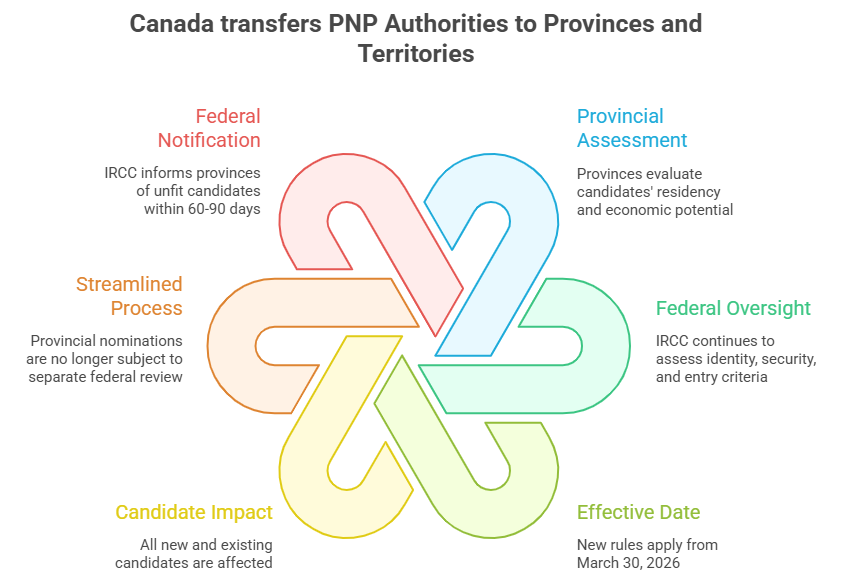
Note: If the federal government finds an applicant's profile unfit to proceed, the respective PT will be informed of the action within 60 to 90 days.
*Want to apply for Canada PNP? Let Y-Axis guide you with the process.
How will the New PR Authority Transfer Impact PNP candidates in 2026?
The transfer of authorities to provinces for independent assessment will affect new PNP applicants in the following ways:
- PNP eligibility assessments will be conducted solely by provinces and territories.
- Closer evaluation by PTs based on intent to reside and economic prospects before issuing a nomination.
- Upon securing a valid nomination certificate, IRCC cannot revoke your application based on those two criteria.
- Reduced risk of federal refusal on the grounds of transferred criteria.
- New PNP applicants must thoroughly prepare their documents to meet both criteria.
Existing requirements to establish intent to reside and economic establishment in Canada are as follows:
- Valid job offer/employment contract in a high-demand occupation.
- Work/study experience in the respective province(Canadian work experience).
- Family connection in the selected province/territory.
- Record of temporary residential status in selected PT.
- Strong knowledge of the local community.
- Educational qualifications aligned with labor-market criteria.
- Sufficient settlement funds.
*Are you looking for step-by-step assistance with Canada immigration? Contact Y-Axis, the world's No. 1 overseas immigration consultancy.
For recent Canadian immigration updates, check out the Y-Axis Canada Immigration News Page.
FAQs
What is Canada’s new PNP rule announced in March 2026?
Canada has introduced a new Provincial Nominee Program rule where provinces and territories now have full authority to assess key eligibility factors for permanent residence applicants. A valid nomination certificate will serve as proof of eligibility, reducing duplicate assessments and helping streamline the immigration process for faster decisions.
When did the new Canada PNP rule come into effect?
The new PNP rule came into effect on March 30, 2026. It applies to new and existing applications. Provinces and territories now assess applicants’ ability to settle economically and their intent to reside locally, while federal authorities focus on admissibility and final approval procedures.
What decisions will provinces now control under the new PNP rule?
Provinces and territories will now determine whether applicants can economically establish themselves and genuinely intend to live in the nominating province. These responsibilities were previously shared with federal immigration authorities but are now primarily handled by provincial governments.
What role will federal immigration officers play after the new rule?
Federal immigration officers will verify applicant identity, confirm valid nomination certificates, ensure applicants are not excluded from the program, and assess admissibility factors such as criminal background, security risks, health requirements, and financial stability before granting permanent residence.
Will the new PNP rule speed up Canada PR processing?
Yes, the new rule is expected to speed up Canada PR processing by eliminating duplicate assessments. Provinces will evaluate candidates once, and federal authorities will conduct final checks, leading to a more efficient immigration process and potentially faster permanent residence approvals.
Who benefits the most from the new Canada PNP rule?
Skilled workers, international graduates, and professionals applying through provincial streams will benefit the most. Provinces can now select candidates based on local labour shortages and economic needs, increasing opportunities for applicants with in-demand skills and relevant work experience.
Does the new rule apply to all Provincial Nominee Program streams?
Yes, the new regulation applies to most Provincial Nominee Program streams, including both Express Entry-aligned and base PNP programs. This ensures a consistent approach across provinces while allowing them greater flexibility in selecting candidates suited to regional needs.
Will provinces now have more control over immigration selection?
Yes, provinces and territories now have greater authority over immigration selection. This allows them to address labour shortages, support regional development, and attract candidates who are more likely to settle long-term and contribute to the local economy.
What does this mean for Canada PR applicants in 2026?
Canada PR applicants may experience faster processing, clearer eligibility assessments, and improved chances if their skills align with provincial labour demands. The new rule also reduces confusion by limiting overlapping reviews between provincial and federal immigration authorities.
Will a provincial nomination guarantee Canada PR approval?
A provincial nomination significantly strengthens a Canada PR application, but it does not guarantee approval. Applicants must still meet federal admissibility requirements, including medical, security, criminal, and financial checks before permanent residence is granted.
Want to apply for Canada PR? Contact Y-Axis today.
Tags:
Canada immigration
Canada PR
work in Canada
migrate to Canada
Provincial Nomination Program
Canada immigration news
Canada permanent residence
Canada work visa
Canada PNP
Share
Options for you by Y-Axis

Get it on your mobile

Get News alerts

Contact Y-Axis
Latest Article
Related Post
Trending Article
Posted On April 01 2026
Canada Introduces New PNP Rule: Provinces Get Full Authority Over PR Selection