


Posted on July 09 2026
Canada extends the Direct PR pathway for French-speaking international students until 2027 to attract global talent. Apply now!

By , Editor & Director
Updated July 12 2026
Highlights: Canada extends the Francophone Student Pilot until 2027 as a direct route to Permanent Residence
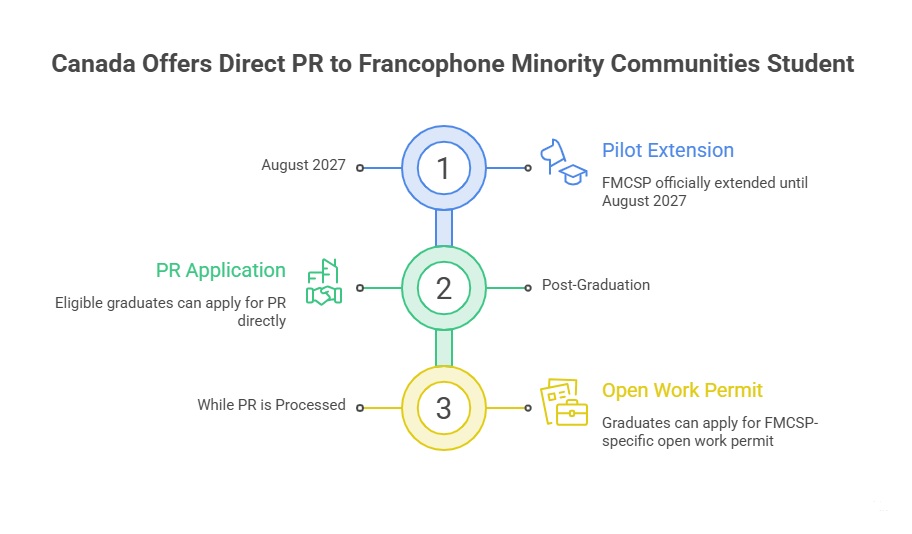
- Canada has extended the Francophone Minority Communities Student Pilot (FMCSP) until August 2027.
- Eligible French-speaking international students can apply directly for Canada Permanent Residence (PR) without requiring a job offer.
- Applicants need only NCLC Level 5 French proficiency, lower than the NCLC Level 7 required under Express Entry.
- The Canada pilot program is open to students enrolled in eligible French-language programs at 17 Canadian participating institutions outside Quebec.
- International graduates can apply for Permanent Residence and receive an open work permit while their PR application is still under process.
*Want to check your eligibility for Canada PR? Avail Y-Axis Canada Eligibility Points Calculator to assess your profile.
Canada to Offer Direct PR access for French-speaking international students
Canada has officially extended the Francophone Minority Communities Student Pilot (FMCSP) until August 2027, giving eligible French-speaking international students studying outside Quebec more time to benefit from a direct pathway to Permanent Residence (PR). The pilot offers an alternative to the traditional study-to-work-to-PR route by allowing eligible graduates to apply for PR without first obtaining Canadian work experience or a job offer.
The extension supports Canada's long-term immigration strategy to increase the number of French-speaking permanent residents settling outside Quebec. Students who graduate under the pilot can also apply for an FMCSP-specific open work permit while their PR application is being processed.
To qualify under the Francophone Minority Communities Student Pilot, applicants must:
- Be a citizen of an eligible country.
- Be living outside Canada at the time of application.
- Receive an admission letter from a participating Designated Learning Institution (DLI) outside Quebec.
- Enrol in a full-time post-secondary program of at least two years leading to a diploma or degree.
- Complete a program where more than 50% of instruction is in French.
- Demonstrate French language proficiency at NCLC Level 5.
- Show sufficient financial resources to cover tuition and living expenses.
- Meet all applicable immigration, medical, and security requirements.
| Category | Details |
|---|---|
| Who can apply? | Eligible French-speaking international students from approved countries enrolling in participating Designated Learning Institutions (DLIs) outside Quebec. |
| Participating institutes | 17 Designated Learning Institutions (DLIs) across Ontario, New Brunswick, Prince Edward Island, British Columbia, Saskatchewan, Manitoba, Alberta, and Nova Scotia. Additional institutions may be added in the future. |
| Study permit cap | 2024–25: 2,300 applications. |
| 2025–26: 2,970 applications. | |
| 2026–27: Cap yet to be announced. |
Also, read...
Canada introduces a fast-track PR pathway for selected temporary workers. Apply now!
How to Apply for Canada PR Via Francophone Minority Communities Student Pilot?
Canada's Francophone Minority Communities Student Pilot (FMCSP) offers eligible French-speaking international students a streamlined route to Permanent Residence (PR). After meeting the program requirements and completing an eligible course of study outside Quebec, applicants can apply for PR without requiring a job offer.
The steps to apply for Canada permanent residence as an FMCSP candidate are as follows:
Step 1: Confirm your eligibility by meeting the FMCSP requirements, including admission to a participating DLI, NCLC Level 5 French proficiency, and enrolment in an eligible French-language program outside Quebec.
Step 2: Apply for a Canadian study permit and claim the exemption from submitting a provincial or territorial attestation letter under the FMCSP.
Step 3: Receive a Port of Entry (POE) Letter of Introduction along with an eTA or visitor visa, depending on your nationality, after your study permit application is approved.
Step 4: Travel to Canada and obtain your study permit at the port of entry before starting your full-time eligible program.
Step 5: Complete your eligible French-language diploma or degree program while maintaining valid temporary resident status outside Quebec.
Step 6: Apply for Permanent Residence under the FMCSP after graduation and obtain an open work permit while your PR application is being processed.
*Are you looking for step-by-step assistance with Canada immigration? Contact Y-Axis, the world's No. 1 overseas immigration consultancy.
For recent Canadian immigration updates, check out the Y-Axis Canada Immigration News Page.
FAQs
What is the Francophone Minority Communities Student Pilot (FMCSP)?
The Francophone Minority Communities Student Pilot (FMCSP) is a Canadian immigration pathway for eligible French-speaking international students studying outside Quebec. It allows graduates to apply directly for Permanent Residence (PR) without first gaining Canadian work experience or securing a job offer. The pilot aims to attract French-speaking immigrants to provinces and territories outside Quebec and has been extended until August 2027.
Who is eligible to apply under the FMCSP?
Applicants must be citizens of eligible countries, live outside Canada when applying, receive admission from a participating Designated Learning Institution (DLI) outside Quebec, enrol in an eligible full-time French-language program, demonstrate French proficiency at NCLC Level 5, meet financial requirements, and satisfy Canada's medical and security requirements.
Does the FMCSP require a job offer for Permanent Residence?
No. One of the biggest advantages of the FMCSP is that eligible graduates can apply directly for Canadian Permanent Residence without needing a job offer or prior Canadian work experience. This makes it different from traditional pathways, where students usually need to obtain a Post-Graduation Work Permit (PGWP) and gain work experience before applying for PR.
What level of French language proficiency is required?
Applicants must demonstrate French language proficiency at NCLC Level 5 in reading, writing, listening, and speaking. This is lower than the NCLC Level 7 generally required under the French-language category of Canada's Express Entry system, making the pilot more accessible to eligible international students.
Which institutions participate in the FMCSP?
Currently, 17 Designated Learning Institutions (DLIs) across provinces such as Ontario, New Brunswick, Prince Edward Island, British Columbia, Saskatchewan, Manitoba, Alberta, and Nova Scotia participate in the pilot. The Canadian government has also indicated that additional institutions may be included in the future.
When does the FMCSP expire?
Canada has extended the Francophone Minority Communities Student Pilot until August 2027. The pilot was originally scheduled to end in August 2026, but the extension provides another year for eligible students to apply for study permits and benefit from the direct Permanent Residence pathway.
What documents do successful applicants receive after study permit approval?
Once the study permit application is approved, applicants receive a Port of Entry (POE) Letter of Introduction along with either an electronic Travel Authorization (eTA) or a visitor visa, depending on their nationality. The actual study permit is issued when they arrive at a Canadian port of entry.
Can FMCSP graduates work while waiting for their PR application?
Yes. Graduates who submit a Permanent Residence application under the FMCSP can also apply for an FMCSP-specific open work permit. This allows them to work anywhere outside Quebec while Immigration, Refugees and Citizenship Canada (IRCC) processes their PR application.
Is the FMCSP available for students studying in Quebec?
No. The Francophone Minority Communities Student Pilot is specifically designed for students studying outside Quebec. The program supports Canada's goal of increasing the number of French-speaking immigrants settling in minority Francophone communities across other provinces and territories.
What is the study permit cap under the FMCSP?
The pilot accepted 2,300 study permit applications in its first year (2024–25), and the cap increased to 2,970 applications for 2025–26. Canada has not yet announced the study permit cap for the extended period from August 2026 to August 2027.
Tags:
Francophone Minority Communities Student Pilot
Canada direct PR
Canada permanent residence
work in Canada
Canada visas
Canada immigration news
Canada open work permit
Canada immigration
migrate to Canada
Share
Options for you by Y-Axis

Get it on your mobile

Get News alerts

Contact Y-Axis
Latest Article
Related Post
Trending Article

Posted On October 07 2026
Australia updates student visa rules for Indian students. Check Your Eligibility!