

Don't know what to do ?
Get Free Counseling
South Korea Job Market in 2026–30
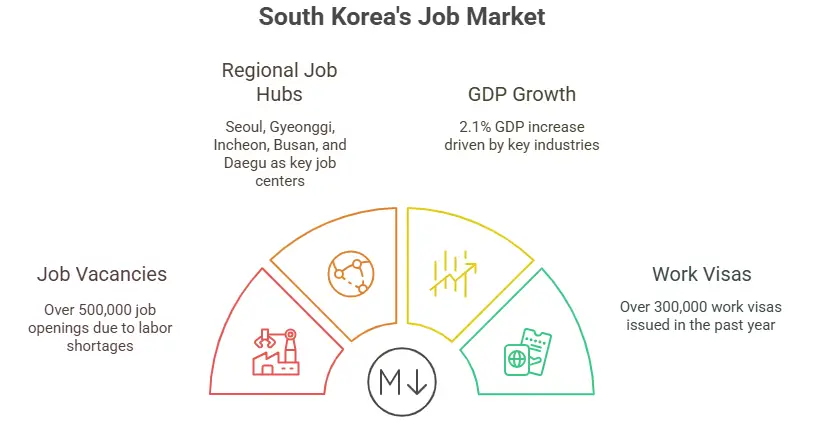
- Over 500,000 job vacancies in South Korea, driven by labour shortages in manufacturing, IT, caregiving, construction, logistics, and hospitality.
- Seoul, Gyeonggi, Incheon, Busan, and Daegu are the top regions with the highest concentration of job openings.
- South Korea’s GDP increased by approximately 2.1%, supported by electronics, semiconductors, automotive manufacturing, and exports.
- South Korea issued over 300,000 work visas and employment permits in the most recent year.
Job Outlook in South Korea
Understanding the current job outlook is essential for both employers and job seekers considering opportunities in South Korea. The country offers strong employment prospects across various high-growth sectors. South Korea currently has over 500,000 job vacancies, driven by labour shortages in manufacturing, IT, caregiving, logistics, hospitality, and engineering. Major employment hubs include Seoul, Gyeonggi, Incheon, Busan, and Daegu, where most companies and factories are concentrated.
South Korea continues to welcome foreign workers through programmes such as the E-7 Skilled Worker Visa and the E-9 Employment Permit System. With steady economic growth, advanced infrastructure, and global industry leadership, South Korea has become an attractive destination for skilled professionals seeking long-term career opportunities and a high standard of living.
*Want to work in South Korea? Let Y-Axis guide you with the process.
General Employment Trends for the year
Employment opportunities in South Korea continue to align with the nation’s demand for highly skilled professionals across key industries such as IT, engineering, semiconductors, healthcare, caregiving, manufacturing, and education. Staying updated on the skills most valued by Korean employers is essential for job seekers who want to secure high-demand jobs in South Korea. The country’s overall economic performance, demographic shifts, and rapid digital transformation significantly influence employment trends.
South Korea’s aging population, declining birth rate, and strong focus on advanced technology and innovation are shaping future labour needs. As the government invests in priority sectors like AI, robotics, and semiconductor production, job opportunities are expected to rise for both local and foreign talent.
Also, read...
South Korea Introduces K-STAR Visa to Attract Global STEM Professionals. Apply now!
Factors Influencing Job Creation or Reduction in South Korea
Several factors impact the creation and reduction of jobs in South Korea, including the national economy, availability of skilled workers, technological advancements, and the growth of high-demand industries. The expansion of sectors like IT, AI, semiconductors, healthcare, logistics, and renewable energy continues to generate strong job demand. Conversely, automation and digitalisation may reduce roles in traditional labour sectors.
Government initiatives, immigration policies, population decline, and global market fluctuations also play a major role in shaping the South Korean job market. As employers compete to address labour shortages, they increasingly seek qualified foreign professionals to fill essential roles. This makes South Korea an attractive destination for individuals looking for high-paying jobs abroad and long-term career opportunities.
In-Demand Industries and Occupations in South Korea
Some of the most in demand occupations in South Korea along with their salaries are given in the table below:
|
Occupations |
Average Annual Salary (KRW) |
|
Engineering |
₩80,000,000 |
|
Information Technology (IT) |
₩85,000,000 |
|
Healthcare |
₩70,000,000 |
|
Marketing & Sales |
₩65,000,000 |
|
Banking & Finance |
₩75,000,000 |
|
Nursing |
₩45,000,000 |
|
Education |
₩40,000,000 |
|
Hospitality |
₩38,000,000 |
|
Skilled Trades |
₩50,000,000 |
Read more…
Highest Paying Jobs in South Korea for Indians
Workforce Demands in Different Regions of South Korea
Details of the workforce demands and employment opportunities across major regions in South Korea are given below:
Examination of Job Market Differences across South Korean Regions
Skilled professionals are increasingly choosing to work in South Korea as the nation offers strong employment opportunities, competitive salaries, and a high standard of living. South Korea’s job market is one of the most dynamic in Asia, with a growing need for skilled foreign workers across IT, engineering, semiconductors, healthcare, caregiving, education, hospitality, and manufacturing.
Different regions of South Korea offer distinct job opportunities:
- Seoul: Largest hub for IT jobs, finance, digital marketing, business services, and English teaching opportunities for foreigners.
- Gyeonggi Province: Major centre for manufacturing, semiconductors, logistics, and industrial jobs due to its large factory zones.
- Incheon: High demand in logistics, airport services, shipping, and international trade roles.
- Busan: Strong opportunities in maritime trade, hospitality, shipbuilding, and logistics.
- Daegu: Growing demand for textile manufacturing, machinery, engineering, and healthcare jobs.
- Daejeon: Known for R&D, biotech, aerospace, and government-funded technology jobs.
- Ulsan: Korea’s industrial powerhouse for automotive, petrochemical, engineering, and heavy manufacturing jobs.
South Korea’s regional workforce needs continue to expand as companies seek qualified international professionals to fill persistent skill shortages. This makes South Korea a top destination for foreign workers looking for long-term, high-demand career opportunities abroad.
Areas with Notable Job Opportunities in South Korea
South Korea has over 500,000 job opportunities across major regions, with the highest demand in manufacturing, IT, engineering, healthcare, caregiving, hospitality, and logistics.
|
Region |
Job Vacancies |
Salaries (per annum) |
|
Seoul |
120,000+ |
₩45,000,000 – ₩85,000,000 |
|
Gyeonggi Province |
150,000+ |
₩40,000,000 – ₩75,000,000 |
|
Incheon |
45,000+ |
₩38,000,000 – ₩70,000,000 |
|
Busan |
35,000+ |
₩35,000,000 – ₩65,000,000 |
|
Daegu |
25,000+ |
₩32,000,000 – ₩60,000,000 |
|
Daejeon |
18,000+ |
₩40,000,000 – ₩70,000,000 |
|
Ulsan |
20,000+ |
₩40,000,000 – ₩75,000,000 |
|
Gwangju |
15,000+ |
₩32,000,000 – ₩58,000,000 |
|
Jeju Island |
10,000+ |
₩28,000,000 – ₩45,000,000 |
Also, read…
What are the most in-demand jobs in South Korea for the next 10 years?
Impact of Technology and Automation in South Korea
South Korea’s job market is undergoing rapid transformation driven by advanced technology, automation, AI, robotics, and digital innovation. These changes are creating strong demand for skilled foreign professionals across multiple sectors and shaping the future of work in the country.
Technological Advancements and Automation Shaping the Job Market
South Korea is one of the world’s leading technology-driven economies, and advancements in AI, robotics, semiconductor manufacturing, automation, cloud computing, cybersecurity, and smart factory systems are reshaping the Korean job market. As companies embrace digital transformation, there is rising demand for professionals with advanced technical skills and adaptability.
Automation is also changing traditional industries such as manufacturing and logistics, increasing the need for workers with STEM expertise, programming knowledge, digital literacy, and engineering skills. These shifts highlight the importance of continuous skill development for job seekers.
Potential Opportunities and Challenges for Workers in the Evolving Landscape
South Korea’s evolving economy presents exciting opportunities for job seekers. The technology sector remains one of the strongest hiring industries, especially for roles in software development, AI engineering, semiconductor processing, data science, and cybersecurity. High-demand fields such as healthcare, nursing, finance, management, HR, marketing, sales, logistics, and education also offer strong employment potential.
At the same time, increased automation may reduce opportunities in labour-intensive roles, making upskilling and reskilling essential. Professionals who invest in new competencies, digital tools, Korean language skills, and globally recognised certifications will be better positioned in South Korea’s future job market.
Skills in-demand in South Korea
South Korean employers seek candidates with a strong blend of technical, professional, and soft skills to meet rising workforce demands across high-growth sectors such as IT, engineering, semiconductors, healthcare, education, finance, and manufacturing. Job seekers who understand the skills Korean employers value are better positioned to secure high-demand jobs in South Korea and qualify for visas like the E-7 Skilled Worker Visa.
Key Skills Sought by Employers in South Korea
- STEM (Science, Technology, Engineering, Mathematics)
- Technical skills (IT, engineering, software development, semiconductor processing)
- Management and leadership skills
- Communication and interpersonal skills
- Problem-solving and critical thinking
- Creativity and innovation
- Project management
- Marketing and digital marketing skills
- Sales and business development abilities
- Financial analysis and risk management
- Customer service and client support skills
- Digital literacy and ICT proficiency
- Adaptability and flexibility in fast-changing industries
- Collaboration and teamwork
- Korean language proficiency (highly beneficial for most roles)
- Multilingual skills (English + Korean preferred)
- Time management and organisational skills
- Emotional intelligence
- Cross-cultural communication skills
Importance of Upskilling or Reskilling for Job Seekers in South Korea
Upskilling and reskilling play a crucial role in helping professionals stay competitive in South Korea’s rapidly evolving job market. As Korean industries continue to adopt AI, automation, robotics, and digital transformation, workers must consistently update their skills to maintain job relevance and career stability.
Reskilling helps employees remain effective as new technologies reshape traditional job roles, while upskilling allows professionals to contribute more strategically to their organisations. Continuous learning fosters adaptability, innovation, and long-term career growth. In a knowledge-driven economy like South Korea’s, job seekers who invest in certifications, Korean language training, and industry-specific skills are far more likely to succeed and access high-paying jobs in South Korea.
*Want to apply for jobs abroad? Avail Y-Axis Resume Marketing services to find the right one.
Remote Work and Flexible Arrangements in South Korea
Remote work in South Korea is gradually becoming more common as companies adopt hybrid models to improve work-life balance, productivity, and access to global talent. Many Korean firms, especially in IT, software, gaming, finance, consulting, and digital marketing sectors, now offer flexible work environments that appeal to both local and foreign professionals seeking jobs in South Korea.
Remote Work Trends in South Korea
Several companies in South Korea now offer hybrid or flexible work options, enabling employees to achieve better work–life balance while maintaining productivity. This shift is largely driven by the country’s rapid digital transformation, growth of cloud-based systems, and widespread adoption of remote collaboration tools across industries.
Sectors such as IT, software development, gaming, digital marketing, finance, consulting, education, and customer service are experiencing the strongest rise in remote and hybrid work arrangements. These flexible work models help Korean organizations stay competitive, attract global talent, and improve workplace satisfaction.
The trend is especially beneficial for foreign professionals seeking remote-friendly jobs in South Korea, as global companies and tech-driven employers increasingly prioritize digital skills, English proficiency, and international experience. As the South Korea job market continues to evolve, remote work is expected to expand further, particularly in high-skill sectors.
Exploration of the Continuing Trend of Remote Work
South Korea is gradually embracing remote and hybrid work trends, especially in sectors like IT, gaming, digital content, AI, fintech, and global business services. Many companies now allow employees to work part-time from home to improve mental well-being and help balance long working hours — a major workplace theme in Korea.
The shift toward hybrid work allows Korean employers to tap into global talent pools, increase productivity, reduce operating costs, and support employees’ personal needs.
As more workers seek flexible jobs in South Korea, the demand for remote-compatible roles and digital skills continues to grow across the Korean job market.
Implications for Both Employers and Employees in South Korea
Remote work provides employers in South Korea with the advantage of accessing a wider global talent pool, allowing companies to hire highly skilled professionals—both local and foreign—regardless of location. This flexibility helps Korean employers attract and retain top talent in competitive industries such as IT, software development, gaming, engineering, finance, and digital marketing. Remote work also supports employee well-being, encourages diversity and inclusion, and strengthens productivity within the evolving South Korea job market.
For employees, remote and hybrid work arrangements offer greater control over their daily schedules and significantly improve work–life balance. Many professionals find that flexible work environments reduce stress, enhance creativity, and increase job satisfaction. Remote work also opens up opportunities to access high-demand jobs in South Korea that may not be available in their immediate region. This trend supports career growth, mental well-being, and long-term employment stability, enabling both local and international workers to thrive in a modern, digitally driven workplace.
Government Policies and Initiatives in South Korea
The Government of South Korea continues to implement strong policies and initiatives to attract skilled foreign workers and address labour shortages across key sectors such as IT, engineering, semiconductors, manufacturing, healthcare, education, and caregiving.
Overview of Government Programs or Policies Influencing Employment
South Korea is actively seeking to hire foreign skilled professionals to fill workforce gaps in its rapidly expanding industries. Through immigration pathways such as the E-7 Skilled Worker Visa, E-7-4 Points-Based Skilled Visa, and the E-9 Employment Permit System (EPS), the government supports the recruitment and smooth integration of foreign workers into the South Korean job market.
The country faces over 500,000 job vacancies, especially in high-demand fields like technology, engineering, caregiving, hospitality, and logistics. To support employers and foreign nationals, South Korea has introduced initiatives to strengthen labour mobility, improve work conditions, and expand eligibility for skilled visas.
South Korea continues to welcome a significant number of foreign workers each year. According to the Korea Immigration Service (KIS), the country issues 300,000+ work visas and employment permits annually, covering both skilled and semi-skilled sectors. Government programs also focus on language training, fair employment practices, and integration support to help foreign workers settle and succeed in Korea’s workforce.
Challenges and Opportunities for Job Seekers in South Korea
Certain challenges are commonly faced by job seekers, especially foreigners, when trying to find employment in South Korea. Below are key challenges and insights to help job seekers navigate the South Korea job market more effectively.
Challenges Faced by Job Seekers
Job seekers in South Korea often experience strong competition, especially in high-demand sectors such as IT, engineering, and finance. Fresh graduates or individuals with limited professional experience may find it difficult to stand out. Language barriers can also pose challenges, as many jobs require at least basic Korean proficiency (TOPIK Level 2 or above), and cultural differences may affect workplace communication.
Additionally, some foreign job seekers struggle to build professional networks in Korea, which are often essential for accessing hidden job opportunities. Navigating visa requirements and understanding employer expectations can also be challenging for newcomers looking to work in South Korea.
Tips and Strategies for Navigating the South Korea Job Market Successfully
- Stay updated and develop new skills through courses, workshops, Korean language training, and industry certifications to stay competitive in the dynamic South Korea job market.
- Build professional networks using platforms like LinkedIn, Korean job portals, networking events, and job fairs to explore opportunities.
- Customize your Korean-style resume (CV) and cover letter for each job, highlighting skills and experience relevant to Korean employer expectations.
- Use online job boards such as JobKorea, Saramin, LinkedIn, and company career pages to actively search for jobs in South Korea for foreigners.
- Gain practical experience through internships, freelance work, or volunteering—especially helpful for fresh graduates entering the Korean job market.
- Attend workshops, webinars, and industry conferences to strengthen your knowledge and expand your professional network.
- Use career services from universities, global organisations, and government programs supporting foreign workers in South Korea.
- Reach out to professionals in your industry for informational interviews and mentorship.
- Optimise your LinkedIn profile to showcase skills, certifications, Korean language levels, and accomplishments effectively.
Summary of South Korea Job Outlook
South Korea’s job outlook is increasingly positive, offering diverse opportunities for both local and foreign professionals across major sectors. Key growth areas include IT, AI, semiconductors, engineering, healthcare, caregiving, education, finance, and logistics, driven by rapid digital transformation and ongoing labour shortages. The booming technology sector is creating strong demand for software developers, AI engineers, and data specialists.
Healthcare, manufacturing, and service-based industries also require a skilled workforce to support Korea’s expanding economy. Overall, South Korea is emerging as an attractive destination for foreign job seekers seeking high-demand jobs, competitive salaries, and long-term career opportunities, supported by the country’s advanced infrastructure and stable economic environment.
*Want to apply for jobs abroad? Get in touch with experts at Y-Axis to guide you with the process.
Don't know what to do ?
Get Free Counseling
Looking for Inspiration
Explore what Global Indians have to say about Y-Axis in shaping their future
Frequently Asked Questions