

Qatar Job Market
Down Arrow
Down Arrow
Down Arrow

I accept the Terms & Conditions

Don't know what to do
Don't know what to do ?

Get Free Counseling

Qatar Job Market: Trends and Opportunities

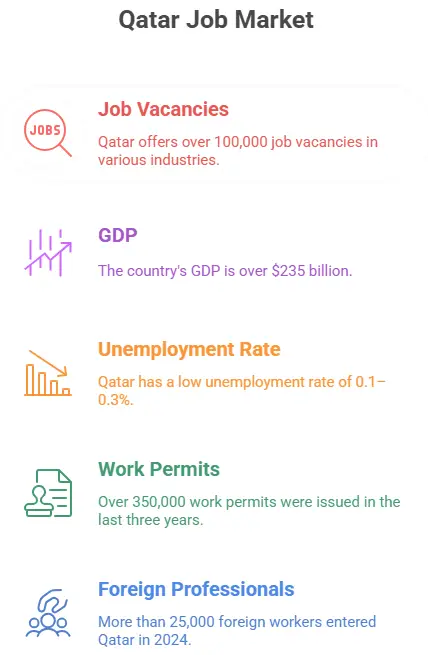
  • Qatar offers 100,000+ job vacancies across multiple industries
  • The country’s GDP stands at $235+ billion
  • Qatar maintains a low unemployment rate of 0.1–0.3%
  • The country issued over 350,000 work permits in the past three years
  • More than 25,000 foreign professionals entered Qatar in 2024 under skilled employment pathways

Qatar Job Market

*Planning to migrate overseas? Y-Axis will guide you in the step-by-step process.

Job Outlook in Qatar

Understanding the job outlook for job seekers and employers

Qatar has a rapidly growing and investment-driven job market, powered by expansion in energy, construction, healthcare, finance, education, and IT. The country attracts global talent due to its tax-free salaries, modern infrastructure, world-class projects, and stable economy. Overall, Qatar presents excellent career opportunities with competitive salaries for skilled professionals across diverse sectors.

General Employment Trends

Qatar’s employment landscape continues to expand with rising demand in engineering, construction, oil and gas, IT, cyber security, healthcare, education, hospitality, and financial services. Digital transformation and smart city projects like Lusail have increased demand for technology professionals skilled in automation, cloud computing, AI, and data analytics. Remote work and flexible job models are slowly growing, particularly in IT and consulting sectors.

Factors Influencing Job Creation or Reduction in Qatar

  • National Vision 2030 reforms
  • Expansion in oil & gas (North Field Expansion)
  • Investments in smart cities and infrastructure
  • Increased digitalization and automation
  • Immigration and labour policies
  • Global market and energy price fluctuations
  • Growth and global expansion of Qatar Airways and the aviation sector

In-Demand Industries and Occupations in Qatar

Qatar has several fast-growing industries that offer excellent opportunities for skilled professionals. The country’s economy is powered by key sectors such as oil and gas, engineering, IT, healthcare, and finance, which continue to generate high-paying jobs. In addition, Qatar Airways and the aviation sector play a major role in supporting the country’s income and employment. The airline’s global expansion has created strong demand for professionals in aviation, hospitality, customer service, logistics, and ground operations. Ongoing infrastructure projects, smart city developments, and tourism growth also increase hiring in education, hospitality, management, and engineering.

Below is the list of the most in-demand jobs in Qatar along with their average annual salaries:

Occupations

Average Salary (annually)

Engineering

QAR 180,000

IT & Software

QAR 210,000

Oil & Gas

QAR 240,000

Healthcare

QAR 190,000

Accounting & Finance

QAR 165,000

Education & Teaching

QAR 140,000

Marketing & Sales

QAR 150,000

HR & Management

QAR 160,000

Hospitality

QAR 120,000

Want to work in Qatar? Contact Y-Axis for complete guidance.

Workforce Demand in Qatar

Examination of Qatar's Job Market

Qatar offers diverse employment opportunities in major cities such as Doha, Al Wakrah, Al Khor, and Lusail, which serve as hubs for business, energy, construction, IT, hospitality, and healthcare.

High-demand sectors include:
  • IT & Software
  • Oil & Gas
  • Engineering
  • Healthcare & Nursing
  • Finance
  • HR & Management
  • Marketing & Sales
  • Hospitality & Aviation
  • Education

Qatar attracts global talent with its tax-free income, multicultural environment, and fast-growing economy.

Impact of Oil & Gas Expansion and Digital Transformation in Qatar

Qatar’s job market is heavily influenced by the continuous growth of the oil and gas sector, which remains the backbone of the country’s economy. Large-scale projects like the North Field Expansion are creating high demand for engineers, technicians, safety experts, project managers, and energy specialists. These projects also support the growth of related industries such as construction, logistics, and manufacturing.

At the same time, Qatar is adopting modern technologies to improve efficiency across energy, healthcare, banking, and IT. Digital tools, automation, and advanced engineering technologies are now widely used to enhance operations, reduce costs, and increase productivity.

This shift is creating new roles in:
  • Cybersecurity
  • Data science
  • Cloud engineering
  • Software development
  • AI & machine learning
  • Energy engineering technologies

While the oil and gas industry continues to provide the most jobs, Qatar’s move toward digital innovation is opening opportunities for professionals with strong technical and digital skills.

Growth Opportunities & Challenges for Professionals in Qatar

Qatar offers many career opportunities for skilled professionals, especially in engineering, oil and gas, IT, and healthcare. The country is growing fast, investing in new projects, and creating high-paying jobs. However, professionals also face some challenges, such as strong competition and the need to keep improving their skills. Below are the main opportunities and challenges for people who want to work in Qatar.

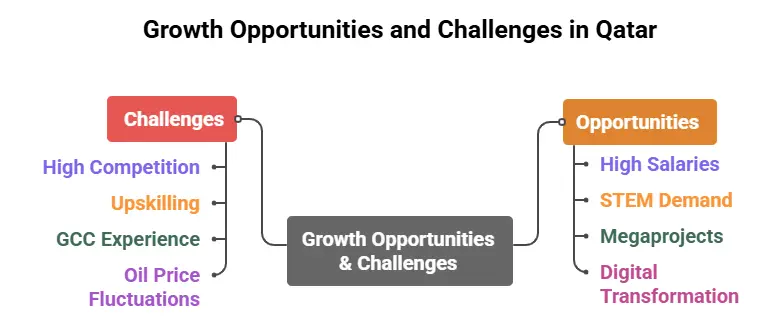
Opportunities:
  • High salaries with tax-free income
  • Growing demand in STEM fields
  • Expansion of oil & gas megaprojects
  • Rapid digital transformation
Challenges:
  • High competition for top roles
  • Need for continuous upskilling
  • Preference for candidates with GCC experience
  • Industry fluctuations based on oil prices
Work in Qatar

Skills In-Demand in Qatar

Employers in Qatar prioritize candidates with strong technical expertise, problem-solving capabilities, and communication skills.

Key skills include:

  • Digital Literacy
  • Cybersecurity
  • Cloud & DevOps
  • Communication Skills
  • English proficiency
  • Problem-Solving
  • Adaptability
  • Teamwork & Collaboration
  • Leadership
  • Project Management

Importance of Upskilling or Reskilling

Upskilling is essential due to Qatar’s focus on digital transformation, smart infrastructure, and automation. Continuous learning enhances employability and supports long-term career growth.

Flexible Work Options and Remote Job Opportunities in Qatar

While Qatar remains office-centric, remote jobs are increasing in:

  • IT & Tech
  • Consulting
  • Marketing
  • Education

Hybrid roles offer improved work-life balance and attract global talent.

Government Policies and Initiatives in Qatar

Programs Influencing Employment

Qatar promotes skilled migration to meet labour shortages and support national development goals.

Key initiatives include:
  • Fast-tracked work visa processes
  • Labour reforms improving worker mobility
  • Investments in digital transformation
  • Qatar National Vision 2030 economic diversification
  • New residency pathways for professionals and investors

Skilled immigration plays a major role in filling gaps across healthcare, IT, engineering, construction, and hospitality.

Tips and Strategies to Get a Job in Qatar

  • Prepare a professional resume tailored to GCC standards
  • Improve English communication; Arabic is a plus
  • Gain certifications in your domain
  • Stay updated with market trends
  • Build a strong LinkedIn profile
  • Network through GCC groups and professional events
  • Apply through verified platforms
  • Prepare thoroughly for interviews

Summary of Qatar Job Outlook

Qatar has a strong and fast-growing job market that offers many opportunities for skilled workers. The country continues to hire professionals in engineering, IT, oil and gas, healthcare, education, finance, and aviation. Because of its tax-free income, modern infrastructure, safe environment, and high quality of life, many people from around the world choose Qatar to build their careers.

Qatar is also investing heavily in new projects, smart cities, and major energy developments, which will create even more jobs in the coming years. With stable economic growth and increasing demand for skilled talent, Qatar is a great destination for professionals looking for long-term, rewarding career opportunities.

Planning to work in Qatar? Contact Y-Axis, the world’s number one immigration consultancy, for end-to-end support.

Sign up for a free expert consultation
Down Arrow
Down Arrow
Down Arrow

I accept the Terms & Conditions

Don't know what to do
Don't know what to do ?

Get Free Counseling

Looking for Inspiration

Explore what Global Indians have to say about Y-Axis in shaping their future

Frequently Asked Questions

What is the current job market situation in Qatar?
plus

Qatar’s job market is steadily expanding, supported by strong economic growth, ongoing infrastructure development, and diversification under Qatar National Vision 2030. While oil and gas remain major employers, other sectors such as healthcare, IT, construction, logistics, hospitality, and education are growing rapidly. The demand for skilled foreign professionals continues to rise due to local talent shortages in technical and specialized roles. Companies are also investing in digital transformation, creating new opportunities in technology and innovation. Overall, the job market remains competitive but offers excellent prospects for qualified candidates with relevant experience and specialized skills.

Which industries are hiring the most in Qatar right now?
plus

Industries currently hiring actively in Qatar include construction, healthcare, IT and cybersecurity, oil and gas, hospitality, logistics, education, finance, and renewable energy. Mega development projects, expanding medical facilities, and increased demand for digital services are driving hiring across these sectors. The hospitality industry continues to grow after Qatar’s global expansion in tourism. The logistics and transportation sectors are also expanding due to strategic investments in ports, aviation, and trade. Qatar’s Vision 2030 and economic diversification initiatives ensure continuous recruitment across skilled, semi-skilled, and professional roles.

Are there good job opportunities for foreigners in Qatar?
plus

Yes, Qatar provides excellent job opportunities for foreigners, especially in skilled, technical, and professional fields. Expatriates play a major role in the workforce, and companies continue hiring internationally to fill talent shortages. Foreigners can find opportunities in engineering, healthcare, IT, teaching, hospitality, oil and gas, accounting, and logistics. Competitive, tax-free salaries, modern work environments, and attractive benefits make Qatar a preferred destination. While the job market is competitive, qualified professionals with relevant experience and certifications can secure strong long-term roles. Many multinational companies and global organizations also operate in Qatar, offering diverse opportunities.

What are the highest-paying jobs in Qatar?
plus

The highest-paying jobs in Qatar are typically in healthcare, engineering, IT, and energy. Doctors, surgeons, project managers, petroleum engineers, senior IT specialists, cybersecurity experts, finance managers, and architects earn some of the highest salaries. Oil and gas sector roles, especially in LNG operations, offer premium compensation due to technical expertise requirements. Senior management roles in banking, construction, and multinational companies also pay exceptionally well. Salaries in Qatar are tax-free, and packages often include housing, travel allowance, health insurance, and annual flights, making high-paying jobs even more attractive for expatriates.

Which skills are most in demand in Qatar today?
plus

Qatar’s job market currently demands skills in engineering, project management, IT and cybersecurity, data analytics, healthcare, construction supervision, education, and logistics. Soft skills such as communication, teamwork, customer service, and leadership are also highly valued. Technical expertise, certifications, and industry-specific experience significantly improve employability. With Qatar focusing on digital transformation and smart city development, skills in artificial intelligence, cloud computing, automation, and cybersecurity are increasingly important. As the country expands its infrastructure and services, skilled technicians, medical professionals, and finance specialists are also consistently in demand.

What qualifications do employers in Qatar prefer?
plus

Employers in Qatar usually prefer candidates with relevant degrees, industry certifications, and proven experience in their field. Professional certifications such as PMP, CPA, CFA, NEBOSH, CCNA, AWS, and specialized medical or engineering licenses strengthen job prospects. Many companies seek candidates with international exposure or experience in large-scale projects. For technical roles, hands-on expertise and vocational certifications are valued. Strong English communication skills are essential, while Arabic is an advantage but not mandatory for most sectors. Employers prioritize competence, reliability, and the ability to work in a multicultural environment.

Is Qatar a good country for Indian professionals seeking jobs?
plus

Yes, Qatar is one of the best destinations for Indian professionals due to strong demand for skilled talent, tax-free income, and excellent career growth. Indians are employed across sectors such as engineering, construction, healthcare, IT, education, hospitality, oil and gas, and finance. Employers value Indian qualifications, work ethic, and adaptability. Qatar also offers safe living conditions, modern infrastructure, and competitive employment benefits. With strong bilateral relations and a large Indian community, Qatar provides stable opportunities and long-term career prospects for Indian workers at all skill levels.

How can expatriates find jobs in Qatar?
plus

Expatriates can find jobs in Qatar by applying through company websites, recruitment agencies, job portals, LinkedIn, and networking events. Many employers conduct hiring drives internationally, especially for healthcare, engineering, and technical roles. Applicants should prepare professional CVs tailored to Qatar’s job market and ensure their qualifications are recognized. It is recommended to research companies, understand visa procedures, and verify job offers before relocation. Networking with professionals in Qatar and attending virtual job fairs can also improve visibility. Once selected, employers typically sponsor the work visa and relocation process.

Do I need a work visa to work in Qatar?
plus

Yes, all foreign nationals require a valid work visa and residency permit to work legally in Qatar. The hiring company is responsible for sponsoring the visa, handling documentation, and completing formalities such as medical tests and fingerprint registration. Working without a valid visa is strictly prohibited. Once approved, employees receive a Qatar ID, which allows them to live and work in the country. The work visa is typically tied to the employer, and changing jobs requires additional approvals. The visa process is streamlined and generally handled by the employer.

What is the process for getting a Qatar work visa?
plus

The Qatar work visa process begins after receiving a job offer. The employer applies for a work permit and submits required documents to the Ministry of Labour. Once approved, the employee receives an entry visa to travel to Qatar. Upon arrival, medical tests, biometric registration, and health checks are completed. The employer then processes the residency permit (QID), which legally allows the employee to work and reside in Qatar. The full process typically takes a few weeks to a couple of months depending on documentation and employer procedures.

What is the average salary in Qatar across popular sectors?
plus

Average salaries in Qatar vary by industry and experience. Skilled professionals typically earn between QAR 8,000 to QAR 25,000 per month, while senior roles can exceed QAR 30,000–50,000. Healthcare professionals, engineers, IT experts, and finance specialists generally earn higher salaries. Entry-level roles in hospitality, retail, and admin often range from QAR 3,000 to QAR 7,000. Salaries are tax-free, and many employers provide additional benefits such as housing allowance, medical insurance, transport allowance, and annual airfare. This makes overall compensation highly competitive compared to other countries.

Which jobs offer strong long-term career growth in Qatar?
plus

Jobs in healthcare, IT, engineering, finance, logistics, education, and energy offer strong long-term growth due to Qatar’s continued economic development. Careers in project management, cybersecurity, data science, infrastructure development, and teaching remain stable and future-proof. With Qatar investing in digital modernization and industrial diversification, advanced technical and managerial roles will continue expanding. Professionals with specialized skills, relevant certifications, and experience in large-scale projects enjoy excellent career progression. Long-term opportunities are especially strong for workers in sectors aligned with Qatar National Vision 2030.

What are the emerging job sectors in Qatar for the next decade?
plus

Emerging sectors include renewable energy, IT and cybersecurity, digital banking, smart city development, healthcare technology, logistics, education, and sustainability. Qatar is investing heavily in solar energy, automation, and advanced infrastructure, creating new technical and engineering jobs. The demand for data-driven roles and AI specialists is also increasing as companies shift toward digital operations. The hospitality and tourism sectors are growing due to ongoing international events and investments. Overall, sectors focused on innovation, technology, and sustainability will see the strongest growth in the coming years.

Does Qatar hire freshers or only experienced professionals?
plus

Qatar primarily hires experienced professionals, especially for technical, engineering, and healthcare roles. However, opportunities for freshers exist in hospitality, retail, customer service, sales, and entry-level administrative roles. International graduates with specialized degrees or internships may also find opportunities in IT, finance, and education. Many companies prefer candidates with relevant experience due to the fast-paced work environment. Freshers improve their chances by gaining certifications, building skills, or applying for internships and trainee positions. While experience is preferred, determined applicants can still find suitable roles.

What is the work culture like in Qatar?
plus

Qatar’s work culture is professional, diverse, and influenced by both Middle Eastern and international business practices. Work environments are generally structured, with clear hierarchies and strong emphasis on teamwork and respect. Expatriates from around the world contribute to a multicultural workplace. Employers value punctuality, discipline, and effective communication. Working hours typically follow a 40–48 hour week, depending on the sector. While business attire is expected, workplaces are modern and supportive. Employees receive competitive benefits and enjoy a safe, stable, and family-friendly environment. Qatar’s culture promotes hospitality and respect for all nationalities.

Are women allowed to work in Qatar, and what opportunities exist?
plus

Yes, women can work in Qatar and actively participate in sectors such as healthcare, education, IT, finance, hospitality, aviation, and administration. Companies value female professionals, and many leadership roles are held by women. Qatar promotes gender inclusion and offers safe, supportive work environments. Expatriate women can work with a valid work visa sponsored by an employer. Dress codes are modest but professional, and workplaces are culturally sensitive and respectful. With many industries expanding, women have strong opportunities for growth, leadership, and long-term career development.

What documents are required to apply for a job in Qatar?
plus

Common documents include a CV, passport copy, educational certificates, experience letters, passport-sized photos, and professional licenses (if applicable). Some employers may also request background checks, medical records, and authenticated certificates. After receiving a job offer, the employer typically handles work visa documentation, including medical tests, fingerprints, and residency processing. It is important to ensure all documents are valid and clear. For regulated professions such as engineering, teaching, and healthcare, license verification may be required.

What are the benefits of working in Qatar as an expatriate?
plus

Working in Qatar offers many benefits, including tax-free income, competitive salaries, modern workplaces, and strong employment benefits. Most employers provide housing allowance, transportation, health insurance, paid leave, and annual flight tickets. Qatar offers excellent safety, high living standards, world-class healthcare, and a multicultural environment. Career growth opportunities are strong due to continuous development projects and demand for skilled talent. Expatriates also enjoy access to modern infrastructure, efficient public services, and diverse lifestyle options. Overall, Qatar provides a stable, rewarding career environment for foreign workers.

Is knowledge of Arabic required for jobs in Qatar?
plus

No, Arabic is not mandatory for most jobs in Qatar, especially in private companies and multinational organizations. English is widely used in business, education, healthcare, and hospitality, making it the primary language for most expatriate workers. However, knowing basic Arabic can be beneficial for customer-facing roles, government jobs, and enhancing workplace communication. Learning a few common phrases may also improve cultural understanding and daily interactions. While not required, Arabic skills can give candidates an advantage in certain sectors.

How competitive is the job search process in Qatar?
plus

The job search in Qatar can be competitive, especially for high-demand roles in engineering, IT, healthcare, and finance. Employers often receive applications from professionals worldwide, making relevant experience and qualifications essential. Applicants with certifications, strong CVs, and industry expertise stand out more easily. While competition exists, job opportunities are plentiful due to ongoing development and talent shortages. Networking, applying through reputable channels, and tailoring CVs to Qatar’s job market significantly improve success. Skilled candidates can secure excellent opportunities with the right preparation.