


Don't know what to do ?
Get Free Counseling
Last Updated 21 September 2026
Malaysia Job Market in 2026–30
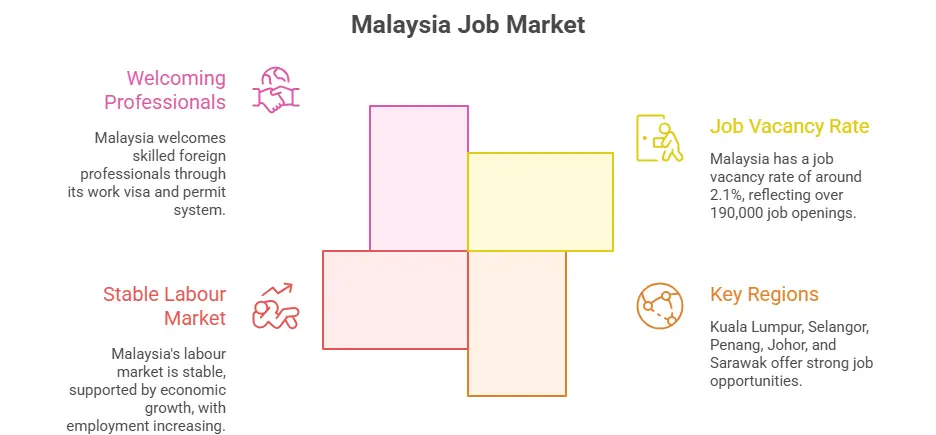
- Malaysia's job vacancy rate stood at 2.1% in Q1 2026, with total vacancies rising to 194,800 positions, according to the Department of Statistics Malaysia (DOSM) Quarterly Employment Survey. Total labour demand (filled jobs + vacancies) grew to 9.23 million.
- Key regions such as Kuala Lumpur, Selangor, Penang, Johor, and Sarawak continue to offer strong job opportunities in Malaysia, especially in IT, electronics, finance, engineering, and healthcare.
- Malaysia's labour market remains resilient, with filled jobs growing 1.8% year-on-year to 9.03 million, according to the Department of Statistics Malaysia (DOSM) Q1 2026 Quarterly Employment Survey.
- The country continues to welcome skilled foreign professionals through the Malaysia work visa and Malaysia work permit system.
Job Outlook in Malaysia 2025–26
Understanding the current Malaysia job market is essential for job seekers planning to build a career in Southeast Asia’s growing economy. With steady economic expansion and increasing digital transformation, there is rising demand for skilled talent across industries, creating promising high-paying jobs in Malaysia.
Malaysia’s major cities—Kuala Lumpur, Cyberjaya, Penang, Johor Bahru, and Kuching—offer the highest number of jobs in Malaysia, particularly in information technology, semiconductor manufacturing, banking, telecommunications, healthcare, hospitality, and logistics.
Malaysia's unemployment rate held steady at 2.9% in early 2026, reflecting a tight, stable labour market with strong hiring momentum in services, technology, and manufacturing.
The country’s workforce trends show strong hiring across both traditional and emerging sectors, influenced by:
- Growth in digital and tech industries
- Expansion of semiconductor and electronics manufacturing
- Increasing investments in logistics and e-commerce
- Strengthening financial and business services
Malaysia continues to attract Indian professionals due to competitive salary in Malaysia, English-friendly workplaces, and relatively smooth processing for a Malaysia work visa from India. Many companies also support remote work in Malaysia, and global professionals increasingly explore digital and flexible work models—including opportunities aligned with the growing interest in the Malaysia digital nomad visa framework.
With its diverse economy, rising skills demand, and emphasis on work–life balance, Malaysia remains one of the most appealing destinations for global talent seeking jobs in Malaysia and long-term career growth abroad.
*Want to apply for a Malaysia work visa? Let Y-Axis guide you with the process.
General Employment Trends in Malaysia
Employment opportunities in the Malaysia job market continue to evolve as industries expand and the need for specific skills increases. Trends in jobs in Malaysia often align with the nation’s economic growth, digital transformation, and demand for specialised talent. Staying updated on skills in demand in Malaysia is essential for job seekers planning to work in Malaysia.
Malaysia’s demographic changes, such as a maturing workforce and rising demand for technology-driven roles, influence hiring needs across sectors. Industries like IT, electronics, healthcare, engineering, finance, and logistics show strong hiring momentum. Government initiatives supporting innovation, digitalisation, and SME development are also contributing to the creation of in-demand jobs in Malaysia and improving long-term job opportunities in Malaysia.
Factors Influencing Job Creation or Reduction in Malaysia
The creation or reduction of jobs in Malaysia is influenced by several economic and structural factors, including:
- Overall economic performance
- Availability of skilled labour
- Growth of emerging industries such as technology, e-commerce, and renewable energy
- Advances in automation and digital tools
- Government policies affecting employment, investment, and talent mobility
- Global economic conditions and trade relationships
- Shifts in market demand, supply chain dynamics, and industry competitiveness
Employers across Malaysia increasingly seek qualified professionals with the right skills, which enhances the demand for both local and international talent. This presents strong prospects for individuals exploring jobs in Malaysia, especially in sectors offering high-paying jobs.
Flexible work trends, including remote jobs in Malaysia and hybrid setups, are also shaping modern employment, supported by growing interest in digital mobility options like the Malaysia digital nomad visa. As Malaysia continues to strengthen its economy and digital capabilities, skilled professionals will find expanding opportunities across diverse industries.
*Want to apply for jobs abroad? Avail Y-Axis Resume Marketing services to find the right one.
In-Demand Industries and Occupations in Malaysia
Some of the most in demand occupations in Malaysia along with their salaries are given in the table below:
| Occupations | Average Annual Salary (MYR) |
|---|---|
| Engineering | 120,000 |
| Information Technology (IT) | 150,000 |
| Healthcare | 140,000 |
| Marketing & Sales | 110,000 |
| Banking & Finance | 160,000 |
| Nursing | 110,000 |
| Teachers | 100,000 |
| Hospitality | 95,000 |
| Skilled Trades | 95,000 |
Read more…
Highest Paying Jobs in Malaysia for Indians
Workforce Demands in Different Regions of Malaysia
Details of the workforce demands and job opportunities across key regions in Malaysia are given below:
Examination of Job Market Differences across Malaysian Regions
Malaysia continues to attract skilled professionals due to its growing economy, competitive salaries, and rising demand across multiple industries. The Malaysia job market offers abundant job opportunities in Malaysia in sectors such as IT, electronics, engineering, healthcare, manufacturing, logistics, and finance.
Different regions in Malaysia offer varying strengths and employment prospects. Major hubs such as Kuala Lumpur, Selangor, Penang, Johor, and Sarawak provide strong hiring demand, especially for professionals seeking jobs in Malaysia from India.
Regions with Strong Job Opportunities in Malaysia
Below is an overview of regions with notable job opportunities in Malaysia, along with typical salary in Malaysia ranges.
| Region / State | Job Demand Level | Average Salary (Per Annum, MYR) |
|---|---|---|
| Kuala Lumpur | High demand in IT, finance, digital roles | RM 70,000–RM 150,000 |
| Selangor | High demand in manufacturing, logistics, engineering | RM 60,000–RM 120,000 |
| Penang | Very high demand in electronics, semiconductors, engineering | RM 65,000–RM 140,000 |
| Johor | Growing demand in manufacturing, logistics, operations | RM 55,000–RM 110,000 |
| Sarawak | Demand in energy, construction, oil & gas | RM 50,000–RM 100,000 |
| Sabah | Demand in tourism, construction, services | RM 45,000–RM 90,000 |
| Perak | Demand in education, manufacturing, healthcare | RM 45,000–RM 85,000 |
| Melaka | Demand in electronics, hospitality, logistics | RM 45,000–RM 90,000 |
| Negeri Sembilan | Steady demand in manufacturing, logistics | RM 48,000–RM 95,000 |
Also, read…
What are the most in-demand jobs in Malaysia for the next 10 years?
Impact of Technology and Automation in Malaysia
Malaysia’s job market is evolving rapidly due to advancements in technology, automation, and digitalisation. These changes continue to influence hiring trends and create new job opportunities across multiple industries. As companies modernize their operations and adopt new technologies, the demand for skilled professionals in Malaysia continues to rise.
Technological Advancements and Automation Shaping the Job Market
The increase in digital transformation across Malaysia has significantly reshaped workplace requirements. Automation, AI, cloud technologies, and advanced manufacturing systems are becoming integral to business operations, resulting in higher demand for professionals with technical and digital skills.
Industries such as IT, financial services, electronics, engineering, healthcare, logistics, and e-commerce are undergoing major transformation. As a result, employers are increasingly seeking individuals with strong digital capabilities, analytical thinking, and adaptability.
These shifts highlight the importance of continuous skill development, as the evolving landscape encourages job seekers to stay updated with emerging tools and technologies.
Potential Opportunities and Challenges for Workers in the Evolving Landscape
The rise of technology brings both opportunities and challenges to Malaysia’s workforce. On the opportunity side, sectors such as digital technology, cybersecurity, data analytics, fintech, healthcare, and advanced manufacturing are expanding, creating stable career paths with good earning potential. Many roles now require hybrid skill sets, blending technical knowledge with problem-solving, communication, and management abilities.
However, increased automation can also make certain routine tasks redundant, creating competition for higher-skilled roles. Professionals are encouraged to continuously upskill or reskill to stay competitive in the job market. This includes investing in digital literacy, technical certifications, and soft skills that align with modern industry needs.
The growing adoption of flexible work models has also opened more avenues for remote and hybrid roles, allowing workers to benefit from greater flexibility and access to broader opportunities.
Skills in-demand in Malaysia
Employers across the Malaysia job market are increasingly seeking candidates with strong technical and professional skills. As industries evolve, especially in technology, engineering, finance, healthcare, and digital services, the demand for skilled talent continues to rise. Understanding the skills in demand in Malaysia is essential for job seekers aiming to secure competitive roles and benefit from growing job opportunities in Malaysia.
Key Skills Sought by Employers in Malaysia
Professionals looking to work in Malaysia or explore jobs in Malaysia should focus on developing the following essential skills:
- STEM (Science, Technology, Engineering, Mathematics)
- Technical and analytical abilities
- Management skills
- Communication and interpersonal skills
- Problem-solving and critical thinking
- Creativity and innovation
- Project management
- Marketing and digital marketing skills
- Sales and business development
- Financial analysis and risk management
- Customer service and support skills
- Digital literacy
- Adaptability and flexibility
- Teamwork and collaboration
- Leadership skills
- Bilingual or multilingual proficiency (English + Malay or Mandarin an advantage)
- Time management
- Emotional intelligence
These skills continue to shape hiring needs across industries and contribute to the creation of in-demand jobs in Malaysia, particularly in major employment hubs such as Kuala Lumpur, Selangor, Penang, and Johor.
Importance of Upskilling or Reskilling for Job Seekers in Malaysia
In today’s rapidly evolving work environment, upskilling and reskilling have become essential for professionals who want to remain competitive in the Malaysia job market. Employers value individuals who demonstrate a willingness to learn and adapt as industries embrace automation, digital innovation, and new workplace technologies.
Reskilling helps professionals update their knowledge and remain relevant in their roles, while upskilling enables them to take on greater responsibilities and advance their careers. This proactive approach benefits both employees and employers, fostering a culture of continuous improvement, innovation, and adaptability.
By investing in skill development, job seekers position themselves strongly for long-term growth, especially in sectors offering stable and high-paying jobs in Malaysia, as well as opportunities for flexible or hybrid work, including the rising trend of remote jobs in Malaysia.
Remote Work and Flexible Arrangements in Malaysia
Remote work has become increasingly common in Malaysia as companies embrace modern work models that support flexibility, productivity, and employee well-being. Many organisations now offer hybrid arrangements that allow employees to balance in-office collaboration with the convenience of working from home. This shift has contributed to growing interest in remote work in Malaysia, especially among skilled professionals exploring new workplace options.
Malaysia Digital Nomad Visa (DE Rantau Pass)
Malaysia has introduced the DE Rantau Digital Nomad Pass, which allows eligible remote workers and digital professionals to live in Malaysia while working for employers or clients outside the country. This initiative supports the country’s digital economy goals and makes Malaysia an appealing destination for global talent seeking lifestyle-friendly remote work environments.
Digital nomads approved under this program can reside in Malaysia for up to 12 months, with the option to renew. It also provides access to digital hubs, co-working spaces, and a supportive community of remote professionals.
Digital nomads approved under this program receive a pass valid for 3 to 12 months, renewable once for an additional 12 months (24 months maximum). Applicants must show a minimum annual income of USD 24,000 for tech/digital roles or USD 60,000 for non-tech roles, and pay a processing fee of around RM 1,080 (plus RM 540 per dependant). Processing typically takes 6–8 weeks. The pass also provides access to digital hubs, co-working spaces, and a supportive community of remote professionals.
*Want to apply for a Malaysia Digital Nomad Visa? Let Y-Axis guide you with the process.
Exploring the Continuing Trend of Remote Work
Companies across Malaysia are increasingly adopting hybrid and remote work models. This trend is driven by technological advancements, improved connectivity, and greater focus on work–life balance. Employees benefit from reduced commuting time and increased flexibility, while employers gain access to a broader talent pool and improved retention.
Many industries—including IT, digital marketing, finance, education, and business services—now offer flexible arrangements, creating more opportunities for professionals seeking remote jobs in Malaysia or roles that allow partial remote work.
As organisations realise the positive impact on morale, creativity, and efficiency, remote work continues to grow as a sustainable and preferred option for many employees.
Implications for Both Employers and Employees
For Employers
- Ability to hire talent from different regions across Malaysia and beyond
- Improved employee satisfaction and retention
- Increased diversity and access to specialised skill sets
- Reduced operational costs and improved workforce flexibility
For Employees
- Better control over daily schedules and improved work–life balance
- Reduced travel time and lower stress levels
- Opportunity to work in comfortable, personalised environments
- Broader access to job opportunities in Malaysia, including hybrid and remote roles
- Greater overall job satisfaction and productivity
Government Policies and Initiatives in Malaysia
The Government of Malaysia continues to introduce policies and initiatives aimed at strengthening the workforce, supporting economic growth, and creating more job opportunities in Malaysia across key industries. These initiatives also help attract skilled professionals and support individuals seeking to work in Malaysia under various employment and talent programs.
Overview of Government Programs or Policies Influencing Employment
Malaysia actively supports labour market development through policies that encourage digital transformation, foreign investment, and skills development. Key government programs are focused on:
- Expanding the digital economy and Industry 4.0 adoption
- Promoting high-value sectors such as technology, electronics, renewable energy, finance, and healthcare
- Encouraging upskilling and reskilling through national training schemes
- Supporting SMEs and start-ups through grants and innovation-driven programs
- Attracting skilled international professionals through structured Malaysia work visa and Malaysia work permit pathways
The government’s emphasis on boosting productivity, developing local talent, and attracting highly skilled expatriates helps strengthen the overall Malaysia job market, especially in regions with strong economic activity such as Kuala Lumpur, Selangor, Penang, and Johor.
Challenges and Opportunities for Job Seekers in Malaysia
Just like any growing economy, the Malaysian labour market presents both challenges and opportunities. Job seekers, whether local or international, must be aware of factors that influence hiring trends, competition, and skill requirements.
Challenges Faced by Job Seekers
Job seekers in Malaysia may experience:
Competition for roles in fast-growing industries such as IT, engineering, finance, and marketing
- Skill mismatches, especially for candidates lacking technical or digital expertise
- Limited professional networks for fresh graduates or newcomers entering the workforce
- Language expectations in certain industries (advantageous to know Malay or Mandarin depending on the sector)
- Shifts in hiring patterns due to automation and digitalisation
While these challenges exist, Malaysia continues to offer strong job opportunities in Malaysia across high-growth industries, especially for skilled professionals seeking jobs in Malaysia or applying from abroad.
Tips and Strategies for Navigating the Malaysia Job Market Successfully
Navigating the Malaysia job market requires strong preparation, the right skills, and a proactive approach. Whether you are a fresh graduate, mid-career professional, or an overseas applicant exploring jobs in Malaysia, these strategies can help you stand out and secure better opportunities.
- Stay updated with industry trends and build new skills through courses, workshops, and certifications to remain competitive.
- Build professional networks using LinkedIn, industry events, and informational interviews to explore more job opportunities in Malaysia.
- Tailor your resume and cover letter for each application, highlighting relevant skills and experiences.
- Use job portals, company websites, and professional networks to search for open positions and connect with employers.
- Gain practical experience through internships, on-the-job training, or volunteer work, especially if you are a recent graduate.
- Attend webinars, conferences, and workshops to strengthen your knowledge and stay current with market changes.
- Take advantage of career centres or employment programs offered by universities and government agencies.
- Reach out to industry professionals for insights through informational interviews.
- Optimize your LinkedIn profile and digital presence to clearly showcase your strengths, achievements, and experience.
Summary of Malaysia Job Outlook
Malaysia’s job outlook remains positive, supported by strong growth across technology, healthcare, engineering, finance, and manufacturing. The expanding digital economy continues to create demand for IT specialists, data professionals, and digital marketing experts. Healthcare, logistics, business services, and education also offer stable and in-demand jobs in Malaysia.
With competitive salaries, expanding industries, and increasing flexibility in the workplace—including options for hybrid and remote jobs in Malaysia—the country remains an attractive destination for skilled professionals. For international applicants, especially those exploring jobs in Malaysia for Indians, the nation offers a diverse work environment and structured pathways through the Malaysia work visa and Malaysia work permit systems.
Overall, Malaysia is emerging as a strong destination for individuals seeking sustainable career growth and long-term employment opportunities in Malaysia in a dynamic Southeast Asian economy.
*Want to work abroad? Let Y-Axis guide you with the process.
Y-Axis snapshot
1M
Successful applicants
1500+
Experienced counselors
25Y+
Expertise
50+
Offices
Don't know what to do ?
Get Free Counseling
Looking for Inspiration
Explore what Global Indians have to say about Y-Axis in shaping their future