

Luxembourg Job Outlook
Down Arrow
Down Arrow
Down Arrow

I accept the Terms & Conditions

Don't know what to do
Don't know what to do ?

Get Free Counseling

Luxembourg Job Market

  • Luxembourg reports over 50,000 job vacancies across major industries
  • The country’s GDP stands at approximately $85+ billion, one of the highest per capita in the world
  • Luxembourg maintains a low unemployment rate of around 4.8%
  • Over 40,000 work permits have been issued in the last three years
  • More than 12,000 foreign professionals entered Luxembourg on skilled visas in the past year
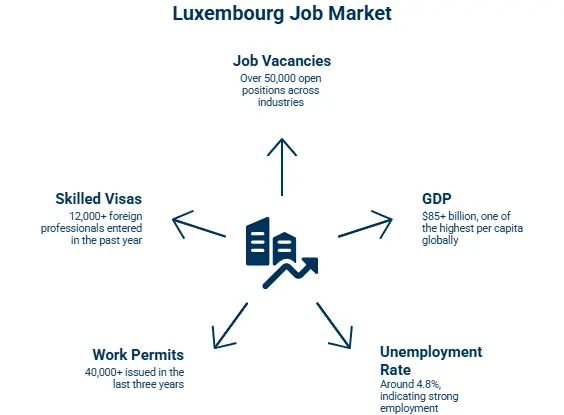
Luxembourg Job Market

Job Outlook in Luxembourg

Luxembourg offers a highly developed, stable, and innovation-driven job market with excellent opportunities for skilled foreign professionals. The country is a global hub for finance, IT, engineering, logistics, space technology, and banking. Known for its strong economy, multilingual workforce, high salaries, and exceptional quality of life, Luxembourg attracts top talent from around the world. Overall, Luxembourg provides competitive pay, long-term job stability, and strong career growth across multiple fast-growing sectors.

Job Vacancy in Luxembourg

Luxembourg is seeing steady growth in job opportunities due to strong economic stability, financial sector expansion, and government investment in digital and green initiatives. The country continues to hire skilled professionals across sectors such as finance, IT, healthcare, logistics, engineering, construction, and education.

Luxembourg’s long-term development plans focus on becoming a global hub for finance, fintech, technology, space research, and sustainable development. Major investments in digital transformation, smart infrastructure, housing projects, and cross-border trade are creating thousands of new jobs. These initiatives aim to support economic growth, innovation, and attract skilled foreign workers.

The table below shows the estimated number of job openings in Luxembourg by 2030, highlighting sectors with the highest demand:

Occupation

Estimated Number of Jobs by 2030

Healthcare

25,000

IT & Software

30,000

Finance & Banking

35,000

Engineering

20,000

Construction & Infrastructure

22,000

Logistics & Supply Chain

18,000

Teaching & Education

15,000

Accounting & Audit

14,000

Human Resources & Management

10,000

General Employment Trends for the Year

Luxembourg’s job market is evolving rapidly, with strong demand across IT, banking, engineering, healthcare, finance, and logistics. Digital transformation is creating major growth in:

  • Artificial Intelligence
  • FinTech & digital banking
  • Cloud computing
  • Cybersecurity
  • Data analytics

Flexible models such as hybrid work, cross-border commuting roles, and remote options are increasing. Multilingual skills (English/French/German/Luxembourgish) and continuous upskilling are becoming essential.

Factors Influencing Job Creation or Reduction in Luxembourg

  • Global financial market performance
  • Technology adoption & automation
  • EU regulations & policy changes
  • Immigration reforms & work permit rules
  • Rapid expansion in green finance and sustainability
  • Cross-border labor mobility from Belgium, Germany & France

In-Demand Industries and Occupations in Luxembourg

Most in-demand jobs in Luxembourg with average annual salaries:

Occupations

Salary (Annually)

Finance & Banking

€85,000

IT & Software

€75,000

Engineering

€70,000

Human Resource Management

€60,000

Healthcare

€68,000

Teaching

€50,000

Accounting & Audit

€72,000

Logistics & Supply Chain

€55,000

Nursing

€48,000

*Want to work in Luxembourg? Contact Y-Axis for complete guidance.

Job Opportunities for Indians in Luxembourg

Luxembourg offers strong career opportunities for skilled Indian professionals, particularly in finance, IT, engineering, audit, healthcare, and logistics. Due to its small population and high demand for talent, the country actively hires international workers, including many from India, to fill critical skill shortages.

Most Indian professionals move to Luxembourg through two main permits:

  • EU Blue Card: for highly skilled and experienced workers
  • Work Permit: applied by employers when hiring non-EU candidates

English is widely used in Luxembourg’s workplaces, especially in finance, IT, and multinational companies, making it easier for Indian professionals to work. However, learning French or German can significantly improve job prospects, workplace integration, and long-term career growth.

Impact of the Finance and Banking Sector in Luxembourg

The finance and banking sector is the backbone of Luxembourg’s economy. It contributes a significant share to the national GDP and positions the country as one of the world’s leading financial hubs. Luxembourg is known for its strong investment fund industry, wealth management services, private banking, insurance, and fintech innovation.

Financial activities generate high-value exports, including investment services, financial consulting, cross-border banking solutions, and digital finance technologies. The sector creates thousands of skilled jobs each year and attracts multinational companies, making it a major driver of economic growth.

Luxembourg’s continued focus on digital banking, green finance, regulatory innovation, and fintech expansion ensures long-term development, stability, and global competitiveness within the finance and banking industry.

Growth Opportunities & Challenges for Professionals in Luxembourg

Luxembourg’s job market is expanding, especially in digital banking, fintech, engineering, and sustainability-focused roles. Studies show that over 60% of employers plan to hire skilled workers. Countries face talent shortages in high-skilled occupations, which opens opportunities for international professionals. However, multilingual requirements and competitive hiring processes pose challenges.

Opportunities:

  • Expansion in finance and fintech
  • Strong demand for IT, cybersecurity & data roles
  • High salaries and global career exposure
  • Growth in green finance and sustainability

Challenges:

  • Competitive job market for top positions
  • Multilingual requirements (French/German/English)
  • High cost of living
  • Need for continuous upskilling

*Want to look for jobs abroad? Avail Y-Axis Resume Marketing services to find the right one.

Skills In-Demand in Luxembourg

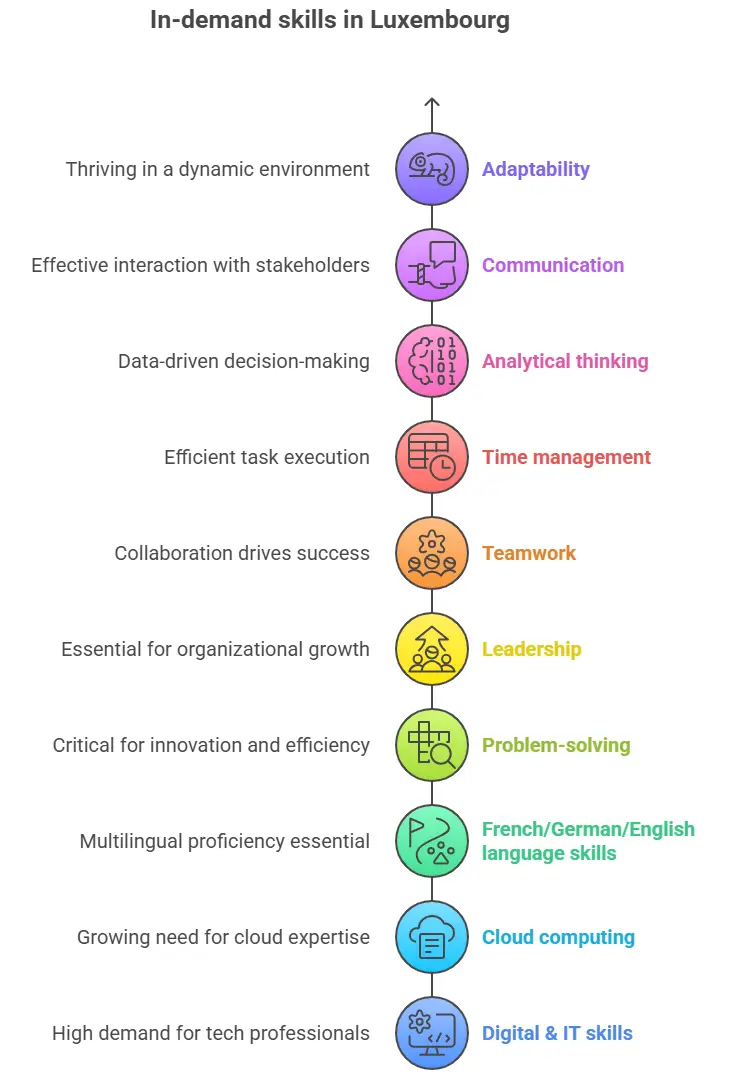
Luxembourg employers need professionals with strong technical and soft skills. Nearly 65% of companies report difficulty finding suitable candidates. Skills in highest demand include:

  • Digital & IT skills
  • Cloud computing
  • French/German/English language skills
  • Problem-solving
  • Leadership
  • Teamwork
  • Time management
  • Analytical thinking
  • Communication
  • Adaptability
  • Financial & audit skills

In-Demand Skills in Luxembourg

Importance of Upskilling or Reskilling

Luxembourg’s fast-changing job market requires professionals to continuously update their skills. Upskilling helps workers stay competitive, secure better positions, and adapt to technological advancements, especially in finance, IT, and engineering sectors.

Flexible Work Options and Remote Job Opportunities in Luxembourg

Hybrid and remote work options have become more common in Luxembourg. Many companies now offer:

  • Flexible work schedules
  • Hybrid office arrangements
  • Remote-first opportunities in IT, consulting, banking, and finance

These models improve productivity and attract global talent, allowing foreign professionals to contribute even from outside Luxembourg.

Tips and Strategies to Get a Job in Luxembourg

  • Create a strong professional CV and cover letter
  • Improve language proficiency (French/German/English)
  • Gain high-demand certifications (IT, finance, engineering)
  • Build a strong LinkedIn profile
  • Network through job fairs and industry events
  • Research employers and roles
  • Stay updated on Luxembourg labor market trends
  • Prepare well for interviews and assessments

Summary of Luxembourg Job Outlook

Luxembourg offers a dynamic and high-quality job market with excellent opportunities for foreign professionals. With strong economic growth, high salaries, low unemployment, and increasing demand across finance, IT, engineering, healthcare, and logistics, the country remains a top destination for global talent. Skilled workers with multilingual abilities and relevant expertise can expect strong career prospects and long-term growth in Luxembourg.

*Planning to move to Luxembourg? Contact Y-Axis, world’s number one immigration consultancy for end-to-end support

Sign up for a free expert consultation
Down Arrow
Down Arrow
Down Arrow

I accept the Terms & Conditions

Don't know what to do
Don't know what to do ?

Get Free Counseling

Looking for Inspiration

Explore what Global Indians have to say about Y-Axis in shaping their future

Frequently Asked Questions

What is the current job outlook in Luxembourg?
plus

Luxembourg’s job outlook is very positive, with strong demand for skilled workers across finance, IT, engineering, healthcare, and logistics. The country has one of Europe’s lowest unemployment rates and offers high salaries, excellent work-life balance, and long-term career growth. Luxembourg’s stable economy and international work environment attract global talent. Digital transformation, fintech growth, and green finance projects will continue creating new jobs over the next decade.

Why is Luxembourg’s job market attractive for foreign professionals?
plus

Luxembourg’s job market is attractive because it offers high salaries, strong economic stability, safe workplaces, and excellent career opportunities. It is home to major financial institutions, multinational companies, and leading fintech firms. The country has a multilingual environment and low unemployment. Foreign workers are needed due to limited local workforce availability, especially in finance, IT, engineering, and healthcare. Luxembourg also provides clear work visa options such as the EU Blue Card.

Which sectors are driving job creation in Luxembourg?
plus

Finance and banking remain the biggest job creators, followed by IT, fintech, engineering, logistics, and healthcare. The country’s strong investment fund industry, digital banking growth, and rapid technology adoption play a major role in expanding job opportunities. Additionally, Luxembourg’s space and satellite technology sector is growing. With continued focus on digital transformation, green finance, and innovation, these sectors will generate thousands of new jobs in the coming years.

How many job vacancies does Luxembourg currently have?
plus

Luxembourg has more than 50,000 job vacancies across various industries. Many of these openings are in finance, IT, engineering, healthcare, logistics, and professional services. Due to its small population and strong economy, demand for skilled foreign workers continues to rise. Companies find it difficult to fill specialist roles locally, which creates opportunities for international professionals. Job vacancies are expected to increase further as digital and green transformation projects expand.

What trends are shaping Luxembourg’s job market?
plus

Key trends shaping Luxembourg’s job market include digital banking, fintech growth, automation, cloud technology, cybersecurity, and data analytics. There is also rising demand for green finance and sustainability-focused roles. Hybrid work models and remote-friendly jobs are becoming common. Companies are looking for multilingual professionals who can work across French, English, and German. Overall, the job market is becoming more technology-driven, globally connected, and skills-focused.

What roles are most in demand in Luxembourg?
plus

The most in-demand roles in Luxembourg include finance specialists, investment fund managers, auditors, cybersecurity experts, software developers, engineers, healthcare staff, and logistics professionals. These jobs are driven by strong financial activity, rapid digitalization, and growing demand for high-tech services. The country also seeks multilingual candidates who can work in international teams. Demand for skilled workers is expected to increase across fintech, data analytics, and cloud technology.

How does digital transformation affect Luxembourg’s job market?
plus

Digital transformation is creating high demand for IT specialists, cybersecurity professionals, cloud engineers, fintech experts, and data analysts. Banks and financial firms are investing heavily in automation, digital banking, and AI-based financial services. This shift is generating new jobs and changing workplace requirements. Companies now seek professionals with strong digital skills, analytical abilities, and knowledge of modern tools. Digital transformation is one of the main drivers of Luxembourg’s future job market.

What impact does the finance sector have on Luxembourg’s job market?
plus

The finance sector is the backbone of Luxembourg’s economy and the largest employer. It creates thousands of high-paying jobs every year in areas like fund management, banking, insurance, and compliance. Financial services also attract multinational companies, boosting overall employment. The sector contributes a major share of GDP and drives innovation through fintech and digital banking. Its continued growth ensures stable job opportunities for skilled professionals, especially foreign talent.

Which skills are most in demand in Luxembourg?
plus

Luxembourg employers look for digital skills, cloud computing, financial expertise, data analysis, problem-solving, communication, teamwork, and leadership. Multilingual abilities—especially English, French, and German, are highly valued. Companies also want professionals who can adapt quickly, manage projects, and work in diverse teams. With rapid technology adoption, skills in IT, cybersecurity, fintech, and audit are becoming essential. Soft skills like adaptability and time management remain important for success.

Is Luxembourg a good place for IT professionals?
plus

Yes, Luxembourg is an excellent destination for IT professionals. The country has a rapidly growing digital sector with high demand for cloud engineers, data scientists, software developers, cybersecurity experts, and fintech specialists. IT roles offer competitive salaries, strong job security, and opportunities to work with global companies. Digital transformation across finance and government services ensures long-term demand for skilled tech workers. English is widely accepted in many IT environments.

What are the job opportunities for Indian professionals in Luxembourg?
plus

Indian professionals enjoy strong job opportunities in finance, IT, engineering, audit, healthcare, and logistics. Luxembourg actively hires skilled workers from India to fill shortages in high-demand sectors. Indians commonly move through the EU Blue Card or employer-sponsored work permit. Many multinational companies in Luxembourg use English as a working language, making it easier for Indian professionals to integrate. Learning French or German helps with long-term career growth and networking.

What challenges do job seekers face in Luxembourg?
plus

Job seekers may face challenges like language requirements, high cost of living, and competition for top positions. Many roles prefer candidates who speak French or German in addition to English. Housing costs can be high in major cities. Some industries require specific certifications or EU-recognized qualifications. However, skilled workers with strong digital or financial expertise generally find good opportunities and long-term career stability.

What is the unemployment rate in Luxembourg and what does it mean for job seekers?
plus

Luxembourg’s unemployment rate is around 4.8%, which is low compared to most European countries. This means jobs are widely available, especially for skilled professionals. Employers often struggle to find qualified candidates, creating opportunities for foreign workers. A low unemployment rate usually signals economic stability, strong demand, and long-term career prospects. Skilled applicants in finance, IT, engineering, healthcare, and logistics can expect a positive job outlook.

How does automation affect jobs in Luxembourg?
plus

Automation is changing roles in finance, logistics, and manufacturing, leading to greater demand for digital skills, data analysis, and technology-driven jobs. While some manual tasks are being replaced, new roles are emerging in IT, cybersecurity, cloud computing, and AI. Professionals who adapt and upskill will benefit the most. Automation is not reducing jobs overall, it is shifting the job market toward higher-skilled, technology-focused positions.

Are remote or hybrid jobs common in Luxembourg?
plus

Yes, remote and hybrid jobs have become common, especially in finance, IT, consulting, and administrative roles. Many companies now offer flexible working hours, hybrid models, or even remote-first opportunities. This shift allows professionals to balance work and personal life more effectively. Some roles even allow cross-border workers to work partially from neighboring countries. Digital transformation and flexible work culture make these options increasingly popular.

What salary trends can professionals expect in Luxembourg?
plus

Professionals in Luxembourg can expect consistently high salaries due to strong economic performance and high demand for skilled workers. Sectors like finance, IT, engineering, and audit offer some of the best pay in Europe. Salaries continue rising in digital banking, cybersecurity, data analysis, and fintech roles. Healthcare and logistics are also seeing gradual increases. High wages reflect the country’s competitive job market and need for specialized talent.

How does Luxembourg support career growth for skilled professionals?
plus

Luxembourg supports career growth through continuous learning programs, professional development opportunities, multilingual work environments, and access to international companies. Many organizations encourage upskilling digital tools, project management, languages, and leadership. Professionals can grow quickly due to the country’s small but dynamic economy. Regular exposure to global projects and diverse teams also helps employees gain valuable experience that boosts long-term career success.

What job opportunities exist in Luxembourg’s fintech sector?
plus

Luxembourg’s fintech sector offers growing opportunities in digital banking, blockchain, payment technologies, cybersecurity, and AI-based financial services. The country is a European leader in fintech innovation and hosts many startups and global firms. Professionals with skills in software development, data analysis, cloud technology, and financial regulation can find strong career prospects. Fintech roles offer high salaries, international exposure, and long-term growth.

Is Luxembourg a good place for engineers to work?
plus

Yes, Luxembourg is a good place for engineers, especially in civil, electrical, mechanical, automation, and industrial fields. The country’s infrastructure projects, high-tech industries, logistics operations, and sustainability goals create strong demand. Engineers also work in banking technology, space research, and telecommunications. Salaries are competitive, and many companies hire international professionals. Engineers who bring digital or automation skills are especially valued.

What steps can job seekers take to succeed in Luxembourg’s job market?
plus

To succeed in Luxembourg’s job market, professionals should follow the below mentioned steps:

  • Prepare a strong and professional CV that meets Luxembourg hiring standards.
  • Improve language skills in French, German, or English to increase job opportunities.
  • Gain relevant certifications in fields like finance, IT, engineering, or healthcare.
  • Network actively on LinkedIn and connect with professionals in your industry.
  • Apply to high-demand sectors such as finance, IT, engineering, logistics, and healthcare.
  • Attend job fairs, industry events, and workshops to build strong connections.
  • Learn about Luxembourg’s work culture to make a smooth transition into the workplace.
  • Stay updated on job market trends and employer requirements.
  • Prepare well for interviews by practicing common questions and role-specific skills.
  • Be willing to upskill continuously to stay competitive and improve long-term career growth.