

Posted on January 03 2026
What are the eligibility requirements for a Poland work visa?

By , Editor
Updated January 05 2026
The eligibility requirements for a Poland work visa includes a valid job offer form a verified Polish employer, a work permit (issued by the employer), along with documents such as an original passport, a fully-filled visa application form, copies of your latest passport-sized photographs, proof of qualifications, medical insurance, proof of accommodation in Poland, and a clear criminal record. You can apply for a work visa at the nearest Polish consulate once you receive a work permit from your employer.
*Want to apply for a work visa in Poland? Let Y-Axis guide you with the process.
What are the requirements for a Poland Work Visa?
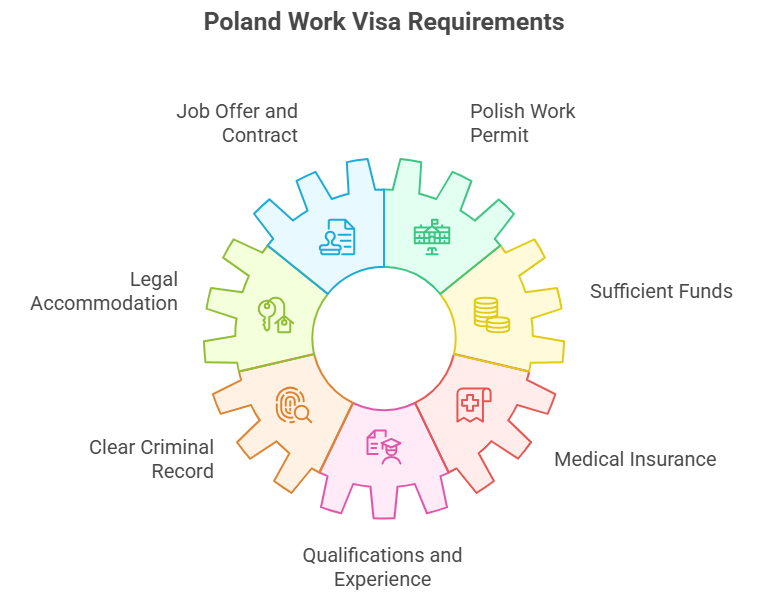
To be eligible for a Poland work visa, you must meet the following requirements:
- Job offer and a valid employment contract: A job offer from a Polish employer with a valid work contract, which includes details of your job role, job duration, and salary offered.
- Polish work permit: A work permit granted by the Voivodeship Office (your Polish employer applies for this on your behalf)
- Legal accommodation: Proof of accommodation in Poland (A rental agreement or lease)
- Sufficient funds: Have adequate proof of funds to support your stay in Poland
- Clear criminal record: Must have a clean criminal record
- Medical insurance: Have a mandatory health insurance that aligns with the Polish and Schengen requirements.
- Proof of qualifications and experience: Submit evidence of relevant educational qualifications along with proof of work experience that matches your job role.
Also, read…
Is a job offer mandatory for a Poland work visa for Indians?
List of Documents required for a Poland work visa
The documents required for a Poland work visa from India are as follows:
- Valid job offer and employment contract
- Poland work permit (issued by the Voivodeship Office)
- Proof of accommodation in Poland (rental agreement or lease)
- Proof of sufficient funds (bank statements or pay slips)
- Police clearance certificate (PCC)
- Valid medical insurance
- Proof of educational qualifications and work experience
- An original and valid passport
- Copies of the latest passport-sized photographs
- A fully-filled Poland National (D) visa application form
*Are you looking for step-by-step assistance with overseas immigration? Contact Y-Axis, the world’s No. 1 overseas immigration consultancy, for end-to-end assistance!
FAQs
What are the basic eligibility requirements for a Poland work visa?
To be eligible for a Poland work visa, you must have a valid job offer from a Polish employer and an approved work authorisation, such as a work permit or employer declaration. Applicants must hold a valid passport, meet the job’s qualification requirements, and have no serious criminal record. Proof of accommodation, sufficient financial means, and valid health insurance covering the stay in Poland are also required. The employer plays a crucial role, as the visa application depends on employer sponsorship and compliance with Polish labour laws.
Do I need a job offer to apply for a Poland work visa?
Yes, a job offer is mandatory to apply for a Poland work visa. The employer must be legally registered in Poland and willing to sponsor the foreign worker. In most cases, the employer must apply for a work permit or submit a declaration of employment before the visa application can begin. Without a job offer or employer sponsorship, applicants cannot obtain a standard Poland work visa. This ensures that foreign workers enter Poland only for verified and lawful employment opportunities.
What types of work permits are available in Poland?
Poland offers several types of work permits based on employment nature. The most common is Type A, issued when a foreign national works directly for a Polish employer. Type B is for foreign board members, while Types C, D, and E apply to employees posted by foreign companies to work in Poland. The correct permit depends on job location, employer type, and duration of work. Choosing the right permit is essential, as the visa validity depends on the permit issued.
Is a work permit mandatory for all foreign nationals working in Poland?
In most cases, a work permit is required for non-EU and non-EEA nationals to work legally in Poland. However, some nationals can work for a limited period using an employer’s declaration instead of a full work permit. EU, EEA, and Swiss citizens are exempt from work permit requirements due to freedom of movement rules. Even when exemptions apply, employment must still comply with Polish labour regulations and registration requirements.
What educational qualifications are required for a Poland work visa?
There is no universal education requirement for a Poland work visa, but applicants must meet the qualifications demanded by the job role. Skilled and professional positions often require relevant degrees, diplomas, or industry experience. The employer may need to justify why the foreign worker is suitable for the role. For specialised roles, proof of qualifications or experience is essential to ensure compliance with labour market regulations and fair hiring practices.
Is there a minimum salary requirement for a Poland work visa?
Yes, the salary offered must meet Polish labour law standards and cannot be lower than the national minimum wage or the salary offered to Polish workers for similar roles. The wage must be realistic and stated clearly in the work permit application. Authorities assess salary levels to prevent exploitation and ensure fair working conditions. If the salary does not meet legal requirements, the work permit or visa application may be rejected.
Do I need to show proof of funds for a Poland work visa?
Yes, applicants may need to demonstrate that they have sufficient financial means to support themselves in Poland, particularly during the initial period before receiving a salary. This may include bank statements, salary details mentioned in the employment contract, or employer-provided accommodation. Proof of funds helps ensure that applicants can manage living expenses without relying on public assistance while residing and working in Poland.
Is health insurance mandatory for a Poland work visa?
Yes, valid health insurance is mandatory for a Poland work visa. The insurance must cover medical expenses for the duration of stay in Poland. This can be private health insurance or employer-provided coverage that meets visa requirements. Without adequate insurance, visa applications may be refused. Health insurance ensures that foreign workers have access to healthcare services and do not burden the public healthcare system.
Can Indian citizens apply for a Poland work visa?
Yes, Indian citizens are eligible to apply for a Poland work visa if they meet all eligibility requirements. This includes having a job offer from a Polish employer, an approved work permit or employer declaration, valid documentation, proof of funds, and health insurance. Indian applicants must submit their visa application through the Polish embassy or authorised visa centre in India. Processing times and document requirements may vary based on location and job type.
How long is a Poland work visa valid?
The validity of a Poland work visa depends on the duration stated in the work permit or employer declaration. Most work visas are issued for up to one year initially and can be extended if employment continues. Long-term employment may allow applicants to apply for a temporary residence permit and, eventually, permanent residence. Visa extensions depend on compliance with employment conditions and Polish immigration regulations.
Tags:
eligibility requirements for a Poland work visa
Poland work visa
work in Poland
Poland work visa requirements
documents required for Poland work visa
Poland work visa eligibility
Documents required for Poland work visa from India
Poland work visa
Share
Options for you by Y-Axis

Get it on your mobile

Get News alerts

Contact Y-Axis
Latest Article
Popular Post
Trending Article
Posted On April 01 2026
Study vs Work Abroad – Which is Better for Indians in 2026?