

Posted on January 09 2026
What are the eligibility requirements for a Philippines work visa?

By , Editor
Updated January 10 2026
To apply for a Philippine work visa, you must first secure a job from a Philippine employer with a valid work contract and an offer letter. The employer registers for an Alien Employment Permit (AEP) on your behalf after job confirmation. Sponsorship from the employer and a minimum legal age of 18 are other crucial factors influencing the approval of a Philippine work visa for Indians. Additionally, you should submit documents such as your passport, proof of qualification, and accommodation, along with a signed and completed visa application form, to initiate the process.
*Do you want to apply for a Philippines work visa? Contact Y-Axis for step-by-step guidance!
Eligibility criteria for the Philippines Work Visa for Indians
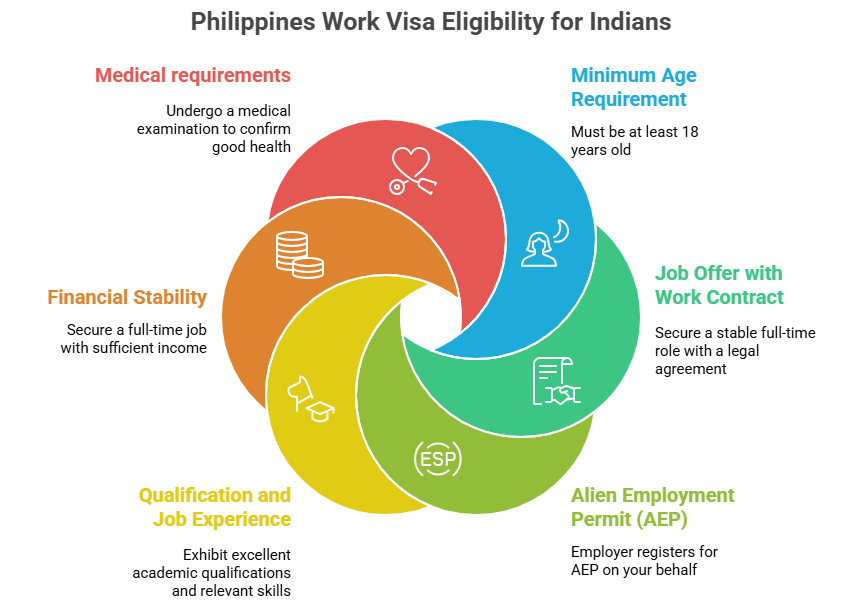
The eligibility requirements for the Philippines work visa are listed below:
- Minimum age requirement: You must be at least 18 years old to be eligible for the application process.
- Job offer with work contract: Secure a stable full-time role with a legal work agreement that highlights tenure, responsibility, and compensation.
- Alien Employment Permit(AEP): The employer registers for the Alien Employment Permit (AEP) on your behalf, post job confirmation, and before visa processing.
- Qualification and job experience: Exhibit excellent academic qualifications, exceptional skills, and relevant experience in your field.
- Financial stability: Secure a full-time job with sufficient income to sustain yourself during the stay period.
- Medical Examination: You need to undergo a medical examination to confirm good health conditions to travel and work abroad.
*Are you interested in working in the Philippines? Sign up with Y-Axis for assistance in every step.
List of documents required for a Philippines work visa from India
Below is a list of essential documents required for a Philippines work visa for Indian citizens:
- A passport with at least 6 months' validity.
- Job offer letter and AEP.
- Filled and signed application form.
- Educational certificates.
- Work experience letter.
- Bank statement.
- Certificate of good conduct.
- Medical test report( including test for HIV).
- Birth certificate.
*Are you looking for step-by-step assistance with overseas immigration? Contact Y-Axis, the world's No. 1 overseas immigration consultancy, for end-to-end assistance!
FAQs
What is a Philippine work visa, and who needs it?
A Philippine work visa is a legal authorization allowing foreign nationals to work for a Philippine-based employer. Most foreign professionals require a 9G Pre-Arranged Employment Visa to work long-term. Eligibility depends on having a valid job offer, employer sponsorship, and approval from the Philippine authorities. Short-term or project-based workers may qualify for alternative permits. The visa ensures compliance with labor and immigration laws, protects employee rights, and allows lawful employment. Working without the proper visa can lead to penalties, deportation, or future entry bans, making compliance essential for foreign professionals.
What are the basic eligibility requirements for a Philippines work visa?
To be eligible for a Philippines work visa, applicants must have a valid passport, a confirmed job offer from a Philippine employer, and employer sponsorship. The employer must secure an Alien Employment Permit from the Department of Labor and Employment. Applicants should meet the educational and experience requirements for the role and demonstrate that the position cannot be easily filled by a local worker. Medical clearance, police clearance, and proof of legal entry may also be required. Meeting these criteria helps ensure lawful employment approval in the Philippines.
Is an Alien Employment Permit mandatory for a Philippines work visa?
Yes, an Alien Employment Permit is a mandatory requirement for most Philippines work visa applications. It is issued by the Department of Labor and Employment and confirms that hiring a foreign national will not adversely affect local employment. The employer applies for the permit on behalf of the foreign worker before the visa process begins. Without an approved Alien Employment Permit, immigration authorities will not issue a 9G work visa. Certain categories, such as diplomats or treaty-based employees, may be exempt under specific conditions.
Do applicants need a job offer before applying for a Philippines work visa?
Yes, a confirmed job offer is essential before applying for a Philippines work visa. The visa is employer-sponsored, meaning the applicant cannot apply independently. The employer must submit supporting documents, employment contracts, and justification for hiring a foreign worker. Immigration authorities assess whether the role aligns with labor regulations and skill requirements. Without a valid job offer and sponsorship, the application will not proceed. This requirement ensures that foreign employment supports economic needs and complies with Philippine labor policies.
What educational qualifications are required for a Philippines work visa?
Educational qualifications for a Philippines work visa depend on the job role and industry. Generally, applicants must possess relevant degrees, diplomas, or certifications that match the position offered. Professional experience is often evaluated alongside education to assess suitability. Immigration authorities may request authenticated academic documents and proof of work history. While there is no universal minimum degree requirement, higher-skilled roles require stronger qualifications. Proper documentation strengthens eligibility and supports the employer’s justification for hiring a foreign professional.
Are medical and police clearances required for eligibility?
Yes, medical and police clearances are commonly required for a Philippines work visa eligibility. Applicants must undergo a medical examination from an accredited clinic to confirm they are fit for employment. A police clearance or criminal background check from the home country is also required to ensure the applicant has no serious criminal record. These requirements help protect public safety and workplace standards. Failure to submit valid clearances can delay processing or result in visa denial.
Can eligibility vary based on the type of work visa?
Yes, eligibility requirements vary depending on the type of Philippines work visa. The 9G visa is for long-term employment, while special non-immigrant visas apply to treaty traders, executives, or short-term assignments. Some roles may require additional approvals from regulatory bodies. Certain visa categories have different experience, salary, or documentation requirements. Understanding the correct visa type is crucial, as applying under the wrong category can lead to rejection or delays in employment authorization.
Is there an age limit for Philippines work visa applicants?
There is no officially defined age limit for the Philippines work visa applicants. Eligibility is primarily based on skills, qualifications, and employer requirements rather than age. However, applicants must be legally employable and medically fit to work. Some employers may impose internal age preferences based on job nature or contract terms. Immigration authorities focus on compliance, professional suitability, and labor market impact rather than age restrictions when assessing work visa applications.
Do employers have specific eligibility responsibilities?
Yes, employers play a major role in the Philippines' work visa eligibility. They must be legally registered, tax-compliant, and authorized to hire foreign workers. Employers are responsible for securing the Alien Employment Permit, submitting visa documents, and ensuring compliance with labor laws. They must also prove that the position requires foreign expertise. Failure by the employer to meet these obligations can result in visa rejection, penalties, or future hiring restrictions under Philippine regulations.
Can a Philippines work visa lead to long-term stay eligibility?
Yes, a Philippine work visa can support long-term stay eligibility. The 9G work visa is usually issued for one to three years and is renewable based on continued employment. Long-term residence may be possible through extended employment, investment, or special resident visa programs. Maintaining legal status, tax compliance, and employment continuity is essential. While a work visa does not guarantee permanent residency, it can be a pathway toward longer-term legal residence in the Philippines.
Tags:
Philippines work visa for Indians
Philippines visa 9a
Philippines work visa for Indians cost
Philippines work visa processing time
Philippines work visa requirements for Indian citizens
Do I need a visa to work in Philippines
Share
Options for you by Y-Axis

Get it on your mobile

Get News alerts

Contact Y-Axis
Latest Article
Popular Post
Trending Article
Posted On April 01 2026
Study vs Work Abroad – Which is Better for Indians in 2026?