

Posted on November 02 2026
What Are the Different Types of Switzerland Visas to Immigrate?
By , Editor & Director
Updated November 02 2026
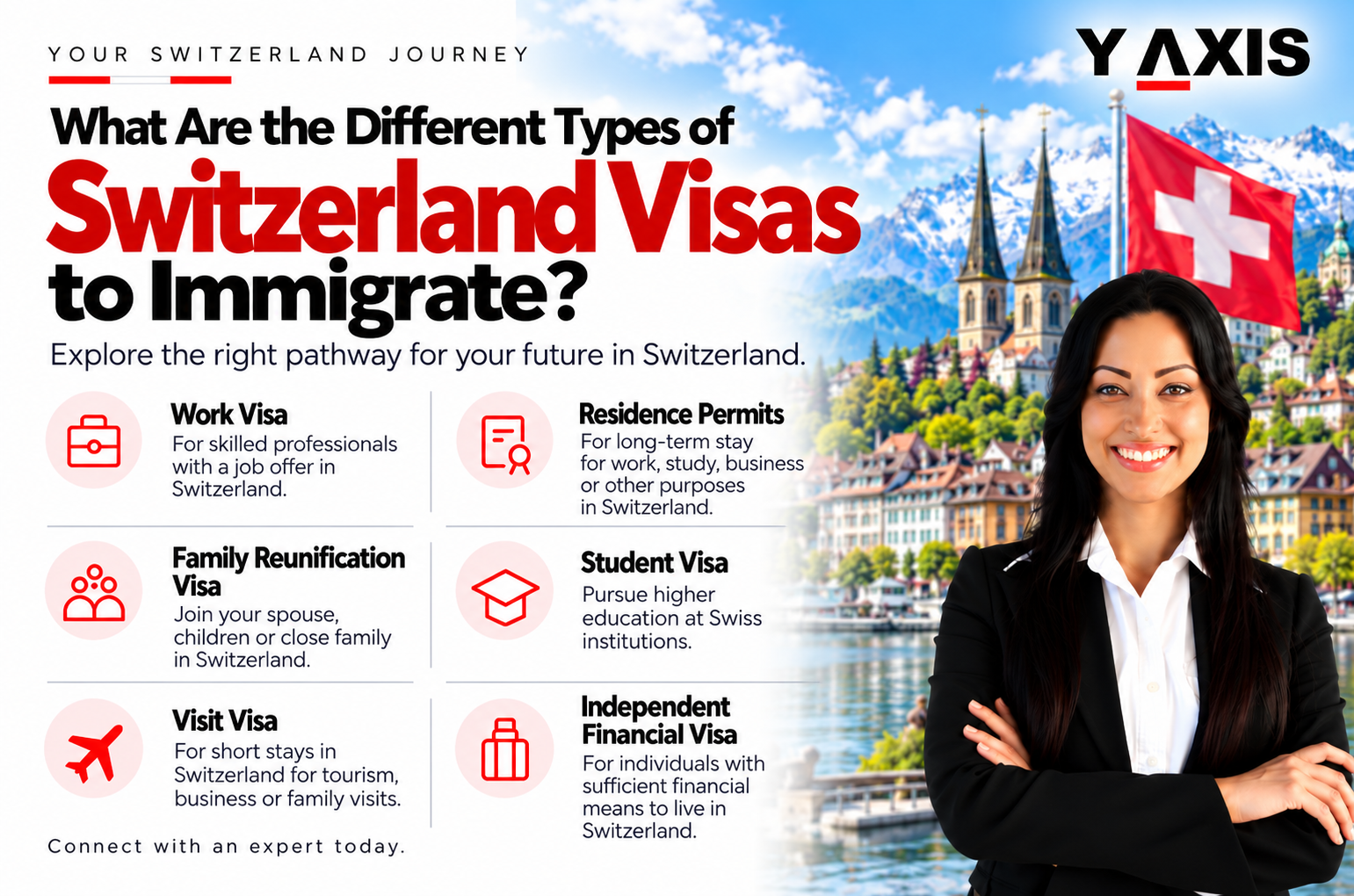
Switzerland offers several visa and permit options for Indian citizens who want to visit, work, study or settle in the country. For short visits of up to 90 days, you need a Schengen Visa. For longer stays, you usually need a National Long-Stay Visa (D Visa) and a Swiss residence permit. The main permits are the L permit for short-term stays, the B permit for longer residence and the C permit for settlement. Work, study, family reunification, research and self-employment are the most common reasons for moving.
The right option depends on your purpose, qualifications and personal situation. Skilled professionals need a job offer from a Swiss employer and must fit within the annual quota for non-EU/EFTA workers. Students need admission to a recognised Swiss institution, while family members can join relatives who already live in Switzerland legally. Switzerland is not part of the European Union, so the EU Blue Card does not apply there. Most long-term residents can apply for a C permit after 10 years.
*Planning to work in Switzerland? Contact Y-Axis for complete guidance.
Types of Switzerland Visas and Residence Permits for Indian Citizens
|
Switzerland Visa or Permit Type |
Who Is It For? |
Main Purpose |
|
Schengen Visa (Type C) |
Tourists, business visitors and people visiting family or friends |
To visit Switzerland and other Schengen countries for up to 90 days in any 180-day period |
|
National Long-Stay Visa (Type D) |
Non-EU citizens whose work, study or family permit has been approved |
To enter Switzerland and collect a residence permit for a stay of more than 90 days |
|
Work Permit (L or B Permit) |
Qualified non-EU professionals, such as managers and specialists, with a Swiss job offer |
To live and work in Switzerland, subject to annual quotas and a labour market check |
|
International students admitted to a recognised Swiss university or institution |
To study in Switzerland full-time, with limited part-time work rights |
|
|
Family Reunification |
Spouses, registered partners and children under 18 of people living legally in Switzerland |
To join a family member who lives in Switzerland |
|
Self-Employment Permit |
Entrepreneurs and independent professionals whose business benefits the Swiss economy |
To start or run a business in Switzerland |
|
Intra-Company Transfer (ICT) |
Managers and specialists moving within the same international company group |
To work temporarily at a Swiss branch of their employer |
|
Researcher Permit |
Researchers and academics with a position at a Swiss university or research institution |
To carry out research in Switzerland |
|
Retiree Permit |
People aged 55 or above with sufficient financial means and close ties to Switzerland |
To live in Switzerland without working |
|
C Permit (Settlement Permit) |
Non-EU residents who have lived in Switzerland for a long period and meet the integration requirements |
To live in Switzerland permanently, usually after 10 years |
*Want to migrate to Switzerland? Sign up with Y-Axis, to guide you through the process.
Switzerland Visa Requirements and Documents for Indian Applicants
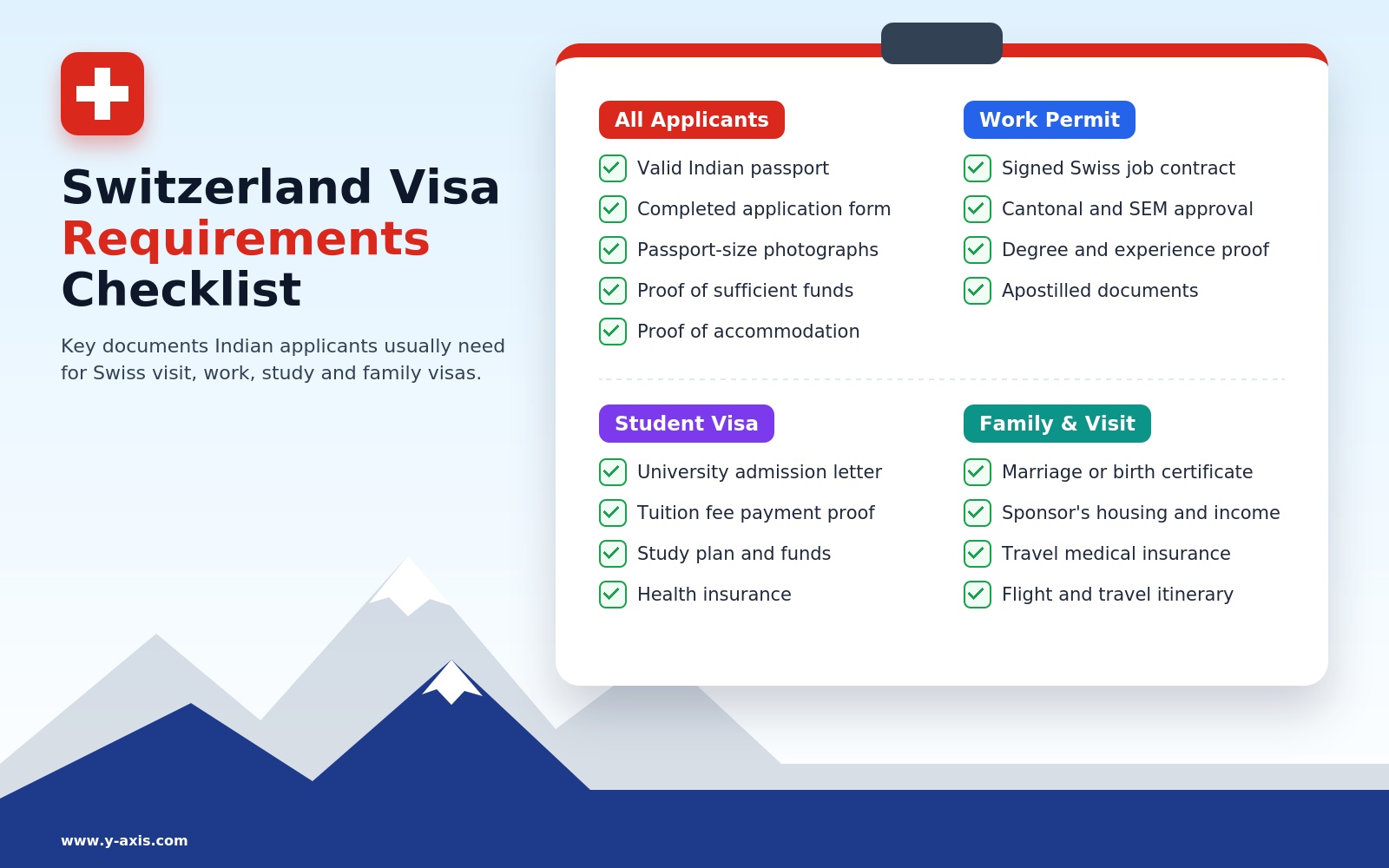
The documents you need depend on your visa or permit type. Common requirements to apply for a Switzerland visa from India include:
- Valid Indian passport with at least two blank pages
- Completed visa application form for the relevant visa type
- Recent passport-size photographs that meet Swiss specifications
- Signed employment contract and permit approval for work applications
- Proof of qualifications and work experience, such as degree certificates and experience letters
- Letter of admission from a recognised Swiss institution for student applications
- Proof of tuition fee payment and a study plan for student applications
- Business plan and financial records for self-employment applications
- Proof of relationship, such as a marriage or birth certificate, for family applications
- Proof that your family member in Switzerland has suitable housing and enough income
- Proof of sufficient funds to support yourself during your stay
- Recent bank statements or other financial documents
- Travel medical insurance for Schengen Visa applications
- Proof of accommodation in Switzerland
- Flight reservation or travel itinerary for short visits
- Police clearance certificate
- Apostilled documents and certified translations
- Any additional documents requested by the Swiss embassy or visa application centre
Also, read…
How Can I Get Permanent Residency in Switzerland?
How to Apply for a Switzerland Visa from India: Step-by-Step Process
The application process depends on your visa type. For most long-stay permits, your Swiss employer, school or family member starts the process in Switzerland. The general steps are:
Step 1: Choose the right visa or permit based on your purpose of moving to Switzerland.
Step 2: Check the eligibility requirements for that visa or permit.
Step 3: Secure a job offer, university admission or family sponsor, depending on your route.
Step 4: For work permits, your Swiss employer applies to the cantonal authority for approval.
Step 5: Wait for the cantonal authority and the State Secretariat for Migration (SEM) to approve your permit.
Step 6: Prepare your documents and complete the visa application form.
Step 7: Book an appointment at the Swiss visa application centre in India.
Step 8: Submit your documents and biometrics, and pay the applicable fees.
Step 9: Collect your passport with the visa once it is approved.
Step 10: Register with your local municipality in Switzerland within 14 days of arrival to receive your residence permit.
Also, read...
Visa Sponsorship Jobs in Switzerland
Switzerland Visa Fees for Indian Applicants
Switzerland visa fees depend on the type of visa you apply for. A short-stay Schengen Visa costs €90 for adults and €45 for children aged 6 to 12. Long-stay D Visas and residence permits have separate fees, and cantonal permit fees vary across Switzerland. You may also need to pay a service fee when you apply through the visa application centre. Fees can change, so check the latest amounts before you apply.
|
Visa/ Fee Type |
Fee |
|
Schengen Visa (adults) |
€ 90 |
|
Schengen Visa (children aged 6 to 12) |
€ 45 |
|
Schengen Visa (children under 6) |
Free |
|
National Long-Stay D Visa |
Separate fee; check with the Swiss embassy |
|
Residence permit (L, B or C) |
Set by each canton |
|
Visa application centre service fee |
Charged in addition to the visa fee |
Switzerland Visa Processing Time for Indian Applicants
Processing time depends on the type of visa and your personal circumstances. Schengen Visa applications are usually decided within 15 days, but this can extend in some cases. Work permits usually take longer because the cantonal authority and SEM must both approve them before the D Visa is issued. Student and family reunification applications may also need extra checks. Apply well in advance and keep your documents complete to avoid delays.
|
Visa or Permit Type |
Usual Processing Time |
|
Schengen Visa |
Within 15 days (can extend up to 45 days) |
|
Work Permit (L or B) |
Several weeks to a few months |
|
Student Visa |
Several weeks to a few months |
|
Family Reunification |
Several weeks to a few months |
|
National Long-Stay D Visa |
Issued after the permit is approved |
*Want guidance with overseas immigration? Connect to Y-Axis, the world's No. 1 overseas immigration consultancy, for end-to-end support with the process.
FAQs
What are the main types of Switzerland visas for Indians?
The main options are the Schengen Visa for short visits, the National Long-Stay D Visa for longer stays, work permits, student visas, family reunification, self-employment, researcher and retiree permits. Long-term residents can apply for a C permit. The right option depends on why you want to move to Switzerland.
What is the difference between the L, B and C permits in Switzerland?
The L permit is a short-term residence permit, usually for work contracts of up to one year. The B permit is a residence permit for longer stays, usually renewed every year for non-EU citizens. The C permit is a settlement permit that lets you live in Switzerland permanently.
Can Indians get a work permit in Switzerland?
Yes, but the rules are strict. You need a job offer from a Swiss employer, and the employer must show that no suitable candidate is available from Switzerland or the EU/EFTA. Permits are mainly for managers, specialists and highly qualified professionals. Switzerland also sets an annual quota for non-EU workers.
What is the Switzerland work permit quota for non-EU citizens?
Switzerland sets an annual quota for workers from non-EU/EFTA countries such as India. The current quota allows up to 8,500 permits, made up of 4,500 B permits and 4,000 L permits. Renewals of existing B permits do not count towards the quota.
Does Switzerland have an EU Blue Card?
No. Switzerland is not a member of the European Union, so the EU Blue Card does not apply there. Skilled professionals from India must apply for a Swiss work permit through their employer instead. Swiss work permits have their own rules, including quotas and a labour market check.
Can I work while studying in Switzerland?
Yes. International students can usually work up to 15 hours a week during term time after six months of study. Full-time work may be allowed during semester breaks. Your studies must remain your main purpose, and you may need approval from the cantonal authorities before you start working.
Can I bring my family to Switzerland?
Yes, in most cases. Spouses, registered partners and children under 18 can join a family member living legally in Switzerland. The family member must usually have suitable housing and enough income to support them. Rules differ depending on the permit held by the family member in Switzerland.
How long does it take to get permanent residence in Switzerland?
Most Indian citizens can apply for a C permit after 10 years of legal residence in Switzerland. Applicants must meet integration requirements, including language skills, respect for public order and financial independence. In some cases, well-integrated applicants may qualify earlier after five years.
Does Switzerland have a digital nomad visa?
No. Switzerland does not have a separate Digital Nomad Visa. Remote workers who want to live in Switzerland must qualify for another permit, such as a work permit with a Swiss employer or a self-employment permit. A Schengen Visa allows visits of up to 90 days but does not allow work.
What is the Switzerland Schengen Visa fee for Indians?
The Schengen Visa fee is €90 for adults and €45 for children aged 6 to 12. Children under 6 are usually exempt. You may also need to pay a service fee to the visa application centre. Long-stay D Visas and residence permits have separate fees.
Tags:
Types of Switzerland visas
Switzerland visa for Indians
Switzerland work permit
Swiss B permit
Swiss L permit
Swiss C permit
Switzerland student visa
Switzerland family reunification
Switzerland Schengen visa
migrate to Switzerland
Share
Options for you by Y-Axis
Get it on your mobile
Get News alerts
Contact Y-Axis
Latest Article
Popular Post
Trending Article
Posted On November 02 2026
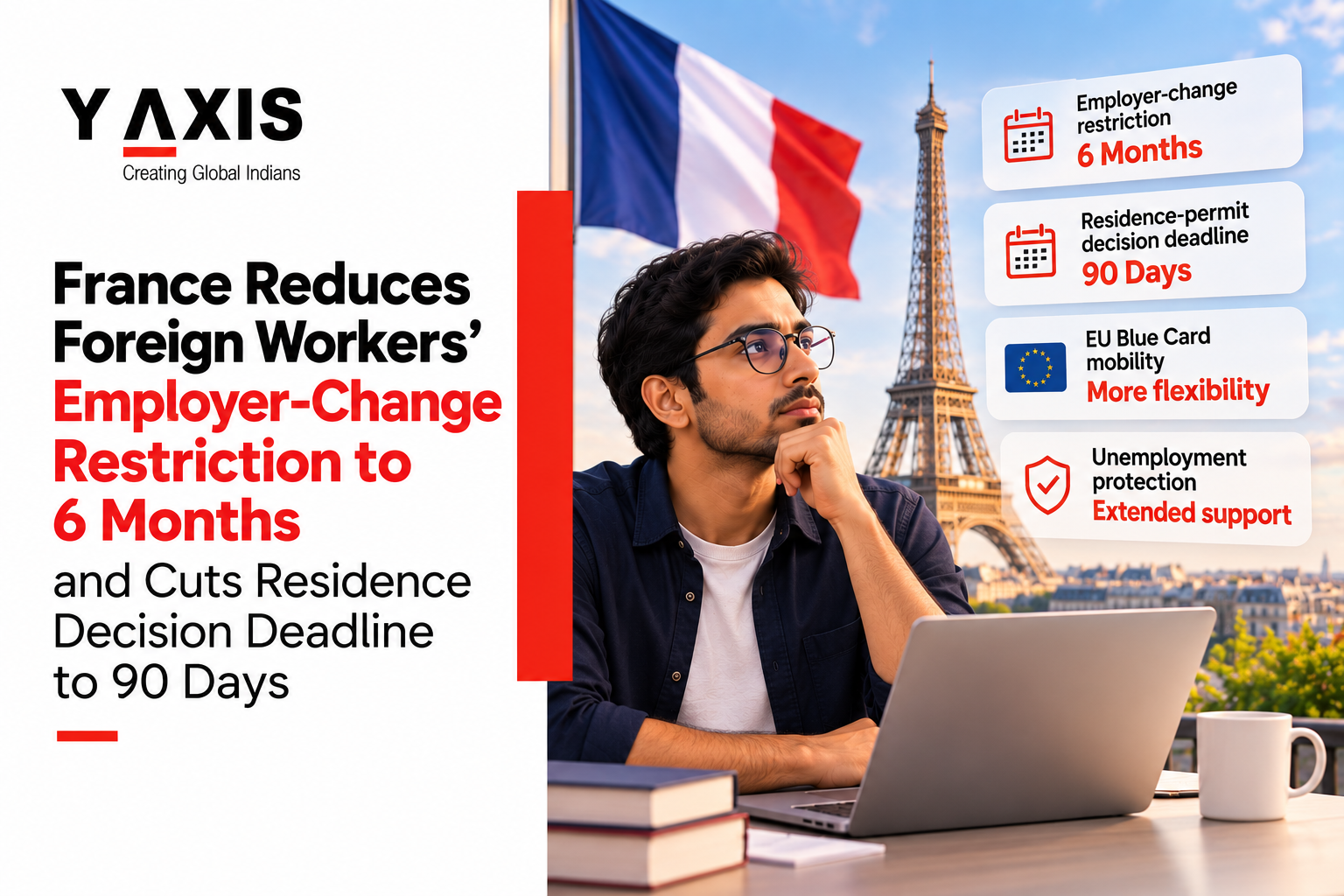
France Reduces Work Permit Restriction to 6 Months and Residence Decisions to 90 Days