

Posted on July 13 2026
Visa Sponsorship Jobs in Poland: In-Demand Roles, Top Employers & Work Permits

By , Editor & Director
Updated July 18 2026
Poland is one of the fastest-growing job markets in Europe for foreign workers. The country has a low unemployment rate of around 3–4%, and many industries are facing a shortage of workers. It is expected that Poland will need about 1.5 million workers in the coming years.
There is high demand for skilled workers in IT, healthcare, manufacturing, construction, logistics, and transport. Since June 2025, Poland has made it easier for employers to hire foreign workers. Employers no longer need to complete a labour market test before sponsoring an international employee. Work permit applications are also submitted online through the praca.gov.pl portal.
For Indian professionals, Poland offers good job opportunities, affordable living costs compared to many Western European countries, and competitive salaries. A sponsored job can also help you move towards permanent residency after meeting the eligibility requirements. Under Poland's 2025–2030 Labour Market Strategy, international workers are expected to make up at least 12% of the workforce by 2030. Whether you are a skilled worker, a recent graduate, or an experienced professional, Poland offers many opportunities to build your career in Europe.
*Want to apply for Poland Work Permit? Contact Y-axis for complete guidance
Why Apply for Visa Sponsorship Jobs in Poland?
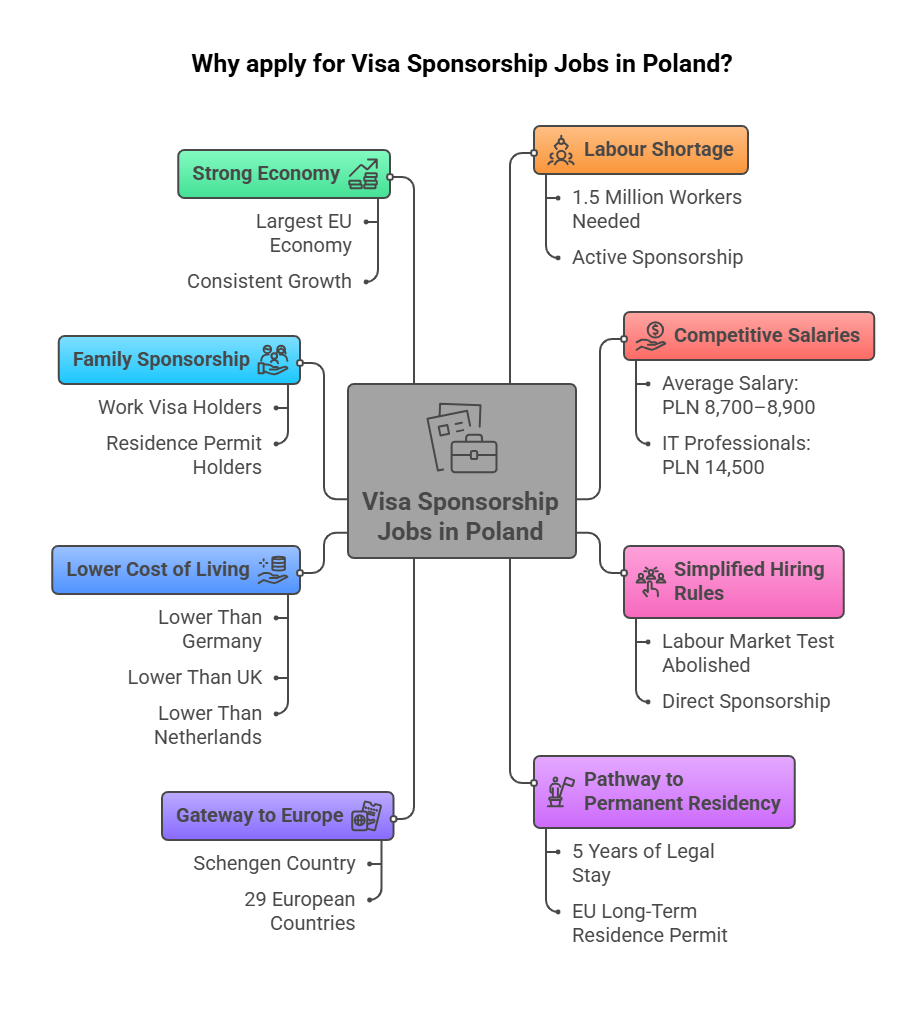
- Huge labour shortage: Poland needs an estimated 1.5 million workers, so employers are actively sponsoring foreign talent across skill levels.
- Competitive salaries: The average salary is around PLN 8,700–8,900 per month, and IT professionals average PLN 14,500 per month.
- Simplified hiring rules: The labour market test was abolished in June 2025, so employers can sponsor foreign workers directly and faster.
- Pathway to permanent residency: After 5 years of continuous legal stay, you can apply for an EU long-term residence permit.
- Gateway to Europe: Poland is a Schengen country, so you can travel across 29 European countries.
- Lower cost of living: Living costs in Poland are much lower than in Germany, the UK, or the Netherlands, so you can save more.
- Family sponsorship: Work visa and residence permit holders can bring their spouse and children to Poland.
- Strong economy: Poland is one of the largest economies in the EU and has grown consistently for over three decades.
What are Visa Sponsorship Jobs in Poland?
Visa sponsorship jobs in Poland are jobs where a Polish employer helps you get the legal permission to work in the country. As a non-EU citizen, you cannot work in Poland without a valid job offer and work permit.
After you receive a job offer, your employer applies for your work permit usually a Type A work permit through the praca.gov.pl portal. Once the work permit is approved, you can apply for a National (Type D) work visa at the Polish Embassy or Consulate in India.
The main advantage of a visa sponsorship job is that your employer takes care of the work permit process and related costs. This allows you to travel to Poland with a legal job, an employment contract that follows Polish labour laws, and access to employee benefits. If you have the required skills and a valid job offer from a Polish employer, you can apply for a visa sponsorship job in Poland.
*Willing to work in Poland? Contact Y-axis for expert guidance
In-Demand Visa Sponsorship Jobs in Poland
Poland has a strong demand for skilled workers across several industries. Many employers are hiring international professionals and offering visa sponsorship to fill labour shortages. The highest demand is in IT, healthcare, construction, manufacturing, transport and logistics, finance, hospitality, and skilled trades. The table below shows some of the most in-demand sectors, popular job roles, and their average annual salaries.
| In-Demand Sector | In-Demand Job Roles | Average Annual Salary (PLN) |
|---|---|---|
| Information Technology (IT) | Software Developer, AI/Machine Learning Engineer, Cybersecurity Specialist, Data Analyst, Full-Stack Developer, Cloud Engineer, DevOps Engineer, QA/Test Engineer, Network Engineer | PLN 144,000–300,000 |
| Healthcare | Registered Nurse, Specialist Doctor, General Physician, Physiotherapist, Pharmacist, Medical Laboratory Technician, Radiographer, Caregiver | PLN 96,000–310,000 |
| Construction | Civil Engineer, Construction Worker, Project Manager, Site Supervisor, Quantity Surveyor, Architect, Carpenter, Plumber | PLN 66,000–132,000 |
| Manufacturing | Welder, Machine Operator, CNC Operator, Production Worker, Mechanical Technician, Maintenance Technician, Quality Control Inspector, Assembly Line Worker | PLN 66,000–78,000 |
| Transport & Logistics | Truck Driver, Bus Driver, Warehouse Worker, Forklift Operator, Logistics Coordinator, Supply Chain Executive, Delivery Driver, Inventory Controller | PLN 60,000–84,000 |
| Finance | Accountant, Financial Analyst, Auditor, Payroll Specialist, Tax Consultant, Accounts Executive, Finance Manager | PLN 108,000–180,000 |
| Hospitality | Chef, Cook, Restaurant Manager, Hotel Receptionist, Housekeeping Supervisor, Food & Beverage Manager, Kitchen Assistant | PLN 66,000–120,000 |
| Skilled Trades | Electrician, HVAC Technician, Refrigeration Technician, Industrial Electrician, Maintenance Electrician, Automation Technician | PLN 90,000–140,000 |
*Know more about In-demand Jobs in Poland
Highest Paying Jobs in Poland
The highest-paying jobs in Poland are mainly in IT, healthcare, and senior management. Cities such as Warsaw, Kraków, and Wrocław usually offer higher salaries because they have more businesses and job opportunities. Jobs in Artificial Intelligence (AI) and Machine Learning are among the fastest-growing and highest-paying careers in Poland's technology sector.
| Job Title | Average Annual Salary (PLN) | Average Annual Salary (INR) |
|---|---|---|
| IT Director | PLN 360,000 | ₹91.1 lakh |
| Specialist Doctor / Surgeon | PLN 310,000 | ₹78.4 lakh |
| AI / Machine Learning Engineer | PLN 300,000 | ₹75.9 lakh |
| Finance Director | PLN 280,000 | ₹70.8 lakh |
| Senior Software Engineer | PLN 240,000 | ₹60.7 lakh |
| DevOps Engineer | PLN 220,000 | ₹55.7 lakh |
| Cybersecurity Specialist | PLN 216,000 | ₹54.6 lakh |
| Data Scientist | PLN 200,000 | ₹50.6 lakh |
| Dentist | PLN 190,000 | ₹48.1 lakh |
| Project Manager | PLN 180,000 | ₹45.5 lakh |
| Civil Engineer | PLN 132,000 | ₹33.4 lakh |
| Pharmacist | PLN 130,000 | ₹32.9 lakh |
| Accountant | PLN 108,000 | ₹27.3 lakh |
| Registered Nurse | PLN 96,000 | ₹24.3 lakh |
Top Companies Offering Visa Sponsorship Jobs in Poland
Many multinational companies and leading Polish employers hire international professionals and offer visa sponsorship for eligible candidates. Opportunities are available across sectors such as IT, consulting, manufacturing, automotive, electronics, telecommunications, and logistics.
| Sector | Top Companies Offering Visa Sponsorship |
|---|---|
| Information Technology (IT) | Infosys Poland, TCS Poland, Wipro Poland, HCLTech Poland, IBM Poland, Google Poland, EPAM Poland, DXC Technology Poland, Atos Poland, Fujitsu Poland, Comarch, Asseco Poland |
| IT Consulting & Business Services | Capgemini Poland, Accenture Poland, Deloitte Poland, PwC Poland, EY Poland, KPMG Poland, Cognizant Poland, Genpact Poland |
| Electronics & Research | Samsung R&D Poland, LG Electronics Poland, Intel Poland, Aptiv Poland, ABB Poland, Hitachi Energy Poland, Siemens Poland, Bosch Poland |
| E-commerce & Logistics | Amazon Poland, DHL Poland, FedEx Poland, DSV Poland, DB Schenker Poland, InPost, UPS Poland, Raben Group |
| Automotive | Volvo Poland, Toyota Motor Manufacturing Poland, Stellantis Poland, Volkswagen Poznań, Mercedes-Benz Manufacturing Poland, MAN Trucks Poland, Solaris Bus & Coach, Valeo Poland |
| Telecommunications | Nokia Poland, Ericsson Poland, Orange Polska, T-Mobile Polska, Play (P4), Netia, Huawei Poland, Cisco Poland |
*Read more about Poland Job Outlook
Eligibility Requirements for Visa Sponsorship Jobs in Poland
To apply for a visa sponsorship job in Poland, you must meet the following requirements:
- Have a valid passport that is valid for at least 3 months beyond your planned stay and has at least 2 blank pages.
- Receive a valid job offer or employment contract from a Polish employer, who will apply for your work permit.
- Have the educational qualifications required for the job. If you are applying for an EU Blue Card, you need a university degree or at least 5 years of relevant professional experience.
- Meet the work experience required for your role. Skilled and senior positions usually require 2–5 years of relevant experience.
- Have the necessary language skills. English is enough for many IT and multinational company jobs, while Polish is useful for healthcare and customer-facing roles.
- Meet the minimum salary requirement for the work permit or EU Blue Card category.
- Have health insurance with coverage of at least €30,000 for your visa application.
- Have a clean criminal record and provide a Police Clearance Certificate if requested.
Documents Required for a Sponsored Work Visa in Poland
You will generally need the following documents when applying for a Poland sponsored work visa:
- Valid passport
- Completed and signed National (Type D) visa application form
- Approved work permit
- Job offer letter or employment contract
- Educational certificates
- Work experience letters
- Health insurance with at least €30,000 coverage
- Proof of accommodation in Poland
- Medical certificate if required
- Police Clearance Certificate if required
- Passport-size photographs that meet Schengen photo requirements
- Proof of visa fee payment
How to Get a Visa Sponsorship Job in Poland?
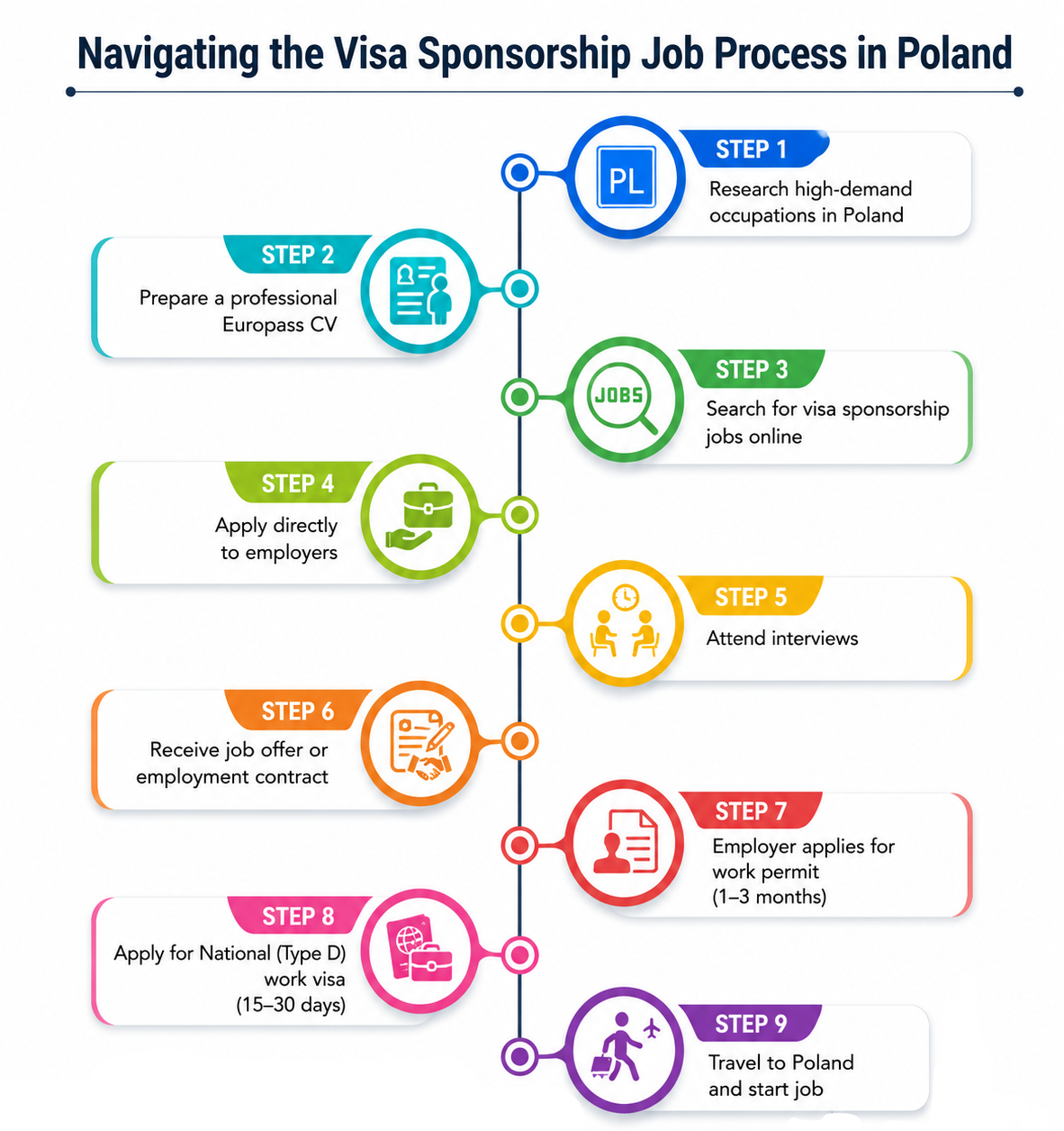
Step 1: Research the occupations that are in high demand in Poland, such as IT, healthcare, logistics, construction, and manufacturing. Make sure your skills and qualifications match the requirements of the jobs you want to apply for.
Step 2: Prepare a professional Europass or European-style CV that highlights your education, work experience, technical skills, and English language proficiency. Update your resume to match each job application.
Step 3: Search for visa sponsorship jobs on platforms such as Pracuj.pl, EURES, LinkedIn, and company career pages. Look for jobs that mention visa sponsorship, relocation support, or English-speaking roles.
Step 4: Apply directly to employers that hire international workers. Submit your resume and the required documents according to the employer's application process.
Step 5: Attend online or in-person interviews if you are shortlisted. Be prepared to explain your work experience, skills, notice period, and willingness to relocate to Poland.
Step 6: If you are selected, you will receive a job offer or employment contract that includes your job role, salary, and other employment terms.
Step 7: After you accept the offer, your employer will apply for your work permit through the praca.gov.pl portal. This process usually takes 1–3 months.
Step 8: Once your work permit is approved, apply for a National (Type D) work visa at the Polish Embassy or Consulate in India. The visa process usually takes 15–30 days.
Step 9: After receiving your visa, travel to Poland, complete the required local registration, and start your new job.
Work Visa Options for Foreign Workers in Poland
| Visa / Permit Type | Purpose | Validity |
|---|---|---|
| Type A Work Permit | Employment with a company registered in Poland (most common) | Up to 3 years |
| Type B Work Permit | Board members staying in Poland over 6 months in a year | Up to 3 years |
| Type C Work Permit | Intra-company transfer to a Polish branch | Up to 3 years |
| Type D Work Permit | Workers seconded by a foreign employer for export services | Up to 3 years |
| Type S (Seasonal) Permit | Seasonal work in agriculture, horticulture, tourism | Up to 9 months in a year |
| National Visa (Type D) | Entry and stay in Poland for work over 90 days | Up to 1 year |
| EU Blue Card | Highly qualified professionals with a degree or 5+ years' experience | Contract period + 3 months, up to 3 years |
| Temporary Residence & Work Permit (Single Permit) | Combined right to live and work in Poland | Up to 3 years |
| ICT Permit | Intra-corporate transferees (managers, specialists, trainees) | Up to 3 years (1 year for trainees) |
Need step-by-step help with overseas immigration? Contact Y-Axis, the world’s No. 1 Overseas Immigration Consultancy, for complete guidance!
FAQs
What are visa sponsorship jobs in Poland?
Visa sponsorship jobs in Poland are jobs where a Polish employer supports your legal right to work in the country. The employer applies for your work permit, usually a Type A permit, through the government portal. Once the permit is approved, you apply for a National (Type D) work visa at the Polish embassy. You then travel to Poland and start working legally.
Can Indians get visa sponsorship jobs in Poland?
Yes, Indians can get visa sponsorship jobs in Poland. Poland faces a labour shortage of around 1.5 million workers and actively recruits from India. Indian professionals are hired in IT, manufacturing, logistics, healthcare, and construction. Since the labour market test was abolished in June 2025, Polish employers can sponsor Indian workers directly without proving that no local candidate was available.
Which companies sponsor foreign workers in Poland?
Companies known to hire international talent in Poland include Infosys, TCS, Wipro, HCLTech, Capgemini, Accenture, IBM, Google, Samsung R&D, LG Electronics, Amazon, Volvo, and Nokia. Most are in IT, business services, electronics, and logistics. Sponsorship depends on the role and your qualifications, so always confirm visa support with the employer during the interview process.
Which jobs are easiest to get in Poland?
Jobs with the most vacancies are usually easiest to get. In Poland, these include machine operators, assemblers, warehouse workers, construction workers, welders, truck drivers, and hospitality staff. These roles have lower entry requirements and high demand. For skilled professionals, IT and business services roles are widely available, especially if you speak English well and have in-demand technical skills.
What are the highest-paying sponsorship jobs in Poland?
The highest-paying jobs in Poland are IT Director (around PLN 360,000 per year), specialist doctors and surgeons (around PLN 310,000), and AI/ML engineers (around PLN 300,000). Finance directors, senior software engineers, DevOps engineers, and cybersecurity specialists also earn well above the national average. IT and healthcare offer the best combination of high pay and visa sponsorship.
What qualifications are required for Poland work visa jobs?
Qualification requirements depend on the job. Skilled roles need a relevant degree or diploma plus work experience. The EU Blue Card requires a university degree or at least 5 years of equivalent professional experience, plus a salary of at least PLN 12,272.58 gross per month in 2026. Lower-skilled roles in manufacturing, logistics, and construction may only need basic training and fitness.
Do I need work experience for jobs in Poland?
Work experience helps but is not always mandatory. Senior and specialist roles usually require 2–5 years of relevant experience. However, Poland's labour shortage means many entry-level roles in manufacturing, warehousing, hospitality, and construction accept candidates with little experience. Fresh graduates with in-demand skills, especially in IT, can also find employers willing to sponsor them.
Is IELTS required for a Poland work visa?
No, IELTS is not required for a Poland work visa. Poland does not have a mandatory language test for work visa applicants. However, employers may expect good English for IT and multinational roles, and basic Polish is useful for healthcare, retail, and customer-facing jobs. Learning some Polish will improve your job options and daily life in Poland.
How long does Poland work visa processing take?
The full process usually takes 2–4 months. The work permit, which your employer applies for electronically, takes about 1–3 months. After the permit is approved, the National (Type D) visa application at the Polish embassy or consulate typically takes 15–30 days. Applying with complete, accurate documents helps avoid delays, so prepare your paperwork carefully.
Can family members accompany me to Poland?
Yes, your family can join you in Poland. Once you hold a valid residence permit, your spouse and minor children can apply for temporary residence permits for family reunification. EU Blue Card holders enjoy faster family reunification. Family members with residence permits can also access education, and spouses can generally work in Poland once their permits allow it.
Can visa sponsorship lead to permanent residency in Poland?
Yes. After 5 years of continuous legal residence in Poland, you can apply for an EU long-term residence permit, which is a form of permanent residency. You need a stable income, health insurance, and basic Polish language proficiency. EU Blue Card holders can count some time spent in other EU countries towards the 5-year requirement.
What industries hire foreign workers in Poland?
Manufacturing has the most unfilled vacancies, followed by construction, where 7 out of 10 companies report shortages. Logistics employs about 20% of all foreign permit holders. IT, healthcare, transport, hospitality, agriculture, and business services also hire foreign workers heavily. Ukrainian workers dominate manufacturing and construction, while Asian workers increasingly fill roles in IT, healthcare, and food production.
How can I find sponsored jobs in Poland?
Search on pracuj.pl, EURES, LinkedIn, and Just Join IT for tech roles. Filter for English-speaking positions or jobs offering relocation support. Apply directly on career pages of companies known to hire foreigners, like Infosys, Capgemini, and Amazon. A strong Europass-style CV improves your chances. Y-Axis job search services can also match your profile with sponsoring employers.
Are healthcare jobs in demand in Poland?
Yes, healthcare is one of Poland's biggest shortage sectors. Nurses, specialist doctors, caregivers, and physiotherapists are in high demand as Poland's population ages. Foreign-trained nurses and doctors must get their qualifications recognised and usually need basic Polish language skills. Once registered, healthcare professionals enjoy stable employment, and specialist doctors earn among the highest salaries in the country.
Are IT jobs available for foreigners in Poland?
Yes, IT is one of the best sectors for foreigners in Poland. IT roles made up around 10% of all specialist job postings, with AI/ML, cybersecurity, cloud, and software development growing fastest. Most IT jobs in Warsaw, Kraków, and Wrocław are English-speaking. IT professionals average PLN 14,500 per month, and many qualify for the EU Blue Card.
Can fresh graduates apply for jobs in Poland?
Yes, fresh graduates can apply, especially in IT, business services, and engineering. Poland's shared services centres hire English-speaking graduates for finance, customer support, and analyst roles. Junior developers earn around PLN 8,500 gross per month. Entry-level roles in logistics, manufacturing, and hospitality are also open to graduates. A relevant degree and good English are your strongest assets.
What is the average salary in Poland?
The average salary in Poland is around PLN 8,700–8,900 gross per month in 2026, roughly PLN 105,000 per year (about ₹26.6 lakh). The median is closer to PLN 7,000–7,300 per month. IT professionals average PLN 14,500 monthly and finance professionals around PLN 13,200. The minimum wage is PLN 4,806 gross per month. Exchange rates may vary.
What documents are required for a Poland work visa?
You need a valid passport, completed visa application form, approved work permit, job offer letter or employment contract, educational certificates, work experience letters, health insurance of at least €30,000, proof of accommodation, photographs, and the visa fee. A medical certificate and police clearance certificate may also be requested. Submit complete, accurate documents to avoid processing delays.
Can I change employers in Poland on a sponsored visa?
Your work permit is tied to a specific employer and role, so you cannot simply switch jobs. If you change employers, your new employer must apply for a new work permit before you start. If you hold a temporary residence and work permit, you must notify authorities and have the permit changed. Always maintain legal status during any job change.
How can Y-Axis help me get a job in Poland?
Y-Axis provides end-to-end support for your Poland career plan: professional resume writing to European standards, job search assistance to find sponsoring employers, interview preparation, complete documentation help, and expert guidance for your work permit and National (Type D) visa application. With decades of overseas career experience, Y-Axis counsellors guide you at every step, from your first application to landing in Poland.
Tags:
Visa sponsorship jobs in Poland 2026
Poland work visa sponsorship for Indians
Poland work permit jobs
In-demand jobs in Poland with visa sponsorship
Poland employer-sponsored jobs
Poland jobs for foreign workers
Poland work visa for skilled
Share
Options for you by Y-Axis

Get it on your mobile

Get News alerts

Contact Y-Axis
Latest Article
Popular Post
Trending Article
Posted On October 09 2026
Canada’s Immigration Reset: Why the Next Move May Be About Fit, Not Volume