

Posted on August 18 2026
Visa Sponsorship Jobs in Austria: In-Demand Jobs, Top Employers & How to Apply

By , Editor & Director
Updated August 23 2026
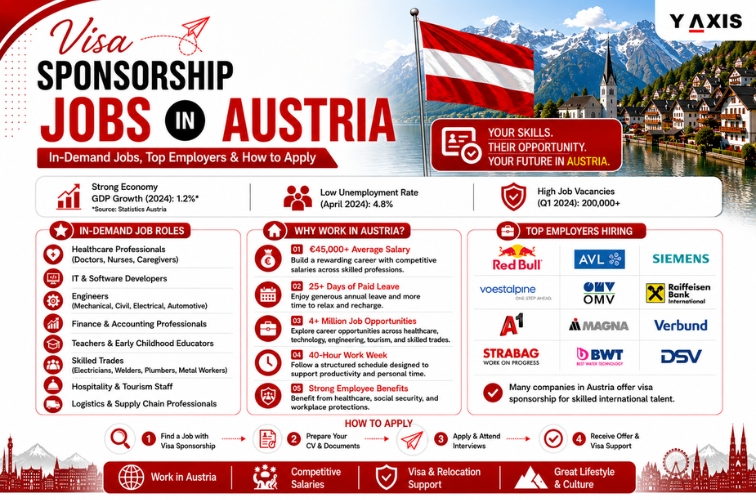
Austria is one of Europe's developed countries and has a high demand for skilled workers. In 2026, Austria has 64 shortage occupations across the country and 66 regional shortage occupations. These are jobs where employers are finding it difficult to hire enough local or EU workers. Shortages are mainly seen in areas such as engineering, healthcare and nursing, energy, IT, skilled trades, rail transport and early-childhood education.
However, Austria's overall job market has become more competitive. The country ended 2025 with an unemployment rate of around 8.4%, while 123,400 job vacancies were recorded in the second quarter of 2026. This means jobs are available, but employers are mainly looking for people with the right skills and qualifications. For Indian professionals, the main options are the Red-White-Red Card (Rot-Weiß-Rot-Karte) and the EU Blue Card. Both allow qualified foreign workers to work and live in Austria if they meet the required conditions and, in most cases, have a job offer from an Austrian employer. In simple terms, a visa sponsorship job in Austria means an Austrian employer hires a foreign worker and supports their work and residence permit application.
*Planning to work in Austria? Y-Axis can guide you step-by-step.
Why Apply for Visa Sponsorship Job Opportunities in Austria?
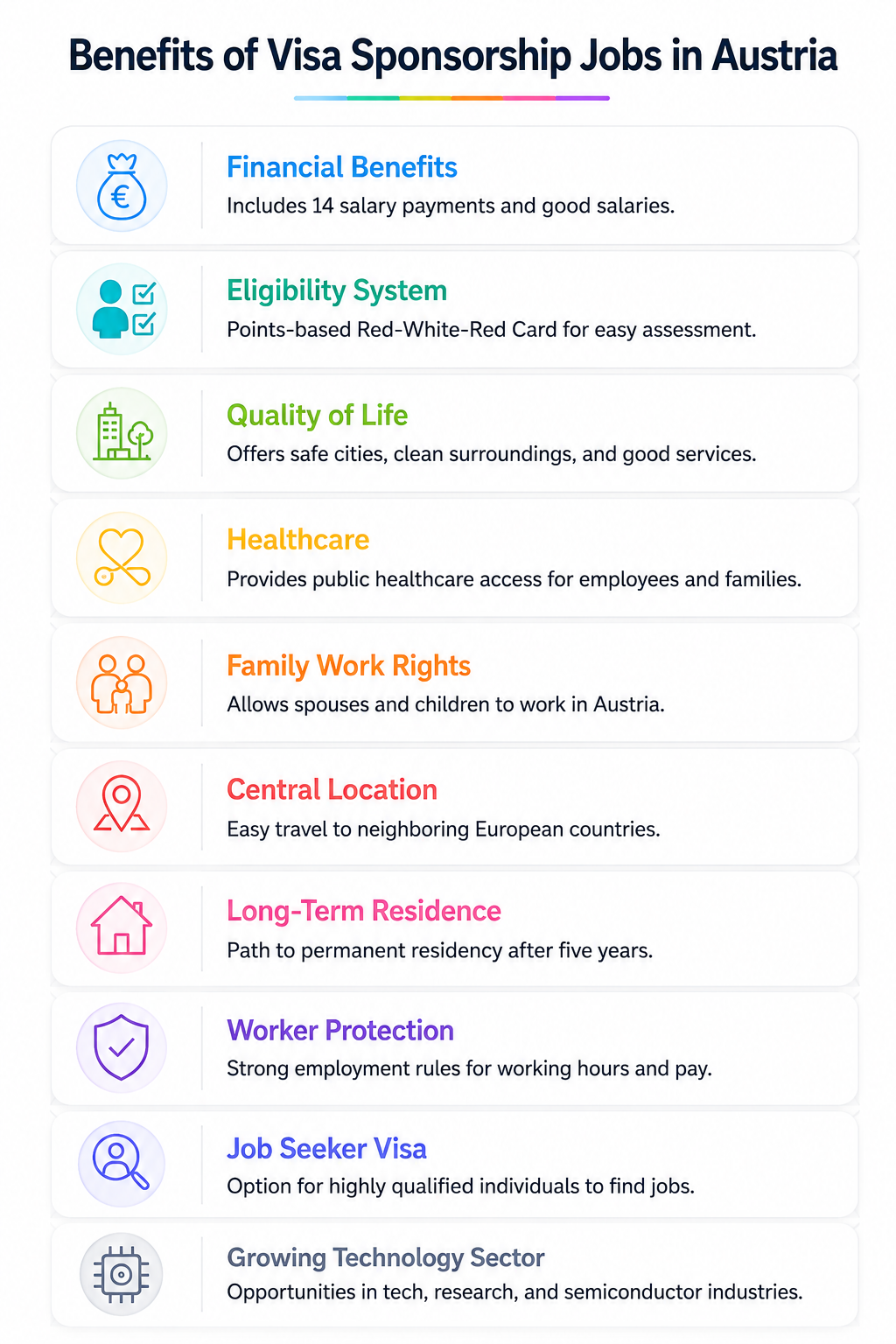
- 14 salary payments a year: Employees usually receive 12 monthly salaries plus extra payments for holiday and Christmas.
- Good salaries: Full-time employees in Austria earn an average gross annual salary of around €51,500. Salaries vary by job, experience and industry.
- Points-based system: The Red-White-Red Card uses a points system based on factors such as education, work experience, language skills and age. This helps applicants check their eligibility.
- Good quality of life: Austria offers safe cities, clean surroundings, good public transport and strong public services.
- Public healthcare: Employees covered by Austrian social insurance can access the country's public healthcare system. Eligible family members can also receive coverage.
- Family work rights: Eligible spouses and children can apply for a Red-White-Red Card Plus, which gives them wider access to the Austrian job market.
- Central location in Europe: Austria is close to countries such as Germany, Italy, Switzerland, Czechia, Slovakia and Hungary, making travel around Europe easier.
- Path to long-term residence: After meeting the required conditions, foreign workers may apply for long-term residence (Daueraufenthalt-EU) after five years of legal residence.
- Strong worker protection: Austrian employment rules provide protections for working hours, pay and leave. Employees generally receive at least 25 working days of paid annual leave.
- Job Seeker Visa option: Highly qualified applicants who meet the required points can enter Austria for up to six months to look for a job.
- Growing technology sector: Cities such as Vienna, Graz, Linz, Villach and Klagenfurt have growing technology, research and semiconductor industries.
What are Sponsored Jobs in Austria?
A visa sponsorship job in Austria is a job where an Austrian employer supports a foreign worker's application for a work and residence permit.
Here is how the process usually works:
- An Austrian employer offers you a job and completes the Employer's Declaration (Arbeitgebererklärung).
- You or your employer submits the Red-White-Red Card application through the Austrian embassy or consulate in India, or the relevant authority in Austria.
- The AMS (Austrian Public Employment Service) checks your points, qualifications, work experience and salary. For some job categories, it may also check whether a suitable worker is already available in Austria.
- If the application meets the requirements, the relevant authority approves and issues the Red-White-Red Card.
- The Red-White-Red Card works as both a work permit and residence permit and is linked to the employer mentioned in the application.
Non-EU workers with the required qualifications, work experience and a genuine job offer can apply. In most cases, you need an Austrian employer and a valid job offer to get a work permit.
*Also, read...
Austria Job Market: Trends and Opportunities
In-Demand Visa Sponsorship Jobs in Austria for Indians
The table below shows occupations Austrian employers actively recruit for, most of which appear on the 2026 nationwide or regional shortage lists. Salaries are gross annual figures across 14 payments.
|
In-Demand Sector |
In-Demand Job Roles |
Average Annual Salary (EUR) |
|
IT & Software |
Software Developer, Data Engineer / AI Specialist, IT Security Specialist, Cloud / DevOps Engineer, Full-Stack Developer, Systems Engineer |
€45,000 – €95,000 |
|
Energy & Electrical |
Electrical / Power Engineering Technician, Electrical Engineer, Energy Technician, Automation Engineer |
€48,000 – €80,000 |
|
Manufacturing & Industry |
Mechanical Engineer, Production Engineer, Industrial Engineer, Manufacturing Technician |
€48,000 – €78,000 |
|
Construction & Infrastructure |
Civil Engineer, Construction Manager, Structural Engineer, Roofer, Site Supervisor |
€32,000 – €72,000 |
|
Electronics & Semiconductors |
Semiconductor / Process Engineer, Electronics Engineer, Microelectronics Engineer, Process Technician |
€55,000 – €85,000 |
|
Healthcare |
Graduate Nurse (DGKP), Physician / General Practitioner, Physiotherapist, Medical Assistant, Healthcare Specialist |
€35,000 – €110,000 |
|
Healthcare & MedTech |
Medical Technology Specialist, Biomedical Engineer, Medical Equipment Technician, Laboratory Technician |
€40,000 – €60,000 |
|
Skilled Trades |
Electrical Installer / Fitter, Plumbing / HVAC Technician, Welder / CNC Machinist, Metalworker, Industrial Mechanic |
€32,000 – €48,000 |
|
Hospitality & Tourism |
Chef / Cook, Hotel Receptionist, Restaurant Manager, Hotel Staff, Tourism Staff |
€28,000 – €45,000 |
|
Education |
Kindergarten Teacher / Early-Childhood Educator, Childcare Worker, Special Education Assistant, Education Specialist |
€33,000 – €45,000 |
|
Finance & Accounting |
Cost Accountant / Controller, Accountant, Financial Analyst, Tax Specialist, Audit Associate |
€50,000 – €80,000 |
*Also, read...
What Are the Most In-Demand Jobs in Austria for the Next 10 Years?
Highest Paying Jobs in Austria
Austria offers some of its highest salaries in banking and finance, senior management, specialist healthcare, semiconductor and automotive engineering, law and aviation. Senior-level jobs may also include performance bonuses along with the basic salary. Below are the highest paying jobs in Austria with their average annual salary.
|
Job Title |
Average Annual Salary (EUR) |
Average Annual Salary (INR) |
|
Managing Director / CEO (large company) |
€180,000 |
₹1.98 crore |
|
Investment Banking / Finance Director |
€150,000 |
₹1.65 crore |
|
Medical Specialist / Surgeon |
€140,000 |
₹1.54 crore |
|
Airline Pilot (Captain) |
€130,000 |
₹1.43 crore |
|
IT Director / CIO |
€130,000 |
₹1.43 crore |
|
Legal Counsel / Senior Lawyer |
€120,000 |
₹1.32 crore |
|
Engineering / Technical Director |
€115,000 |
₹1.27 crore |
|
Sales & Marketing Director |
€110,000 |
₹1.21 crore |
|
Pharmaceutical / Clinical Research Director |
€110,000 |
₹1.21 crore |
|
Semiconductor / Chip Design Lead |
€110,000 |
₹1.21 crore |
|
Data Science / AI Lead |
€100,000 |
₹1.10 crore |
|
HR Director |
€95,000 |
₹1.05 crore |
|
Cybersecurity Manager |
€95,000 |
₹1.05 crore |
|
Finance Manager / Controller |
€85,000 |
₹93.5 lakh |
|
Senior Software Engineer / Solution Architect |
€80,000 |
₹88 lakh |
*Also, read...
Highest Paying Jobs in Austria
Top Companies Offering Jobs in Austria with Sponsorship
|
In-Demand Sector |
Top Companies |
Common Sponsored Roles |
|
Semiconductors & Electronics |
Infineon Technologies Austria |
Chip Design Engineers, Process Engineers, Software Developers, Data Scientists |
|
Technology & Automation |
Siemens Österreich |
Automation Engineers, Electrical Engineers, Software Developers, Project Managers |
|
Automotive & R&D |
AVL List GmbH, Magna Steyr, Bosch Austria |
Simulation Engineers, Vehicle Engineers, Embedded Software Developers, Production Engineers, Quality Engineers |
|
Steel & Industrial Technology |
voestalpine AG |
Metallurgical Engineers, Process Engineers, Data Scientists, Maintenance Technicians |
|
Plant & Machinery |
ANDRITZ AG |
Mechanical Engineers, Process Engineers, Automation Specialists, Project Managers |
|
Oil, Gas & Chemicals |
OMV AG |
Process Engineers, IT Specialists, Data Scientists, Geoscientists |
|
Banking & Fintech |
Erste Group, Erste Digital, Raiffeisen Bank International |
Software Engineers, Data Engineers, AI Specialists, Risk Analysts, Cybersecurity Specialists |
|
Telecom & Digital Technology |
A1 Telekom Austria, Kapsch Group |
Network Engineers, Cloud Engineers, Cybersecurity Analysts, Software Engineers, Systems Engineers |
|
Rail Transport & Infrastructure |
ÖBB Austrian Federal Railways |
Train Drivers, Railway Engineers, Electrical Engineers, IT Specialists |
|
Pharmaceuticals & Biotech |
Boehringer Ingelheim RCV |
Scientists, Clinical Research Associates, QA Specialists, Process Engineers |
|
Chemicals & Polymers |
Borealis AG |
Process Engineers, R&D Chemists, Plant Technicians |
|
FMCG & Media |
Red Bull GmbH |
Data Analysts, Supply Chain Specialists, Digital Specialists, IT Professionals |
|
Gaming Technology |
Novomatic |
Software Developers, Hardware Engineers, QA Engineers |
|
Luxury Goods & Manufacturing |
Swarovski |
Production Engineers, Digital Specialists, Supply Chain Professionals |
|
Healthcare |
Wiener Gesundheitsverbund, Vinzenz Gruppe, tirol kliniken |
Graduate Nurses, Physicians, Medical Technologists, Physiotherapists |
|
IT Services & Consulting |
Accenture, IBM, TCS, Infosys |
Software Developers, SAP Consultants, Cloud Consultants, Project Managers |
Eligibility Requirements for Visa Sponsorship Jobs in Austria
- Indian passport valid for the intended period of stay, preferably with at least 24 months validity.
- A binding job offer from an Austrian employer with a signed Employer's Declaration.
- Skilled Workers in Shortage Occupations and Other Key Workers generally need 55 out of 90 points, while Very Highly Qualified Workers need 70 out of 100 points.
- Relevant vocational training, diploma or university degree matching the job.
- Relevant work experience, with most employers preferring 2–5 years and senior roles often requiring 8+ years.
- Other Key Workers need at least €3,465 gross per month in 2026, while the EU Blue Card requires €55,678 gross per year.
- A labour market test may apply to Other Key Workers and EU Blue Card applicants.
- German or English language skills can help applicants earn points. Accepted certificates include IELTS, TOEFL, Cambridge, Goethe and ÖSD.
- Regulated professions such as doctors, nurses, pharmacists and teachers may require formal qualification recognition.
- Applicants under 30 can receive more age points, while applicants under 40 can also receive age points.
- Health insurance covering the applicant in Austria.
- Proof of suitable accommodation may be required.
- Applicants may need to show sufficient funds to support themselves and their family.
- A recent police clearance certificate may be required.
*Also, read...
What are the fast-track hiring options in Austria for Skilled Professionals?
Documents Required for a Sponsored Work Visa in Austria
- Completed Red-White-Red Card or EU Blue Card application form.
- Original valid passport and copies.
- Recent passport-size photographs meeting Austrian requirements.
- Employer's Declaration confirming the job, salary and working hours.
- Employment contract or binding job offer showing the position, salary, duration and workplace.
- Degree, diploma or vocational qualification certificates.
- Qualification recognition documents for regulated professions, where required.
- Work experience letters or reference letters.
- German or English language certificates, where applicable.
- Recent police clearance certificate.
- Proof of health insurance in Austria.
- Proof of accommodation, such as a rental agreement or employer-provided housing confirmation.
- Proof of funds, such as bank statements, payslips or other financial documents.
- Marriage and birth certificates if eligible family members are applying for the Red-White-Red Card Plus.
- Proof that the required application fees have been paid.
How to Get a Visa Sponsorship Job in Austria?
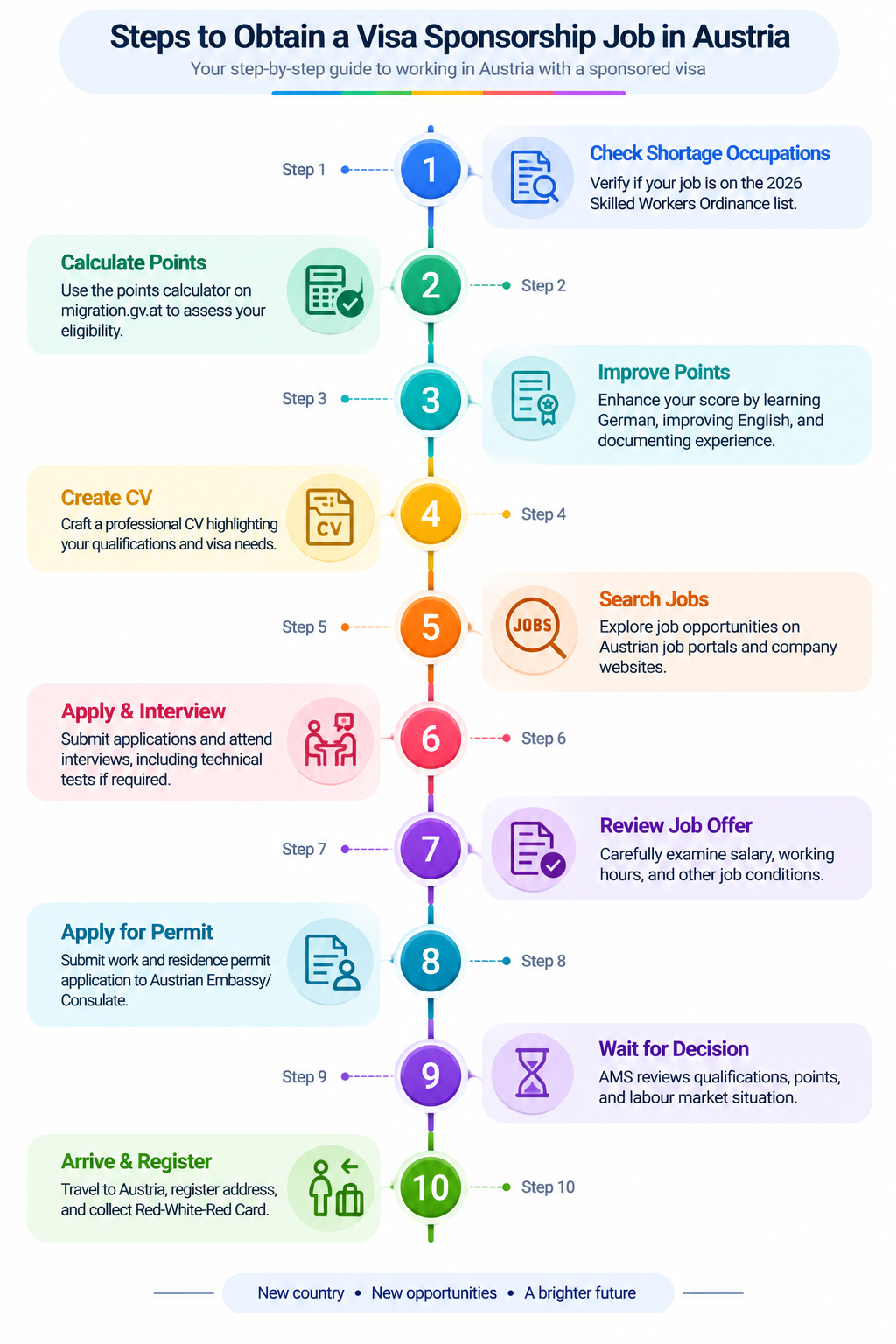
Step 1: Check the 2026 Skilled Workers Ordinance list. It includes 64 nationwide and 66 regional shortage occupations. If your job is on the list, you may not need a labour market test.
Step 2: Use the points calculator on migration.gv.at to check your score based on your education, work experience, language skills and age. You generally need 55 points for the Skilled Worker and Other Key Worker routes and 70 points for Very Highly Qualified Workers.
Step 3: Improve your points by learning German which can help you earn more points. English language skills and properly documented work experience can also increase your score.
Step 4: Create a clear, professional CV, preferably around two pages. Add your education, work experience, skills and achievements. Clearly mention if you need a Red-White-Red Card to work in Austria.
Step 5: Look for jobs through the Austrian Business Agency Talent Hub, AMS eJob-Room, karriere.at, StepStone Austria, willhaben, EURES and company websites. Focus on cities such as Vienna, Graz, Linz, Villach and Salzburg.
Step 6: Apply for suitable jobs and attend online interviews. IT and engineering jobs may include technical tests, while healthcare, skilled trades and customer-facing jobs may require German language skills.
Step 7: Once selected, check your salary, payment terms, working hours, probation period, notice period and other job conditions. The employer must also complete the Employer's Declaration.
Step 8: Apply for the work and residence permit through the Austrian Embassy or Consulate in India, or your employer may submit the application to the relevant authority in Austria.
Step 9: Wait for the decision where the AMS checks your qualifications, points, salary and, where required, the labour market situation. If approved, the relevant authority issues your Red-White-Red Card.
Step 10: After approval, you can travel to Austria if you need an entry visa. After arriving, register your address with the local authorities and collect your Red-White-Red Card.
Work Visa Options for Foreign Workers in Austria
|
Visa / Permit Type |
Purpose |
Validity |
|
Red-White-Red Card – Skilled Workers in Shortage Occupations |
For workers trained in one of the 2026 shortage occupations; no labour market test |
Up to 24 months |
|
Red-White-Red Card – Other Key Workers |
Standard skilled route with a labour market test and a €3,465 monthly salary floor |
Up to 24 months |
|
Red-White-Red Card – Very Highly Qualified Workers |
For top-tier candidates scoring 70+ points; no labour market test |
Up to 24 months |
|
Red-White-Red Card – Graduates of Austrian Universities |
For graduates of Austrian institutions; no points test, no salary floor, no labour market test |
Up to 24 months |
|
Red-White-Red Card – Regular Seasonal Workers |
For repeat seasonal workers with A1 German and a permanent-employment prospect |
Up to 24 months |
|
Red-White-Red Card – Self-Employed Key Workers |
Requires €100,000 investment capital and clear economic benefit |
Up to 24 months |
|
Red-White-Red Card – Start-Up Founders |
Requires €30,000 capital (50%+ equity) and an innovative business |
Up to 24 months |
|
EU Blue Card |
For degree-holders (or 3 years' equivalent ICT experience) earning €55,678+ gross a year |
24 months |
|
Red-White-Red Card Plus |
Free labour market access; for family members and for card holders after 21 months of compliant employment |
1 year, or 3 years once settled 2 years and Integration Agreement module 1 is met |
|
Job Seeker Visa (Visa D) |
Lets Very Highly Qualified candidates with 70+ points enter Austria to look for work; does not permit working |
6 months |
|
Intra-Corporate Transfer (ICT) permit |
For transfers within the same corporate group |
Up to 3 years for managers and specialists |
|
Seasonal Work Permit |
Tourism and agriculture quota places (5,500 tourism, 3,496 agriculture/forestry in 2026) |
Season-limited |
|
Long-Term Residence (Daueraufenthalt-EU) |
Independent status after 5 years of legal residence no employer sponsorship needed |
5 years, renewable |
*Want to Austria work visa? Let Y-Axis assist you with the process.
Cost of an Austria Work Visa
|
Item |
Fee |
Paid By |
|
Red-White-Red Card application |
€120 |
Applicant |
|
Red-White-Red Card granting fee |
€20 |
Applicant |
|
Card personalisation / processing |
€20 |
Applicant |
|
EU Blue Card application |
€156 |
Applicant |
|
EU Blue Card granting + personalisation |
€26 + €20 |
Applicant |
|
Red-White-Red Card Plus (family members) |
€218 |
Applicant |
|
Visa D (entry visa, where required) |
Around €100 |
Applicant |
|
Apostille, court-certified translation and legalisation |
€200 – €600 depending on volume |
Applicant |
|
Qualification recognition |
Varies by profession and institution |
Applicant |
|
Police clearance certificate |
Nominal fee in India |
Applicant |
|
Typical total (Red-White-Red Card) |
€160 in government fees, €400 – €900 including translations and apostille |
Applicant |
Processing time: There is no single guaranteed timeline. The AMS opinion typically takes a few weeks (three weeks is the target for self-employed and start-up assessments), and the residence authority decision follows. In practice, expect roughly 6 to 12 weeks from a complete application, longer if documents need recognition or translation.
*Looking for assistance for overseas immigration? Contact Y-Axis, the world’s #1 overseas career consultancy for job search support and visa assistance.
FAQs
What are visa sponsorship jobs in Austria?
Visa sponsorship jobs in Austria are positions where an Austrian employer supports your application for a Red-White-Red Card or EU Blue Card. The employer signs an Employer's Declaration confirming the job, salary and hours, and the Austrian Public Employment Service (AMS) then assesses your points, qualification and pay. The card serves as both your work permit and your residence permit.
Can Indians get visa sponsorship jobs in Austria?
Yes. An estimated 13,510 Indian nationals live in Austria, along with over 730 Indian students, according to the Indian Embassy in Vienna. Indian professionals are recruited in IT, engineering, semiconductors, healthcare, research and hospitality. You need a genuine job offer, a matching qualification and enough points on the Red-White-Red Card scale.
What is the Red-White-Red Card?
The Red-White-Red Card (Rot-Weiß-Rot-Karte) is Austria's points-based combined work and residence permit for non-EU skilled workers. It has seven categories: Skilled Workers in Shortage Occupations, Other Key Workers, Very Highly Qualified Workers, Graduates of Austrian Universities, Regular Seasonal Workers, Self-Employed Key Workers and Start-Up Founders. It is valid for up to 24 months and is tied to one employer.
How many points do I need for the Red-White-Red Card?
Skilled Workers in Shortage Occupations and Other Key Workers need at least 55 out of 90 points. Very Highly Qualified Workers need at least 70 out of 100 points. Start-up founders need 50 out of 85. Points come from qualification (up to 30), work experience (up to 20), language skills (up to 25) and age (up to 15) on the skilled worker scale.
What is Austria's shortage occupation list for 2026?
The 2026 Skilled Workers Ordinance (Fachkräfteverordnung) lists 64 nationwide and 66 regional shortage occupations. Top entries include agricultural machinery engineers, graduate nurses, power engineering technicians and specialists, train drivers, physicians, cost accountants, roofers, motor vehicle mechanics, plumbing specialists and electrical installers. Kindergarten teachers and railway roles were added for 2026; bakers and retail salespersons were removed.
What is the minimum salary for a work visa in Austria?
For the Other Key Worker category, the 2026 minimum is €3,465 gross per month. For the EU Blue Card, it is €55,678 gross per year. Executives and "super key employees" must earn at least €8,316 gross per month. Shortage-occupation and Austrian-graduate categories have no fixed floor but must meet the applicable collective bargaining agreement.
What is the EU Blue Card in Austria?
The EU Blue Card is for university graduates (or ICT professionals with at least three years of comparable experience gained in the last seven years) with a job offer of at least six months paying €55,678 gross a year or more. It is valid for 24 months. After 21 months of compliant employment you can move to a Red-White-Red Card Plus with unrestricted labour market access.
Do I need to speak German to work in Austria?
There is no compulsory German exam for the card itself, but German earns you significant points and is essential in practice for healthcare, nursing, trades, hospitality, construction and customer-facing work. IT, research, semiconductor and multinational roles often operate in English. Reaching B1 German will roughly double the number of jobs open to you.
Is IELTS required for an Austria work visa?
No, IELTS is not mandatory. However, English certificates from Cambridge, TELC, IELTS, TOEIC or TOEFL earn you points on the Red-White-Red Card scale, and certificates must be less than five years old. Employers may also test your English during interviews.
What is the Austria Job Seeker Visa?
The Job Seeker Visa is a Visa D that lets Very Highly Qualified candidates scoring at least 70 points enter Austria for up to six months to look for work. You cannot work on it. Once you receive a job offer, you apply for the Red-White-Red Card for Very Highly Qualified Workers before starting employment.
How long does an Austria work visa take?
There is no fixed statutory timeline for all categories. The AMS assessment usually takes a few weeks, and the residence authority decision follows. In practice, plan for roughly 6 to 12 weeks from a complete application, plus extra time for apostille, translation and qualification recognition, which can add several months for regulated professions.
How much does an Austria work visa cost?
The Red-White-Red Card costs €120 to apply, €20 on granting and €20 for personalisation, about €160 in government fees. The EU Blue Card costs €156 + €26 + €20. The Red-White-Red Card Plus is €218. Add €200 to €600 for apostille and court-certified translations, plus the Visa D fee of around €100 if you need one.
Can my family come with me to Austria?
Yes. Your spouse or registered partner and unmarried children under 18 can apply for the Red-White-Red Card Plus, which gives them unrestricted access to the Austrian labour market; they are not tied to a specific employer. Family members generally need A1-level German when first applying, unless exempt based on the sponsor's permit type.
Can visa sponsorship in Austria lead to permanent residency?
Yes. After five years of continuous legal residence you can apply for long-term residence (Daueraufenthalt-EU), which lets you live and work in Austria without employer sponsorship. You will need to meet income, accommodation, health insurance and Integration Agreement requirements.
Can I get Austrian citizenship?
Austrian citizenship generally requires 10 years of continuous legal residence, including at least 5 years of permanent residence. You must pass German language and civics tests, show stable income for 36 of the previous 72 months, and have a clean record. Austria normally requires you to give up your Indian citizenship, so most people consider OCI status instead.
Which jobs are easiest to get sponsorship for in Austria?
Occupations on the 2026 nationwide shortage list are the easiest, because no labour market test applies. Engineering (mechanical, electrical, power), nursing, medical technology, IT security, software development, skilled trades such as electrical installation and plumbing, train driving and cost accounting are all strong bets.
Are nursing and healthcare jobs available in Austria?
Yes, graduate nurses (DGKP) and physicians are near the top of the 2026 shortage list. The catch is process: non-EU nurses and doctors must have their qualification formally recognised (Nostrifikation / Berufsanerkennung), register with the relevant professional body, and usually demonstrate German at B2 level. Budget several months for this.
Are IT jobs available in Austria for foreigners?
Yes, and IT is where English-only roles are most common. Software developers, data engineers, IT security specialists, cloud architects, DevOps engineers and database administrators are all in shortage. Vienna, Graz, Linz and the Villach–Klagenfurt semiconductor cluster are the main hubs, with senior salaries reaching €80,000–€120,000.
Can fresh graduates get sponsorship in Austria?
Directly from India it is difficult, because you score few experience points and employers must justify the hire. The far easier route is to study in Austria first. Graduates of Austrian universities, universities of applied sciences and accredited private universities get their own Red-White-Red Card category with no points test, no salary floor and no labour market test.
How can Y-Axis help me get a sponsorship job in Austria?
Y-Axis offers Europe-format resume writing, LinkedIn profile optimisation, job search assistance, and access to employer and vacancy databases for Austria and the EU. Our team also helps you calculate and improve your Red-White-Red Card points score, prepares you for interviews, and supports documentation, apostille, qualification recognition and the visa application end to end.
Tags:
Visa Sponsorship Jobs in Austria 2026
Austria Work Visa Sponsorship for Indians
Austria Work Visa Jobs
Austria Work Visa for Foreign Workers
In-Demand Jobs in Austria with Visa Sponsorship
Austria Employer-Sponsored Jobs
Austria Jobs for Foreign Wor
Share
Options for you by Y-Axis

Get it on your mobile

Get News alerts

Contact Y-Axis
Latest Article
Popular Post
Trending Article
Posted On October 01 2026
The Borderless Indian