

Posted on June 15 2026
Visa Sponsorship Jobs in Germany for Indians

By , Editor & Director
Updated August 20 2026
Visa Sponsorship Jobs in Germany: In-Demand Jobs, Top Employers & How to Apply
Germany is the largest economy in Europe and one of the top destinations for skilled workers from around the world. The country is currently facing a shortage of skilled professionals in many industries. As of 2026, about 163 occupations are listed as shortage occupations, and employers are looking to fill thousands of job vacancies in fields such as healthcare, IT, engineering, skilled trades, and logistics.
To meet the growing demand for workers, Germany has introduced easier immigration policies through the Skilled Immigration Act. Many employers are now hiring international professionals and helping them obtain work visas. Popular pathways include the EU Blue Card, Skilled Worker Visa, and Opportunity Card (Chancenkarte), which make it easier for qualified candidates to work and live in Germany.
For Indian professionals, Germany offers excellent career opportunities. Indians are among the largest groups receiving EU Blue Cards each year. With attractive salaries, strong employee benefits, good work-life balance, and a pathway to permanent residency, visa sponsorship jobs in Germany can help you build a successful international career.
*Planning to Work in Germany? Contact Y-Axis for complete guidance
Why Apply for Jobs in Germany with Visa Sponsorship?
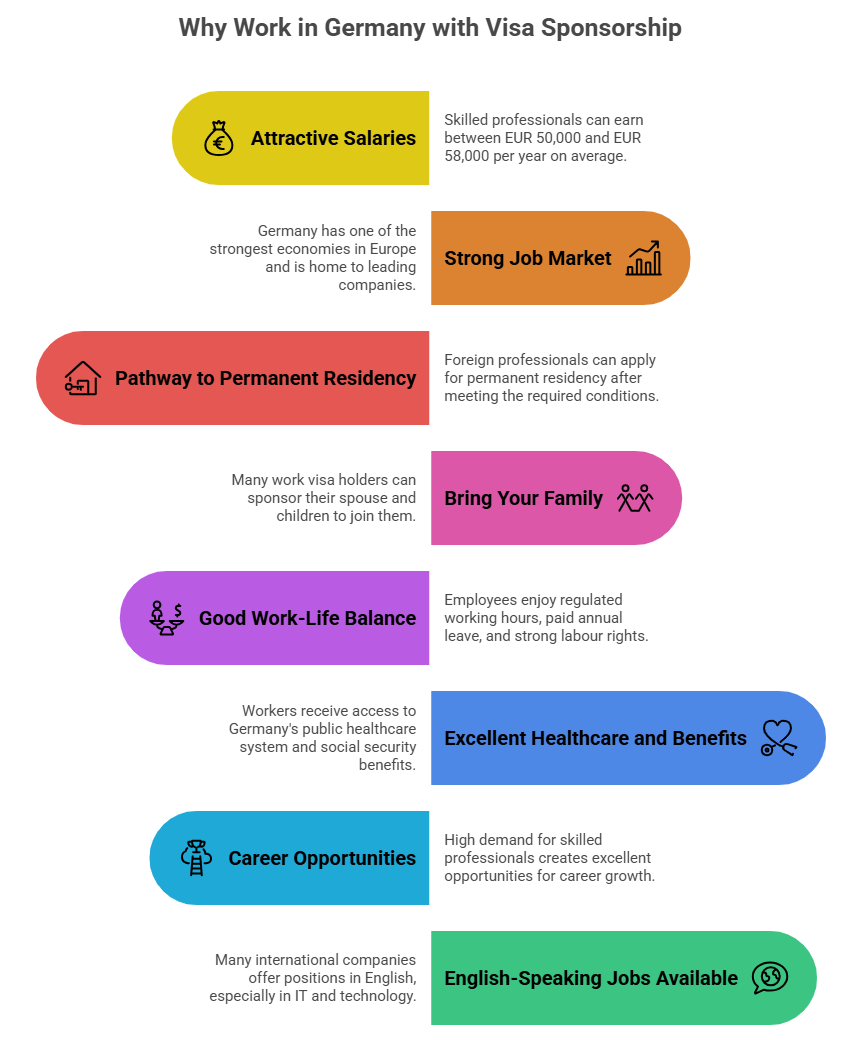
- Attractive salaries: Skilled professionals can earn between EUR 50,000 and EUR 58,000 per year on average, with higher salaries available in IT, healthcare, engineering, and finance.
- Strong job market: Germany has one of the strongest economies in Europe and is home to leading companies such as SAP, Siemens, BMW, and Bosch.
- Pathway to permanent residency: Foreign professionals can apply for permanent residency after meeting the required work and residence conditions.
- Bring your family: Many work visa holders can sponsor their spouse and children to join them in Germany. Spouses may also be allowed to work.
- Good work-life balance: Employees enjoy regulated working hours, paid annual leave, public holidays, and strong labour rights.
- Excellent healthcare and benefits: Workers receive access to Germany's public healthcare system, pension plans, and social security benefits.
- Career opportunities: High demand for skilled professionals creates excellent opportunities for career growth and professional development.
- English-speaking jobs available: Many international companies offer positions in English, especially in IT, engineering, and technology sectors.
*Want to apply for Jobs in Germany? Avail Y-Axis resume marketing service for complete assistance
What are Visa Sponsorship Jobs in Germany?
Visa sponsorship jobs in Germany are jobs where a German employer hires a foreign worker and supports their work visa application. The employer provides a job offer or employment contract, which is required when applying for a German work visa, such as the EU Blue Card or Skilled Worker Visa. Unlike some countries, German employers do not need a special sponsorship licence to hire international workers. Once you receive a valid job offer, you can apply for the appropriate work visa and move to Germany for employment.
Many employers also help foreign workers with the visa process, required documents, and relocation support. Some companies may use Germany's fast-track skilled worker procedure to speed up the approval process. Professionals with a recognized university degree, vocational qualification, or relevant work experience can apply for visa sponsorship jobs if they meet the job and visa requirements. This makes Germany an attractive destination for Indian professionals, skilled workers, and recent graduates looking to build an international career.
In-Demand Visa Sponsorship Jobs in Germany for Indians
Germany is experiencing a growing shortage of skilled workers across several industries, creating excellent opportunities for international professionals. Employers are actively recruiting qualified candidates from overseas and offering visa sponsorship support to fill critical positions. The highest demand is in sectors such as information technology, healthcare, engineering, logistics, construction, education, and hospitality.
Professionals with the right qualifications, skills, and work experience can benefit from competitive salaries, long-term career growth, and pathways to permanent residency. The table below highlights some of the most in-demand visa sponsorship jobs in Germany and their average annual salary ranges.
| Sector | In-Demand Job Roles | Average Annual Salary (INR) |
|---|---|---|
| Healthcare | Medical Specialist, Surgeon, Doctor, Physician, Registered Nurse, Elderly Care Worker, Physiotherapist, Radiographer | INR 36.3 lakh – 1.32 crore |
| Information Technology (IT) | IT Manager, Software Architect, Software Developer, Data Scientist, Cybersecurity Specialist, AI/Machine Learning Engineer, Cloud Engineer, DevOps Engineer, Full-Stack Developer | INR 71.5 lakh – 1.05 crore |
| Engineering | Engineering Manager, Mechanical Engineer, Electrical Engineer, Industrial Engineer, Mechatronics Engineer, Process Engineer, Automation Engineer | INR 60.5 lakh – 1.01 crore |
| Construction & Infrastructure | Civil Engineer, Construction Manager, Site Engineer, Surveyor, Building Services Engineer, Project Engineer | INR 57.2 lakh – 82.5 lakh |
| Finance & Accounting | Financial Manager, Financial Analyst, Accountant, Auditor, Tax Consultant, Risk Analyst | INR 55.0 lakh – 93.5 lakh |
| Consulting & Business Services | Management Consultant, Business Analyst, Strategy Consultant, Operations Consultant, Project Manager | INR 60.0 lakh – 90.2 lakh |
| Legal | Legal Counsel, Lawyer, Compliance Officer, Contract Manager, Legal Advisor | INR 66.0 lakh – 88.0 lakh |
| Sales & Marketing | Sales Manager, Business Development Manager, Digital Marketing Manager, Account Manager, Marketing Specialist | INR 49.5 lakh – 85.8 lakh |
| Logistics & Supply Chain | Warehouse Specialist, Logistics Specialist, Supply Chain Manager, Procurement Specialist, Truck Driver, Transport Coordinator | INR 35.2 lakh – 77.0 lakh |
| Manufacturing & Production | Production Manager, Quality Engineer, CNC Operator, Production Technician, Manufacturing Engineer | INR 44.0 lakh – 82.5 lakh |
| Education & Research | STEM Teacher, University Lecturer, Research Associate, Academic Coordinator, Training Specialist | INR 49.5 lakh – 71.5 lakh |
| Hospitality & Tourism | Chef, Cook, Hotel Manager, Restaurant Manager, Hospitality Supervisor, Catering Manager | INR 33.0 lakh – 60.5 lakh |
| Aviation | Pilot, Aircraft Maintenance Engineer, Aviation Operations Manager, Flight Instructor | INR 66.0 lakh – 1.10 crore |
*Read more...
High-paying Jobs in Germany for Indians
Top Companies Offering Jobs in Germany with Sponsorship
Germany is home to many globally recognized companies that actively recruit skilled international professionals. Due to ongoing talent shortages in sectors such as IT, engineering, healthcare, finance, logistics, and manufacturing, many German employers are willing to sponsor work visas for qualified foreign candidates.
Large multinational companies often provide additional support, including relocation assistance, onboarding programs, language training, and help with work permit applications. These organizations regularly hire international talent through pathways such as the EU Blue Card and Skilled Worker Visa, making Germany an attractive destination for professionals seeking global career opportunities. The table below highlights some of the leading companies in Germany that commonly offer visa sponsorship opportunities and the roles they frequently recruit for:
| Company Name | Industry | Common Sponsored Roles |
|---|---|---|
| SAP | Software / IT | Software developers, cloud engineers, data scientists |
| Siemens | Engineering / Technology | Engineers, automation specialists, IT professionals |
| Bosch | Automotive / Engineering | Embedded engineers, AI specialists, manufacturing engineers |
| BMW Group | Automotive | Automotive engineers, IT specialists, designers |
| Volkswagen Group | Automotive | Software engineers, e-mobility specialists, production engineers |
| Mercedes-Benz Group | Automotive | Software developers, mechanical engineers, data analysts |
| Deutsche Bank | Banking / Finance | Technology analysts, risk specialists, finance professionals |
| Allianz | Insurance / Finance | Actuaries, data scientists, IT specialists |
| Deutsche Telekom | Telecommunications | Network engineers, cybersecurity experts, developers |
| DHL Group | Logistics | Logistics specialists, supply chain analysts, IT roles |
| Bayer | Pharmaceuticals | Researchers, data scientists, regulatory specialists |
| Airbus | Aerospace | Aerospace engineers, software engineers, technicians |
| Infineon Technologies | Semiconductors | Chip design engineers, hardware developers |
| Zalando | E-commerce | Software engineers, product managers, data engineers |
| Delivery Hero | Technology / Food-tech | Backend developers, data scientists, mobile engineers |
*Read aboout: Germany Job Outlook
Eligibility Requirements for Visa Sponsorship Jobs in Germany
To qualify for a visa sponsorship job in Germany, applicants must meet specific educational, professional, and immigration requirements. These requirements may vary depending on the occupation and visa type, but most foreign workers must satisfy the following criteria:
- Hold a valid passport that remains valid throughout the intended stay in Germany.
- Secure a confirmed job offer or signed employment contract from a German employer.
- Possess a recognized university degree or vocational qualification. In some cases, foreign qualifications may need to be officially recognized in Germany.
- Have relevant professional work experience, particularly for skilled occupations. Certain visa pathways may require several years of industry experience.
- Meet any language requirements applicable to the profession. While many IT and international business roles are available in English, healthcare, education, and regulated professions often require German language proficiency.
- Obtain valid health insurance coverage before starting employment in Germany.
- Maintain a clean criminal record and provide a police clearance certificate if requested by the authorities.
- Fulfil all visa application requirements, including submitting the necessary forms, photographs, fees, and supporting documents.
Documents Required for a Sponsored Work Visa in Germany
After receiving a job offer from a German employer, applicants must prepare a complete set of documents for their work visa application. Providing accurate and complete documentation can help speed up the processing of the visa.
The commonly required documents include:
- A valid passport.
- A job offer letter or signed employment contract from a German employer.
- Employer-related documents supporting the employment application, where applicable.
- Educational certificates, degrees, diplomas, or vocational training certificates.
- Qualification recognition documents if the profession requires official recognition in Germany.
- Work experience certificates and reference letters from previous employers.
- An updated CV or resume outlining educational and professional achievements.
- Proof of valid health insurance coverage.
- A police clearance certificate, if requested.
- Language proficiency certificates for German or English, where required.
- A completed work visa application form.
- Recent passport-sized photographs that meet German visa specifications.
Before submitting the application, candidates should ensure that all documents are translated into German or English, where necessary, and that any qualification recognition requirements have been completed. Proper preparation can improve the chances of obtaining a German work visa successfully.
How to Get a Visa Sponsorship Job in Germany from India?
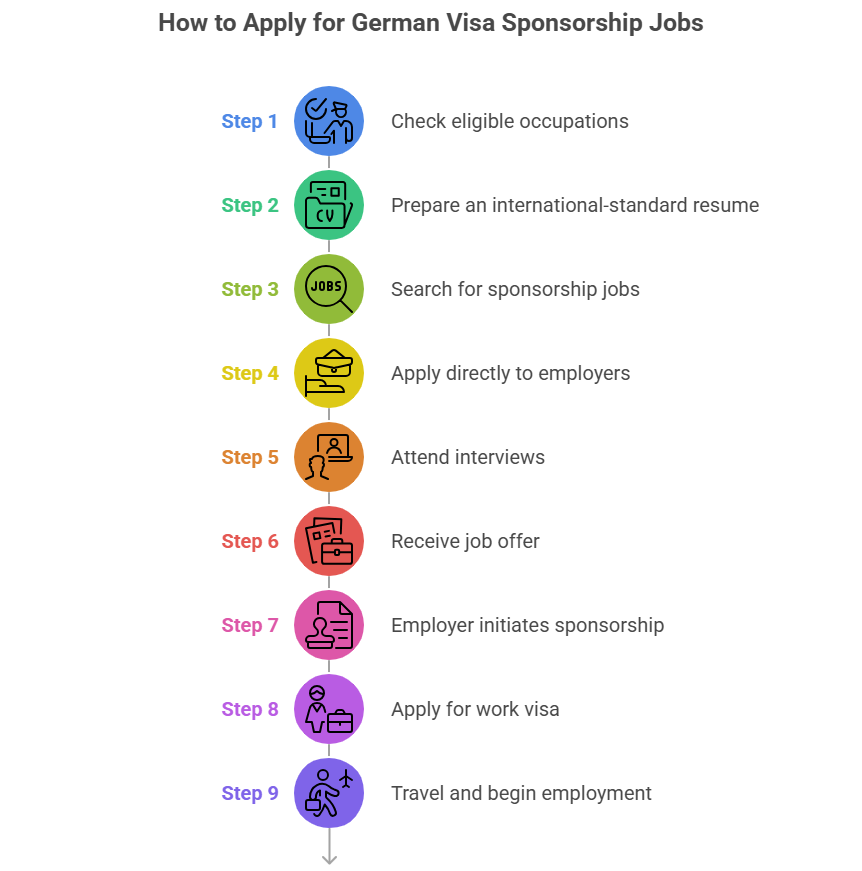
Step 1: Check eligible occupations
Review Germany's shortage occupation list and confirm your profession is in demand. Check whether your qualification needs formal recognition.
Step 2: Prepare an international-standard resumeb
Create a German-style CV (Lebenslauf) concise, reverse-chronological, with a professional photo (optional) and no spelling errors.
Step 3: Search for sponsorship jobs
Use portals like Make it in Germany, LinkedIn, StepStone, Indeed Germany, and company career pages. Filter for English-speaking or visa-support roles.
Step 4: Apply directly to employers
Apply with a tailored CV and cover letter. Mention your visa situation clearly and highlight your willingness to relocate.
Step 5: Attend interviews
Most interviews with international candidates are held online. Prepare for technical rounds and questions about relocation.
Step 6: Receive job offer
Once selected, you receive an employment contract or binding job offer stating your role and salary.
Step 7: Employer initiates sponsorship
Your employer completes the Declaration of Employment and may opt for the fast-track skilled worker procedure to cut approval time to a few weeks.
Step 8: Apply for work visa
Book an appointment at the German Embassy/Consulate in India, submit documents, biometrics, and the EUR 75 fee. Processing usually takes a few weeks to 3 months.
Step 9: Travel and begin employment
After visa approval, travel to Germany, register your address (Anmeldung), and convert your visa into a residence permit at the local foreigners' office.
*Also, read...
3 Million Jobs in Germany Over the Next Decade: Job Outlook and Work Visa Options
German Shortage Occupation List (Engpassberufe)
Germany maintains an official shortage occupation list, known as the Engpassberufe (bottleneck occupations) list. This list is regularly updated by the Federal Employment Agency (Bundesagentur für Arbeit) based on labour market needs and workforce shortages across the country. As of 2026, around 163 occupations are classified as shortage occupations due to a lack of qualified workers.
For foreign professionals, being employed in a shortage occupation can significantly improve the chances of securing a visa sponsorship job in Germany. Employers in these sectors actively recruit international talent to fill vacant positions and support work visa applications.
Benefits of Working in a Shortage Occupation
- Lower EU Blue Card salary requirement: Professionals in shortage occupations can qualify for the EU Blue Card with a lower minimum salary threshold than other occupations.
- Faster hiring and visa processing: Employers can often recruit international candidates more quickly due to labour shortages.
- Higher demand for skilled workers: Job opportunities are more abundant, increasing the chances of receiving interview calls and job offers.
- Competitive salary packages: Many employers offer attractive salaries, relocation assistance, and additional benefits to attract qualified talent.
- Better long-term career prospects: Shortage occupations generally provide strong job security and opportunities for career growth.
Key Occupations on the German Shortage List
| Category | Shortage Occupations |
|---|---|
| Healthcare | Registered nurses, elderly care workers, doctors, physiotherapists, midwives, pharmacists |
| IT & Communications | Software developers, IT consultants, cybersecurity specialists, data scientists, network engineers |
| Engineering | Mechanical, electrical, civil, automotive, and energy engineers |
| Skilled Trades | Electricians, plumbers, HVAC technicians, welders, mechatronics technicians |
| Construction | Site supervisors, construction workers, civil engineering technicians |
| Transport & Logistics | Truck drivers, bus drivers, train drivers, logistics specialists |
| Education | School teachers (especially STEM), early-childhood educators |
| Science | Mathematicians, natural scientists, laboratory technicians |
| Hospitality | Chefs and cooks |
What are the most in-demand jobs in Germany for the next 10 years?
Work Visa Options for Foreign Workers in Germany
| Visa Type | Purpose | Validity |
|---|---|---|
| EU Blue Card | For university graduates with a job offer meeting the salary threshold (EUR 50,700 / EUR 45,934 for shortage roles in 2026). | Up to 4 years; PR possible in 21–27 months. |
| Skilled Worker Visa (Section 18a/18b) | For workers with a recognised degree or vocational qualification and a job offer (no high salary threshold). | Up to 4 years; PR possible after 5 years. |
| Opportunity Card (Chancenkarte) | Points-based job-seeker visa; allows you to move to Germany to find work, with part-time work (20 hrs/week) allowed. Requires ~EUR 1,091/month in funds. | 1 year (extendable up to 2 more years once employed). |
| IT Specialist Visa | For experienced IT professionals without a degree (3+ years of experience, lower Blue Card salary threshold). | Up to 4 years. |
| EU ICT Card | For intra-company transfers of managers and specialists from a company branch outside the EU. | Up to 3 years. |
| Research Visa (Section 18d) | For researchers with a hosting agreement from a German institution. | Duration of the research project. |
| Vocational Training Visa | For pursuing recognised vocational training (Ausbildung) in Germany. | Duration of training. |
*Willing to know more about Germany visas? Talk to Y-Axis for complete guidance.
Build a Successful Future in Germany with Visa Sponsorship Jobs
Germany is one of the leading destinations for skilled professionals seeking international career opportunities, competitive salaries, and long-term career growth. As Europe's largest economy, Germany faces a significant shortage of skilled workers across industries such as healthcare, information technology, engineering, manufacturing, logistics, construction, education, and skilled trades. Visa sponsorship jobs provide an excellent pathway for qualified foreign professionals to live and work in Germany.
By securing a job offer from a German employer, skilled workers can apply for work permits such as the EU Blue Card or the Skilled Worker Visa, gain valuable international work experience, and become eligible for permanent residency. Germany's skilled immigration policies have made it easier for international professionals to enter the labour market and build successful careers in the country.
Understanding the visa sponsorship process, qualification recognition requirements, shortage occupations, and work visa eligibility criteria can significantly improve your chances of finding employment and relocating successfully. Many German employers actively recruit international talent and offer support with visa applications, relocation, and onboarding.
With strong worker protections, excellent healthcare, attractive salaries, a high standard of living, and a clear pathway to permanent residency, Germany offers outstanding opportunities for skilled professionals and their families. Visa sponsorship jobs can be the first step toward building a successful future in one of Europe's most stable and prosperous countries.
*Are you looking for step-by-step assistance with German immigration? Contact Y-Axis, the world's No. 1 overseas immigration consultancy, for end-to-end guidance on Germany work visas, EU Blue Cards, job search support, and permanent residency pathways.
FAQs
What are visa sponsorship jobs in Germany?
Visa sponsorship jobs in Germany are positions where a German employer hires a foreign worker and supports their work visa process. The employer provides a job offer or contract and the required employer declaration, which the candidate uses to apply for visas like the EU Blue Card or Skilled Worker Visa. Many employers also help with relocation, paperwork, and fast-track visa procedures.
Can Indians get visa sponsorship jobs in Germany?
Yes. Indians are among the largest groups of skilled migrants in Germany and hold a major share of EU Blue Cards. Indian IT professionals, engineers, doctors, and nurses are in high demand. With a recognised degree, relevant experience, and a job offer meeting the salary requirements, Indian professionals can easily qualify for a German work visa with employer support.
Which companies in Germany sponsor foreign workers?
Top employers known to hire international talent include SAP, Siemens, Bosch, BMW, Volkswagen, Mercedes-Benz, Deutsche Bank, Allianz, Deutsche Telekom, DHL, Bayer, Airbus, Infineon, Zalando, and Delivery Hero. These companies recruit globally for IT, engineering, finance, and research roles, and many offer relocation packages and English-speaking work environments for foreign professionals.
Which jobs are easiest to get with visa sponsorship in Germany?
Jobs on Germany's shortage occupation list are easiest, as employers struggle to find local candidates. These include software developers, nurses, elderly care workers, electricians, mechatronics technicians, truck drivers, chefs, and engineers. Shortage occupations also enjoy a lower EU Blue Card salary threshold (EUR 45,934 in 2026) and often skip the labour market priority check, speeding up approval.
What are the highest-paying visa sponsorship jobs in Germany?
Medical specialists and surgeons earn around EUR 120,000 per year, followed by pilots, IT managers, engineering managers, and software architects earning EUR 90,000–100,000. AI engineers, data scientists, financial managers, and consultants also earn well above the national average of EUR 50,000–58,000. Salaries are highest in Munich, Frankfurt, Stuttgart, and Hamburg.
What qualifications are required for visa sponsorship jobs in Germany?
You need a university degree or a vocational qualification of at least two years that is recognised in Germany. Degrees are checked against the ANABIN database, and some need a ZAB statement of comparability. IT specialists without a degree can qualify with three or more years of proven professional experience under Germany's relaxed Skilled Immigration Act rules.
Do I need work experience to get a sponsored job in Germany?
Work experience is not legally mandatory for most visas if you hold a recognised qualification, but employers strongly prefer experienced candidates. The IT specialist route specifically requires at least three years of relevant experience instead of a degree. Two to five years of experience greatly improves your chances of getting interview calls and higher salary offers.
Is IELTS required for Germany work visas?
No, IELTS is not mandatory for German work visas like the EU Blue Card or Skilled Worker Visa. However, employers may ask for proof of English ability, and the Opportunity Card awards points for English (B2/C1) or German skills. German language certificates (A2–B2) are required for regulated professions like nursing and medicine, and they improve overall job prospects.
How long does German work visa processing take?
Standard work visa processing at German missions in India usually takes a few weeks to three months after your appointment. If your employer uses the fast-track skilled worker procedure (beschleunigtes Fachkräfteverfahren), approvals can come in as little as four to eight weeks. Booking embassy appointments early and submitting complete documents helps avoid delays.
Can my family accompany me to Germany on a work visa?
Yes. Spouses and minor children can join you through family reunification visas. Spouses of EU Blue Card holders receive unrestricted work rights in Germany and usually do not need to prove German language skills before arrival. Children can attend German schools free of cost, and the family enjoys full healthcare and social security benefits.
Can visa sponsorship lead to permanent residency in Germany?
Yes. EU Blue Card holders can apply for permanent residence after just 21 months with B1-level German, or 27 months without. Other skilled workers qualify after about five years (often reduced to three or four years with good German skills). Permanent residency can later lead to German citizenship, which now allows dual citizenship.
What industries hire the most foreign workers in Germany?
IT and software, healthcare, engineering, construction, manufacturing, logistics, hospitality, and education hire the most foreign workers. Germany has over 130,000 open IT roles and severe shortages of nurses, care workers, engineers, and skilled tradespeople. E-commerce growth has also boosted demand for drivers, warehouse staff, and supply chain professionals across the country.
How can I find visa sponsorship jobs in Germany from India?
Search on the official Make it in Germany portal, LinkedIn, StepStone, Indeed Germany, and XING, and apply directly on company career pages. Filter for English-speaking roles and mention your visa status clearly. Networking, referrals, and professional job search support like Y-Axis Job Search Services can significantly increase your chances of landing interviews.
Are healthcare jobs in demand in Germany?
Yes, healthcare is one of Germany's most critical shortage sectors. Hospitals and care homes urgently need registered nurses, elderly care workers, doctors, and physiotherapists. Foreign nurses need B2-level German and recognition of their qualifications, and many employers fund language training and relocation. Indian nurses are increasingly recruited through government-supported programmes.
Are IT jobs available in Germany with visa sponsorship?
Yes, IT is the strongest sector for sponsorship. Germany recorded over 130,000 unfilled IT positions, and roles like software developer, data scientist, cybersecurity expert, DevOps engineer, and AI specialist are in huge demand. Many IT jobs are English-speaking, and experienced IT professionals can even get an EU Blue Card without a university degree.
Can fresh graduates apply for visa sponsorship jobs in Germany?
Yes. Recent graduates qualify for the EU Blue Card at the lower salary threshold of EUR 45,934 (2026) if they earned their degree within the last three years. Freshers can also use the Opportunity Card to move to Germany, work part-time, and search for a full-time job for up to one year, extendable after finding employment.
What is the average salary in Germany?
The average gross salary in Germany is around EUR 50,000–58,000 per year (approximately INR 55–64 lakh at 1 EUR ≈ INR 110; rates may vary). IT specialists, doctors, engineers, and finance professionals earn the most, with senior roles crossing EUR 90,000. Salaries are higher in southern cities like Munich and Stuttgart than in eastern regions.
What documents are required for a German sponsored work visa?
You need a valid passport, employment contract or job offer letter, the employer's Declaration of Employment, recognised educational certificates, work experience letters, an updated CV, proof of health insurance, biometric photos, and the visa fee. A police clearance certificate and language test results may also be requested depending on your profession and visa type.
Can I change employers in Germany on a sponsored visa?
Yes, but with conditions. EU Blue Card holders must inform the foreigners' authority if they change jobs within the first 12 months; afterwards, they can switch freely as long as the new job meets Blue Card conditions. Skilled Worker Visa holders may need approval for a new role. Permanent residents can work for any employer without restriction.
📞 Call: +91-7670800000
📩 Email: info@y-axis.com
🌐 Visit: https://www.y-axis.com
Tags:
Visa sponsorship jobs in Germany 2026
Germany work visa sponsorship for Indians
Germany EU Blue Card jobs
Germany Skilled Worker Visa jobs
In-demand jobs in Germany with visa sponsorship
Germany shortage occupation list
Share
Options for you by Y-Axis

Get it on your mobile

Get News alerts

Contact Y-Axis
Latest Article
Popular Post
Trending Article

Posted On September 10 2026
How to Apply for a Greece Work Visa From India