

Posted on November 20 2026
US Court strikes down four-year student visa rule: What Indian students and researchers must know

By , Editor & Director
Updated November 20 2026
~ Dr. Serah Vinodini Vilvaraj
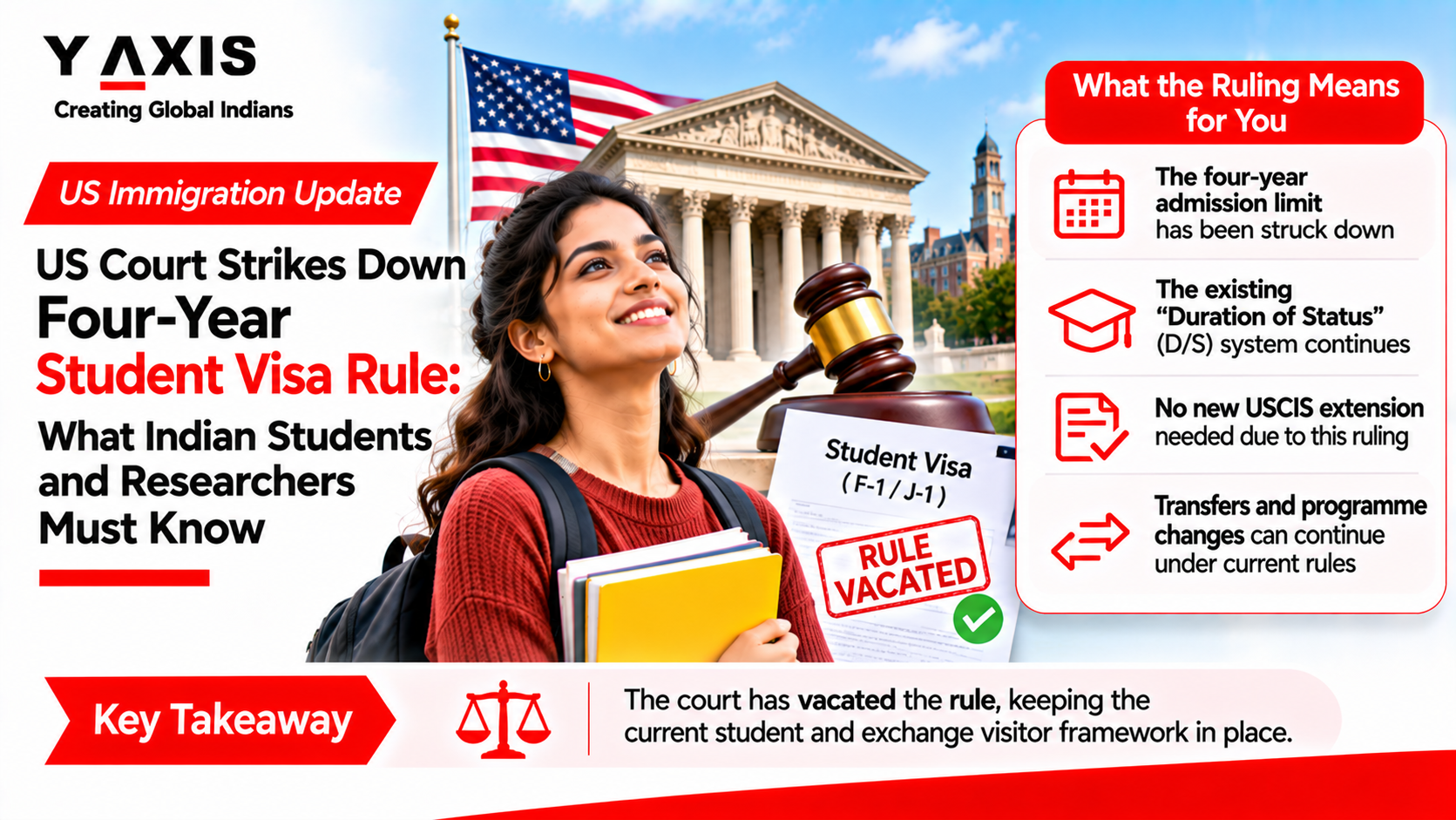
A US federal court has overturned a rule that would have imposed fixed admission periods on international students and exchange visitors. The November 16 decision preserves the existing Duration of Status system, allowing eligible students and researchers to continue following established immigration procedures.
Why has a US Court overturned the four-year student visa rule?
International students and researchers in the United States have received an important clarification about their immigration status. On November 16, 2026, Judge F. Dennis Saylor IV of the US District Court for the District of Massachusetts struck down a Department of Homeland Security (DHS) rule that would have replaced the longstanding Duration of Status system with fixed admission periods. The court found the regulation unlawful under the Administrative Procedure Act and vacated it in its entirety.
The decision follows an earlier September 14 order that temporarily prevented the rule from taking effect. Unlike that temporary order, the November judgment sets aside the final rule itself. For Indian students pursuing undergraduate degrees, postgraduate education, doctoral research or exchange programmes, the ruling provides greater clarity about the immigration framework governing their stay.
What Was the Four-Year Student Visa Rule?
The DHS final rule, published on July 17, 2026, sought to change how certain international students and exchange visitors are admitted to the United States. Under the proposed framework, affected individuals would generally have received a fixed admission period of up to four years rather than admission for Duration of Status. Those requiring additional time could have needed to submit formal extension-of-stay applications to US Citizenship and Immigration Services (USCIS).
The rule also included restrictions affecting academic transfers, changes in educational level and certain additional degree programmes. These provisions raised concerns about students whose academic programmes extend beyond standard timelines. Doctoral research, for example, may require additional time because of laboratory work, field research or dissertation requirements. However, the rule never became operative because of the September court intervention.
What Does Duration of Status Mean?
Duration of Status, commonly abbreviated as D/S, allows eligible F-1 students and J-1 exchange visitors to remain in the United States while maintaining the requirements of their immigration status. Rather than relying solely on a fixed admission end date, lawful stay is connected to compliance with the applicable programme and immigration conditions. For F-1 students, these conditions generally include maintaining the required course of study and keeping immigration records accurate. Students must also follow the relevant rules when extending programmes, changing institutions or undertaking employment. An electronic Form I-94 may show “D/S” instead of a specific admission expiration date. Importantly, Duration of Status does not provide unlimited permission to remain in the United States. Students must continue meeting the conditions attached to their status.
What Did the Federal Court Decide?
The November 16 judgment granted summary judgment in favour of the organisations challenging the rule. The court concluded that the regulation was arbitrary and capricious and otherwise inconsistent with applicable administrative law. It therefore vacated the final rule completely. The decision means the planned fixed admission periods, associated extension requirements and academic mobility restrictions cannot currently be implemented under that regulation. The existing Duration of Status framework remains in effect nationwide. The judgment also represents a significant development in litigation that began before the rule's scheduled September implementation.
Do Indian Students Need to Apply for a New Visa Extension?
No new USCIS extension application is required solely because of the overturned rule. The University of Southern California confirmed on November 18 that existing programme-extension procedures remain applicable. Students whose academic programmes require additional time should continue working with their designated school officials or international student advisers. Where necessary, their Form I-20 and SEVIS records must be updated through the established process. Students should not confuse an extension of their academic programme with renewal of a visa stamp used for international travel. These are separate immigration matters.
Can Students Still Change Universities or Degree Programmes?
Yes, subject to existing immigration requirements. The overturned rule included additional restrictions affecting transfers between institutions, changes in academic level and certain subsequent degree programmes. Because the court vacated the regulation, those new restrictions will not take effect under that rule. Eligible students may continue using established procedures for school transfers and programme changes.
However, academic transfers are not automatically permitted without documentation. Students must coordinate with the relevant institutions and comply with SEVIS and immigration requirements.
What Does the Ruling Mean for Doctoral Researchers?
Doctoral programmes often involve research schedules that cannot be predicted precisely when a student first enrols. Under a fixed admission framework, students whose research extended beyond the authorised period could have faced additional immigration filing requirements. The court's decision preserves the existing approach, under which eligible researchers may continue their programmes while maintaining valid status and completing required programme extensions. This is particularly relevant to international researchers working on long-term academic projects. Nevertheless, the ruling does not remove existing requirements relating to programme documentation, employment authorisation or institutional sponsorship.
Are OPT and Other Employment Rules Changing?
The ruling does not independently create new employment rights.
F-1 students seeking Optional Practical Training (OPT), STEM OPT extensions or other employment authorisation must continue following the applicable rules. Students should verify their eligibility, application deadlines and employment conditions before accepting work.
Similarly, J-1 exchange visitors must continue observing the requirements of their exchange programmes and any applicable employment authorisation arrangements. The court's decision concerns the Duration of Status final rule, not every aspect of student employment policy.
Could the US Government Appeal the Decision?
Yes.
The federal government may seek appellate review or other judicial relief. However, filing an appeal would not automatically reinstate the overturned rule. A further court order, such as a stay or reversal, would be required to change its present legal effect. Students should therefore rely on current immigration requirements while monitoring official updates.
What Should Indian Students Do Now?
Students and researchers should continue complying with their existing immigration obligations. They should maintain accurate SEVIS records, monitor programme completion dates and obtain appropriate authorisation before undertaking employment. Those planning university transfers or programme extensions should contact their designated school officials. Students considering international travel should separately check passport validity, visa documentation and re-entry requirements. No special application is required merely because the court issued its November 16 judgment.
The ruling offers greater clarity for academic planning, but students must continue meeting all existing immigration and employment requirements.
Official and Institutional Sources
- US District Court Judgment — November 16, 2026
- University of Southern California — Duration of Status Final Rule Vacated
- Stanford University — Federal Court Vacates Duration of Status Rule
- Dartmouth College — Federal Immigration Law and Policy Changes
Frequently Asked Questions
Has the US cancelled the four-year student visa rule?
Yes. A federal district court vacated the DHS final rule on November 16, 2026. Further litigation remains possible.
Can F-1 students remain in the US for longer than four years?
Eligible students may remain under Duration of Status while maintaining their immigration status and complying with applicable programme requirements.
Do Indian students need to apply for an extension through USCIS?
Not solely because of the overturned rule. Existing programme-extension procedures continue to apply.
Does the ruling affect J-1 exchange visitors?
Yes. The overturned regulation also concerned J-1 exchange visitors and related categories.
Does the decision guarantee a US student visa?
No. Admission, visa issuance and maintenance of lawful status remain subject to existing requirements.
What Happens Next?
The November 16 judgment preserves the longstanding immigration framework for international students and exchange visitors. Universities are continuing to monitor the possibility of further legal proceedings. For Indian students and researchers, the immediate message is clear: the proposed fixed admission system has been struck down, and established Duration of Status procedures remain applicable.
Tags:
US Immigration
US Student Visa
F-1 Visa
J-1 Visa
Duration of Status
Indian Students
Study in USA
Immigration Court Ruling
Student Visa Rules
US Visa Updates
Share
Options for you by Y-Axis

Get it on your mobile

Get News alerts

Contact Y-Axis
Latest Article
Popular Post
Trending Article
Posted On November 20 2026
US Court strikes down four-year student visa rule: What Indian students and researchers must know