

Posted on December 26 2025
Top 10 Countries for Teaching Professionals to Work Abroad: Salary, Demand & PR Opportunities Compared

By , Editor
Updated December 29 2025
Teaching professionals are in high demand globally due to teacher shortages, expanding education systems, and the growing number of international and bilingual schools. Working abroad offers better salaries, improved work-life balance, international experience, and long-term settlement options, especially for Indian teachers.
Countries across the world are hiring qualified teachers from overseas to meet demand in schools, colleges, universities, and international institutions. Choosing the right country is an important decision, as each country differs in salary levels, requirements, language needs, and career growth opportunities.
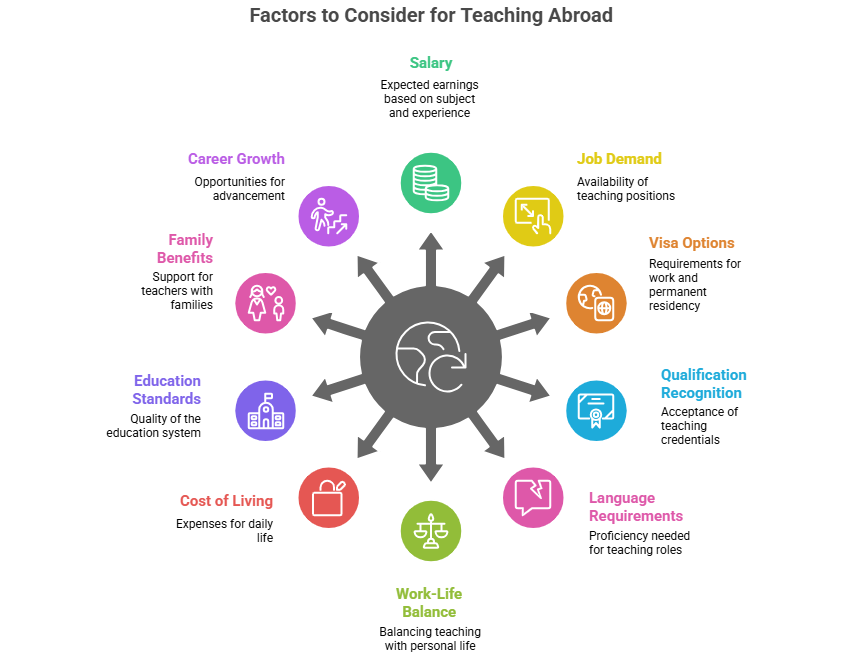
Key Factors to Consider Before Choosing a Country for Teaching Jobs
- Expected salary based on subject and experience
- Demand for teachers and job vacancies
- Work visas and PR options for teachers
- Teaching qualification recognition
- Language requirements for teaching roles
- Work-life balance and teaching hours
- Cost of living
- Education system standards
- Family benefits and dependent visa options
- Long-term career growth opportunities
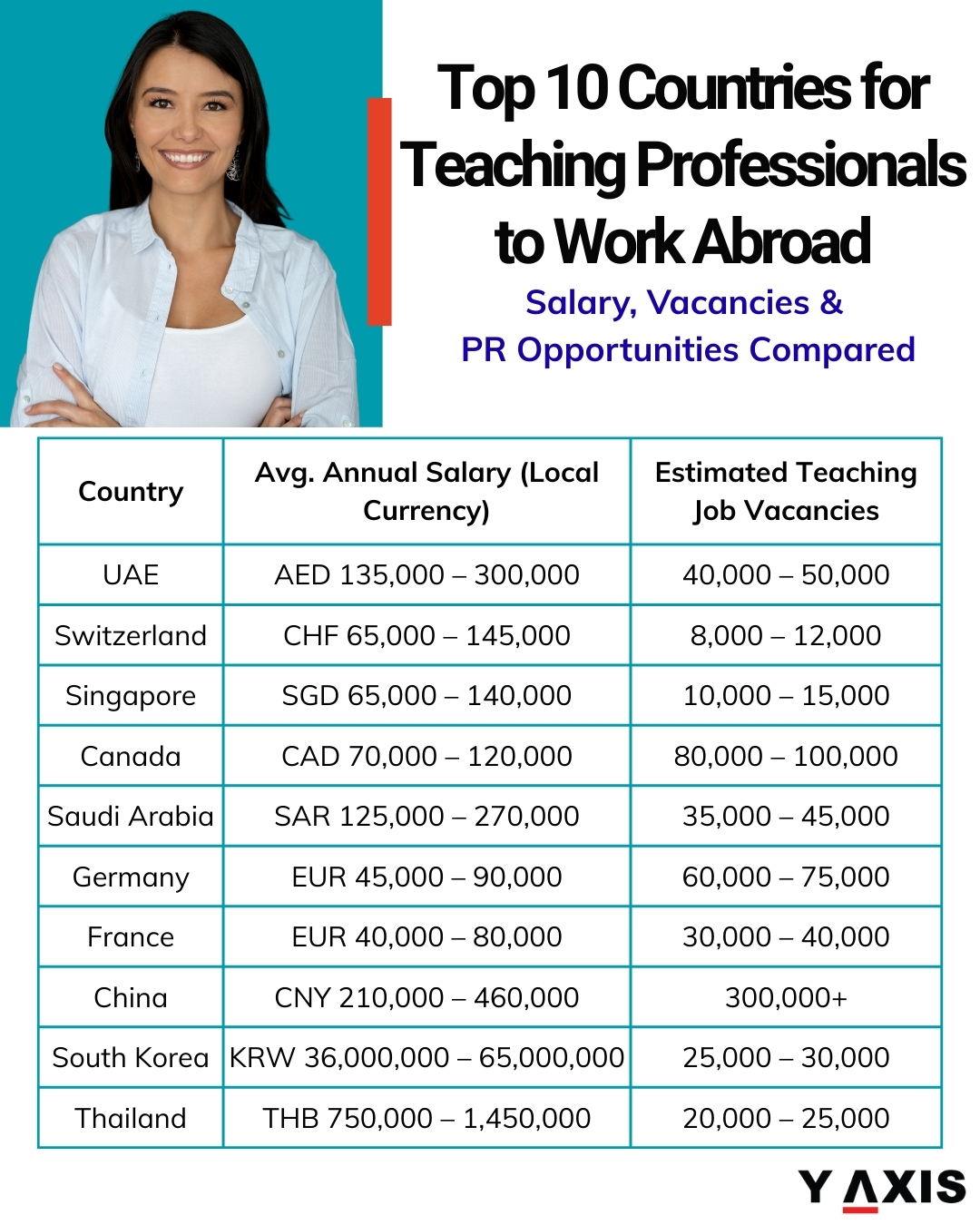
Best Countries for Indian Teaching Professionals to Work Abroad
Teaching professionals from India have strong opportunities in countries across Asia, Europe, the Middle East, and North America actively hire qualified teachers for schools, colleges, and international institutions. The table below highlights the best countries for Indian teaching professionals based on average annual salaries and estimated job vacancies, helping you compare options and choose the right destination.
|
Country |
Avg. Annual Salary (INR) |
Estimated Teaching Job Vacancies |
|
United Arab Emirates |
₹30 – ₹65 Lakh |
40,000 – 50,000 |
|
China |
₹25 – ₹55 Lakh |
300,000+ |
|
Switzerland |
₹50 Lakh – ₹1.1 Cr |
8,000 – 12,000 |
|
Singapore |
₹40 – ₹85 Lakh |
10,000 – 15,000 |
|
South Korea |
₹22 – ₹40 Lakh |
25,000 – 30,000 |
|
Saudi Arabia |
₹28 – ₹60 Lakh |
35,000 – 45,000 |
|
Thailand |
₹18 – ₹35 Lakh |
20,000 – 25,000 |
|
Germany |
₹40 – ₹80 Lakh |
60,000 – 75,000 |
|
Canada |
₹35 – ₹75 Lakh |
80,000 – 100,000 |
|
France |
₹35 – ₹70 Lakh |
30,000 – 40,000 |
*Willing to work abroad? Y-Axis will guide you step by step.
Top Countries for Teaching Jobs Abroad
Teaching Jobs in the UAE
The UAE is one of the top destinations for teaching professionals due to strong demand in international and private schools. Cities like Dubai and Abu Dhabi have many British, IB, American, and CBSE curriculum schools that regularly hire overseas teachers.
Teachers in the UAE earn tax-free salaries, which helps them save more money. Many schools also provide free accommodation, annual flight tickets, health insurance, and paid holidays. The UAE is ideal for teachers looking for high savings and international exposure. The table below shows key details about teaching job opportunities in UAE, including in-demand roles, visa options, required qualifications, PR possibilities, and family sponsorship.
|
Factors |
Detailed Explanation |
|
In-Demand Teaching Roles |
The UAE has high demand for international schoolteachers, ESL teachers, and subject teachers (Math's, Science, English, IT, Business, etc.). Most opportunities are in British, IB, American, and CBSE curriculum schools across United Arab Emirates. |
|
Work Visa Options |
Teachers are hired through an employer-sponsored UAE work visa. Once you receive a job offer, the school manages the visa process, residence permit, and labor approval on your behalf. |
|
Required Qualifications & Experience |
Schools usually require a bachelor's or master's degree in education or the subject taught, along with 1–3 years of teaching experience. International schools may prefer prior experience with IB, British, American, or CBSE curricula. |
|
Fast-Track Hiring Options |
Many private and international schools offer fast-track hiring, especially before the academic year starts. Schools often complete visa processing quickly so teachers can join without long delays. |
|
Long-Term Stay Options |
Eligible teachers with strong experience, higher salaries, or long-term contracts may qualify for the UAE Golden Visa, which allows for longer residence without frequent renewals. |
|
Family Sponsorship |
Teachers earning the required minimum salary can sponsor their spouse and children. Dependents can live, study, and access healthcare in the UAE under the teacher’s residence visa. |
Teaching Jobs in China
China is one of the largest job markets for teaching professionals, especially for English language teachers and subject teachers in international and bilingual schools. Due to the growing number of international schools, private academies, and universities, China regularly hires overseas teachers across major cities such as Beijing, Shanghai, Shenzhen, and Guangzhou. Teachers in China earn competitive salaries along with benefits such as free or subsidized accommodation, flight allowances, contract completion bonuses, and paid national holidays. China is a good choice for teachers who want quick job placement, steady income, and cultural exposure. The table below shows key details about teaching job opportunities in China, including in-demand roles, visa options, required qualifications, long-term stay options, and family sponsorship.
|
Factors |
Detailed Explanation |
|
In-Demand Teaching Roles |
China has strong demand for ESL teachers, kindergarten teachers, subject teachers (Maths, Science, Physics), and university lecturers. International and bilingual schools prefer teachers familiar with British, IB, American, or Cambridge curricula. |
|
Work Visa Options |
Teachers work in China under the Z Work Visa, which is issued after securing a job offer. Schools assist with work permits, residence registration, and contract approvals before arrival. |
|
Required Qualifications & Experience |
Most schools require a bachelor’s degree, a TEFL/TESOL certificate for ESL roles, and 1–2 years of teaching experience. Some schools accept fresh graduates for entry-level teaching roles. |
|
Fast-Track Hiring Options |
Many schools conduct online interviews and quick contract offers, especially before the academic year. Visa processing is often completed within a few weeks once documents are approved. |
|
Long-Term Stay Options |
Teachers can renew work permits yearly. Experienced teachers with long-term contracts may qualify for long-term residence permits in select cities. |
|
Family Sponsorship |
Some employers support dependent residence visas for spouses and children. International schools are more likely to offer family sponsorship for experienced teachers. |
Teaching Jobs in Switzerland
Switzerland offers excellent opportunities for teaching professionals, especially in international and private schools. The country has a strong education system and regularly hires overseas teachers for international schools that follow IB, British, American, or bilingual curricula. Major cities such as Zurich, Geneva, Basel, and Lausanne have most of the teaching opportunities.
Teachers in Switzerland earn high salaries and work in well-structured schools with modern facilities. Although the cost of living is high, strong pay, social benefits, and work-life balance help teachers maintain a comfortable lifestyle. Switzerland is best suited for experienced teachers looking for quality of life and long-term stability in Europe. The table below shows key details about teaching job opportunities in Switzerland, including in-demand roles, visa options, required qualifications, long-term stay options, and family sponsorship.
|
Factors |
Detailed Explanation |
|
In-Demand Teaching Roles |
Switzerland mainly hires international school teachers, subject teachers (Maths, Science, Economics), and language teachers. Demand is higher in IB, British, American, and bilingual schools rather than public schools. |
|
Work Visa Options |
Teachers are hired through employer-sponsored Swiss work permits (L Permit or B Permit). Schools assist with work authorization and residence permit applications. Non-EU teachers are subject to yearly quotas. |
|
Required Qualifications & Experience |
Schools usually require a Bachelor’s or Master’s degree in Education or the subject taught, along with 2–5 years of teaching experience. Experience in international curricula (IB, British, American) is highly preferred. |
|
Fast-Track Hiring Options |
International schools may support priority work permit processing for experienced teachers in shortage subjects. Hiring is faster when schools directly sponsor permits. |
|
Long-Term Stay Options |
Teachers can apply for long-term residence (C Permit) after several years of continuous legal employment, usually between 5–10 years, depending on canton and integration. |
|
Family Sponsorship |
Teachers holding a valid residence permit can sponsor their spouse and dependent children, provided income and housing requirements are met. Dependents can live, study, and access healthcare in Switzerland. |
Teaching Jobs in Singapore
Singapore is a popular destination for teaching professionals because of its high-quality education system and strong demand for teachers in international and private schools. Many schools in Singapore follow IB, British, American, and Cambridge curricula. Most teaching jobs are available in international schools, private institutions, and junior colleges.
Teachers in Singapore earn competitive salaries and work in a safe, modern, and well-organized environment. While the cost of living is high, good pay, clean living conditions, and strong public services make Singapore attractive for long-term work. Singapore is ideal for teachers who want career growth, stability, and exposure to world-class education standards. The table below shows key details about teaching job opportunities in Singapore, including in-demand roles, visa options, required qualifications, long-term stay options, and family sponsorship.
|
Factors |
Detailed Explanation |
|
In-Demand Teaching Roles |
Singapore mainly hires international school teachers, subject teachers (Maths, Science, ICT), early childhood educators, and language teachers. Demand is high in IB, British, American, and Cambridge curriculum schools. |
|
Work Visa Options |
Teachers work under the Employment Pass (EP), which is sponsored by the school. Once hired, the employer handles visa application and approval through Singapore’s Ministry of Manpower. |
|
Required Qualifications & Experience |
Most schools require a Bachelor’s or Master’s degree in Education or the subject taught, along with 2–4 years of teaching experience. International curriculum experience is strongly preferred. |
|
Fast-Track Hiring Options |
International schools often conduct direct interviews and quick job offers, especially for experienced teachers. Visa approvals are usually fast once documents are submitted correctly. |
|
Long-Term Stay Options |
Teachers who work in Singapore for several years may apply for Permanent Residency (PR), depending on salary level, skills, and duration of stay. |
|
Family Sponsorship |
Teachers earning the required salary can sponsor their spouse and children under Dependant Passes. Dependents can live, study, and access healthcare services in Singapore. |
*Looking for teaching jobs in Singapore? Take help from Y-axis Jobs search services
Teaching Jobs in South Korea
South Korea is one of the best destination for teaching professionals, especially for English language teachers and subject teachers in public schools, private academies (hagwons), and international schools. Cities like Seoul, Busan, Incheon, and Daegu offer many teaching opportunities for overseas teachers. Teachers in South Korea earn stable salaries and often receive benefits such as free accommodation or housing allowance, paid holidays, health insurance, and flight tickets. The country is known for its safety, modern lifestyle, and strong respect for education. South Korea is ideal for teachers looking for quick job placement, structured work culture, and cultural exxperience. The table below shows key details about teaching job opportunities in South Korea, including in-demand roles, visa options, required qualifications, long-term stay options, and family sponsorship.
|
Factors |
Detailed Explanation |
|
In-Demand Teaching Roles |
South Korea mainly hires ESL teachers, international school teachers, subject teachers (Maths, Science), and university instructors. Demand is high in public schools and private language academies. |
|
Work Visa Options |
Teachers usually work under the E-2 (Teaching) Visa for ESL roles or E-7 Visa for subject and international school teachers. Visas are sponsored by the employer. |
|
Required Qualifications & Experience |
Most roles require a Bachelor’s degree. ESL teachers usually need a TEFL/TESOL certificate, while international schools prefer 2–3 years of teaching experience and subject-specific degrees. |
|
Fast-Track Hiring Options |
Many schools offer quick online interviews and fast contract signing. Visa processing is generally smooth and completed within a few weeks once documents are ready. |
|
Long-Term Stay Options |
Teachers working continuously in South Korea may become eligible for long-term residence visas (F-series) after several years, based on experience, salary, and language skills. |
|
Family Sponsorship |
Teachers on long-term or higher-category visas can sponsor spouse and children. Family sponsorship is more common for international school and university teaching roles. |
Teaching Jobs in Saudi Arabia
Saudi Arabia is becoming a major destination for teaching professionals due to rapid development in the education sector under Vision 2030. There is strong demand for teachers in international schools, private schools, colleges, and universities, especially in cities like Riyadh, Jeddah, and Dammam.
Teachers in Saudi Arabia earn tax-free salaries, which allows them to save a large part of their income. Many schools also provide benefits such as free accommodation, annual flight tickets, medical insurance, and paid vacations. Saudi Arabia is best suited for experienced teachers who want high savings, stable contracts, and long-term employment. The table below shows key details about teaching job opportunities in Saudi Arabia, including in-demand roles, visa options, required qualifications, long-term stay options, and family sponsorship.
|
Factors |
Detailed Explanation |
|
In-Demand Teaching Roles |
International school teachers, ESL teachers, subject teachers (Maths, Science, English), and university lecturers are in high demand. |
|
Work Visa Options |
Teachers are hired under an employer-sponsored Saudi work visa with an Iqama (residence permit). Schools handle the visa process. |
|
Required Qualifications & Experience |
A Bachelor’s degree in Education or the subject taught is required, along with 2–5 years of teaching experience. International curriculum experience is preferred. |
|
Fast-Track Hiring Options |
Many schools hire quickly before the academic year and support faster visa processing for overseas teachers. |
|
Long-Term Stay Options |
Long-term stay depends on contract renewals. Permanent residence options are limited but long contracts are common. |
|
Family Sponsorship |
Teachers who meet salary requirements can sponsor their spouse and children to live in Saudi Arabia. |
Teaching Jobs in Germany
Germany offers good opportunities for teaching professionals, mainly in international schools, private schools, and language institutions. The country has a strong education system and demand is high for teachers in STEM subjects and English, especially in cities like Berlin, Frankfurt, Munich, and Hamburg.
Teachers in Germany earn stable salaries and enjoy benefits such as health insurance, paid leave, and strong worker protections. Germany is ideal for teachers who want job security, work-life balance, and long-term settlement in Europe. The table below shows key details about teaching job opportunities in Germany, including in-demand roles, visa options, required qualifications, long-term stay options, and family sponsorship.
|
Factors |
Detailed Explanation |
|
In-Demand Teaching Roles |
International school teachers, STEM teachers (Maths, Science), English teachers, and language instructors are in demand. |
|
Work Visa Options |
Teachers work under the EU Blue Card or Skilled Worker Visa, sponsored by the employer. |
|
Required Qualifications & Experience |
A recognised Bachelor’s or Master’s degree in Education or the subject taught, with 2–4 years of teaching experience. International curriculum experience is helpful. |
|
Fast-Track Hiring Options |
Employers can use Germany’s fast-track skilled worker procedure to speed up visa approval. |
|
Long-Term Stay Options |
Teachers can apply for Permanent Residence after 21–33 months of legal work, depending on salary and language level. |
|
Family Sponsorship |
Yes. Teachers can sponsor their spouse and children. Family members are allowed to live, work, and study in Germany. |
*Looking for teaching jobs in Germany? Take help from Y-axis Jobs search services
Teaching Jobs in Thailand
Thailand is a popular destination for teaching professionals who want international teaching experience and a relaxed lifestyle. Teaching jobs are widely available in private schools, international schools, and language institutes, especially in cities like Bangkok, Chiang Mai, and Phuket. Teachers in Thailand earn moderate salaries, but the low cost of living allows them to live comfortably. Many teachers enjoy a good work-life balance, friendly work culture, and rich cultural experience. Thailand is well suited for ESL teachers and early-career teaching professionals. The table below shows key details about teaching job opportunities in Thailand, including in-demand roles, visa options, required qualifications, long-term stay options, and family sponsorship.
|
Factors |
Detailed Explanation |
|
In-Demand Teaching Roles |
ESL teachers, kindergarten teachers, international school teachers, and language instructors are commonly hired. |
|
Work Visa Options |
Teachers work under a Non-Immigrant B Visa, which is sponsored by the employer. |
|
Required Qualifications & Experience |
A Bachelor’s degree is required. TEFL/TESOL certification is preferred. Teaching experience is helpful but not always mandatory for ESL roles. |
|
Fast-Track Hiring Options |
Many language schools offer quick interviews and faster joining, especially for ESL teachers. |
|
Long-Term Stay Options |
Teachers can renew their work visa yearly as long as they remain employed in Thailand. |
|
Family Sponsorship |
Family sponsorship is limited and depends on the visa type, salary level, and employer support. |
Teaching Jobs in France
France offers good opportunities for teaching professionals, especially in international schools, private schools, and language institutions. The country regularly hires overseas teachers for schools that follow IB, British, American, and international curricula, mainly in cities like Paris, Lyon, Nice, and Toulouse.
Teachers in France enjoy a good quality of life, reasonable working hours, and long paid holidays. While salaries may be moderate compared to some countries, strong labour laws, healthcare benefits, and cultural exposure make France attractive. France is suitable for teachers who want European work experience, stability, and long-term residence options. The table below shows key details about teaching job opportunities in France, including in-demand roles, visa options, required qualifications, long-term stay options, and family sponsorship.
|
Factors |
Detailed Explanation |
|
In-Demand Teaching Roles |
International school teachers, ESL teachers, language teachers, and subject teachers (English, Maths, Humanities) are in demand. |
|
Work Visa Options |
Teachers are hired through an employer-sponsored French work visa. Schools assist with work permit and residence card applications. |
|
Required Qualifications & Experience |
A Bachelor’s or Master’s degree in Education or the subject taught is required, along with 2–3 years of teaching experience. English-speaking teachers are in higher demand; basic French is an advantage. |
|
Fast-Track Hiring Options |
International schools often support faster hiring and visa processing for overseas teachers before the academic year starts. |
|
Long-Term Stay Options |
Teachers can apply for long-term residence or permanent residence after 5 years of continuous legal stay in France. |
|
Family Sponsorship |
Teachers with a valid residence permit can sponsor their spouse and dependent children. Family members can live, study, and access healthcare in France. |
Steps to Follow Before Applying for Teaching Jobs Abroad
Step 1: Check your eligibility based on your teaching qualification, subject specialization, and years of experience.
Step 2: Choose the country that matches your salary expectations, work visa options, PR pathways, and lifestyle preferences.
Step 3: Understand the teaching qualification recognition or approval process required in the selected country or school system.
Step 4: Prepare for language requirements such as IELTS, TOEFL, or local language proficiency, if required by the country or employer.
Step 5: Get your educational credentials evaluated or verified, if needed for work visa or school requirements.
Step 6: Apply for teaching approval, eligibility clearance, or school-level assessment in the destination country.
Step 7: Search for verified teaching job openings and secure a job offer from a recognized school or institution.
Step 8: Apply for the appropriate work visa with employer sponsorship and complete the residence permit process.
Step 9: Plan relocation, accommodation, travel, and finances before moving abroad.
Step 10: Apply for dependent visas for your spouse and children, if applicable, after securing your work permit.
*Looking for teaching jobs abroad? Talk to Y-Axis, world’s number one immigration consultancy for complete guidance and end-to-end support.
FAQs
What are the best countries for Indian teaching professionals to work abroad?
Indian teachers have strong opportunities in countries like the UAE, China, Switzerland, Singapore, South Korea, Saudi Arabia, Thailand, Germany, Canada, and France. These countries face teacher shortages and actively hire overseas educators for schools, colleges, universities, and international institutions. They offer competitive salaries, good work conditions, and international exposure. Some countries also provide long-term stay or permanent residency options, making them suitable for teachers planning global careers and settlement with family.
Which country offers the highest salary for teaching professionals?
Switzerland offers some of the highest salaries for teaching professionals, especially in international schools. Singapore and the UAE also provide high income potential, with the UAE offering tax-free salaries. While countries like Canada and Germany offer slightly lower salaries, they compensate with strong social benefits, job security, and permanent residency options. Salary levels depend on the subject, experience, school type, and location within the country.
Are teaching jobs abroad open to Indian teachers?
Yes, many countries actively hire Indian teaching professionals, especially for international schools and English-medium education. Indian teachers are preferred due to strong subject knowledge, English proficiency, and experience with global curricula like CBSE, IB, British, and American systems. Countries such as the UAE, China, Singapore, and Canada regularly recruit teachers from India for ESL, subject teaching, and early education roles.
What qualifications are required to apply for teaching jobs abroad?
Most countries require a bachelor's or master's degree in education or the subject you teach. Teaching experience of 1–5 years is usually required, depending on the country and school. ESL roles may require TEFL or TESOL certification. International schools often prefer experience in IB, British, American, or Cambridge curricula. Some countries may also require qualification recognition or school-level approval before employment.
What type of visa is required for teaching jobs abroad?
Teaching jobs abroad usually requires an employer-sponsored work visa. The visa type varies by country, such as UAE Work Visa, China Z Visa, Singapore Employment Pass, South Korea E-2/E-7 Visa, EU Blue Card (Germany), or Skilled Worker permits. Schools generally handle most of the visa process after issuing a job offer. Teachers cannot legally work abroad on tourists or visit visas.
Is it possible to get permanent residency through teaching jobs abroad?
Yes, some countries offer permanent residency (PR) pathways for teaching professionals. Canada, Germany, France, and Singapore provide PR options after a few years of legal work. The UAE and Saudi Arabia offer long-term residence options, but direct PR is limited. PR eligibility depends on salary, experience, duration of stay, and language or integration requirements.
Which countries offer tax-free salaries for teachers?
Countries in the Middle East, especially the UAE and Saudi Arabia, offer tax-free salaries for teaching professionals. This allows teachers to save a large portion of their income. In other countries like Switzerland, Germany, and Canada, salaries are taxable but come with strong social benefits such as healthcare, pensions, and paid leave, which balance overall financial stability.
Are ESL teachers in demand internationally?
Yes, ESL teachers are in high demand worldwide, especially in countries like China, South Korea, Thailand, the UAE, and France. Schools, language institutes, and international schools hire ESL teachers to teach English to students of different age groups. A bachelor's degree and TEFL/TESOL certification are commonly required. ESL roles are often suitable for early-career teachers seeking international exposure.
How long does it take to get a teaching job abroad?
The timeline varies by country and school. In countries like China, Thailand, and South Korea, teachers can secure jobs within 1–3 months. In Europe and Canada, the process may take 3–6 months due to qualification recognition and visa processing. Hiring is usually faster before the academic year starts, when schools recruit in bulk.
What are the language requirements for teaching jobs abroad?
English proficiency is required for most teaching roles. Some countries may require IELTS or TOEFL, especially for visas or PR purposes. For teaching in Germany or France, basic knowledge of the local language can be an advantage but is not mandatory for international schools. ESL teachers usually do not need local language skills.
Can teachers bring their family when working abroad?
Yes, most countries allow teachers to sponsor their spouse and children once they meet salary and visa requirements. Countries like Canada, Germany, France, Singapore, and the UAE offer dependent visas. Family members can usually live, study, and access healthcare. Some countries also allow spouses to work, depending on visa type.
What subjects are most in demand for teachers abroad?
High-demand subjects include English, Math's, Science, Physics, Chemistry, Computer Science, ICT, Business Studies, and Special Education. Early childhood educators and ESL teachers are also widely needed. STEM teachers are especially in demand in Germany, Canada, and international schools worldwide.
Are international schools better than public schools for overseas teachers?
Yes, international schools are more open to hiring overseas teachers. They follow global curricula like IB, British, American, and Cambridge systems. Public schools often have strict local licensing and language requirements. International schools offer better salary packages, relocation support, and a diverse working environment for foreign teachers.
What benefits do teaching jobs abroad usually offer?
Teaching jobs abroad often include benefits such as accommodation allowance, flight tickets, health insurance, paid holidays, and bonuses. Middle Eastern and Asian countries provide more relocation benefits, while European countries offer social security, pensions, and healthcare. Benefits vary by country, school type, and contract terms.
Is work-life balance good for teachers abroad?
Yes, most countries offer a good work-life balance for teaching professionals. European countries like Germany, France, and Switzerland have fixed working hours and long holidays. Asian countries may have longer hours, but weekends and public holidays are usually free. Work-life balance depends on school policies and teaching levels.
What challenges should teachers consider before moving abroad?
Teachers should consider cost of living, cultural differences, qualification recognition, visa rules, and long-term settlement options. Some countries have strict documentation requirements or limited PR options. Planning finances, understanding school expectations, and choosing the right country based on career goals is important before moving.
When is the best time to apply for teaching jobs abroad?
The best time to apply is usually 3–6 months before the academic year starts. Most international schools hire between January and June. ESL roles may be available year-round. Early application improves chances of selection, faster visa processing, and better job options.
Tags:
teaching jobs abroad
top countries for teachers
teacher salaries worldwide
demand for teachers abroad
PR opportunities for educators
international teaching careers
work abroad for teaching professionals
global education jobs
Share
Options for you by Y-Axis

Get it on your mobile

Get News alerts

Contact Y-Axis
Latest Article
Popular Post
Trending Article

Posted On April 01 2026
Study vs Work Abroad – Which is Better for Indians in 2026?