

Posted on November 20 2026
The Qualification Gap: Why Skilled Migrants Struggle to Find Jobs Matching Their Education Abroad

By , Editor & Director
Updated November 20 2026
~ Dr. Serah Vinodini Vilvaraj
An international degree or years of professional experience do not always guarantee a matching career overseas. New OECD research reveals why highly educated migrants often work below their qualification levels—and what professionals can do before relocating.
Key Highlights
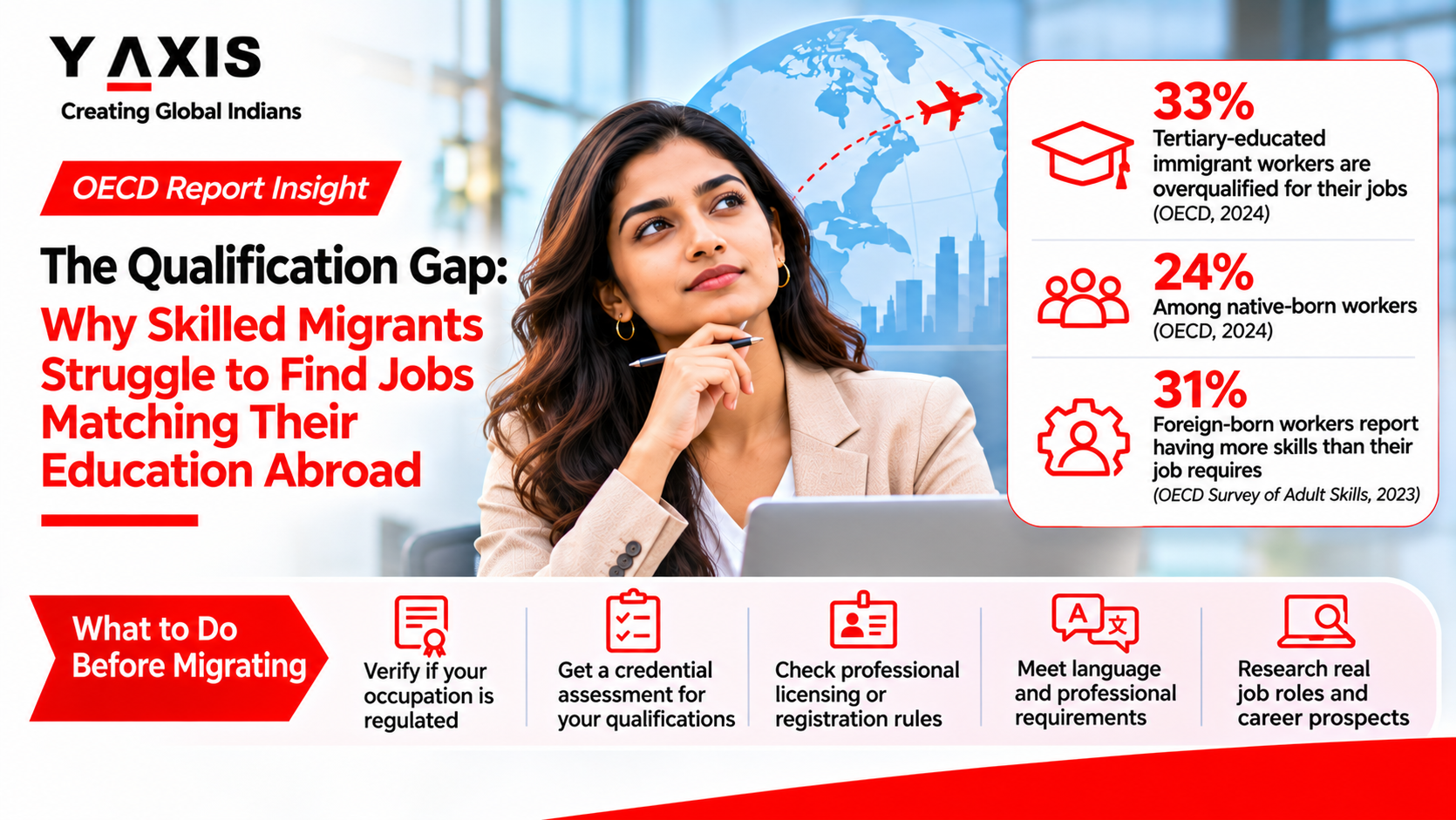
- 33% of tertiary-educated immigrant workers across OECD countries with available data were overqualified for their jobs in 2024, compared with 24% of native-born workers.
- 31% of foreign-born respondents reported having more skills than their jobs required, compared with 27% of native-born respondents.
- Qualification recognition, occupational licensing, language requirements and limited professional networks contribute to employment mismatches.
- A July 2026 EU–OECD study identified skills recognition and targeted language training as important responses.
- Indian professionals should verify licensing and credential requirements before relocating.
Why Do Skilled Migrants Struggle to Find Suitable Jobs Abroad?
A qualified engineer working outside engineering. A trained doctor unable to practise medicine. An experienced professional accepting work unrelated to their education. These situations illustrate a challenge that international migration statistics do not always reveal. According to the Organisation for Economic Co-operation and Development's (OECD) International Migration Outlook 2026, published on November 12, highly educated migrants remain more likely than native-born workers to hold jobs below their qualification levels.
The findings highlight an important distinction: securing permission to live and work overseas does not automatically mean that professional qualifications will be recognised or fully utilised. For Indian professionals considering international careers, understanding this gap can help prevent unexpected employment difficulties after migration.
What Does the OECD's Latest Research Reveal?
The OECD's analysis of 2024 labour-force data found that approximately 33% of tertiary-educated immigrant workers were employed in occupations classified as requiring medium or lower skill levels. The corresponding figure for native-born workers was 24%. This represents a nine-percentage-point difference.
The OECD also examined workers' perceptions of their skills. According to its Survey of Adult Skills, 31% of foreign-born respondents reported possessing more skills than their current jobs required, compared with 27% of native-born respondents.These findings use different measures and datasets. They should not be combined or interpreted as statistics specifically describing Indian migrants.
What Is Overqualification in International Employment?
Overqualification occurs when a person's educational attainment exceeds the typical requirements of their occupation. For example, a university graduate employed in a role that does not normally require tertiary education may be classified as overqualified. However, overqualification does not automatically mean that a worker lacks valuable employment or is performing an unsuitable job. Some professionals deliberately change careers, accept transitional employment or pursue opportunities outside their original field. The concern arises when qualified workers cannot access appropriate positions because their credentials, experience or professional skills are not recognised.
Why Are Foreign Qualifications Sometimes Difficult to Recognise?
Education systems and professional standards differ between countries. A degree accepted for employment in India may require additional assessment before being recognised elsewhere. The OECD identifies several barriers, including differences in educational curricula, language proficiency, professional licensing and employers' familiarity with foreign qualifications.
Recognition procedures can also vary significantly between occupations. An academic qualification may be accepted as comparable to a local degree without automatically granting permission to practise a regulated profession. This distinction is particularly important in healthcare, education, law, engineering and other occupations subject to professional regulation.
Which Countries Have Larger Qualification Gaps?
The OECD reports that immigrant overqualification rates exceeded those of native-born workers by at least 20 percentage points in several countries. These included Italy, Chile, Costa Rica, Denmark, Estonia, Poland, Norway and Sweden. However, the findings do not mean that every migrant in these countries faces the same barriers. Employment outcomes depend on occupation, language proficiency, qualifications, experience and the relevant recognition system. The OECD's findings also suggest that improving qualification recognition and access to suitable employment could help destination countries make better use of existing migrant skills.
How Does the Qualification Gap Affect Migrants and Employers?
When migrants work below their qualification levels, their education and professional experience may be underused. This can limit career progression and earnings while reducing opportunities for employers to access available talent. A July 2026 study jointly published by the European Migration Network and OECD examined these challenges across European countries. It identified qualification recognition, language barriers, discrimination and limited access to suitable employment as important obstacles. The study also highlighted responses including career guidance, language training, professional development and improved skills-matching services.
What Should Indian Professionals Check Before Migrating?
Professionals planning an overseas career can reduce uncertainty by completing several checks before relocation.
1. Identify whether the occupation is regulated.
Determine whether the destination requires professional registration or licensing. Requirements may differ between countries and even between states or provinces.
2. Verify qualification recognition.
Check whether an academic credential assessment or formal recognition procedure is required.
3. Understand the difference between assessment and licensing.
A credential evaluation may establish educational comparability without granting permission to practise.
4. Review language and professional requirements.
Some occupations require occupation-specific language proficiency, examinations, supervised practice or additional training.
5. Research actual employment conditions.
Compare job descriptions, required experience, employer expectations and realistic career progression before accepting an offer.
Official professional regulators and immigration authorities should be the primary sources for these checks.
Can Migrants Move into Better-Matched Jobs After Arrival?
Yes, career mobility is possible, although outcomes vary. Migrants may improve their employment prospects through local experience, additional qualifications, professional registration, language development and stronger employment networks. OECD research also highlights the importance of moving into firms and sectors where workers' skills can be used more productively. However, progression is not automatic. Workers should verify whether their immigration status permits changes of employer or occupation and whether additional licensing requirements apply.
Before choosing where to migrate, investigate not only whether you qualify for a visa, but whether you can realistically practise your profession and develop your career after arrival.
Official Sources
- OECD — International Migration Outlook 2026
- OECD — The Impact of Migration on Productivity Growth, Chapter 5
- European Commission — EMN–OECD Study on Skills Matching, 28 July 2026
- OECD — International Migration Outlook 2026 Editorial
Frequently Asked Questions
What percentage of highly educated migrants are overqualified?
The OECD reports that approximately 33% of tertiary-educated immigrant workers were overqualified in 2024, compared with 24% of native-born workers.
Does a recognised degree guarantee professional employment abroad?
No. Professional licensing, employer requirements, language proficiency and work authorisation may still apply.
Are credential assessment and professional licensing the same?
No. Credential assessment evaluates qualifications, while licensing determines whether an individual can legally practise a regulated occupation.
Can Indian professionals assess their qualifications before migrating?
Often, yes. Applicants should consult the relevant official credential recognition authority or professional regulator to determine available procedures.
What Does This Mean for the Future of Skilled Migration?
The OECD's latest findings demonstrate that successful skilled migration requires more than attracting educated professionals.
Destination countries also need systems that recognise qualifications, support professional integration and help workers access employment matching their abilities.
For Indian professionals, the lesson is equally important.
Tags:
OECD Report
Skilled Migration
Qualification Recognition
Overseas Careers
Credential Assessment
Professional Licensing
International Employment
Indian Professionals
Skills Mismatch
Work Abroad
Share
Options for you by Y-Axis

Get it on your mobile

Get News alerts

Contact Y-Axis
Latest Article
Popular Post
Trending Article

Posted On November 20 2026
US Court strikes down four-year student visa rule: What Indian students and researchers must know