

Posted on October 07 2026
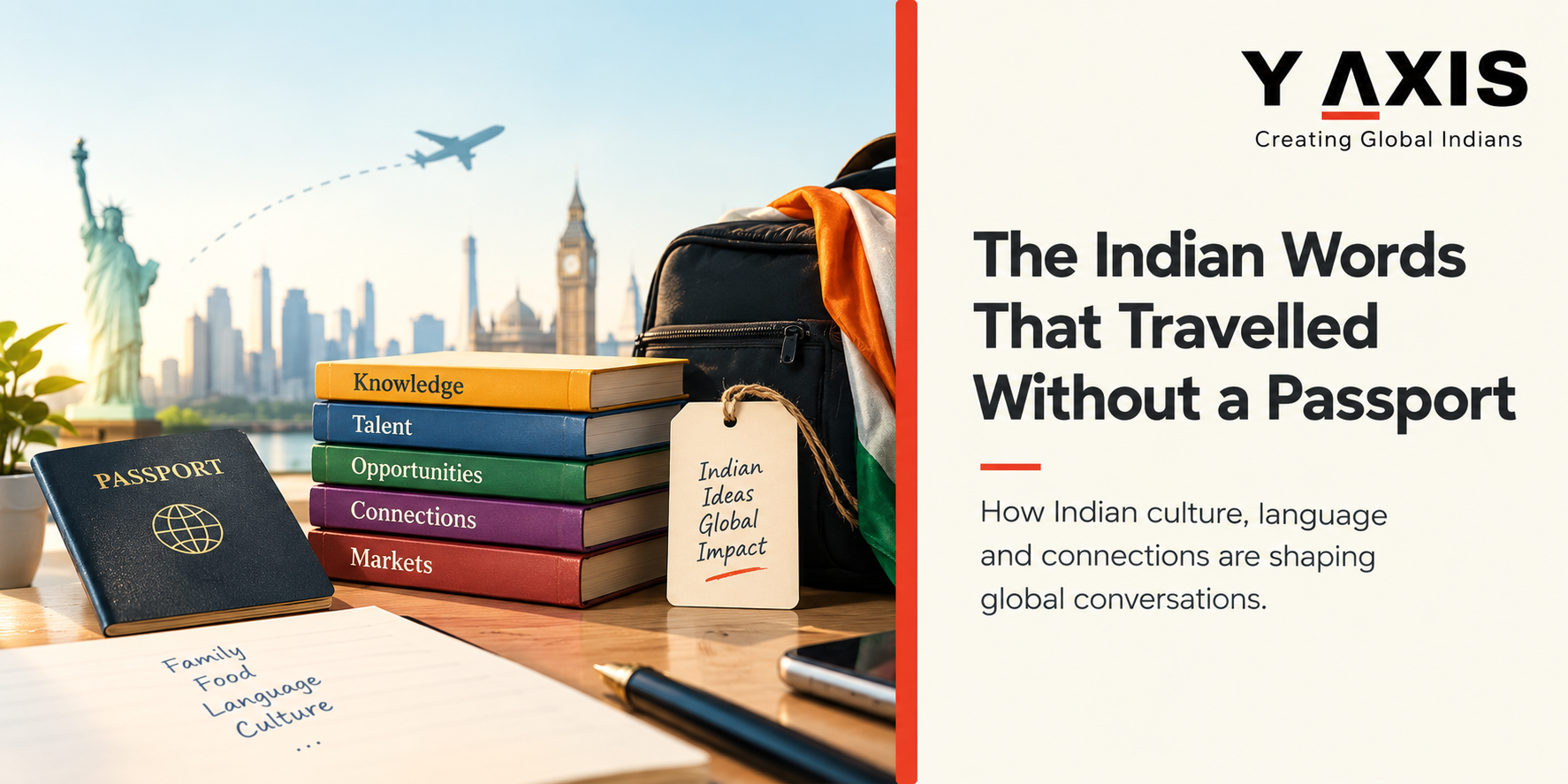
The Indian Words That Travelled Without a Passport

By , Editor & Director
Updated October 07 2026
India’s global influence is not only visible in its people, businesses and culture. Sometimes, it is hiding in the words they carry with them.
When Indians move abroad, they take more than clothes, photographs and familiar recipes. They take a way of speaking.
It appears in office conversations, family WhatsApp groups, university corridors, restaurants, taxis and video calls. Sometimes it is a word borrowed from an Indian language. Sometimes it is a phrase shaped by Indian English. Sometimes it is simply a way of addressing another person that makes perfect sense in an Indian social context. Some of these expressions remain distinctly Indian. Others become familiar to people who have never lived in India. That is one of the less visible stories of Indian migration: people do not only carry language with them. They carry ways of using language. And once those ways of speaking travel, they can become part of the linguistic lives of the communities around them.
How does Indian English travel with the diaspora?
Language rarely moves because someone decides to export it. It moves through people. An Indian professional joins an international team. A student moves to another country. A family settles abroad. Children grow up hearing one language at school and another at home. Friends pick up expressions from one another. The process is gradual. A colleague hears an Indian expression. A friend repeats a word. A child grows up using a family expression outside the home. A phrase that once needed explanation becomes familiar within a particular community.
Linguists have long studied Indian English as a distinct variety shaped by India’s multilingual environment. Research on Indian English also shows how language, identity and migration interact across communities and generations. That makes the story more interesting than simply asking which Indian words have entered English.
The bigger question is: What happens to a language when the people who speak it move?
Indian English did not simply copy British English
English arrived in India through colonial history, but it did not remain unchanged. Over time, English in India developed its own vocabulary, structures, rhythms and conventions, influenced by India’s multilingual society and everyday use. Linguistic scholarship treats Indian English as a variety of English in its own right, with its own lexical and grammatical features. Researchers have also examined how Indian English interacts with other Indian languages and how it functions across international diaspora communities. That distinction matters. Indian English is not simply “English spoken with an Indian accent”. It includes vocabulary and expressions that have developed through the particular linguistic and social environment of India. And when Indians move abroad, parts of that linguistic environment can travel with them.
The Indian workplace has gone global
Perhaps the clearest place to see this is the workplace. Indian professionals now work across companies and teams spanning cities such as Bengaluru, London, New York, Singapore, Dubai and Sydney. But international mobility does not only move professional skills.
It also moves habits of communication.
How do you address a senior colleague?
How do you disagree politely?
How do you make a request sound less direct?
How do you build familiarity with someone older than you?
Even apparently small choices in communication can carry cultural information.
An expression that sounds completely ordinary in an Indian workplace may sound unusual elsewhere. Sometimes it needs explaining. Sometimes it gets adopted. Sometimes it simply becomes part of the shared vocabulary of a multicultural team. No visa required.
Why do Indians call unrelated older people “uncle” and “aunty”?
Consider two of the most ordinary words in many Indian households:
Uncle.
Aunty.
In India, these words can refer to far more than biological relatives. They can be used for older family friends, neighbours, acquaintances and other adults who occupy a familiar social position. The word therefore does more than identify age or family relationship. It can communicate respect, familiarity and social connection. For Indian families living abroad, that usage can travel with them. Children may grow up using “uncle” and “aunty” for people who are not relatives, even while navigating a different set of social conventions outside the home. It is difficult to translate that relationship perfectly because the word is carrying more than its dictionary definition. It is carrying a social idea. And that is one reason everyday language can be such a powerful marker of identity.
Then there is “chai”
Few words illustrate the cultural journey of tea as neatly as chai.
“Chai” means tea in several languages of South Asia and related forms of the word are found across a much wider linguistic history of tea. The word is now widely recognisable in English, particularly in contexts involving spiced or South Asian-style tea. Then came the menu variations:
Masala chai.
Chai latte.
Iced chai.
Chai blends.
There is even a small linguistic joke in the expression “chai tea”. Because chai means tea, the phrase can essentially be understood as “tea tea”. But language is not a mathematical equation. If people understand the expression, use it and recognise what it refers to, it can survive perfectly well. That is how words travel. Not because somebody formally approves their journey. Because people keep using them.
“Prepone”: the Indian English word that made it into dictionaries
Then there are words that reveal something even more interesting about Indian English.
Take “prepone.”
To postpone something is to move it to a later time. So, what happens when you want to move something earlier? In Indian English, you can prepone it. The word is now recognised by major English dictionaries. Oxford Advanced Learner’s Dictionary labels prepone as Indian English, informal, and defines it as moving something to an earlier time than originally planned. Cambridge Dictionary also identifies it as Indian English. Oxford dates the word’s origin to the 1970s, formed from pre- + postpone. Not every English speaker uses it. That is precisely what makes it interesting.
It shows that a major variety of English can create vocabulary to meet the needs of its speakers - and that an expression associated with one variety can eventually receive recognition in dictionaries used by English speakers worldwide. A language spoken across a country as linguistically diverse as India does not simply absorb vocabulary. It creates it too.
Every generation edits the language
Migration does not freeze culture. It changes it. The first generation may carry one version of a language. The second may modify it. The third may combine it with the language of the country where they grew up. A child in Dubai might move between English, Malayalam and Arabic. Someone growing up in Singapore might navigate English, Tamil, Mandarin and the vocabulary of an Indian household. A young Indian-origin person in London, Toronto or Melbourne may understand an expression perfectly in a family setting but rarely use it outside that circle. This is not necessarily cultural loss. It can be cultural adaptation.
Research on diaspora communities has found that migration can affect the way Indian English features are maintained, changed or accommodated across generations. Language therefore becomes less like a box that must be kept intact and more like a living playlist.
You add something.
You lose something.
You borrow something else.
And eventually, the combination becomes something new.
What does Indian language look like in the next generation?
The future Global Indian may speak differently from their grandparents. That does not necessarily make them less Indian. Their connection to India might live in a handful of family expressions.
A pronunciation.
The ability to understand a joke in another language.
A word they cannot translate but know exactly how to feel.
A phrase their grandmother uses.
A food name.
A greeting.
A song lyric.
This is how culture often survives.
Not intact. Adapted.
Living languages change because their speakers change. For diaspora communities, that change can happen particularly quickly because people are constantly negotiating between languages, countries and identities. Research into Indian English and diaspora multilingualism reflects exactly this interaction between language, identity and migration.
What happens when a language travels far enough?
Something remarkable can happen. A word can become detached from the place where it first became familiar. That does not mean its origin disappears. It means the word acquires new lives. Words have crossed borders for centuries through trade, migration, religion, food, entertainment and everyday interaction. India has participated in those exchanges throughout its history. The modern Indian diaspora gives that process a new geography. Global Indian currently describes its community as comprising more than 32 million Global Indians across more than 140 countries. The significance of that number is not simply how many people have moved. It is how many places now contain fragments of Indian family life, memory, food, music, language and social habits. Language is one of the easiest of those fragments to carry. You do not need luggage for it.
The words tell us something statistics cannot
Statistics can tell us how many Indians live abroad. They can tell us where diaspora communities are concentrated. They can tell us about migration, remittances, citizenship and professional achievement. But statistics cannot easily capture what happens when a grandmother in Hyderabad teaches a child in Melbourne a word that the child later uses with a friend who has never been to India. That is a different kind of movement.
No passport.
No visa.
No airport.
No immigration form.
Just a word.
And perhaps that offers another way to understand the Indian diaspora.
It is not only people travelling out of India.
It is Indian culture being reinterpreted in different places.
Is language one of India’s most enduring exports?
We often ask what Indians have contributed to the world.
Doctors?
Yes.
Engineers?
Certainly.
Entrepreneurs?
Absolutely.
Scientists, artists, academics, CEOs and founders?
Without question.
But there is another contribution hiding in ordinary conversation.
The phrases.
The accents.
The jokes.
The ways of addressing people.
The words that move from Indian homes into workplaces, universities, restaurants and communities around the world.
Some will remain recognisably Indian.
Some will be absorbed into local usage.
Some will disappear.
Others may eventually find their way into dictionaries.
That is the nature of language.
It is constantly moving.
And the Indian diaspora gives that movement a remarkable global reach.
The next Indian export may be a sentence
Perhaps the most interesting thing about language is that nobody owns its future. A word can begin in one place and acquire a new meaning somewhere else.
A child can inherit an expression without knowing where it came from.
A family can preserve a phrase for generations.
A workplace can absorb a new word simply because enough people understand it.
And somewhere in that process, culture travels without looking like culture.
When Indians move, they do not leave everything behind at the airport.
They carry memories.
They carry habits.
They carry food.
They carry stories.
And sometimes, they carry words that travel much further than they ever expected.
No passport required.
Tags:
Indian English
Indian diaspora
Indian words
Global Indian
Indian culture
Indian language
Indian English words
Indian diaspora culture
Indian influence
Indian migration
Share
Options for you by Y-Axis

Get it on your mobile

Get News alerts

Contact Y-Axis
Latest Article
Popular Post
Trending Article
Posted On October 08 2026
The Things Indians Abroad Export That Never Appear on a Customs Form