

Posted on April 10 2026
Jobs in Italy for Indians: How to Land a Job & Apply for a Work Visa

By , Editor & Director
Updated August 20 2026
Italy is one of the top destinations for foreign professionals seeking international career growth. Indian workers in sectors such as IT, engineering, and healthcare can benefit from Italy's strong job market, competitive pay, and a stable work-life balance. Italian employers are increasingly hiring skilled and semi-skilled workers to stabilize the country's economy. To secure a job offer in Italy from India, target high-demand roles that meet the minimum salary requirements. An Italian work visa is tied to employment, and you must first obtain a work permit (Nulla Osta) before applying for the visa.
*Want to apply for an Italy work visa? Let Y-Axis guide you with the process.
Benefits of Working in Italy
Indian professionals wanting to work in Italy benefit from a high standard of living, work-life balance, high job vacancies across tech sectors, and strong labor protection laws.
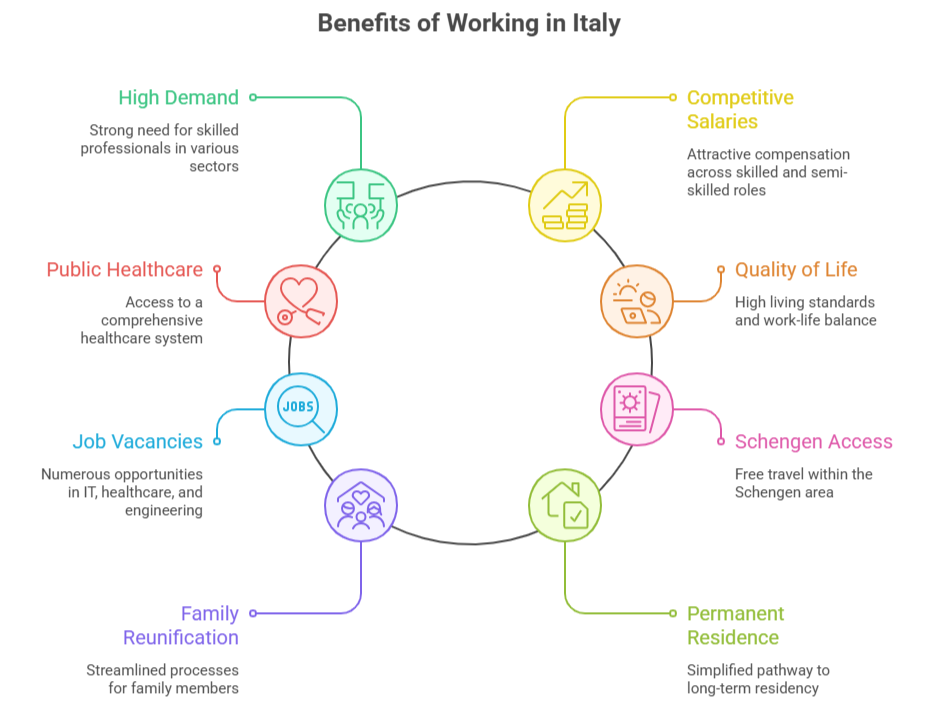
The benefits of working in Italy are as follows:
- High demand for international skilled professionals in Italy’s regional job market.
- Competitive salaries across skilled and semi-skilled sectors.
- Access to the public healthcare system.
- High quality of life and strong work-life balance.
- High job vacancies across fields such as IT and technology, healthcare, engineering, manufacturing, and renewable energy.
- Freedom of movement across all 26 Schengen Area countries.
- Streamlined family reunification and dependent laws.
- Simplified pathway to permanent residence in 5 years.
Also, read...
Highest Paying Job Opportunities in Italy
In-demand jobs in Italy for Indians
Italy offers significant opportunities for Indian professionals, as the country faces a skills shortage. Indian workers can target sectors such as IT and technology, healthcare, engineering, manufacturing, and renewable energy, which are in high demand due to digital transformation and infrastructure development. The local job market in Italy attracts foreign nationals by offering competitive salaries, work-life balance, and pathways to long-term residency.
| Sector | In-Demand Roles | Avg. Monthly Salary (EUR) | Approx. in INR | Qualification Required |
|---|---|---|---|---|
| IT & Technology | Software Engineer, Data Analyst, Cloud Architect, Cybersecurity Specialist, DevOps Engineer, AI/ML Engineer | €3,900–€5,300 | ₹3.5L–₹4.8L | Bachelor's/Master's in CS, IT or related |
| Healthcare & Medicine | General Physician, Specialist Doctor, Registered Nurse, Radiologist, Physiotherapist, Pharmacist | €2,900–€6,000 | ₹2.6L–₹5.5L | Medical degree + Italian authorisation (ENPAM/Order registration) |
| Finance & Banking | Financial Analyst, Risk Manager, Investment Banker, Auditor, Compliance Officer | €4,200–€6,000 | ₹3.8L–₹5.5L | Finance/Economics degree; CFA/CPA preferred |
| Engineering (Civil & Mechanical) | Civil Engineer, Mechanical Engineer, Structural Engineer, Project Manager, Automation Engineer | €3,300–€4,500 | ₹3.0L–₹4.1L | Bachelor's/Master's in Engineering |
| Renewable Energy | Solar/Wind Technician, Energy Engineer, Environmental Engineer, Energy Project Manager, Sustainability Consultant | €3,200–€4,500 | ₹2.9L–₹4.1L | Engineering/Energy degree + relevant experience |
| Manufacturing & Industry 4.0 | Production Engineer, Robotics Technician, Mechatronics Engineer, Quality Control Manager, Industrial Designer | €3,000–€4,200 | ₹2.7L–₹3.8L | Engineering/Technical degree or vocational qualification |
| Construction & Trades | Electrician, Plumber, Carpenter, Site Engineer, Quantity Surveyor, Civil Contractor | €2,500–€3,500 | ₹2.3L–₹3.2L | Vocational certificate or trade qualification |
| Education & Research | University Lecturer, Postdoctoral Researcher, STEM Teacher, Academic Researcher | €2,300–€3,200 | ₹2.1L–₹2.9L | Master's/PhD; Italian language often required |
| Logistics & Supply Chain | Supply Chain Manager, Freight Coordinator, Warehouse Supervisor, Procurement Officer, Transport Planner | €2,500–€3,500 | ₹2.3L–₹3.2L | Degree in Logistics/Business or equivalent experience |
| Tourism & Hospitality | Hotel Manager, Chef, F&B Director, Tourism Coordinator, Event Manager | €2,200–€3,500 | ₹2.0L–₹3.2L | Hospitality/Tourism degree or vocational training |
| Agriculture & Agri-food | Agronomist, Food Processing Technician, Food Safety Inspector, Agricultural Specialist | €2,200–€3,000 | ₹2.0L–₹2.7L | Agriculture/Food Science degree or vocational training |
| Architecture & Design | Architect, Interior Designer, Urban Designer, BIM Specialist, Sustainable Building Designer | €2,800–€4,000 | ₹2.5L–₹3.6L | Architecture/Design degree + portfolio |
Also, read...
Italy Job Market: Trends and Opportunities
How to find a job in Italy from India?
To secure a job in Italy from India, you need to target high-demand sectors for greater opportunities. Some of the in-demand sectors in Italy include IT, engineering, and tourism, offering competitive pay and steady career growth.
The steps to secure a job in Italy are as follows:
Step 1: Target sectors such as IT, engineering, healthcare, agriculture, and tourism/hospitality that have high numbers of job vacancies for foreign applicants.
Step 2: Draft a comprehensive resume that highlights your work experience, qualifications, and skills to meet Italian market standards.
Step 3: Create your professional profile on job search websites like LinkedIn and Indeed, and upload your CV.
Step 4: Apply for jobs in your field that match your expectations and qualifications.
Step 5: Network with professionals in Italy to increase your chances of getting hired.
Step 6: Appear for the virtual interviews for the shortlisted roles.
Step 7: Upon job confirmation, the employer will initiate the work permit (Nulla Osta) application.
Step 8: After the work permit is approved, apply for the Italian work visa from India.
Step 9: Await work visa approval to migrate to Italy legally.
Step 10: Once you arrive in Italy, apply for a Permesso di Soggiorno (residence permit) within 8 days.
Also, read...
How can I get a job in Italy from India?
Italy work visa for Indians
Multiple Italy work visas are available for Indian professionals wanting to explore the Italian job market. Skilled, seasonal, and self-employed professionals are eligible for different types of work permits based on qualification, experience, skills, and field of work. Professionals must qualify for Italy’s annual Decreto Flussi quota system, which highlights jobs across major in-demand sectors. An EU Blue Card offers faster processing, higher salary thresholds, and a pathway to long-term EU residency for highly qualified foreign nationals in IT, engineering, healthcare, and finance.
The table below has eligibility requirements, validity periods, and processing timelines for different Italian work permits/visas.
| Permit Type | Who It's For | Eligibility Criteria | Validity Period | Processing Time | Renewable? |
|---|---|---|---|---|---|
| Standard Subordinate Work Permit (Nulla Osta + Type D Visa) | Employed non-EU workers in most sectors (construction, manufacturing, logistics, caregiving, etc.) | Confirmed job offer; employer applies for Nulla Osta via the Sportello Unico; subject to annual Decreto Flussi quota system | Up to 2 years (tied to employment contract) | 2–3 months (quota waitlists can extend this significantly) | Yes — renewable with continued employment; can lead to PR after 5 years |
| EU Blue Card (Carta Blu UE) | Highly skilled professionals in IT, engineering, healthcare, finance, etc. | Tertiary degree or 5 years' relevant experience + job offer paying at least €35,000 gross/year (1.5× national average); outside Decreto Flussi quota | Up to 2 years (open-ended contract); otherwise contract duration | 1–3 months | Yes — extendable; pathway to EU long-term residency after 5 years |
| Seasonal Work Permit | Workers in agriculture and tourism/hospitality | Job offer for seasonal role; no degree required; subject to annual quota (~110,000 slots last year) | Up to 9 months per year | 4–8 weeks | No — must reapply each season; same employer may rehire the following year |
| Self-Employment / Freelance Permit | Freelancers, consultants, business owners, entrepreneurs | Proof of professional licences, financial self-sufficiency, viable business plan; small dedicated quota (730 slots last year); must comply with Italian professional regulations | Up to 2 years | 2–4 months | Yes — extendable if business/activity is ongoing |
| Intra-Company Transfer Permit (Art. 27 — ICT) | Managers and specialists transferred within a multinational company to its Italian branch | Must have worked with the company for at least 3 months; senior/specialist role; quota-exempt under Art. 27 of the Immigration Act | Up to 2 years | 3–8 weeks | Yes — with continued employment at the same company |
| Researcher / Academic Permit (Art. 27 — Researcher Visa) | Academics, scientists & researchers invited by Italian universities or institutions | Hosting agreement with a recognised Italian research institution; advanced qualifications (usually PhD or equivalent); quota-exempt | Up to 2 years (extendable per project duration) | 4–8 weeks | Yes — extendable based on research project |
| Digital Nomad / Remote Worker Visa | High-skilled remote workers employed by non-Italian companies or clients | Proof of remote employment/freelance contracts; income at least 3× Italy's healthcare co-pay exemption threshold (~€28,000/year); private health insurance; 6+ months prior remote work experience; outside Decreto Flussi quota | 1 year | 4–10 weeks | Yes — renewable if conditions persist |
| Startup Visa | Non-EU entrepreneurs launching an innovative startup in Italy | Detailed business plan approved by an expert committee; evidence of innovation and funding; quota-exempt | Up to 1 year | 30 days (fast-track committee review) | Yes — convertible to self-employment permit if startup is active |
Also, read...
Italy to Grant 500,000 Work Visas in 2026-28. Apply now!
Eligibility requirements for an Italy work visa
To obtain the Nulla Osta (work authorization) from the local immigration office (Sportello Unico per l'Immigrazione ). Your application must fall within the annual Decreto Flussi quota limits.
The eligibility criteria to apply for an Italy work visa are as follows:
- Valid job offer letter/employment contract.
- Work permit (Nulla Osta) issued by the Sportello Unico per l'Immigrazione (SUI).
- Meet the Annual Decreto Flussi quota.
- Relevant educational degree/diploma.
- Professional work experience.
- Proof of sufficient funds.
- Proof of accommodation (hotel booking receipt/rental agreement).
- Minimum insurance coverage of EUR 30,000.
- Valid passport.
*Want to work in Italy? Sign up with Y-Axis for end-to-end assistance.
How to apply for an Italy work visa from India?
To apply for an Italian work visa from India, you first need to secure a valid job offer for the Nulla Osta (work permit). Upon securing the work permit, you can apply for the work visa by submitting the visa application along with the required documents, such as a job offer letter, proof of funds, accommodation, and insurance coverage.
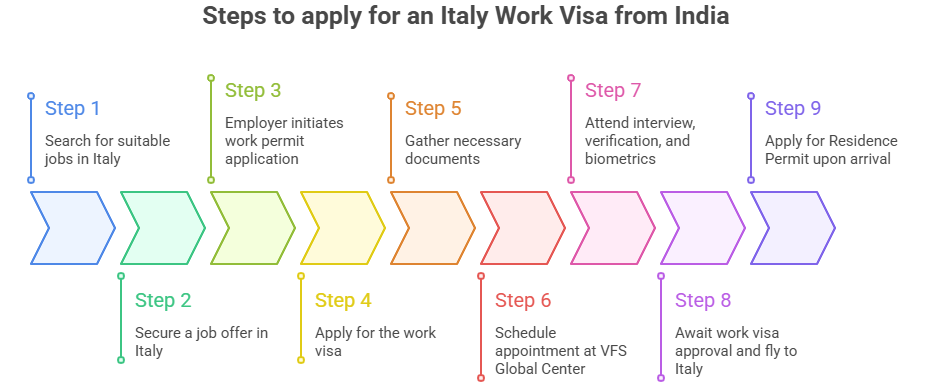
The steps to apply for an Italy work visa are as follows:
Step 1: Search for suitable jobs in Italy based on your work experience, field of expertise, and educational qualifications.
Step 2: Secure a job offer in Italy through reliable job search platforms that align with minimum income standards and your expectations.
Step 3: Upon job confirmation, the employer initiates the process of application for the work permit (Nulla Osta).
Step 4: Once your work permit is approved, apply for the work visa.
Step 5: Gather the necessary documents, such as a work permit (Nulla Osta), passport, proof of funds, accommodation, insurance, etc.
Step 6: Schedule an appointment at the nearest VFS Global Center in India.
Step 7: Appear for the interview, document verification, and biometrics on the scheduled date.
Step 8: Await work visa approval, fly to Italy.
Step 9: Upon arrival, apply for a Residence Permit (Permesso di Soggiorno) to work and stay legally in Italy.
*Are you looking for step-by-step assistance with overseas immigration? Contact Y-Axis, the world’s No. 1 overseas immigration consultancy, for end-to-end assistance!
FAQs
Is Italy currently hiring foreign workers?
Yes, Italy is actively hiring foreign workers to meet rising labor demand. The country plans to issue nearly 500,000 work visas between 2026 and 2028, mainly targeting sectors such as construction, tourism, healthcare, and agriculture.
Which are the most in-demand jobs in Italy?
The most in-demand jobs in Italy are in technology, healthcare, and engineering. High-paying roles include AI engineers, software developers, nurses, and specialized technicians with strong technical skills.
Is it easy for Indians to find a job in Italy?
Yes, it is relatively easier due to high job vacancies and workforce shortages. Indian professionals in IT, engineering, healthcare, and hospitality have good opportunities, especially with strong skills and language proficiency.
Can Indians apply for Italy work visas without a job offer?
No, a valid job offer is mandatory. The Italian work visa process is employer-driven and requires an employment contract and a work permit (Nulla Osta).
What documents are required for an Italy work visa from India?
The required documents include:
- Work authorization/permit (Nulla Osta).
- Educational degree or diploma.
- Proof of work experience.
- Signed employment contract.
- Proof of accommodation.
- Proof of financial funds (bank statements).
- Travel insurance (minimum €30,000 coverage).
- Valid passport.
What qualifications do I need to work in Italy?
You need a relevant educational qualification, technical skills, and professional experience in your field. Academic documents must be legalized (apostilled), and Indian applicants may need a Declaration of Value (DOV) and work experience verification from the Italian Consulate.
What is the average salary of foreign workers in Italy?
The average salary ranges between €30,000 and €32,500 annually. Entry-level roles typically offer €1,000–€1,700 per month, while experienced professionals earn significantly higher depending on the industry and location.
Which cities in Italy are best for Indian workers?
Cities like Rome, Milan, Turin, and Bologna offer strong job opportunities. Regions like Lombardy have large Indian communities, while cities such as Brescia and Verona are preferred for lower living costs.
How long does it take to get an Italy work visa from India?
An Italy work visa (National Visa D) usually takes 3 to 6 weeks to process after application submission. Timelines may vary depending on work permit approval and document verification.
What is the success rate for an Italy work visa from India?
The success rate is high for applicants with a valid job offer and approved work permit. Italy plans to approve 500,000 work permits under the Decreto Flussi program between 2026 and 2028, increasing opportunities for foreign workers.
Tags:
working in Italy
work in Italy
in-demand jobs in Italy
Italy work visa for Indians
Italy work visa
Italy work visa from India
Italy immigration
migrate to Italy
highest-paying jobs in Italy
jobs in Italy for Indians
Share
Options for you by Y-Axis

Get it on your mobile

Get News alerts

Contact Y-Axis
Latest Article
Popular Post
Trending Article

Posted On October 13 2026
US Green Card Crackdown: What Indian IT Workers Need to Know