

Posted on May 30 2026
Job Seeker Visa vs Work Visa vs Student Visa: Which Route Is Fastest to Get PR for Indians?

By , Editor & Director
Updated May 31 2026
For millions of Indians aspiring to build a better future abroad, Permanent Residency (PR) remains the ultimate immigration goal. Whether it is securing long-term career opportunities in Canada, gaining access to high-paying jobs in Australia, or settling in Europe for a better quality of life, PR offers stability, global mobility, and long-term security for individuals and families alike. India continues to be one of the world’s leading sources of international migrants. According to global migration estimates, more than 18.5 million people of Indian origin were living overseas, with migration numbers expected to rise steadily in the coming years. As international mobility grows, so does one critical question among aspiring migrants:
Among the most popular immigration pathways for Indians are the Job Seeker Visa, Work Visa, and Student Visa routes. Each pathway comes with its own advantages, processing timelines, financial requirements, employment opportunities, and PR prospects. However, choosing the wrong route can significantly delay settlement plans, increase overall costs, and reduce PR success chances. This guide provides a detailed comparison of all three immigration pathways, including their PR timelines, costs, risks, eligibility requirements, and country-specific opportunities across top destinations such as Canada, Australia, Germany, the UK, and Ireland. Whether you are a working professional, a recent graduate, or someone planning to migrate with family, this article will help you identify the most suitable and fastest PR route based on your profile and long-term goals.
*Are you willing to move abroad? To make an informed decision, Sign up with Y-Axis
What Is Permanent Residency (PR)?
Permanent Residency (PR) is a legal immigration status that allows foreign nationals to live, work, and settle in a country indefinitely without becoming citizens. For many Indians planning to migrate abroad, PR is considered the most important long-term immigration milestone because it provides stability, career flexibility, and access to several benefits that are not available on temporary visas.
Unlike work permits or student visas, Permanent Residency allows individuals to stay in the country without depending on an employer, university, or temporary sponsorship. PR holders can usually work for any employer, change jobs freely, start businesses, and enjoy many of the same rights and benefits as citizens, except voting rights and certain government positions.
One of the biggest advantages of Permanent Residency is the opportunity to build a secure future abroad for the entire family. In most countries, PR holders can sponsor their spouse, dependent children, and in some cases parents for migration. Many PR programs also provide access to public healthcare systems, social security benefits, education support, and long-term settlement opportunities.
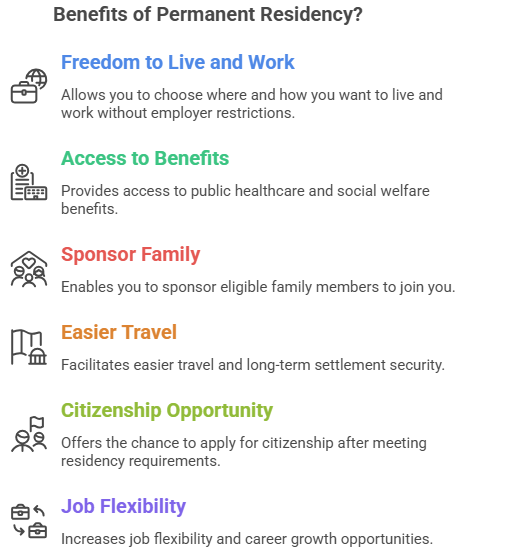
Some of the major benefits of Permanent Residency include:
- Freedom to live and work without employer restrictions
- Access to public healthcare and social welfare benefits
- Ability to sponsor eligible family members
- Easier travel and long-term settlement security
- Opportunity to apply for citizenship after meeting residency requirements
- Greater job flexibility and career growth opportunities
The main difference between Permanent Residency and citizenship is that PR holders continue to retain their Indian citizenship and passport, while citizens acquire the nationality of the host country. For many Indians, PR serves as a practical long-term settlement option, with citizenship becoming an optional future step depending on personal and professional goals.
*Planning to apply for PR abroad? Get expert guidance from Y-Axis
Understanding the Three Main Visa Routes to PR
Job Seeker Visa
A Job Seeker Visa is a visa that allows skilled professionals to enter a country and search for a job without having a job offer before travelling. In Germany, this visa is also known as the Opportunity Card or Chancenkarte. This visa route is becoming popular among Indian professionals who want to explore international job opportunities and later apply for Permanent Residency (PR).
Countries Offering Job Seeker Visas
Some of the popular countries offering Job Seeker Visas include:
- Germany
- Austria
- Portugal
- Sweden
How Does a Job Seeker Visa Work?
Under this route, applicants must show their educational qualifications, work experience, language skills, and proof of financial funds to support themselves during their stay. Once the visa is approved, the applicant can travel to the country and search for a job within the allowed period. After securing employment, the Job Seeker Visa can usually be converted into a Work Permit or EU Blue Card. After working legally for a few years, applicants may become eligible to apply for Permanent Residency.
Risks Involved in the Job Seeker Visa Route
Although the Job Seeker Visa can be a good pathway to PR, it also comes with certain risks:
- There is no guaranteed job offer before travelling
- Living expenses during the job search period can be high
- Applicants must leave the country if they do not find a job within the allowed time
- Competition for skilled jobs can be strong in some sectors
PR Timeline Through the Job Seeker Visa Route
The average time to obtain Permanent Residency through the Job Seeker Visa pathway is usually around 4 to 8 years, depending on the country, work experience, salary level, and immigration rules.
Work Visa
A Work Visa is one of the most popular and reliable immigration pathways for skilled Indian professionals who want to settle abroad permanently. This visa is usually employer-sponsored or based on a points system, allowing applicants to move to another country with a confirmed job offer or through skilled migration programs. Compared to other immigration routes, the Work Visa pathway is often considered the fastest and safest route to Permanent Residency (PR) for experienced professionals.
Countries Offering Strong Work Visa PR Pathways
Many countries provide excellent PR opportunities through Work Visas, including:
- Canada
- Australia
- United Kingdom
- Ireland
- Germany (EU Blue Card)
How Does a Work Visa Work?
Under this route, applicants either:
- Secure a job offer from an overseas employer, or
- Apply through a points-based immigration system such as Canada’s Express Entry or Australia’s SkillSelect.
After arriving in the country, applicants work legally for a required number of years, usually between 2 and 5 years. Once they meet the work experience, salary, language, and residency requirements, they can apply for Permanent Residency.
PR Timeline Through the Work Visa Route
The average time to obtain Permanent Residency through the Work Visa pathway is generally around 2 to 5 years, depending on the country, occupation, salary level, and immigration program.
Student Visa
A Student Visa is a popular pathway for Indians who want to study abroad and later settle permanently in another country. After completing their education, students can apply for a Post-Study Work Permit (PSWP), gain local work experience, and later apply for Permanent Residency (PR). This route is especially suitable for fresh graduates and young professionals who want international education along with long-term settlement opportunities.
Countries Offering Strong Student Visa PR Pathways
Many countries provide good PR opportunities for international students, including:
- Canada
- Australia
- United Kingdom
- Ireland
- Germany
- New Zealand
Under this pathway, students first enroll in an approved degree or diploma program abroad. After completing their studies, they can apply for a post-study work permit that allows them to stay and work in the country. During this period, students gain local work experience, which improves their chances of qualifying for Permanent Residency through skilled migration programs. In most countries, students usually need 1 to 2 years of skilled work experience after graduation before becoming eligible for PR programs.
Tuition Costs for International Students
The cost of studying abroad depends on the country and university.
Average tuition fees are:
- Canada: CAD 15,000–30,000 per year
- Australia: AUD 20,000–45,000 per year
- United Kingdom: GBP 15,000–35,000 per year
Germany is one of the most affordable options because many public universities charge little or no tuition fees for international students.
PR Timeline Through the Student Visa Route
The average time to obtain Permanent Residency through the Student Visa pathway is usually around 3 to 6 years, depending on the country, study program, work experience, and immigration rules.
Comparative Overview: Job Seeker vs Work Visa vs Student Visa
| Factor | Job Seeker Visa | Work Visa | Student Visa |
|---|---|---|---|
| PR Speed | Medium (4–8 years) | Fast (2–5 years) | Medium-Fast (3–6 years) |
| Upfront Cost | Low | Medium | High |
| Risk Level | High | Low | Medium |
| Job Offer Required | No | Yes (in most cases) | No |
| Family Sponsorship | Limited | Yes | Yes (post-study) |
| Settlement Chances | Moderate | High | High |
| PR Timeline | 4–8 years | 2–5 years | 3–6 years |
| Best For | Budget-conscious applicants | Experienced professionals | Fresh graduates |
| Top Countries | Germany, Austria, Portugal | Canada, Australia, UK, Ireland | Canada, Australia, Germany, UK |
Which Route Is Fastest for PR by Country?
Canada PR
Canada continues to be one of the most preferred PR destinations for Indians. With more than 427,000 Indian students and a large number of skilled professionals already living there, Canada offers several pathways to Permanent Residency. The fastest PR route in Canada depends on your education, work experience, and career profile.
Work Visa Route (Fastest for Skilled Professionals)
For experienced professionals, the Work Visa route is usually the fastest way to get PR in Canada.
Canada’s Express Entry system is one of the world’s fastest and most popular immigration programs. It includes:
- Federal Skilled Worker Program (FSWP)
- Canadian Experience Class (CEC)
- Federal Skilled Trades Program (FSTP)
Once applicants receive an Invitation to Apply (ITA), PR applications are usually processed within 6 to 8 months.
In 2026, Canada introduced category-based Express Entry draws targeting professionals in sectors such as:
- Healthcare
- STEM fields
- Skilled trades
- Transport
- French-speaking professions
- Senior management roles with Canadian experience
Indian professionals working in IT, healthcare, engineering, and technology are among the strongest candidates under Express Entry.
Student Visa Route
The Student Visa route is a popular option for fresh graduates and younger applicants.
Under this pathway, students:
- Study in Canada
- Apply for a Post-Graduate Work Permit (PGWP)
- Gain Canadian work experience
- Apply for PR through Express Entry
Canada allows many graduates to receive a PGWP for up to 3 years after completing eligible programs. Canadian work experience gives extra CRS points under Express Entry, which improves PR chances significantly. Usually, every year of Canadian work experience can add around 15 to 20 CRS points. The total PR timeline through the Student Visa route is usually around 4 to 6 years from the time of arrival in Canada.
*Want to apply for Canada PR? Get end-to-end Canada PR assistance from Y-Axis.
Australia PR
Australia is another leading PR destination for Indians. The country announced 185,000 PR places for 2026–27 and continues to attract skilled professionals and international students from around the world. Australia is also improving immigration processing systems to reduce waiting times for applicants.
Work Visa Route (Fastest Option)
The Work Visa route is currently the fastest pathway to PR in Australia for skilled professionals. Australia’s Specialist Skills Pathway for highly skilled workers is being processed very quickly, sometimes within 7 to 10 days. The Core Skills Pathway usually takes around 3 to 6 months.
The most popular PR visa programs include:
Australia currently has strong demand for professionals in sectors such as:
- Healthcare
- Information Technology (ICT)
- Engineering
- Construction
- Science
- Education
Applicants with work experience in these sectors usually have better PR opportunities.
*Want to apply for Australia PR? Get end-to-end Australia PR assistance from Y-Axis.
Student Visa Route
Australia’s Student Visa pathway is also popular among Indian students. After graduation, students can apply for the Temporary Graduate Visa (Subclass 485), which allows them to stay and work in Australia for 2 to 4 years depending on their qualification and age. After gaining 1 to 2 years of skilled work experience, applicants can apply for PR through Australia’s SkillSelect system.Australia also introduced a new automated immigration processing system in March 2026 to reduce visa processing times for students and workers. The total PR timeline through the Student Visa route is usually around 4 to 6 years from arrival in Australia.
Germany PR
Germany is becoming one of the fastest PR destinations in Europe for skilled Indian professionals. The country offers strong job opportunities, affordable education, and one of the quickest PR pathways through the EU Blue Card system.
Work Visa / EU Blue Card Route (Fastest Route in Europe)
Germany’s EU Blue Card is currently one of the fastest ways to get Permanent Residency in Europe.
To qualify, applicants usually need:
- A recognized degree
- A job offer in Germany
- A minimum salary of around €50,700 per year
- Around €45,934 per year for shortage occupations such as IT, engineering, and healthcare (from January 2026)
The PR timeline depends on German language skills:
- With B1-level German: PR possible in 21 months
- With A1-level German: PR possible in 27 months
- Without German language skills: PR possible in 33 months
Germany is especially attractive for Indian professionals working in IT, engineering, healthcare, and technical fields because of the country’s high demand for skilled workers.
Student Visa and Opportunity Card Route
Germany is also popular among Indian students because many public universities offer low-cost or tuition-free education.
Under this route, students:
- Study in Germany
- Apply for an 18-month Job Seeker Visa after graduation
- Find a job and switch to an EU Blue Card
- Apply for Permanent Residency later
This pathway is often called a “low-cost PR route” because education expenses in Germany are much lower compared to countries like Canada, Australia, or the UK. The total timeline from arrival in Germany to PR is usually around 3.5 to 4 years.
*Want to apply for EU Blue Card? Contact Y-Axis for end-to-end support
United Kingdom ILR
The United Kingdom continues to be a popular destination for Indian students and skilled professionals, especially in healthcare, IT, finance, and engineering sectors.
Work Visa Route (Fastest Option)
The Skilled Worker Visa is the main pathway to long-term settlement in the UK.
To qualify, applicants generally need:
- A job offer from an approved UK employer
- A minimum salary of around £41,700 per year
- A graduate-level skilled job
- Required English language proficiency
From January 2026, applicants must meet B2-level English language requirements for Skilled Worker Visas. After living and working in the UK continuously for 5 years on a Skilled Worker Visa, applicants can apply for Indefinite Leave to Remain (ILR), which is the UK equivalent of Permanent Residency.
Student Visa Route
The UK is also a major destination for Indian students. After graduation, international students can stay and work under the Graduate Route. As of December 2026:
- Bachelor’s graduates can stay for up to 18 months
- Master’s graduates can stay for up to 18 months
However, time spent under the Graduate Route does not directly count toward Permanent Residency. Most graduates later switch to a Skilled Worker Visa to continue their long-term stay in the UK. The total PR timeline through the Student Visa route is usually around 7 to 8 years from the start of studies.
*Want to apply for UK ILR? Contact Y-Axis for end-to-end support
Ireland PR
Ireland is becoming a fast-growing destination for Indian professionals, especially in technology, finance, healthcare, and pharmaceutical sectors.
Critical Skills Employment Permit Route (Fastest Option)
Ireland’s Critical Skills Employment Permit (CSEP) is one of the fastest PR pathways in Europe. This permit is designed for skilled professionals working in shortage occupations and earning at least €40,904 per year. After working in Ireland for about 21 months under the CSEP, applicants can apply for Stamp 4 permission, which is similar to Permanent Residency.
Stamp 4 gives several benefits, including:
- Freedom to work for any employer
- Ability to start a business
- No need for employer sponsorship
After 5 years of legal residence, applicants may also become eligible for Irish citizenship.
Student Visa Route (Stamp 1G)
Ireland also offers good opportunities for international students.
After graduation:
- Master’s and PhD graduates can stay and work for up to 24 months
- Bachelor’s graduates can stay and work for up to 12 months
Students can later switch to work permits and continue their PR journey. The total PR timeline through the Student Visa route is usually around 5 to 7 years.
*Want to apply for an Ireland work visa? Contact Y-Axis to help you with the process
Which Pathway Offers the Best PR Opportunities?
For Fresh Graduates
For fresh graduates and young applicants, the Student Visa route is usually the best option for building a long-term future abroad. Studying in another country helps students gain internationally recognized qualifications, improve communication skills, and understand the local job market and work culture. It also gives them the opportunity to build professional connections and gain local work experience after graduation, which greatly improves PR chances. Countries like Canada, Australia, and Germany currently offer some of the strongest study-to-PR pathways for Indian students.
For Experienced IT and Tech Professionals (3–8 Years of Experience)
Experienced professionals working in IT, software, engineering, healthcare, and other skilled sectors usually benefit the most from the Work Visa route. Countries such as Canada, Ireland, and Germany actively look for skilled foreign workers to fill labor shortages in important industries. Programs like Canada’s Express Entry, Ireland’s Critical Skills Employment Permit, and Germany’s EU Blue Card are designed to attract professionals with strong work experience and technical skills. Applicants with good language scores and occupations in high demand can often achieve PR within 2 to 3 years.
For Budget-Conscious Applicants
For applicants who want an affordable migration pathway, Germany’s Job Seeker Visa or Opportunity Card is one of the best options. Germany offers low-cost or tuition-free education at many public universities, and the overall cost of living is lower compared to countries like Canada, Australia, or the UK. This makes Germany a popular destination for Indians who want to migrate abroad without spending large amounts on tuition fees or immigration expenses.
For Families
Applicants planning to move abroad with their spouse and children usually find Work Visa pathways in Canada and Australia more suitable. These countries offer family-friendly immigration systems with benefits such as public healthcare, access to schools for children, and dependent visa options for spouses. In many cases, spouses are also allowed to work full-time, making it easier for families to settle comfortably and build a stable future abroad.
For Faster Settlement and PR
If the main goal is to get Permanent Residency as quickly as possible, Work Visa pathways in Canada and Australia are generally the fastest and most reliable options. Skilled professionals with strong CRS scores, relevant work experience, and occupations listed under skill shortage categories often receive faster invitations and processing. In many cases, eligible applicants can obtain PR within 2 to 3 years through skilled migration programs.
PR Timeline Comparison by Visa Type
The total time required to get Permanent Residency depends on the visa type, country, and immigration program.
| Visa Type | Initial Visa Processing | Work Permit After Arrival | PR Processing Time | Total PR Timeline |
|---|---|---|---|---|
| Germany Job Seeker Visa | 4–8 weeks | 2–4 weeks | 21–33 months | Around 4–8 years |
| Canada Work Visa | 6–8 months | Not required for direct PR | Included in process | Around 2–4 years |
| Australia Work Visa | 3–6 months | Not required | 6–12 months | Around 2–4 years |
| Ireland Critical Skills Permit | 6–8 weeks | Not required | Around 21 months after employment | Around 2–3 years |
| Germany EU Blue Card | 4–8 weeks | Not required | 21–33 months | Around 3–4 years |
| Canada Student Visa | 4–8 weeks | PGWP: Around 20 weeks | 6–8 months | Around 4–6 years |
| Australia Student Visa | 4–8 weeks | Subclass 485: 4–6 weeks | 6–12 months | Around 4–6 years |
| UK Skilled Worker Visa | 3–8 weeks | Not required | Eligible for ILR after 5 years | Around 5–6 years |
| New Zealand Accredited Employer Work Visa | 4–8 weeks | Not required | 6–12 months after eligibility | Around 3–5 years |
| Portugal D3 Highly Qualified Activity Visa | 30–90 days | Residence permit after arrival | Eligible after 5 years | Around 5–6 years |
| Canada Provincial Nominee Program (PNP) | 6–12 months | Not required | 6–8 months after nomination | Around 2–4 years |
Common Mistakes Indians Make When Choosing a PR Route
- Choosing a Study Destination Without a PR Plan: Many Indian students choose universities based only on rankings, city preference, or course popularity without checking whether their field of study is in demand in that country. If the occupation is not listed under skilled shortage categories, getting a job and qualifying for PR later can become much more difficult.
- Ignoring Occupation Demand: Countries like Canada and Australia regularly update their skilled occupation lists based on labor shortages. Applicants working in high-demand occupations usually have better chances of getting invitations for PR. Applying without checking whether your profession is eligible can reduce your PR opportunities.
- Spending Too Much Without ROI Planning: Some applicants spend ₹50–60 lakh on expensive study programs without properly calculating the return on investment. In many cases, countries like Germany or Canada may offer faster and more affordable PR pathways compared to other expensive destinations.
- Weak IELTS or PTE Scores: Strong English language scores are important for most PR programs. Countries such as Canada, Australia, and the UK use IELTS or PTE scores to assess eligibility and ranking. Low scores can reduce CRS points, delay applications, or lower PR chances.
- Not Having a Long-Term PR Strategy: One of the biggest mistakes is treating study abroad or work abroad as a short-term decision instead of planning it as a long-term PR journey. Successful migration requires proper planning around education, occupation demand, language skills, work experience, and settlement opportunities.
Which Route Has the Highest PR Success Rate?
Based on recent immigration trends and 2026 updates, the Work Visa route currently has the highest PR success rate for Indians. This is mainly because applicants already have a job offer or employer sponsorship, which shows that their skills are needed in the country. Most countries also give higher priority to skilled professionals working in occupations facing labor shortages, leading to faster processing and stronger PR opportunities. The Student Visa route is generally considered the safest option for fresh graduates and younger applicants. Studying in the destination country helps students gain local qualifications, improve language skills, and build work experience, all of which increase PR chances significantly. Countries like Canada, Australia, Germany, and Ireland offer strong study-to-PR pathways for international students.
The Job Seeker Visa route has more uncertainty compared to the other pathways because applicants enter the country without a confirmed job offer. Success depends on finding employment within the allowed period. However, for skilled professionals in STEM fields such as IT, engineering, healthcare, and technology, Germany’s Opportunity Card combined with the EU Blue Card can still provide a relatively fast pathway to PR, often within four years. Across all visa routes, the three biggest factors that improve PR success are having an occupation that is in demand, gaining local work experience, and achieving strong language proficiency scores.
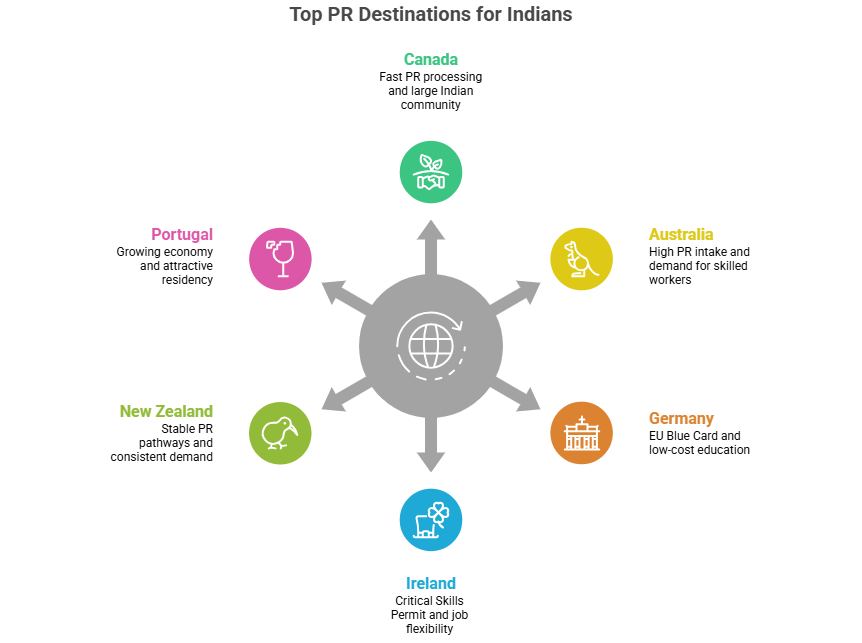
Top Countries Offering Easy PR Pathways for Indians
- Canada: Canada continues to be one of the best destinations for Indians seeking Permanent Residency. The country offers one of the world’s most popular immigration systems through Express Entry, with PR processing often completed within 6 to 8 months after receiving an Invitation to Apply (ITA). Canada also has a large Indian student and professional community, making settlement easier for new migrants.
- Australia: Australia remains a top choice because of its high PR intake targets and strong demand for skilled workers. The country announced 185,000 PR places for 2026–27 and offers fast processing for highly skilled professionals. Sectors such as healthcare, IT, engineering, construction, and education continue to have strong demand.
- Germany: Germany is becoming one of Europe’s fastest-growing PR destinations for Indians. The EU Blue Card allows eligible skilled workers to apply for PR in as little as 21 months with the required German language skills. Germany is also attractive because many public universities offer low-cost or tuition-free education, making it popular among Indian students.
- Ireland: Ireland has become a strong PR destination for Indian professionals working in technology, healthcare, finance, and pharmaceuticals. The Critical Skills Employment Permit allows eligible professionals to obtain Stamp 4 permission in around 21 months, providing greater job flexibility and long-term settlement opportunities.
- New Zealand: New Zealand offers stable and reliable PR pathways through its Skilled Migrant Category and Accredited Employer Work Visa programs. The country has consistent demand for professionals in healthcare, engineering, construction, and information technology.
- Portugal: Portugal is gaining popularity among Indian professionals and entrepreneurs because of its growing economy, quality of life, and attractive residency options. Programs such as the D3 Highly Qualified Activity Visa provide good long-term settlement opportunities for skilled workers and business professionals.
Final Thoughts
The best PR pathway depends on your age, work experience, budget, and long-term goals. For experienced professionals, the Work Visa route remains the fastest and most reliable option, especially in countries like Canada, Australia, Germany, and Ireland. For fresh graduates, the Student Visa pathway offers strong long-term settlement opportunities through local education and work experience. Meanwhile, Germany’s Job Seeker Visa can be a good low-cost option for skilled professionals willing to explore opportunities in Europe.
No matter which route you choose, factors such as occupation demand, language scores, work experience, and proper planning play a major role in PR success. Choosing the right pathway early can help save time, reduce costs, and improve your chances of settling abroad successfully.
*Planning to move abroad with a PR visa? Get expert guidance from Y-Axis, world’s number 1 immigration consultancy, and discover the fastest, safest, and most suitable PR pathway based on your profile, career goals, and budget.
FAQs
Which visa is best for PR for Indians?
The Work Visa is the best option for experienced Indian professionals seeking PR abroad. It offers the fastest PR timelines, especially in Canada, Australia, Ireland, and Germany. Work visa holders enter the job market directly, saving both time and money compared to the student route. For fresh graduates with no foreign work experience, the Student Visa provides a structured and reliable path to PR through post-study work permits and local work experience. Your age, qualifications, and years of experience determine which route suits you best.
Is the work visa better than the student visa for getting PR?
Yes, for experienced professionals, the work visa is faster and more cost-effective for PR. You skip expensive tuition fees and enter the workforce directly, earning a salary while building PR eligibility. However, for candidates with no foreign work experience or qualifications not yet recognised abroad, the student visa builds local credentials, language skills, and professional networks needed to qualify for PR. Both routes are effective, the right choice depends entirely on your current profile and your long-term immigration and settlement goals.
Which country gives PR the fastest for Indians?
Ireland and Germany are the fastest PR countries for Indians in 2026. Ireland's Critical Skills Employment Permit and Germany's EU Blue Card both allow eligible professionals to apply for PR in approximately 21 months of employment. Canada is also very fast — its Express Entry system processes PR applications within 6 to 8 months after an Invitation to Apply is issued. The fastest option for you depends on your occupation, language skills, and whether you prefer an English-speaking or European destination.
Can Indians get PR without IELTS?
Yes, some countries offer PR without IELTS for specific visa categories. Germany's EU Blue Card does not require IELTS — instead, German language skills are needed for long-term settlement. However, Canada, Australia, the United Kingdom, Ireland, and New Zealand require English proficiency test scores for most skilled migration pathways. The minimum score required varies by visa subclass and destination country. It is important to check the exact language requirements for your chosen country and visa category before applying, as these requirements change regularly.
Is Germany's job seeker visa worth it for Indians?
Yes, Germany's Opportunity Card is one of the best low-cost entry routes to Europe for Indian STEM and IT professionals. It requires no job offer at the time of application, making it accessible even without employer connections abroad. Combined with the EU Blue Card, PR in under four years is achievable without the high tuition fees of English-speaking destinations like Canada or Australia. The main challenge is finding employment within the permitted stay period, which requires strong preparation, job search skills, and some basic German language knowledge.
Which country has the easiest PR for Indians?
Ireland is considered one of the easiest PR pathways for Indian tech and pharma professionals due to its clear 21-month Stamp 4 route, English-speaking environment, and strong job market in technology and healthcare. Germany is the easiest option for STEM professionals comfortable with learning the German language, offering PR in 21 months via the EU Blue Card. Canada is also accessible through Express Entry for IT and healthcare professionals with strong language scores and work experience in high-demand occupations listed under category-based draws.
Can international students get PR easily?
Yes, international students in Canada, Australia, Ireland, and Germany have a strong chance of obtaining PR after completing their studies. The key is choosing a course aligned with each country's skilled occupation shortage lists. After graduating, students receive a post-study work permit that allows them to gain local work experience. This experience then strengthens their PR application significantly. Choosing the right course, gaining relevant employment experience, and maintaining strong English language scores are the three most important factors that determine whether a student successfully transitions to permanent residency.
Which visa route is cheapest for getting PR abroad?
The Job Seeker Visa through Germany is the most affordable PR route for Indians in 2026. Germany's public universities are largely tuition-free, and the blocked account requirement of approximately €13,092 is returned on arrival. Total PR investment through this route is significantly lower compared to student visa routes in the UK, Canada, or Australia, which can cost between ₹20 lakh and ₹60 lakh in tuition and living expenses. Germany's free education combined with the Opportunity Card makes it the best budget-friendly PR pathway available in Europe today.
Can I get PR without studying abroad?
Absolutely. The Work Visa route does not require a foreign degree at all. Canada's Federal Skilled Worker Program, Australia's Employer Nomination Scheme, and Ireland's Critical Skills Employment Permit all accept Indian degrees and professional work experience without any requirement for foreign study. Your Indian qualifications may need assessment by a recognised body in the destination country, but this is a standard process. Thousands of Indian professionals successfully obtain PR through work visa routes every year without having previously studied or lived abroad at any point.
How many years does it take for Indians to get PR in Canada?
Through Canada's Express Entry system, the total PR timeline for Indians typically ranges from 2 to 4 years for work visa applicants and 4 to 6 years for student visa applicants. Key factors that affect the timeline include your Comprehensive Ranking System score, your occupation's demand in Canada, whether you receive a Provincial Nomination, and how quickly you receive an Invitation to Apply. Applicants in IT, healthcare, and engineering tend to receive invitations faster due to category-based draws specifically introduced in 2026.
What is the PR timeline in Australia for Indians?
Australia's PR timeline for Indians depends on the visa pathway chosen. The Specialist Skills Pathway for highly qualified professionals can be processed in as little as 7 to 10 days. The Core Skills Pathway typically takes 3 to 6 months. For student visa holders, the total PR journey including post-study work experience usually takes 4 to 6 years from arrival. Australia's new automated immigration system, launched in March 2026, has significantly reduced processing times for skilled workers and international students applying across all visa categories.
Is the UK Graduate Route useful for Indian students seeking PR?
The UK Graduate Route gives international students 18 months of work rights after graduation, but this time does not count toward Indefinite Leave to Remain. To obtain PR in the UK, graduates must switch to a Skilled Worker Visa and complete 5 continuous years of residence. This makes the UK one of the slower PR destinations for Indian students, with a total timeline of 7 to 8 years from the start of studies. The UK works better as a PR route for experienced professionals applying directly on the Skilled Worker Visa.
Which visa route has the highest PR approval rate?
Work Visa routes consistently show the highest PR approval rates across all major destinations. Employer-sponsored or points-based applicants have pre-verified qualifications, confirmed job offers, and proven employment history, which significantly reduces the chances of application rejection. Student visa-to-PR conversions carry more risk because they depend on finding employment after graduation, meeting occupation demand criteria, and maintaining continuous residence throughout the process. If you have a relevant occupation and solid work experience, applying through a work visa route remains the most reliable and predictable path to permanent residency abroad.
What are the best occupations for fast PR?
The best occupations for fast PR vary by country. In Canada, IT professionals, healthcare workers, engineers, financial analysts, and French-speaking professionals receive the most invitations through Express Entry category-based draws. In Australia, nurses, engineers, IT specialists, teachers, and construction tradespeople are in strong demand. In Germany, IT engineers, medical professionals, and STEM researchers qualify easily for the EU Blue Card. In Ireland, technology specialists, pharmacists, doctors, and financial analysts are listed as priority occupations under the Critical Skills Employment Permit program.
Can a job seeker visa lead to PR in Europe?
Yes, the Job Seeker Visa can lead to PR in Europe. In Germany, the Opportunity Card allows Indian professionals to enter the country and search for employment for up to 12 months. Once employed in a qualifying role, they convert to an EU Blue Card and become eligible for PR in 21 to 33 months, depending on German language proficiency. Similar pathways exist in Austria and Portugal. The main risk is the uncertainty of finding employment without a confirmed job offer before arriving in the destination country.
What is the minimum salary required for PR in Germany?
The EU Blue Card minimum annual salary in Germany is €50,700 for general roles from January 2026. For shortage occupations including IT, engineering, and healthcare, the minimum is €45,934 per year. These salary thresholds are reviewed and updated periodically in line with Germany's national average wage. Meeting the salary requirement is one of the most important eligibility conditions for the EU Blue Card. Indian professionals in technology, software development, medical roles, and engineering typically meet these thresholds without difficulty based on current German job market salary levels.
📞 Call: +91-7670800000
📩 Email: info@y-axis.com
🌐 Visit: https://www.y-axis.com
Tags:
job seeker visa vs work visa
student visa vs PR pathway
fastest PR route for Indians
Canada PR through work visa
Germany opportunity card PR
Australia PR pathways
student visa to PR abroad
best country for PR for Indians
work visa PR process
immigration pathways for Indians
Share
Options for you by Y-Axis

Get it on your mobile

Get News alerts

Contact Y-Axis
Latest Article
Popular Post
Trending Article
Posted On October 13 2026
US Green Card Crackdown: What Indian IT Workers Need to Know