


Posted on May 31 2024
How to migrate to the UK as a doctor?

By , Editor
Updated January 27 2026
To migrate to the UK as a doctor, you need to have a General Medical Council (GMC) registration by passing the PLAB test (PLAB 1 or PLAB 2) or having a recognized post-graduation qualification or training pathway. Foreign doctors must meet specific English language proficiency requirements through language tests such as IELTS, OET, or other accepted evidence. You will also need to secure a valid NHS-approved job offer and a Certificate of Sponsorship (CoS), to apply for the UK Skilled Worker visa or Health and Care Worker visa.
*Want to work in the UK? Let Y-Axis guide you with the process.
UK Immigration Pathways for Doctors
The main UK immigration pathways for doctors include the Health and Care Worker visa or the standard Skilled Worker visa. To qualify for these visa pathways, you will generally require a GMC registration that can be done through the PLAB route or have a recognized post-graduate qualification, along with meeting the English Language proficiency requirements through IELTS or OET.
The UK also provides the Medical Training Initiative (MTI), which is a short-term clinical training pathway for overseas doctors, but it does not lead to permanent settlement in the UK. Doctors migrating to the UK must also have a valid job offer, along with a Certificate of Sponsorship (CoS), from a registered UK employer.
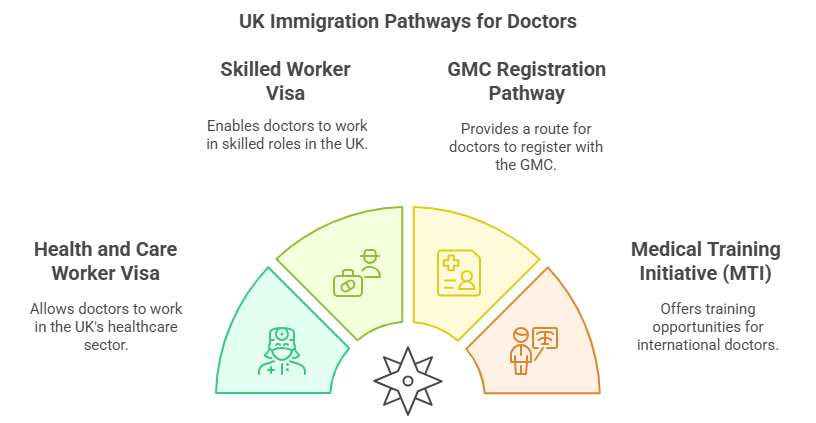
The UK immigration pathways for doctors are as follows:
Health and Care Worker Visa
The Health and Care worker visa is a fast-tracked pathway under the Skilled Worker visa, allowing skilled foreign doctors to migrate to the UK. The path enables doctors to pursue job opportunities in the UK through expedited processing times. The Health and Care Worker visa is primarily applicable for doctors working in NHS organisations, NHS supplier firms, and adult social care organisations. Through this visa pathway, medical experts can extend their settlement period (ILR) in the UK after 5 years.
How it works: Doctors must obtain a complete GMC registration, pass the PLAB test (unless exempt due to specific training), meet language proficiency standards, and secure a job offer with a Certificate of Sponsorship (CoS).
Benefits: The Health and Care Worker visa has comparatively lower processing fees, priority processing, and is exempt from the Immigration Health Surcharge.
Validity Period: A Health and Care worker visa is applicable for 5 years, after which it can be renewed to qualify for an Indefinite Leave to Remain (ILR).
*Want to apply for the Health and Care Worker visa? Let Y-Axis guide you with the steps.
UK Skilled Worker Visa
The Skilled Worker Visa is a standard UK immigration pathway for doctors and medical experts to seek opportunities in labour shortage sectors, such as healthcare, pharmaceuticals, aged care, and surgery. Doctors must have a GMC registration and meet the minimum salary requirements to apply for a Skilled Worker Visa. This immigration route enables doctors/physicians to find jobs in hospitals, private healthcare facilities, or research and academic medical organizations in the UK.
How it works: Doctors must secure a GMC registration, meet the minimum required salary thresholds as per the NHS pay scale or the “going rates” for that particular occupation, provide proof of qualification and language proficiency, followed by a CoS (Certificate of Sponsorship) from a licensed UK employer.
Benefits: The Skilled Worker visa enables doctors to secure employment across various medical sectors, including surgical units, aged care facilities, research laboratories, and academia.
Validity Period: A Skilled worker visa is granted for up to 5 years to doctors, although it can be extended through Indefinite Leave to Remain (ILR) based on job requirements.
*Want to apply for the UK Skilled Worker visa? Let Y-Axis guide you with the process.
GMC Registration and Medical Training Initiative (MTI) Pathways
The entry and eligibility pathways in the UK, such as GMC registration and the Medical Training Initiative (MTI), enable overseas doctors to meet the requirements for training or practicing in the UK. The GMC registration pathway is mandatory for foreign doctors wanting to practise in the UK, while an MTI is granted for short-term training programs for postgraduate doctors/practitioners.
General Medical Council (GMC) Registration Pathway
Overseas doctors wanting to migrate to the UK should obtain GMC (General Medical Council) registration to practice medicine in the UK legally. International Medical Graduates (IMGs) must meet specific educational qualifications, work experience, and training requirements set by the GMC. The eligibility routes for GMC registration are as follows:
- PLAB (Professional and Linguistic Assessments Board) tests: The PLAB 1 round is an MCQ (Multiple-choice question) round for written assessment, and the PLAB 2 round is for Clinical skills assessment.
- Approved Postgraduate Degree: PLAB is exempt for doctors holding a GMC-approved postgraduate degree or training.
- GMC-approved Sponsorship Pathways: Some eligible doctors can also qualify for registration through recognized GMC-approved sponsorship pathways.
Medical Training Initiative (MTI)
The Medical Training Initiative (MTI) program is a structured pathway for foreign postgraduate doctors to participate in a short-term clinical training program in the UK. The Medical Training Initiative (MTI) is ideal for doctors seeking international work experience, specialized training, and non-permanent employment in the UK.
- It is generally valid for up to 2 years (24 months)
- UK Royal Colleges sponsor the MTI.
- The MTI training programs or work experience are held within NHS hospitals.
- PLAB is usually not required for the MTI
- Uses a Temporary Work (Government Authorised Exchange) visa
- You must return to your home country after completion of your program.
- The Medical Training Initiative (MTI) program does not lead to PR, ILR, or long-term settlement in the UK.
Also, read…
What are the new UK Visa Rules in 2026?
Eligibility Criteria for Doctors to Migrate to the UK
To migrate to the UK as a doctor, you will require a GMC registration, a Certificate of Sponsorship (CoS), a job offer from a verified UK employer, sufficient funds, and meet the required salary thresholds.
The eligibility criteria for doctors to migrate to the UK are as follows:
- Mandatory GMC (General Medical Council) registration.
- Primary Medical Qualification (PMQ) from a verified medical institution as proof of a recognized degree/training.
- Proof of language proficiency (7.5 and 7.0 in each section for IELTS) and (Grade B for OET)
- Pass the PLAB tests (PLAB 1 or PLAB 2) or a postgraduate qualification or training pathway that the GMC approves
- Complete a 12-month internship program (3 months in medicine and 3 months in surgery are necessary).
- Valid job offer with a Certificate of Sponsorship (CoS) from a licensed UK employer
- Proof of sufficient funds (required based on the chosen visa category)
- Police Clearance Certificate.
- Valid passport.
*Looking to apply for doctor jobs in the UK? Avail Y-Axis Resume Marketing Services to find the right one.
Steps to Migrate to the UK as a Doctor
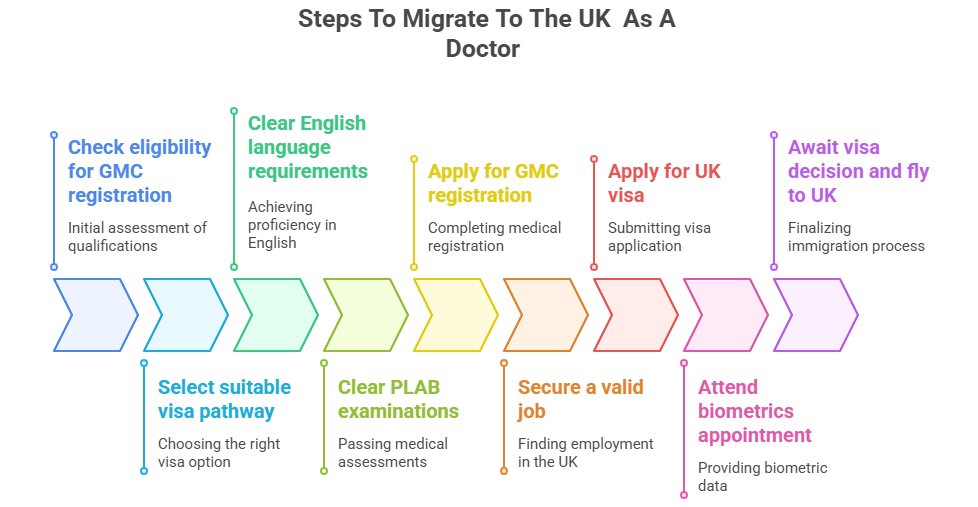
You can follow the steps below for UK immigration as a doctor:
Step 1: Check your eligibility for GMC registration based on your qualifications, training, and work experience.
Step 2: Select the suitable visa pathway for doctors based on your employment sector and job offer in the UK (Health and Care Worker and the UK Skilled Worker Visa)
Step 3: Clear the English language requirements through proficiency tests like IELTS (7.5 overall and 7.0 in each section), OET (Grade B in each section), or any other GMC-approved evidence.
Step 4: Clear the two PLAB (Professional and Linguistic Assessments Board) examinations, PLAB 1 (written exam) and PLAB 2 (clinical skills assessment); (PLAB is exempted for doctors with recognized postgraduate training or qualifications).
Step 5: Apply for GMC (General Medical Council) for complete registration, including a license to practice, and undergo an in-person identity check.
Step 6: Secure a valid job through the NHS or an NHS-approved organization, or any other licensed healthcare employer in the UK, along with a CoS.
Step 7: Apply for a UK Skilled Worker visa or Health and Care Worker visa, and submit necessary documents like a passport, CoS, English language proficiency test results, and a criminal record certificate.
Step 8: Attend the biometrics appointment (photographs and fingerprints)
Step 9: Await a visa decision and fly to the UK to start working as a doctor.
*Are you looking for step-by-step assistance with UK immigration? Contact Y-Axis, the world’s No. 1 overseas immigration consultancy, for end-to-end assistance!
FAQs
How can I register as a doctor in the UK from India?
To register as a doctor for legal practice rights, you need to get a GMC (General Medical Council) registration by providing proof of qualification/training and work experience. Doctors need to pass the PLAB (Professional and Linguistic Assessments Board) tests (or show evidence of an equivalent postgraduate qualification), take a language proficiency exam (IELTS/OET), and complete an internship in the relevant medical sector. It is necessary to secure a job through the NHS (National Health Service) or an NHS-approved organisation to apply for a Health and Care Worker visa to migrate to the UK as a healthcare professional.
What visa options are available for Indian doctors migrating to the UK?
Indian doctors wanting to migrate to the UK can apply through visa pathways such as the Health and Care Worker Visa and the standard Skilled Worker Visa. Doctors are eligible for these UK visa pathways, provided they have a valid job offer through the NHS or its associated organisations, which expedites the processing time and fees. Both the visa options require mandatory GMC registration for doctors to practice legally in the UK.
How long does it take to complete GMC registration and start working as a doctor in the UK?
GMC registration can take between 4 and 12 weeks for doctors migrating to the UK. The process may be delayed due to factors such as the volume of immigration applications and the complexity of the documents. Other necessary pre-verification procedures (such as EPIC for IMGs) can also delay the registration process. Foreign doctors applying with primary source verification (PSV) should begin the GMC registration process early, as the PSV portal offers only 90 days for application submission.
How to get sponsorship from UK healthcare employers as a doctor?
Doctors can seek sponsorship through UK healthcare employers by securing a job offer from a Home Office-approved sponsor, such as the NHS or an NHS-affiliated private organisation. To apply for immigration pathways in the UK for doctors, it is necessary to have a relevant education qualification, meet the minimum salary threshold, provide proof of language proficiency, and secure a CoS (Certificate of Sponsorship).
Can Indian doctors work in the UK without passing the PLAB exam?
Yes, Indian doctors can work in the UK without a PLAB test, provided they hold a GMC-recognised UK postgraduate qualification, such as MRCP (Membership of the Royal Colleges of Physicians) and MRCS (Membership of the Royal College of Surgeons). Other specific medical schemes, such as the BAPIO pathway, also enable Indian doctors to be exempted from PLAB for GMC registration. The alternative routes for GMC registration that exempt PLAB require a high level of educational qualification and focus on advanced skills for direct entry into specialised training programs.
What are the requirements for the Professional and Linguistic Assessments Board exam for UK doctors?
To appear for the Professional and Linguistic Assessments Board (PLAB) exam in the UK, doctors need to have a recognised medical degree, sufficient language proficiency (IELTS 7.5 overall/7.0 in sections or OET Grade B in all) and at least 12 months of postgraduate clinical experience (internship) verified and approved on the GMC application portal. Doctors must clear the two PLAB tests, PLAB 1 for written assessment (MCQs) and PLAB 2 for clinical skills evaluation. Your knowledge and skills will be assessed according to the UK Foundation Year 2 doctor standard before granting a GMC registration.
How do I verify my Indian medical degree for UK medical registration?
Indian medical doctors' degrees are recognised and verified for GMC registration through the MyIntealth platform to secure the Primary Medical Qualification (PMQ). The PMQ is directly verified with the university where you completed your degree. The process requires you to create an account, upload documents, and pay fees through the MyIntealth platform to ensure the records are forwarded to the General Medical Council for registration. A PLAB test is necessary (or exempted for an equivalent recognised postgraduate degree) with proof of language proficiency for successful registration.
How can doctors prepare for the Clinical Skills Assessment for the UK?
Doctors in the UK can prepare for the Clinical and Professional Skills Assessment (CPSA/UKMLA) by maintaining consistent practice and focusing on clinical reasoning, as well as mastering advanced skills. Assessments are based on written tests, communication, data interpretation, and procedures, utilizing resources such as OSCEs, mock exams, and video feedback. The comprehensive CPSA procedure enables the assessing board to evaluate the medical practitioner's confidence level and identify areas for further improvement through performance-based rounds.
Can doctors apply for permanent residence in the UK?
Yes, doctors migrating to the UK can apply for permanent residence in the country through Indefinite Leave to Remain (ILR). To secure UK permanent residence, doctors must hold either a Health or Care Worker Visa or a Skilled Worker Visa, which allows them to work and live in the country legally for at least 5 years. Upon completing five years, doctors can apply for PR in the UK by providing necessary documents, including proof of language proficiency, social/cultural engagement, and evidence of a minimum annual salary from the NHS or an NHS-affiliated organisation.
What are the total costs involved for Indian doctors migrating to the UK?
Migrating to the UK as a doctor involves significant immigration costs for upfront procedures like PLAB tests, language proficiency exams, and visa applications. An Immigration Health Surcharge (IHS) and relocation costs are also involved. This brings the total cost of migration to the UK for doctors to ₹500,000-10,00,000 (£4,500-£8,500) or more, including potential training fees and lifestyle expenses during the initial days.
Tags:
Migrate to the UK
UK Immigration
Share
Options for you by Y-Axis

Get it on your mobile

Get News alerts

Contact Y-Axis
Latest Article
Popular Post
Trending Article

Posted On April 01 2026
Study vs Work Abroad – Which is Better for Indians in 2026?