

Posted on September 24 2026
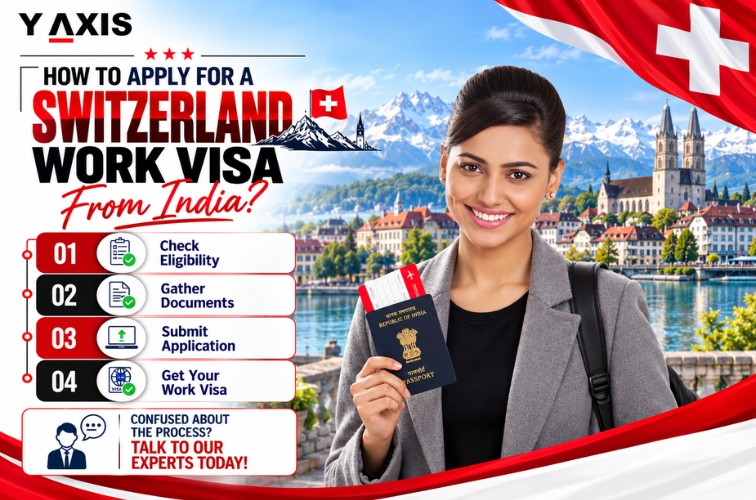
How to Apply for a Switzerland Work Visa From India

By , Editor & Director
Updated September 26 2026
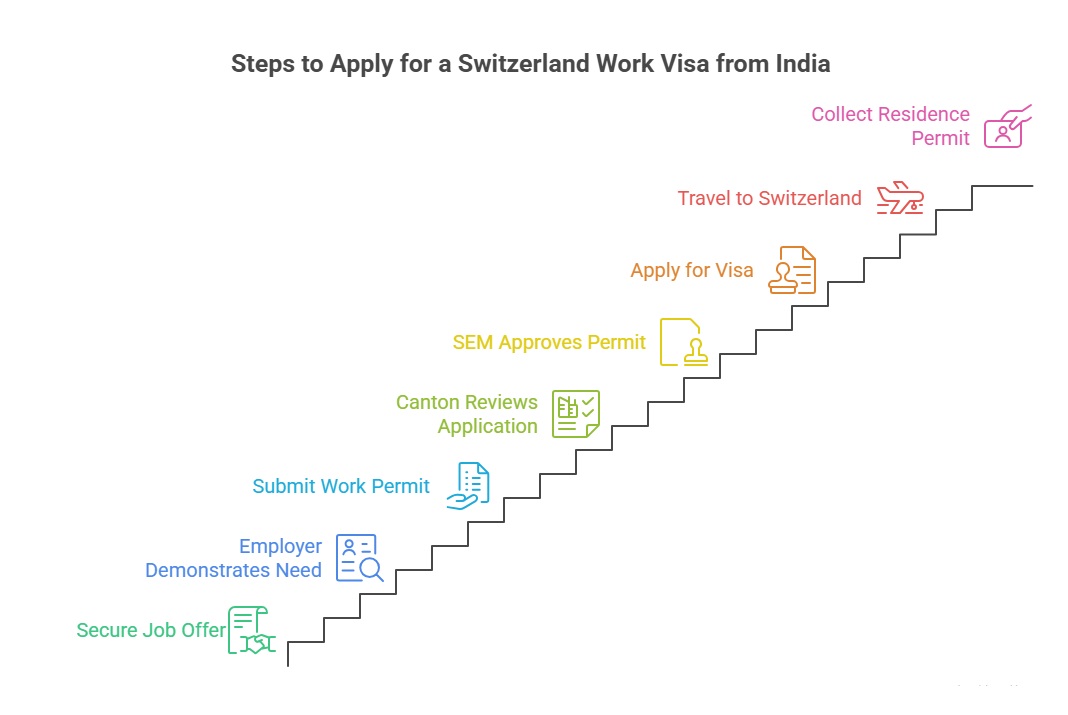
Applying for a Switzerland work visa from India starts with securing a confirmed job offer from a Swiss employer willing to sponsor you. Since India is outside the EU/EFTA, your employer must first prove that no suitable Swiss or EU/EFTA candidate was available, then submit your work permit application to the relevant cantonal migration office. Once the canton approves, the application is submitted to the State Secretariat for Migration (SEM) for federal sign-off. After SEM approval, you apply for the Long-Stay (Type D) National Visa at the Swiss Embassy in New Delhi, the Consulate General in Mumbai, or an authorised VFS Global centre in India. Once in Switzerland, you register with your local commune within 14 days and collect your L or B residence permit, which confirms your right to live and work in the country.
*Want to apply for a Switzerland work visa? Let Y-Axis guide you through the process.
How to Apply for a Switzerland Work Visa from India?
Foreign professionals need the support of their Swiss employer to initiate the Switzerland work visa application process.
The steps to apply for a Switzerland work visa for Indians are as follows:
Step 1: Secure a signed job offer from a Swiss employer willing to sponsor your Type D visa and work permit.
Step 2: Your employer demonstrates that no suitable Swiss or EU/EFTA candidate was available for the role, as required for non-EU/EFTA hires.
Step 3: Your employer submits your work permit application (L or B Permit) to the relevant cantonal migration office (Migrationsamt), along with your employment contract and qualifications.
Step 4: The canton reviews your application against its quarterly quota allocation and, if approved, forwards it to the State Secretariat for Migration (SEM) for federal sign-off.
Step 5: Once SEM approves your permit, book an appointment and apply for the Long-Stay (Type D) National Visa at an authorised VFS Global Visa Application Centre in India.
Step 6: Attend your visa appointment and submit supporting documents, including your passport, photographs, employment contract, and health or travel insurance.
Step 7: Travel to Switzerland once your Type D Visa is issued, and register with your local commune (residents' office) within 14 days of arrival.
Step 8: Collect your L or B residence permit card from the cantonal authorities to complete your legal work authorisation.
Also, read...
Switzerland Job Market in 2026-30
Requirements for the Switzerland Work Visa
Meeting Switzerland's requirements depends heavily on your employer's paperwork and the annual quota for non-EU/EFTA nationals, since the process is employer-led and quota-restricted from the start. The list below brings together the eligibility conditions and documents you and your employer will need.
The eligibility criteria for a Switzerland work visa are as follows:
- A signed job offer or employment contract from a Swiss employer willing to sponsor your permit.
- Proof that your employer could not find a suitable Swiss or EU/EFTA candidate for the role (labour market test).
- A university degree or recognised professional qualification, along with several years of relevant work experience.
- A salary that meets local, cantonal, and sector wage standards — in practice, typically CHF 85,000 or more per year for most non-EU/EFTA roles.
- A valid passport with at least two blank pages and validity beyond your intended stay.
- Two recent passport-size photographs meeting Swiss visa photo standards.
- Health or travel insurance valid for your full stay, meeting Schengen coverage requirements.
- Proof of sufficient funds to support yourself in Switzerland.
- A police clearance certificate (PCC) confirming a clean criminal record, where requested.
- Proof of accommodation in Switzerland, where requested by the cantonal authority or embassy.
Also, read...
High-demand occupations in Switzerland
Cost of Applying for a Switzerland Work Visa From India
Your total spend on a Switzerland work visa depends on the permit type, your employer's cantonal processing fee, and a few document-related charges along the way. Costs below are shown in Swiss francs and their approximate Indian Rupee equivalent, at a rate of roughly ₹100 to the Swiss franc.
|
Cost Item |
Fee |
Notes |
|
Cantonal Work Permit Processing Fee (L or B Permit) |
CHF 100–300 (approx. INR 10,000–30,000) |
Paid by the employer to the cantonal migration office; the exact amount varies by canton |
|
Long-Stay (Type D) Visa Fee |
CHF 88–100 (approx. INR 8,800–10,000) |
Paid at the Swiss Embassy, Consulate General, or an authorised VFS Global Visa Application Centre |
|
Cantonal Residence Registration (on arrival) |
CHF 50–65 (approx. INR 5,000–6,500) |
Paid to your local commune when registering and collecting your permit card |
|
Medical / Travel Insurance |
INR 3,000–8,000 (approx.) |
Must meet Schengen coverage requirements for your full stay |
|
Police Clearance Certificate |
INR 500–2,000 (approx.) |
Confirms a clean criminal record; apostille may be required |
|
Document Translation & Notarisation |
INR 750–3,000 (approx.) |
Needed for documents not in English, German, French, or Italian |
*Are you looking for step-by-step assistance with overseas immigration? Contact Y-Axis, the world's No. 1 overseas immigration consultancy, for end-to-end assistance!
FAQs
Can I apply for a Switzerland work visa without a job offer?
No — Switzerland requires a confirmed job offer from a sponsoring employer, since your employer must prove no suitable Swiss or EU/EFTA candidate was available before applying to the cantonal migration office. There is no independent points-based route open to Indian applicants, and Switzerland does not currently offer a digital nomad visa, so remote workers cannot use this route either.
What is the processing time for a Switzerland work visa from India?
The full process typically takes 3 to 5 months from job offer to arrival, once cantonal permit review, federal SEM approval, and Type D visa processing at the embassy are added together. Cantonal review usually takes 3 to 8 weeks, SEM approval adds another 1 to 2 weeks, and the Type D visa itself is typically issued within 10 to 30 days once submitted.
What is the difference between the L Permit and the B Permit?
The L Permit is a short-term work permit for contracts of up to 12 months and is tied strictly to your original employer and role. The B Permit is a long-term residence and work permit for open-ended or permanent employment, valid for up to five years and more flexible if you later want to change employer or canton. Most Indian professionals target the B Permit for long-term relocation.
Is there an annual limit on Switzerland work permits for Indians?
Yes. Switzerland sets a national quota for non-EU/EFTA nationals each year, covering all third-country applicants, not only Indians. For 2026, the quota is 4,000 L Permits and 4,500 B Permits, distributed quarterly across the 26 cantons. Quotas reset every January, so applying early in the year improves your chances before a canton's allocation runs out.
Do I need a medical test for a Switzerland work visa?
Most applicants do not need a medical test to apply, but valid health or travel insurance covering your full stay is a standard visa requirement. Once you arrive and register, you must also independently purchase mandatory Swiss health insurance (KVG/LAMal) within three months, separate from any travel insurance used for your visa application.
Can my spouse and children join me in Switzerland?
Yes. Once your B Permit is approved, your spouse and dependent children can generally apply for a family reunification residence permit. This depends on you meeting income and accommodation requirements set by your canton, and applications are usually filed after you have settled into your own permit, so it is worth planning the timeline with your employer in advance.
Is there a minimum salary requirement for a Switzerland work visa?
Switzerland does not publish one fixed minimum salary. Instead, your offered salary must match the customary local, regional, and professional wage for your role and canton. In practice, most non-EU/EFTA work permits require an annual salary of at least CHF 85,000, though this varies significantly by canton, sector, and seniority.
Can I switch employers while on a Switzerland work permit?
On a B Permit, switching employers is possible but generally requires notifying the cantonal labour office, and a significant change in role may require a fresh permit application. On an L Permit, changing employer effectively ends your existing permit and requires a new application, which draws again on the annual quota, so it is far less flexible than the B Permit.
What happens if my Switzerland work visa application is rejected?
If the canton or SEM rejects your application, they will generally state the reason, such as insufficient proof that no local candidate was available, an incomplete application, or exhausted quota allocation for that quarter. You can usually reapply once the issue is resolved or once the next quota period opens, though fees already paid are typically non-refundable.
Does a Switzerland work visa lead to permanent residency?
Yes. After 10 years of continuous legal residence on a B Permit, most non-EU/EFTA nationals become eligible for a C Permit, Switzerland's permanent residence status. Some nationalities qualify after 5 years under bilateral agreements, but this does not currently apply to Indian nationals, so 10 years remains the standard path for Indians.
Tags:
Switzerland work visa
Switzerland Type D visa
Switzerland work visa from India
Switzerland B Permit
Switzerland L Permit
work in Switzerland
Switzerland visa requirements
Switzerland immigration for Indians
Share
Options for you by Y-Axis

Get it on your mobile

Get News alerts
Contact Y-Axis
Latest Article
Popular Post
Trending Article
Posted On October 01 2026
The Borderless Indian